Ed Steer's Gold and Silver Daily

24hGold.com RSS Feed - Gold and Silver Market Analysis

24hGold.com RSS Feed - Gold and Silver Editorials

Whiskey & Gunpowder

Numismatic News

Click to Enlarge

Close Call For US Banks
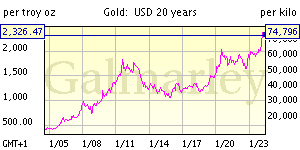
Putting Gold's Recent Decline In Perspective
They say a picture is worth a thousand words, and in the case of gold, I think it's worth that, and more! Gold's recent decline is a blip on the radar screen of the larger bull market trend.


Which makes me ask the following questions:

If you are waiting to buy gold, what are you waiting for? Do you think there will be a better "hopping on" point in the future?
Get Out Of The Dollar Now, Before It's Too Late

excerpt from Doug Casey: How to Prepare for When Money Dies

The U.S. dollar is the de jure national currency of at least three other countries, and the de facto national currency of about 50 others. The main U.S. export for many years has been paper dollars; in exchange, the nice foreigners send us Mercedes cars, Sony electronics, cocaine, coffee—and about everything you see on Walmart shelves. It has been a one-way street for several decades, a free ride—but the party's over.

Nobody knows the numbers for sure, but foreign central banks, and individuals outside the U.S., own U.S. dollars to the tune of something like $6 or $7 trillion. Especially during the recent crisis, the Fed created trillions more dollars to bail out the big financial institutions. At some point, foreign dollar holders will start dumping them; they are starting to realize this is like a game of Old Maid, with the dollar being the Old Maid card. I don't know what will set it off, but the markets are already very nervous about it. This nervousness is demonstrated in gold having hit $1,900 an ounce, copper at all-time highs, oil at $100 a barrel—the boom in commodity prices.

Some countries are already trying to get out of dollars, but it could become a panic if the selling goes from a trickle to a flood. So, yes, it's a time bomb waiting to go off, or maybe a landmine waiting to be stepped on. If a theatre catches fire and one person runs out, soon everybody rushes toward the door and they all get trampled. It's a very serious situation.

The problem is the U.S. doesn't produce enough in return. The U.S. has been lucky to have a currency that has, so far, been accepted by everybody. But when everybody realizes that the dollar is an "IOU nothing" on the part of a bankrupt government and a society that doesn't really produce anything anymore, it's going to create a worldwide catastrophe. Those $7 trillion held by foreigners are going to become instant hot potatoes.
Must Listen Interview With John Embry
Want to understand what's going on in gold and silver? Here's a short audio interview that you MUST listen to.

Click HERE to listen


John Embry: Chief Investment Strategist for Sprott Gold & Precious Minerals Fund - John joined the now $10 billion strong firm SAM as Chief Investment Strategist in 2003, with a focus on the Sprott Gold and Precious Minerals Fund. He plays an instrumental role in the corporate and investment policy of the firm. Mr. Embry, an industry expert in precious metals, has researched the gold sector for over thirty years and has accumulated experience as a portfolio management specialist since 1963. John was named Vice-President, Equities and Portfolio Manager at RBC Global Investment Management, a $33 billion organization where he oversaw $5 billion in assets, including the flagship $2.9 billion Royal Canadian Equity Fund and the $250 million Royal Precious Metals Fund #1 ranked fund across the country for its 2002 net performance of 153%.
Operation Twist
The global economy is faltering and the world’s monetary system is looking exceedingly precarious, yet the price of gold has plunged in the last week. Soon after US Federal Reserve chairman, Ben Bernanke, announced Operation Twist, a policy intended to reduce borrowing costs, global markets plunged. The Fed's $400 billion plan, named "Operation Twist” is the latest in a series of steps aimed at reviving an economy that has very sluggish growth and high unemployment. In this new strategy, the Fed said it intends to sell shorter-term notes and then use those funds to purchase longer-dated Treasuries. It will also reinvest proceeds from maturing mortgage and agency bonds back into the mortgage market, in hopes that it will help an already battered housing sector.

Frankly, I think this latest strategy will fail miserably. You don’t have to be an award winning economist to understand that if people do not have a source of income, no matter how low the borrowing rates, they are not going to embark in making a new house purchase. And, this policy is going to do absolutely nothing to stimulate the economy and generate new jobs.

Source: The Delaire Report - Sept. 27, 2011
Ooops
How did this guy get on TV?

Very rarely do you hear the truth on television, but here's your chance to hear it from an INDEPENDENT trader. In just 3 minutes he bursts the bubbles of all who think this thing won't end ugly. One thing is for sure, you will never see this guy on CNBC! LOL!!


Of course, his solution to flee to Treasuries will only be a short-lived one, as the US Dollar is toast as well and will be the next domino to fall after the Euro.
US Mint Sales Remain Strong
According to Ed Steer over at Casey Research, "it was no surprise to me to see a big sales report from the U.S. Mint yesterday. They sold 15,500 ounces of gold eagles...2,500 one-ounce 24K gold buffaloes...and a very chunky 1,025,000 silver eagles. Month-to-date sales are as follows...65,000 ounces of gold eagles...10,000 one-ounce 24K gold buffaloes...and a whopping 3,325,500 silver eagles. Based on retail bullion sales that I know about in various parts of North America, September will be another strong month for the mint..."

While Central Banks are selling paper IOU's for metal to force the price down, those in-the-know are using the lower prices to accumulate the real thing. This just is another further illustration of the fact that the precious metals market is actually "A Tale Of Two Markets," one real, and one imaginary. And it is a rare opportunity in life that you can buy something real at artificially low/imaginary prices.

Don't look for this little price decline to linger very long as the paper market will soon be overwhelmed by the physical market. Coin premiums are already starting to increase again as those who have physical gold are becoming less willing to let it go at these ridiculous prices.

I'll close with this from Ed's commentary this morning:

"The Perth Mint has been very busy this Monday morning with a lot of buying [but also some selling], however buying is outweighing selling by a fair margin [pun intended]...and the decrease in the AUD/USD has taken some sting out of the drop for Aussie investors.

"I see this sell-off driven by leveraged “weak hand” money. In contrast, average investors [the real smart money] are looking at this as an opportunity to buy in or top up at cheaper prices. These buyers are “strong hands” and have been the ones who have been driving the trend all these years.

My bullion dealer here in Edmonton had another record day in bullion sales on Monday...even larger than the record day he had on Friday. It was wall-to-wall buyers all day...and the phone was ringing off the hook. Nobody sold an ounce of anything.
100% Gains Possible
Unless you've been on the moon, you know the metals got taken down Friday by the bad men. Late in the day Ben Davies of Hinde Capital had this to say about the opportunity investors have when markets are artificially suppressed like they are now:

"This will be your last chance to buy before what I believe will be a serious run-up in the market. I know from our investor base, I know from all our contacts around the world in the institutional base that nothing has changed in the world, and in fact, the world is a far worse place. Much more liquidity will be coming, reflation will be coming into the system and this is going to propel prices beyond that $2000 level to the $2400 level and silver to the $65 level. It may not happen by the end of the year, but I’m not betting against it." Ben Davies, Hinde Capital

With silver at $28 this morning, here is one of those rare opportunities in life where investors can know ahead of time that they have the opportunity for a over 100% return in a very short period of time.
Gift-Wrapped
excerpts from a recent interview with Rick Rule

With gold and silver prices under attack, today King World News interviewed one of the most street smart pros in the resource sector, Rick Rule, Founder of Global Resource Investments, which is now part of the $10 billion strong Sprott Asset Management. When asked how investors should be handling these price swings, Rule responded, “Eric, money is made by buying low and selling high and the opportunity to buy low shouldn’t be regarded as a bad thing. The truth is opportunity comes gift wrapped, you just have to understand when it’s gift wrapped.

When asked about gold specifically Rule stated, “Could gold go lower? Absolutely, does it matter over two or three years? Absolutely not. Think about where the value is, that shiny stuff which has more or less held value for 6,000 years or a dream printed on a piece of paper, backed by the honor, integrity and good will of Congress? This is a simple trade (fiat for gold).

It doesn’t mean it’s a trade that is going to work in the next month or two, but assuming your readers are going to live longer than one or two months, it’s a trade that they have to be involved in.
Something BAD Cometh!
As readers of this blog know by now, in the short term, the price of gold is always suppressed by central bankers just prior to the release of bad news. Since gold is a "safe-haven" asset, money always flows to it in times of political and/or economic uncertainty. This flow of funds away from the paper markets is a death blow to the central banks who are printing money to cover over their budget shortfalls. If investors quit buying the government debt for fear that the issuing government might not be able to pay it back, it forces the issuing governments to raise interest rates to entice investors back into their bonds. Higher interest rates mean higher costs. THIS the bankers cannot allow.

In the US, our current budget shortfall is about 1.5 trillion dollars. Should interest rates rise back to the level they were in the 1980's, that would double our annual deficit to 3 trillion dollars.

The bankers cannot allow this to happen. It would be game over. Therefore, every threat to their paper money must be stopped. Gold is the ultimate threat, so investors must be discouraged from leaving the paper game and pursuing gold. And it is for this reason that gold experiences violent take-downs like the one currently in progress in the hopes that investors will not flee to it.

To understand this better, watch this short clip from the 1981 movie Rollover. Though just a movie, the principles it is based on are still valid.


Therefore, this most recent HUGE take-down of the gold price to just under $1700 this morning has me wondering what ominous event looms on the horizon. Stay tuned.
The Old Maid Card
excerpt from Doug Casey's Conversations With Casey
The Chinese have more US dollars than anybody else and are offloading those dollars anywhere they can, for instance in Africa, in exchange for real wealth - natural resources to fuel their future growth. This is a global trend today; we see deals around the world cutting the dollar out wherever possible, such as the one between the Iranians and the Argentines. It's almost like barter. Nobody wants to use the paper of an unreliable third party, so the dollar has become the Old Maid card nobody wants to get stuck with.


In five years the dollar will have lost its reserve status completely. It could be less - two or three. I hate to put such a near-term time frame on something that's so momentous, but that's the way I see it.
The End of Debt
excerpt from Doug Casey's Conversations With Casey

It’s important to understand that it’s not just the government that has a debt problem. Many of those voters the politicians must pander to have no savings and are one paycheck away from hunger – if they even have jobs. Americans are not alone in being burdened with an entitlement mentality – that’s why Europe is perhaps even more incapable of fixing its problems. It’s why Latin American governments make ever more economically suicidal policy decisions in the wake of protests and pressure from organized labor – but at least there’s no debt in Latin America, simply because no one will even lend them money.

People in many countries have been consuming more than they have been producing, and they feel they have a right to do so. They’ll be disabused of that feeling soon, and it’s going to be very ugly. But until then, no way will debt-ridden voters vote for politicians who promise to smash their cracked rice bowls. That’s why the Ron Paul campaign is of educational value only.

We have finally gone beyond the point of no return. There’s no way to avoid a gargantuan catastrophe – much worse than what happened in the 1930s and ‘40s. There are several ways this could play out, but the government always chooses the worst alternative, which in this case is the destruction of the US dollar. Its first priority is saving the US government, not the dollar, nor the interests of the people. The politicians will wind up destroying the productive parts of the economy to save the government; the parasite will kill the host. It’s a total disaster, with wide-ranging consequences, and it’s already happening.

Swiss first to use gold in securities payments
Gold will soon be accepted in payments against the delivery of securities on the Swiss stock exchange, in what will be a world first.

SIX Securities Services announced the plans after the successful settlement of transactions involving gold with a pilot set of customers.

The Swiss stock exchange and Scoach Switzerland, the stock market for structured products, plan to introduce the listing and trading of products in XAU gold units (equal to one troy ounce of gold) in October.

SIX Securities Services said it decided to launch the new service because of the high interest at this time among investors in gold, following “uncertainty in the markets”.

“Gold is the new currency,” said the company.
How High Can Gold Go?
from Casey Research
Based on the CPI-U (the government’s broadest measure of inflation), gold is a couple of jumps away from matching its 1980 high of $850. Silver, meanwhile, has much further to climb and would return over three times our money if it reached its former peak.


But the CPI is a poor measure of real inflation. Let’s use John Williams’ Shadow Government Statistics calculations. His data are much closer to the real world, and the statistics are calculated the way they were during the Carter administration, stripped of later manipulations.

Check out how high gold and silver would soar if they adjust to this level of inflation:


Clearly, both metals would hand us an extraordinary return from current prices. Those are some admittedly high numbers, but keep in mind that’s what the CPI figures above would register if government officials had never changed the formulas.

One might be skeptical because these projections are based on past performance, and nothing says they must hit these levels. That’s a valid point. But I would argue that we’re in uncharted territory with our debt load and money creation – and neither shows any sign of ending. We had a lot of problems in the 1970s, but our current fiscal and monetary abuse dwarfs what was taking place then. The need to protect one’s assets gets more pressing each day, not less so. That to me is the key signaling this bull market is far from over.

One may also be skeptical because the media continue to claim gold is in a bubble. To date their proclamations have been nothing but a great fake-out, every time. Want to know when we’ll really be in a bubble? When they stop saying it’s one and actually start buying and recommending gold. When they begin running 15-minute updates on the latest gold stock. When you are sought out relentlessly by your friends and relatives because they know you know something about all this “gold and silver stuff.”

All told, I think the baked-in-the-cake inflation – rooted in insane debt levels and deficit spending – will be one of the primary drivers for rising precious metals this decade. This means the masses will look for a store of value against a plunging loss of purchasing power. Enter gold and silver.

The current correction may not be over, and we can count on further pullbacks along the way. But the data here suggest the upside in gold and silver is much bigger than any short-term gyration – or any worry that may accompany it.
Why Gold Is Hated
An excellent article to help you understand why gold is hated by the establishment.
Why Gold Is Hated
The world's banking system operates on a principle called Fractional Reserve. Here's how it works.

You go into the bank and make a $100 deposit. The bank is required to keep 10%, or $10, of your deposit on hand as a "reserve" in case you and/or a bunch of other people all show up at the same time wanting your money. That "reserve" money they are supposed to keep, they are supposed to send to the federal reserve, which in turn authorizes the bank to loan out the other $90 of your deposit.

HOWEVER, this is not what the bank does at all. Instead of sending $10 to the Fed and loaning out $90, the bank sends the whole $100 to the Fed. The Fed then treats this $100 as if it were the 10% reserve of a $1000 deposit, and because it assumes the bank has taken in a $1000 deposit and sent them $100, it authorizes the bank to lend the remaining "imaginary" $900.

Thus, $900 is created out of thin air by this system known as fractional reserve. It is one way in which we "create" money. And as you can see, it is "money" based on nothing.

These loans are then securitized and sold to investors, foreigners, other bankers, insurance companies, and so on and so on. They have infiltrated every corner of the global financial system, waiting and rotting the very bedrock of the worlds' finances.

Now, back to our example... The system works great as long as the banking system can continue to repeat the process, for it is the repeating of the process that brings in more money to enable the bank to pay back its depositors, should they ever show up en masse wanting their money. Remember, not only has the bank sent your entire $100 to the privately owned and foreign controlled Federal Reserve, they have leveraged it by 900%. Much of this 900% in turn reenters the bank as deposits for which the bank is liable. If everyone shows up at the same time demanding their deposits, OR, if the public quits spending and borrowing, it's game over. The game of musical chairs MUST continue or the system collapses.

Now you know why our government is so interested in keeping the people from saving and continuing to borrow and spend. Now you know why interest rates are kept artificially low to encourage consumers to borrow and spend. And now you know why governments and bankers are deathly afraid of the public taking money away from their game and hiding it in gold and/or silver, assets that can't be manipulated or controlled by the bankers.

Now you also know why the mainstream media is so against gold. They are paid to be so by the financial and governmental authorities whose lives depend on the game of musical chairs continuing. For if the music ever stops, the paper currency becomes worthless and only tangible assets such as gold/silver, commodities, businesss and real estate will have any value.

Our financial system is leveraged not just by 900%, but by tens of thousands of percent as this money that has been created out of thin air is redeposited and loaned out again over and over and over. Stop that flow and the whole system collapses.

Gold stops the flow and the bankster, their government front men, and their media mouthpeice are going to do everything they can to keep you from protecting yourself and buying gold.

It's A New Game
As long as this system was a closed system it was able to be managed and kept afloat. Americans can be coersed by our government to accept this game even though we may not like it. However, the system is now no longer a "closed" system which is controlled by our government.

Enter China, Russia and the Arab nations.

Our trading partners who have now amassed trillions of these worthless paper dollars are now beginning to trade them in for gold. Unlike the unsuspecting American public, these nations cannot be controlled or conned into blindly accepting worthless paper money. Hence, for the last 12 years, these nations have been trading in their dollars and buying gold as fast as they can. THIS is what has forced the price of gold up, and THIS is a phenomenon that our government, media and bankers cannot control. This is also the game that they desperately want to keep you in the dark about!

Where does it end?

Well, considering the fact that these are nations who hate us and they have us by the throats and they know it...... I'd say it won't end well for us. The foreign bankers who control our Federal Reserve have sucked all the wealth out of our nation and left us holding a bunch of debt in exchange. Every dollar you hold is not an asset. It is a liability and the more you hold the more you are liable and you WILL pay what you owe.

Storing your wealth in dollars, or anything payable in dollars, such as stocks, bonds, mutual funds, bank accounts or even cash, is sheer idiocy once you understand the rules of the game.

The music is still playing, chairs are being removed one by one, and still we dance. But, one day soon, the music will stop, and he who sits first (buys gold), wins.
WHO Do You Believe
by David Tanner
Often times in life it's not WHAT you believe that brings you success or failure, but WHO you believe.

There are hundreds of millionaires in a little town in Arkansas right now that prove that point.

They were average folks who didn't know too much about stock investing, cost benefit analysis or company valuation methods. But they happened to be so fortunate as to know a man in their town named Sam Walton who convinced them to buy stock in his little company called Walmart, and the rest is history.

Today, we all face the same decision. Many of you can read the posts on this website and walk away feeling confused and unsure of how the financial system really works. You may not understand the HOW or the WHAT behind why you should buy gold. That's okay. The only thing you need to understand is the WHO behind who is telling you not to buy gold.

The WHO is your government, the bankers, Wall Street and their mouthpeice the media. You know, the same media that you distrust when they tell you about politics. The same media that lied about Clinton and Bush and Obama. The same media that is lying about the current recession/depression. The same liberal media that espouses the same "tax the rich and give to the poor" socialist propaganda that help get us to where we are today.

And still yet, you want to trust them when they tell you not to buy gold? Does that make sense? Are they your friends or are they your enemy?

Knowing whether or not to buy gold is easy. Simply figure out WHO is telling you not to.

******************************

So, WHO is telling you that you SHOULD by gold and why should you listen?

About David Tanner
After dropping out of Clemson University, David Tanner eventually graduated from the University of South Carolina in 1983, non-cum laude, with a BS degree in Business Administration, cramming four years of education into five years.

"Never forget folks, it's 'A' students that teach 'B' students how to work for 'C' students. Then, there's the rest of us." David Tanner
The people who run the printing presses have trouble shutting them off. In order to limit one’s exposure to this reckless behavior, it is wise to exchange unsound assets for sound ones. Congressman Ron Paul, June 7, 2010
A Gold Bubble?
As the patsy mainstream media continues to try to scare investors away from gold, probably the most common theme one hears is that "gold is in a bubble."

This word "bubble" strikes fear and panic in the heart of most investors since "most" investors have exemplary track records for listening to the media and investing at the top of bubbles and subsequently getting slaughtered.

For instance, back in the late 90's, tech stocks and mutual funds formed a tremendous bubble in which the final stage saw the average tech mutual fund gain 100% in 1999, enticing investors to buy in at the top. Of course, they subsequently lost most of their investments the next year.

Then, after enough time had passed for investors to forget the lessons learned in the tech bubble, investors began chasing real estate. "Real estate is different," they reasoned. "Real estate always goes up."

Flipping houses became the new thing to quit your job for, much like day-trading had been in the early 90s. Of course, that bubble too came to a screeching halt in 2008, the bottom of which we have still not seen.

Which brings us now to our discussion of gold. Is gold in a bubble?

There are two primary charactaristics of any asset that becomes "bubblicious." First, everybody's doing it. No matter where you go, the talk is about that particular asset or fad or trend.

And second, bubbles always have a parabolic rise at the end of the game, as mentioned above when discussing the tech bubble.

Looking back at the last gold bubble of the 1980s, gold went from $225/oz. to $875/oz in 12 months, a 387% increasing in one year. That was certainly a bubble.

So, what do we find today? Is gold in a bubble? Year-to-date, gold has gone from $1388 an ounce to a high a few weeks ago of $1900. That's a nice 37% gain, certainly not a parabolic blow off where everyone is running out to the local coin shop trying to get in on the action!

In fact, to equal the 387% blowoff of the 80s, gold would need to reach $5,300 before year end. As you can see, we are no where near the "bubble" status that the anti-gold (banksters) crowd would have you believe we are in.

Let's not forget that the last gold "bubble" was born of a similar economic climate that was localized to the US alone. This time around, the whole world is in the crapper, so the "blowoff" stage for gold should be quite a show. Clearly, we are not there yet.

Will this current runup in gold end in a bubble? Certainly. ALL bull markets end with bubbles and this one will be no different as Joe Sixpack finally wakes up and realizes that the paper investments he trust are no longer trustworthy and seeks shelter from gold. Then, as the masses fight for whatever gold scraps they can find, the bubble will certainly come, at which point we'll be glad to sell them ours at unheard of premiums.
Robin Griffiths - Gold Will Become the Greatest Bubble
With the gold market experiencing some profit taking, today King World News interviewed one of the top strategists in the world, 40 year veteran Robin Griffiths of Cazenove. Cazenove is one of the oldest financial firms on the planet and is widely believed to be the appointed stockbroker to Her Majesty The Queen. Griffiths had some extraordinary comments regarding gold during the interview. When asked about his recent trip to China and the speeches he gave in Hong Kong and Beijing, Griffiths responded, “When I went on to the subject of things like gold and was bullish about it, I got a standing ovation. So there is no doubt that it is a very popular investment idea in China and also, of course, in India. The Asians are likely to be the main buyers of gold in the remainder of this year.”

Robin Griffiths continues:

“When gold was over $1,900 it was too high, too soon. The deviation above what I would call a sustainable moving averages was too high. If there is a setback I would see that as another buying opportunity. I believe gold will become a bubble, possibly the greatest bubble I am going to live through, but it isn’t a bubble yet.


I think when you come to the very high net worth individuals, they are accepting now that we are in an era now where all central banks, not just the US Fed, are quantitively easing or printing money. It’s very early days for the pension funds. One or two pension funds are buying the same story, but at the moment it’s (the move into gold) being led by the high net worth individuals.

Later on you will see the pension funds come up to these sorts of numbers, 3% or 4% of the fund in gold related investments. Because pension funds need dividends, they would be slightly more likely to buy major mining companies than bullion. Eventually the income stream is what they will be after.

I think we are in the very early stages of the gold bull market....

“It is definitely not an over-owned trade and by the time it does get over-owned, we’re thinking way into the thousands, possibly double-digit thousands of dollars an ounce for gold before we get to the top.

If I had to make a list of the great bubbles I am going to live through, I think gold is going to be one of the big ones. All of the gold ever mined in history just fills one olympic swimming pool. There’s not enough for all of those Indians and Chinese and central banks to have it. It is just genuinely in short supply.”
Trump's New Gold Standard
from The Wall Street Journal Sept. 14, 2011
On Thursday, the newest tenant in Donald Trump's 40 Wall Street, a 70-story skyscraper in Manhattan's Financial District, will hand Mr. Trump a security deposit worth about $176,000. No money will change hands—just three 32-ounce bars of gold, each about the size of a television remote control.

The occasion will mark the first time the Trump Organization has accepted 99.9% pure gold bullion, rather than cash, as a deposit on a commercial lease.
Get It While You Can
This little pullback gold has seen these last two weeks has really ramped up the buying by those in-the-know. Here's two reports that came out from the Cassey Research mailbag over the weekend.

I had a couple of readers send me a brief 'heads up' about bullion sales in their respective parts of the world. The first is from British reader Tariq Khan. He had this to say...

"My coin dealer told me today that he just does not understand what is going on with the gold price. He opined that the Central bankers are unlikely to succeed if they are responsible for this take down. He is just seeing too much physical demand at the moment. He is turning away enquiries from abroad. The physical supply is disappearing fast, although he managed to find me some sovereigns (these tend to be tax efficient for us in the UK as sovereigns are still legal tender and have been since 1847). I have another coin dealer I occasionally use, he had only 8 gold sovereigns and 4 half sovereigns. The only metal he has to sell at the moment are Silver Eagles and Krugerrands. He tends to sell both silver and gold bars as well, but he has none of those available either. He is out of all other products."

The other is from U.S. expat Bill Goodrich from Hua Hin, Thailand...and this is his report.

"Today I was down in the gold district in Bangkok to buy some bullion on this little pullback... and there was no physical bullion to be had. All the gold shops were packed...and the only thing you could do was pay for an order that would be delivered in 10 days to 2 weeks. I have never seen a lack of physical bullion in this district ever before. There is physical gold on display, but it is all jewelry, which has a much higher margin than just the bullion bars that everyone was wanting."

"At least in this part of the world when gold drops even this little bit, the demand is astounding...and people are out in droves buying for cash. Here, every trade is physical gold...and all the transactions are cash on the barrelhead, so I have no fear that gold will really get a chance to pull back very far at least if the sentiment all over the Asia Zone is the same as it was here today."


How long will it take for Americans to wake up to what the rest of the world already knows? I guess if they keep getting their news from the mainstream media, probably only after it's too late. By then, when they realize the worthlessness of their paper dollars and try to convert to gold, there will be none left.
Who Do You Believe
I got this chart in my inbox today and thought I HAD to pass it on. According to this chart, earnings are back up to where they were before the financial meltdown a few years back. In other words, the recession is over! Yippeee!!!!


Now, the obvious question I have to ask is "what are these numbers based on?" Or, stated another way, "can I believe these numbers?'

I for one, when I compare these numbers to what I hear in the marketplace have to believe somebody is lying. My wife works for the billing department of a local company and she can't even get major companies to pay their $200 past-due bills! They tell her that they can't pay her until they get paid so she will just have to wait. TWO HUNDRED DOLLARS!?!?!?! ARE YOU KIDDING ME? I thought the recession was over?

Is it as good as this chart says? I think not. Which reminds me of this quote from Warren Buffet.

"Managers that always promise to 'make the numbers' will at some point be tempted to make up the numbers."

Somebody's lying somewhere... and I think I know who it is.
Nothing Will Change
from RickAckerman.com
Resolved: Nothing is going to change, so let’s pray that Europe and Japan crash before we do. Will the existing political system change things? No, it will not. The entire process is corrupt beyond redemption. Just look at the slate of cartoon-like characters offered by the Republicans — excepting Ron Paul, who is already invisible to the mainstream media. Will the States rise up and confront the Federal Government?

No, they won’t. Various state governors have their pet complaints — immigration, gun control, national IDs, etcetera — but they all want the Federal money. As much of it as they can get. Even Texas Rick Perry seems to have balanced his budget with Federal stimulus money. Will outraged citizens call a Constitutional convention? No, they won’t. Anyone who has read Kurt Vonnegut’s Slaughterhouse Five knows why. Americans all want to be the boss and will criticize any potential leader to death. Remember Ross Perot and Pat Buchanan?

Will Col. Kurtz stage a military coup? No, he will not. Ah, my favorite dream: Col. Kurtz and an elite force of heavily armed, outraged, active-duty military Patriots descend on the next State of the Union Address to bring the traitors to justice. In reality anyone above the rank of captain has been thoroughly vetted and is only interested in promotions, outstanding performance reviews and not rocking the boat. The higher up you go, the more this is true.

I think that covers all the bases. The downward trend in this country will continue due to that old law of physics: A body in motion will continue in motion unless acted upon by an outside force. I don’t see any outside forces on the horizon. So let’s all feather our nests and pray that Europe and Japan fall apart before we do. Because what will happen in this country after a currency collapse will be a lot worse than what we have to contend with now. Recently, burglars broke into an East West bank branch close to me in Rowland Heights and cleaned out the safe deposit boxes. Just imagine if law and order really break down.
Higher Taxes Coming
The following was in Ed Steer's Daily Commentary on Wednesday, and I thought it foreshadowed perfectly what we can expect here in the US as well. Although most of our real estate wealth has been spent, and Americans would eventually just walk away from their upside-down mortgages and go rent rather than paying higher real estate taxes, there is a bunch of money in retirement plans that I am sure our elected officials will find a way to get a larger peice of as budget shortfalls grow larger. Never forget, governments aways go to where the money is.

Greeks Vow To Rebel Against New 'Monster Tax'
The Greek government's new real estate tax, a desperate bid to meet its budget goals and secure fresh foreign aid, will hit the population hard. Greeks have almost their entire wealth invested in property -- and are more worried about the tax than about the prospect of a national insolvency or leaving the euro.

As I have advised often on this blog, you should be getting money out of retirement plans at this stage of the game and converting your dollars to assets that can remain under the government tax radar. Of course, gold fits that bill perfectly.
Buy While It's Low
I am going to be short and to the point in this post. Gold is being artificially held down by the world's central banks. You can buy right now with full assurance that the price is heading higher. Anyone doubting that statement only needs to read the following article over at The Motley Fool. If fully explains the dynamics at play in the gold market and the obvious conclusion of central banks' price suppression scheme: Gold's going much higher!

All truths are easy to understand once they are discovered; the point is to discover them. - Galileo
I Give You $1,200, You Give Me $45. Deal?
Who would say "no" to the above deal? Nobody! Right?

Yet, that is what we do every day when we refuse to recognize value. This trade off reminds me of the Biblical story found in the book of Matthew.

Matt 13:45-46 Again, the kingdom of heaven is like unto a merchant man, seeking goodly pearls: Who, when he had found one pearl of great price, went and sold all that he had, and bought it.

Here we have a merchant who is involved in the exchange of one form of wealth for another. So the question needs to be asked, "why does he exchange everything he has just to get that one pearl?"

Obviously, he recognizes the fact that the pearl will soon be worth much more than his current portfolio. But what we overlook is the fact that when the trade was made, they were both worth the same thing. In fact, there was someone on the other side of this transaction who didn't recognize the value of this pearl and let it get away. So, this exchange, took a recognition of value on his part that the other party did not posess.

Today, we have the same exchange playing out in the gold and silver markets. Central banks, the front organizations for the world banking cartel are recognizing that the "value" of gold and silver are much greater than the value of their paper currencies. They are quicky "exchanging" paper for metal even though, on the surface, the two appear to be worth the same. In the process, the unsuspecting public, that's you, continues to store their wealth in paper-backed assets such as stocks, bonds, mutual funds, annuities, bank accounts and cash.

Ten years ago, one could exchange 250 paper dollars for one ounce of gold and it was considered an even trade. But was it?

Likewise, today, one can exchange 1900 paper dollars for an ounce of gold and it is considered an even trade. But is it?

Like the merchant who "recognized value" and made an "even trade" for the pearl of great price, our job as investors today is to recognize value ahead of the crowd. In spite of the fact that gold and silver have had tremendous run-ups in recent years, it is still possible to get in ahead of the crowd. It is STILL possible to "trade up" and participate in the great wealth transfer that is taking place in the world today. Consider the following from Eric Sprott, billionaire Chairman of the Sprott Asset Management Fund.

When asked about gold Sprott replied, “I think it’s explosive. As you know James Sinclair said, ‘When it goes through $1,764 it’s going to $12,000,’ and I for one am not ruling out that kind of development here. It could be very explosive as more and more people worry about one, fiat currencies, two, sovereign debt and three, bank deposits. It would take very little to spill into gold to make a dramatic difference in where the price will be.”

When asked where he sees the price of silver headed Sprott responded, “I think silver will outperform gold in the next decade. If silver should trade at a 16 to 1 ratio (to gold), it will probably trade at 10 to 1 because things tend to overshoot. Let’s use Jim Sinclair’s $12,000 target, that would suggest $1,200 silver, which is a thirty bagger from here...The biggest reason it (silver) should go there is people should fear bank deposits, that’s what I think they should fear.”

With silver hovering around $45 an ounce, now the question you need to be asking yourself is "would you trade $45 for $1,200?"

Those who answer "yes" will participate in the greatest wealth transfer the world has ever seen. Those who hang onto all they have and refuse to understand the rules of the game will continue to be blind to value and end up as the "have nots" in the new economy.
Central Bank Reserves
To date, the price of gold has been driven higher not by the average investor, who still owns no gold, but by the world's central banks. As you can see from the following graph, the world's money used to be at least partly backed by gold. Today, the gold backing is less than 10 %.


Source

Now, as confidence in paper money has failed, the trend has reversed, and central banks are buying gold, which has been the main driver of gold prices over the last 10 years.

Now, specifially, the nations doing the most buying in a race to steady up their currencies with more gold and less dollar backing are the Russians, Chinese and Arab nations. Take a look at how much more gold buying they need to do to come up to par with the West.

Source

Gold has gone from $250/ounce to $1900/ounce and the East is no where near finished shoring up their currencies. They still have many multiples more buying to do, which should easily push gold into the $10,000+ range within the next 5 -10 years.
Why Jobs Aren't Coming Back
Here's a few excerpts from a great article entitled Walker's World over at UPI.com. The last sentance in the article is one of the most profound statements I read in a long time. Concerning our current economic woes, it states "this is less an event, than a transition. We won't be getting back to normal, not ever."

Walker's World excerpts
.....there are three important factors at work here, beyond the flawed and over-politicized design of most government stimulus packages.

The first is that consumer demand is down by about $500 billion a year in the United States. The second is that corporations have learned to do more with less, to produce goods with fewer employees and thus to cut costs and boost earnings. The third is more worrying: that current and future employment is being depressed not by the economic cycle but by fundamental structural and technological change in the economy.

The success of Amazon in selling books and e-books means the bankruptcy of bookstore chains like Borders, whose final 11,000 employees are being laid off. The U.S. Postal Service, the need for its services eroded by e-mail, is planning to cut 220,000 jobs over the next five years, half of them through layoffs.

Whereas automation began by eroding the need for a large blue-collar workforce, we are starting to see the way computerization is eroding the demand for a white-collar workforce, whether in newspapers, paralegal services or accounting. The education industry is likely to follow, as cheap distant learning starts to erode the demand for traditional college education.

The next victim will be healthcare services, hitherto one of the fastest-growing employment areas. The coming of constant and automated diagnosis through smart phones, followed by the eventual success of electronic health records, is going to reduce the need for human staff.

Then will come the reduced need for cashiers and retail staff (6 percent of U.S employment) as we move to electronic payment by phones. Vodaphone is building hardware on the assumption that by 2020 half of all retail transactions will be conducted by smartphones.

The core of the problem is that governments have been trying to tackle this economic crisis by using the tools of the 1930s, as if it were another version of the Great Depression that could be resolved through traditional Keynesian methods. But it is starting to become clear that many of the roots of this crisis stem from the reality that we are already entering a completely different technological era in which the traditional tools of job creation and demand stimulus no longer work in the same old ways.

Where this takes us as an economy dependent on mass employment to pay for consumption, taxes and pensions that still unclear. And what it does to us as a society in which most people measure much of their self-worth by their jobs and their incomes and their ability to take care of their families is more uncertain still. But the essence of this crisis is becoming clear; it is less an event than a transition. We won't be getting back to "normal," not ever.
How Many Ounces Of Gold Does It Take To Buy A House In Baltimore?
excerpt:

Saturday I told you that hundreds of houses in Baltimore have sold for less than $10,000 this year. Has the real estate market hit rock bottom? Probably not yet:

An ominous cloud is hanging over the housing market: Millions of distressed properties could be put up for sale at any moment, potentially adding to the glut of unsold homes that are already on the market and depressing home prices even further.

So it’s possible that housing prices will decline further, just like it’s possible that gold prices will keep rising to $2,500. Yet we seem to be approaching that market-fulcrum point when a gold-for-housing exchange will yield maximum value.

Fifteen months ago, when gold was selling for less than $1,200 an ounce, it would have taken about eight ounces of gold to buy one of those under-$10,000 Baltimore bargains. Today the price is closer to five ounces.
A Tale of Two Graphs
The big debate in academic circles today is over whether we are going to see inflation or deflation going forward.

The inflationists site rising food and natural resources prices as evidence that all the money printing that has been going on will continue to force prices higher.

On the other side, the deflationists site the bursting real estate bubble as evidence that we are entering into a deflationary cycle that will see prices falling across the board.

Which camp is right?

I think the argument can be made that they both are. There is no law in nature that says "ALL" prices must be rising or falling at the same time. Each commodity, whether talking about housing or food for example, will certainly be affected by monetary policy overall. But also, each commodity will also be affected by its own supply and demand dynamics.

Therefore, going forward, I see no reason to expect commodity prices to quit rising. I also see no reason to expect real estate prices to quit falling. They each have their own unique set of supply and demand forces at work.

Concerning food/natural resources/etc., there are more and more people on this earth fighting for a limited amount of natural resourses. And specifically, regarding food, when you factor in floods and droughts, it becomes obvious that falling supply and rising demand will lead to higher prices. There is no force at work that can reverse this trend in the immediate future.

Conversely, regarding residential real estate as our deflationists example, we see the opposite happening. Supply is rising as homeowners are increasingly deleveraging, either through choice, or default. Hence, we have more supply than demand, leading to lower prices. With unemployment continuing to rise, bringing with it more and more defaults, there is no force at work today in the market that stands as a catalyst to change this trend.

Now, the million dollar "investments" question is this. How low can home prices fall? Where's the bottom? When will it be time to jump back in?

Here's two graphs for your consideration, each one telling a different story.

The above graph clearly shows the housing bubble that we have experienced. This graph, going back to 1970, seems to indicate that prices are now back in line and it might be time to jump back into this market. However, before jumping to that conclusion, consider the same price data going back to 1890.


When we view the above graph, and in particular the period of time of the last period of deflation our nation went through in the 30s and 40s, it becomes apparent that our residential real estate prices could come down a lot more.

How much more?

Considering the low point in the Great Depression had inflation adjusted home values at about $75,000 would indicate that the homes that were selling for about $250,000 at the peak of the bubble could see a bottom of around $75,000 if this deleveraging period equals that of the 30s. Percentage wise, this will be a price of about 30 cents on the dollar from peak to trough.

However, my contention has always been that markets always over react and we will see this cycle bottom at much lower levels. Once the snowball starts rolling downhill again, it will be much harder to stop this time than it was over the last few years. The feds have almost bankrupted the dollar by their massive money printing efforts to stop the current slide. If/when the next wave of selling hits, will they have enough ammo left to save residential real estate prices from plunging into the abyss?

Good question, but for my money, I still think there is too much downside risk in residential real estate at this point to justify re-entry.

Again, keep your powder dry in gold and/or other commodities that are experiencing inflationary cycles, and stay away from those that are in full blown deflation such as housing and stocks.

Speaking of stocks, here's the inflation adjusted graph of the S&P 500.


Source

In this market as well, once inflation is factored in, it becomes obvious that stocks are in a deflationary cycle and to be avoided.

In dollar terms, your 401k might have more in it than it did 10 years ago, but the problem is that it will only buy half as much, so you end up a net loser in real terms. Now compare that scenario with that of gold. Here's the price of an average home in terms of gold.


In other words, you can buy the same home now for 100 ounces of gold that sold for 500 ounces of gold less than 10 years ago. That's an 80% discount, and such is the power of being on the right side of the inflation vs. deflation argument.
Wayne's World
For your weekend reading pleasure, here's a post by a friend of mine from down in Charleston, Wayne Razzi. On the surface the article seems to be about parenting, but keep reading, I think you'll find that the "parenting" aspect of the article is simply a cover for some much deeper issues. The original article along with many great "replies" can be found here.

Parenting in These Dystopian Times
Parents have many responsibilities and as nothing matters more to me than the wellbeing of my four children, I take my fatherly responsibilities very seriously. Educating and guiding my children are two of the most important of those as I see it, and yet my confidence in addressing these responsibilities is decidedly losing a battle to anxiety.

John 8:32 accounts that “…the truth will set you free.” And it seems that it does most certainly achieve that, even in small doses, but it doesn’t assure that you that you’ll find a better place as a result, which is exactly where I am at present. Aside from the birds and bees and related topics, I never anticipated that I’d have to hesitate so frequently when answering the questions put to me by my children, who range in age from 7 to 12. However, there isn’t a day in which I do not have to either frame my responses quite craftily, or quite honestly tell them that I’ll properly answer a particular question when they are older. The frequency at which this is occurring is increasing significantly and that is what led to me thinking about just how pervasive the dystopian matrix has become. I suppose the real problem lies with me in refusing to deceive my children by offering up pat answers to them.

Here a few anecdotes. The smart bunch that y’all are, I expect that you’ll need nothing beyond these to see my point. Each question is followed partly by some of what I said and some of what I thought. “Hey dad, want to watch the Phillies game with me?” Sure buddy, that sounds good. I know you love baseball — just don’t look at the Big Pharma commercials that are too sexually explicit for a 9-year-old as you watch the game. Oh yes, and try to turn off those areas of your brain that are susceptible to conditioning from our corporate sponsors. “Why do they keep showing all these Gold commercials?” That’s a tough one. We’ll talk about that later. “Dad, who are you going to vote for?” No one, guys. “Why not? My teacher said that we should talk about the race with our parents so we could discuss the candidates in class.” Tell your teacher that your dad even stopped voting for libertarians a while ago after realizing that there’s no point to it. Freedom does not equal a false choice between two finger puppets every four years. “What do you think about Obama?” I think he’s a psychopathic finger puppet of the global elite with an incurable case of unmerited narcissism. He’s a nothing who never achieved anything remarkable or inherently useful and was installed by TPTB to serve as a figurehead fool to placate 45% of the population of this so-called country, which is actually a corporation, for a few years before they flip the switch the other way, sit on their recliners and laugh maniacally as they watch the same gag work to near perfection for the umpteenth time.

Obama the Orator?

“People say he’s a great speaker, do you think he is dad?” No son, I do not. I think that most of our fellow American Debt Slaves have intentionally been so dumbed-down that anyone that confuses “Prompter Man” with a great orator is effectively a zombie. “But a lot people on TV say he’s a great speaker and that he’s really smart…” They say that because they’re planted, cowardly, sycophantic shills who are paid to spew propaganda disguised as bogus opinions of things they know nothing of. These people serve as a distraction from reality. “Do you think that other, old guy would have been better?”

No, I really don’t. He would have been just as eager to lie and mislead everyone as this guy has, and he very well, at the behest of his MIC handlers, may have involved us in even more empire building than the lying, empty suit that beat him already has. “Hey Dad, we started learning about the Civil War today. Why did so many Americans fight against other Americans? I don’t get that.” Well it’s a long answer, but basically the South wanted the U.S. to obey its own laws, and since the U.S. has a history of corrupting and violating its own laws, it decided to use its puppet in the White House in those days to order an invasion of the South. Your teachers are nice people and they’re only teaching you what has been mandated that they teach you; they know not what they do, as it was done to them as well.

“Dad why are we at this Gun Show and not going into it?” Well, we’re trying to talk to who we think will be many like-minded people as they enter the show to get the word out about the Third Palmetto Republic and what we’re trying to do with it. We’re trying to let people know that the only way that we can really put things right and establish ourselves as sovereign individuals is to establish our own independent state, thereby unshackling ourselves in the process. “Dad, did you think you’d end up talking with more than the three people, and what did you mean by sovereign individuals?” To answer your second part first, well, it’s a long ride home from Charleston. Let’s get something to eat and I’ll explain sovereignty to you on the way home. And yes, I did expect to talk to more than three people about their freedom and sovereignty at the Charleston Gun Show
Don't Buy Real Estate..... Yet.
by David Tanner
As I have been preaching here for a long time, don't let this depressed real estate market fool you into thinking we are in a buyer's market.... we're not. At least, not yet. In fact, we are still very early in the game, as most Americans are still hanging on to their homes by a thread.

However, soon, you will look around your neighborhood at many, many vacant properties that can be had for fifty cents on the dollar, or less. THAT, will be the time to cash in your gold and jump on the real estate bandwagon.

Of course, THAT will be the time that NO ONE will want to own real estate because of the bloodbath that the real estate market will have just gone through. Which brings us back to that old, tried and true saying.... the time to buy is when theres blood in the streets.

To understand the factors that are driving this current real estate downturn and how you can profit from it, read the following excerpt from Casey Research regarding the recent history of this market. (The full article can be read here.)

Americans used to be savers. Not any more. As recently as 1990, Americans on average saved about 7% of their income (which allowed them to buy up much of the debt the government was issuing). But the savings rate fell over the 15 years that followed, hitting zero in 2005. Unlike in China, where the average savings rate is said to be 20% (some unofficial reports have it as high as 40%), or even in some European countries where it is reported at 10%, the savings rate in America is now negative.

The debt Americans have been building up isn't just a number that sits on a balance sheet. And it isn't spread evenly through the population and through the economy. It is concentrated in one area, residential real estate. And it is concentrated in an unstable fashion - thanks to the government's efforts to stimulate the economy.

After the equities boom faltered and the US economy showed signs of weakening in 2000-2001, the Fed started cutting interest rates and worked its way almost to zero. Americans borrowed and spent as never before. Anyone who didn't own a house borrowed to buy, increasingly with no money down or with interest-only loans. Those who already owned a house borrowed against it to buy furniture, cars, boats, yard-wide televisions, and trips to Hawaii. And the process didn't stop with just one round. Empowered by ultralow mortgage rates, people bid up the prices of existing houses, allowing their owners to draw even more spendable cash at the refinancing window - or to use their equity to bid on an even more expensive house, or even second and third homes, in the process taking on even bigger mortgage commitments and pushing home prices ever higher.

So it's not just the US government that is in debt, but also individual Americans who have racked up $8.7 trillion in home mortgages (many with adjustable rates that are now rising) and $2.2 trillion in consumer credit ($36,333 per person).


Now, what we must realize is that the same forces that pushed home values higher are now reversing and will push them lower..... much lower.

With trillions in home equity available, Americans went on a spending spree. But today, that equity is wiped out, gone, vanished. So the spending stops, which in turn reduces demand for products and services, which in turn, contracts the economy, which in turn, wipes out jobs.

Now, with homeowners mortgaged to the hilt, and losing their jobs, those mortgage and second mortgage payments become unsubstainable. This leads to defaults and repos which creates an excess supply of real estate on the market which in turn depresses prices.

So what's the game plan?

First, there is only one investment that thrives in times like these: gold. Until the real estate market bottoms out, keep your powder dry in gold. It's managed ascent at 20% - 30% a year will ensure you that you will have plenty of cabbage to go shopping with when the property market finally bottoms.

Then, when the bottom comes, you simply trade in your gold for property. At that point you can pick up $100,000 homes for $25,000 and rent them out for $1,000/month, a 50% annual return! In two years, your rental income will have paid for your property and all cash flows going forward are pure profit!

Don't forget, at the bottom, everyone will be renting. In other words, at just the time you are entering the market will be the exact time of the highest demand for rentals as most Americans will have dropped off the keys to their homes at the local bank.

So the bottom line is this. Be patient! This isn't get rich quick. But IT IS get rich, very rich, over the next 5 - 10 years by careful planning and a strict discipline to stay the course while others are still chasing yesterday's trends. There is a HUGE wealth transfer that is about to take place in this country and I hope you are in position to be the recipient and not the donor!
How Much Upside Is Really Left in Gold and Silver?

By Jeff Clark, Casey Research

With gold a stone’s throw away from $2,000 and already up 30% on the year, the objective investor might begin wondering how much higher both it and silver can climb. After all, gold is nearing its inflation-adjusted 1980 high – and that peak was a spike that lasted only one day.

So, how much return can we realistically expect in each metal at this point? And is one a better buy than the other? There are dozens of ways to calculate price projections, but I’m going to use data based strictly on past price behavior from the 1970s bull market.

First, let’s measure what today’s inflation-adjusted price would be if each metal matched their respective 1980 highs, along with the return needed to reach those levels:


Based on the CPI-U (the government’s broadest measure of inflation), gold is a couple of jumps away from matching its 1980 high of $850. Silver, meanwhile, has much further to climb and would return over three times our money if it reached its former peak.

But the CPI is a poor measure of real inflation. Let’s use John Williams’ Shadow Government Statistics calculations. His data are much closer to the real world, and the statistics are calculated the way they were during the Carter administration, stripped of later manipulations.

Check out how high gold and silver would soar if they adjust to this level of inflation:


Clearly, both metals would hand us an extraordinary return from current prices. Those are some admittedly high numbers, but keep in mind that’s what the CPI figures above would register if government officials had never changed the formulas. What’s tantalizing about these levels is that we’re not even halfway to reaching them.

Let’s look at one more measure. I think another valid gauge would be to apply the same percentage gain that occurred in the 1970s. From their 1971 lows to January 1980 highs, gold rose 2,333%, while silver advanced an incredible 3,646%. The following table applies those gains to our 2001 lows and shows the prospective returns from current prices:


Gold would fetch us two-and-a-half times our money, while silver would give an almost quadruple return.

Regardless of which measure is used, it’s clear that if gold and silver come anywhere close to mimicking the performance of the last great bull market, tremendous upside remains.

One might be skeptical because these projections are based on past performance, and nothing says they must hit these levels. That’s a valid point. But I would argue that we’re in uncharted territory with our debt load and money creation – and neither shows any sign of ending. We had a lot of problems in the 1970s, but our current fiscal and monetary abuse dwarfs what was taking place then. The need to protect one’s assets gets more pressing each day, not less so. That to me is the key signaling this bull market is far from over.

One may also be skeptical because the media continue to claim gold is in a bubble. To date their proclamations have been nothing but a great fake-out, every time. Want to know when we’ll really be a bubble? When they stop saying it’s one and actually start buying and recommending gold. When they begin running 15-minute updates on the latest gold stock. When you are sought out relentlessly by your friends and relatives because they know you know something about all this “gold and silver stuff.”

All told, I think the baked-in-the-cake inflation – rooted in insane debt levels and deficit spending – will be one of the primary drivers for rising precious metals this decade. This means the masses will look for a store of value against a plunging loss of purchasing power. Enter gold and silver.

The current correction may not be over, and we can count on further pullbacks along the way. But the data here suggest the upside in gold and silver is much bigger than any short-term gyration – or any worry that may accompany it.
Managed Advance
With the Swiss announcement that they will no longer allow their currency to serve as the world's safe-haven investment going forward (See yesterday's post, Last Man Standing: Gold), one would have expected gold to skyrocket on the announcement. However, 5 minutes before the announcement, gold was sold off to the tune of $50 an ounce in less than two minutes.

This has become the norm as the world's central banks are no longer even trying to hide their attempts to keep gold from going ballistic. Although the massive "take-down" of gold just 5 minutes before the Swiss announcement serves as a warning that central banks are not going to let gold go ballistic in response to obviously bullish gold news, it also serves as a comforting reminder of the reverse: THEY ARE WILLING to continue to allow gold to maintain an orderly ascent at the rate of 20% - 30% a year as evidenced by the orderly/managed march gold has made for the last ten years.

Those are the paramaters of the game and anyone who thinks they they can do better in the stock market, real estate, treasuries or any other asset class is just not paying attention.

Since gold is the enemy to the worlds' governments being able to continue to print their currencies into oblivion, evey effort will be made by them to keep the gold bull under control for as long as possible. With that being said, there are only two possible outcomes to this game.

First, the central bankers may well continue to manage gold's climb at the rate of 20% to 30% annually, and thereby keeping the music playing and the deficit spending party going.

But the second outcome would have gold breaking out and overwhelming the banker's attempts to hold it down as the public finally figures out what is going on and begins buying. And this is exactly the type of event that yesterday's "take-down" of gold is aimed at preventing by injecting such extreme volitility in the market that gold "newbies" are afraid to even step a toe in the gold pool for fear of being caught in one of these massive sell-offs.

So, enjoy the ride because regardless of which outcome prevails, gold's going a lot higher!

(Here's a great article on the gold "take-down.")
Turk - Historic Event as Gold Surges & Stock Markets Tumble
With Gold continuing to surge, now trading above $1,900, today King World News interviewed James Turk out of Spain. Despite the fact that European stock markets are tumbling between 3% and 5%, gold remains a pillar of strength. Gold has very recently divorced itself from various asset classes such as the US dollar, euro and major stock markets.

Regardless of how those asset classes trade, gold continues its relentless climb. When Turk was asked about the incredibly powerful advance gold has been experiencing he responded, “This brings up a point, Eric, that we have been discussing recently. A lot of people have been comparing today’s problems with those leading up to the Lehman Brothers collapse in September, 2008.”

James Turk continues:

“They have been fearful that when the next major stock market downdraft occurred that gold would be taken down along with it, just like what happened in the aftermath of Lehman. We’ve discussed the fact that the Lehman collapse was a liquidity crisis in which everything was sold, even the highest quality assets, like gold, were sold because of the liquidity they offered.

But what’s happening now, Eric, is not a liquidity crisis. Everybody learned the lesson from the Lehman collapse to be liquid and control their use of leverage, particularly the big hedge funds. So I want KWN readers to understand the major difference between then and now is that the principal driver today is not a rush to liquidity, but rather, a rush to safety....

“Consequently you are seeing gold climb higher, even while stocks in Europe are suffering a bloodbath. This is a historic watershed moment in gold’s bull market because investors globally are finally coming to the realization that gold represents the ultimate safe haven. And more to the point, that gold is one of the only assets on the planet that avoids counter-party risk.

This is an important point, Eric, investors selling stocks are not just attempting to flee the stock market, they are also fleeing the euro and the incredibly fragile european banking system. As money flees Europe, we are seeing a bit of a knee-jerk reaction with some of that hot money going into the dollar, but more importantly we are seeing tremendous money flows into gold.

So going back to our discussion on Thursday, I expected the buy orders for gold and mining shares to roll in this week after everybody returned from the three day weekend. That looks almost certain now given what’s happened today here in Europe.”

These are truly historic times as investors continue to flee the carnage of paper assets (being destroyed by currency debasement) and this secular bull market in gold enters the recognition phase. The gold bull market is in its second phase now and KWN readers need to know that second phases are the longest and strongest phases of a bull market.

This is why gold’s relentless upside advance continues to surprise so many market observers, they don’t understand the power of phase II. The manic phase III lies in the distance somewhere. At that point the masses will be buying and the gold mania as Jim Sinclair said, “Will light your hair on fire.”
Last Man Standing: Gold
Global capital seeking safe-havens has one less place to flee after the announcement that the Swiss Franc will now be pegged to the Euro. This, combined with the recent downgrading of the US Treasury debt from AAA to AA, has left only one rock-solid safe-haven for investors: gold. Here's the rundown on the Swiss Franc devaluation.

Another Reason to Buy Gold: Franc Losing Safety Status
By: Jeff Cox
CNBC.com Senior Writer

Just as talk had begun to intensify about a gold bubble building, the metal got another boost Tuesday when the Swiss National Bank announced measures to decrease the value of the franc.

The SNB's move was widely viewed as positive for gold because the metal will gain even more popularity as a safe-haven investment of choice.

For the past 14 months—and, in fact, since Lehman Brothers failed in September 2008—the franc has experienced a parabolic rise as financial instability beset many of its neighbors as well as the US.

But the Swiss central bank, faced with worries that the ever-strengthening currency would jeopardize the country's export-based economy, announced an aggressive cap for the franc's value against the euro.

Consequently, the currency tumbled more than 8 percent in Tuesday trade. Gold, while down narrowly amid a global asset selloff, is expected to fare well in the days ahead.

"With Japan massively intervening in the (currency) market and the Swiss effectively curbing the safe-haven status of the Swiss franc today, we only really have gold as the last-standing safe-haven currency around," David Rosenberg, senior economist and strategist at Gluskin Sheff in Toronto, wrote in his daily note. "While the US dollar has liquidity, it unfortunately has a debt burden alongside it that gold does not."

Rest of article here.
Don't Pay Off Your Mortgage
Check out the following comments for Bank of America's CEO regarding viewing your home as an asset.

BofA CEO: Owners shouldn't look at home as an asset
CHARLOTTE, N.C. — Homeowners may need to look elsewhere for long-term investment returns as housing prices in some areas may not rebound long-term, Bank of America Corp Chief Executive Officer Brian Moynihan said on Tuesday. Moynihan, CEO of the largest U.S. bank, said at a state attorneys general summit that low population growth in some regions of the country indicated that prices might not rise in the wake of the worst financial crisis since the Great Depression. "It's sobering to think, but some people shouldn't be thinking of (their home) as an asset," Moynihan said at the 2011 National Association of Attorneys General conference. "They should be thinking of it as a great place to live."

Like I've been saying for some time now, sinking money into a depreciating assets is financial suicide. For the last 50 years, "owning" has beat "renting." However, going forward, the reverse will be true.

So what do you do if you already own and your home is not paid off? Borrow all the equity out of your home as quickly as possible and invest in precious metals. With home values poised to plunge at least another 50%+, get that equity out now while you still can. Then invest it in something (gold) that has been appreciating at 18% a year for the last 10 years, and will likely do as well or better for the next 10+ years.

Then, once your stash of gold is equal in value to your mortgage balance, simply pay off the home if you so choose. My guess, however, is that you won't do it. You will hand the keys to your current home over to the bank and then go and rent twice the home you have now for half the price, keeping your little stash of metals in the process.

THAT'S called "having your cake and eating it too!"
The Daily Bell is pleased to present an exclusive interview with Doug Casey.

Introduction: Doug Casey has appeared on hundreds of radio and TV shows, and has been the subject of articles in People, US, Time, Forbes, The Washington Post and numerous other publications. For nearly three decades, Doug Casey and his team have been correctly predicting major budding trends in the overall economy and commodity markets.

Daily Bell: Welcome, Doug. Let's jump right in. Are you still convinced we are heading into a "Greater Depression"?

Doug Casey: Yes. There is no question in my mind about that. Governments all over the world have created trillions of currency units since 2007 in the mistaken idea that it would create prosperity. The Americans – but also the Europeans, the Chinese and others – have papered things over for the short run mainly by inflating the stock markets, artificially depressing interest rates, and slowing the fall of the real estate market. All that extra currency has made people think they're richer than they are, and has encouraged extra consumption – which is a large part of the problem. Now they're out of bullets.

We are coming out of the eye of the hurricane and it's going to be much, much more serious than it was in 2007, 2008 and 2009. That's because all those currency units they created are causing tremendous price rises on the retail level. It's going to be devastating for the average guy.

Daily Bell: How long do you expect it will take before there is a complete breakdown in confidence of the US dollar?

Doug Casey: It's happening right now. The Chinese – or at least their central bank – have more US dollars than anybody else, and they want to get rid of them. They are trying to offload those dollars, for instance in Africa, to get rid of them for real wealth. Nearly everybody in the world feels this way. The new deals that they cut, with the Iranians and the Argentines for instance, are almost like barter deals. Nobody wants to use the paper currency of an unreliable third party. The US dollar is like an Old Maid card; nobody wants to get stuck holding it.

I think in five years the dollar will have lost its reserve status completely. It may be more like two or three years. I hate to put such a near-term time frame on something that's so momentous in size. But I don't see any way out.

Daily Bell: Will there be accompanying civil unrest – rioting, looting and assorted acts of criminal behavior?

Doug Casey: Almost certainly. I think the riots we have seen recently in London, the various flash mobs we have seen around the US, and even the rioting that happened in Vancouver, are just an overture. When people don't have jobs – and actual unemployment in the US is running at over 20% if it is calculated the same way it was 30 years ago – they become very unhappy, while they have lots of time on their hands. Combine that with the fact a vastly higher number of people live in cities than was the case in the '30s – trouble always arises from cities. Combine that with skyrocketing inflation and a generally collectivist/statist psychology on the part of all segments of the population, and the result is inevitable. Living in a big city, or even a suburb, impresses me as a mistake.

Daily Bell: Is there any way of stopping this train wreck from occurring?

Doug Casey: Right now the US Government is spending over a trillion and a half dollars more than they are taking in – but that's as good as it's going to get. We're already in the best of all possible worlds, considering what's happened. It gets vastly worse from here. As unemployment and business failures start going up the government's deficit will rise to $2 trillion per year. They talked about cutting $2 or $3 or $4 trillion, but that's over 10 years and it's loaded towards the end of the 10 years; their supposed cuts are inconsequential, trivial, and meaningless. In addition, there's no reason to believe that spending won't skyrocket from here, because Congress is going to change next year, and again two years after that. They'll all have new cockamamie spending ideas. So this is all a complete charade.

To answer the question, the only ultimate cure for this is that interest rates go back up to the 12 or 14% level, which would reward prudent savers and punish borrowers. But that's just a start. Military spending should be cut 90%, with the closure of all foreign bases, covert operations, and aid. Regulatory agencies like the SEC, the FDA, HUD, USDA, DOE, OHSA, FAA, EPA, etc., etc. should be abolished. The Fed should be abolished and gold reinstituted as money. The national debt should be overtly defaulted on for numerous reasons, but certainly because it acts as a mortgage on future generations. But none of that's going to happen, rather than the opposite. These prescriptions, while economically and morally correct, are a complete political pipe dream.

A big part of the problem is that people have been consuming more than they have been producing. So the way to get the economy back on track is for people to produce more than they consume and save the difference. High interest rates encourage that. But the government is opposed to high interest rates, partly because it runs counter to Keynesian theory and partly because it would greatly accelerate the bankruptcy of the government.

Let's say interest rates go from the 2% level they are now to a 12% level. That's going to mean that interest payments on the whole national debt – which has basically been financed short term and has to be rolled over annually – will go from say $300 billion per year (2% of $15 trillion) to $1.8 trillion per year. The deficit, therefore, must increase by another $1.5 trillion dollars a year if you do the single most important thing to slow down this train wreck.

So, I think they have actually gone beyond the point of no return. There's no way to avoid a genuine catastrophe, much worse than what happened in the 1930s. There are several ways this could end, but I suspect the government will choose the worst alternative. I suspect the destruction of the US dollar is in their minds. How are we going to get rid of all this debt? Well, destroying the US dollar is the only way. Their first priority is saving the US Government.

But they're not considering that the people who will be hurt the worst are the prudent people, people who have saved dollars. They will destroy the prudent parts of society that actually try to produce more than they consume and save the difference. Prudent middle class workers are going to be wiped out, and the people who borrow and are deeply in debt are going to be rewarded by having their debt wiped out. That's perverse. It is going to wipe out the middle class in the US and all over the world. Everywhere in the world, people have preferred to save in US dollars where they can, and those people are going to be wiped out. Perhaps even worse, it's going to put the US government temporarily back on a manageable financial basis. That means they won't have to fire all their employees or disband all these agencies and get rid of the military, which is what should be done. They'll wind up destroying the productive parts of the economy to save the government; the parasite will kill the host. It's a total disaster, with wide-ranging consequences, and it's going to happen in this decade.

Click HERE for full article.