A Lesson in Cajun Economics
It's a slow day in Mamou, Louisiana. The sun is beating down, and the streets are deserted. Times are tough, everybody is in debt, and everybody lives on credit.
On this particular day, a traveling Shreveport salesman is driving through town. He stops at the Hotel Cazan and lays a $100 bill on the desk saying he wants to inspect the rooms upstairs in order to pick one in which to spend the night.
As soon as the man walks upstairs, Bosco, the owner, grabs the bill and runs next door to pay his debt to Boudreaux the butcher.
Boudreaux takes the $100 and runs down the street to retire his debt to Trosclair the pig farmer.
Trosclair takes the $100 and heads off to pay his bill at T-Boy's Farmers Co-op, the local supplier of feed and fuel.
T-Boy at the Farmer's Co-op takes the $100 and runs to pay his debt to the local prostitute, Clarise, who has also been facing hard times and has had to offer her "services" on credit.
Clarise rushes to the hotel and pays off her room bill with Bosco, the hotel owner.
Bosco then places the $100 back on the counter so the traveling salesman will not suspect anything.
At that moment, the salesman comes down the stairs, picks up the $100 bill, states that the rooms are not satisfactory, pockets the money, and leaves town.
No one produced anything.
No one earned anything.
However, the whole town is now out of debt and now looks to the future with a lot more optimism.
And that, my friend, is how the United States Government is conducting business today.
And you are still storing your wealth in paper? Hahahaha! Oh well, there ain't no law against stupid.
![[Most Recent Quotes from www.kitco.com]](http://www.kitconet.com/images/quotes_7a.gif)
Click to Enlarge
Close Call For US Banks


Rick Rule - Much Higher Gold Prices Because of Move in Oil
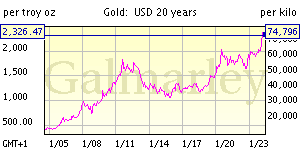
With oil above $100 and gold near all-time highs, King World News interviewed Rick Rule, Founder of Global Resources, now part of the $8 billion Sprott Asset Management. When asked about the move in oil, Rule remarked, “The markets are too tight to take any shocks. I think this move in oil was inevitable, because the balance between supply and demand was too tight. There is a whole bunch of oil production controlled by national oil companies and many of those countries have diverted too much of that cash to domestic spending, without leaving capital to fund their existing infrastructure to allow for continued high production levels.”
Rick Rule continues:
“As a consequence, world export supplies should shrink over the next five years as countries like Mexico, Venezuela, Peru, Indonesia, Ecuador and perhaps even Iran cease to be exporters. This inherit tightness can’t accommodate political disruption in Middle-East supplies.
I think Brent/WTI divergence is an important story. It shows that the US is becoming a less dominant world economy and that the WTI serves a regional market, with Brent becoming the global benchmark.
The bottom line is that the increase in energy prices will have inflationary impacts. The US government wants to report the CPI excluding food and fuel, sadly people eat and drive and it does impact people’s cost of living.
Further, the political response to the economic shock engendered by higher energy prices will doubtless be more quantitive easing. The markets response to central bank counterfeiting will likely be much higher gold prices.”
Rick Rule called for some geopolitical event in the Middle-East to cause the price of oil to take off to the upside in his last King World News interview - Nice call Rick.
Eric King
KingWorldNews.com
With oil above $100 and gold near all-time highs, King World News interviewed Rick Rule, Founder of Global Resources, now part of the $8 billion Sprott Asset Management. When asked about the move in oil, Rule remarked, “The markets are too tight to take any shocks. I think this move in oil was inevitable, because the balance between supply and demand was too tight. There is a whole bunch of oil production controlled by national oil companies and many of those countries have diverted too much of that cash to domestic spending, without leaving capital to fund their existing infrastructure to allow for continued high production levels.”
Rick Rule continues:
“As a consequence, world export supplies should shrink over the next five years as countries like Mexico, Venezuela, Peru, Indonesia, Ecuador and perhaps even Iran cease to be exporters. This inherit tightness can’t accommodate political disruption in Middle-East supplies.
I think Brent/WTI divergence is an important story. It shows that the US is becoming a less dominant world economy and that the WTI serves a regional market, with Brent becoming the global benchmark.
The bottom line is that the increase in energy prices will have inflationary impacts. The US government wants to report the CPI excluding food and fuel, sadly people eat and drive and it does impact people’s cost of living.
Further, the political response to the economic shock engendered by higher energy prices will doubtless be more quantitive easing. The markets response to central bank counterfeiting will likely be much higher gold prices.”
Rick Rule called for some geopolitical event in the Middle-East to cause the price of oil to take off to the upside in his last King World News interview - Nice call Rick.
Eric King
KingWorldNews.com
More Budget Woes
The Providence Journal of Rhode Island reports that the Providence school district "plans to send out dismissal notices to every one of its 1,926 teachers, an unprecedented move that has union leaders up in arms." The paper continues:
In a letter sent to all teachers Tuesday, Supt. Tom Brady wrote that the Providence School Board on Thursday will vote on a resolution to dismiss every teacher, effective the last day of school.
In an e-mail sent to all teachers and School Department staff, Brady said, “We are forced to take this precautionary action by the March 1 deadline given the dire budget outline for the 2011-2012 school year in which we are projecting a near $40 million deficit for the district,” Brady wrote. “Since the full extent of the potential cuts to the school budget have yet to be determined, issuing a dismissal letter to all teachers was necessary to give the mayor, the School Board and the district maximum flexibility to consider every cost savings option, including reductions in staff.” State law requires that teachers be notified about potential changes to their employment status by March 1.
“To be clear about what this means,” Brady wrote, “this action gives the School Board the right to dismiss teachers as necessary, but not all teachers will actually be dismissed at the end of the school year.”
Providence faces a $57 million budget deficit this year and expects an even larger budget deficit next year. You can read the whole story here.
The Providence Journal of Rhode Island reports that the Providence school district "plans to send out dismissal notices to every one of its 1,926 teachers, an unprecedented move that has union leaders up in arms." The paper continues:
In a letter sent to all teachers Tuesday, Supt. Tom Brady wrote that the Providence School Board on Thursday will vote on a resolution to dismiss every teacher, effective the last day of school.
In an e-mail sent to all teachers and School Department staff, Brady said, “We are forced to take this precautionary action by the March 1 deadline given the dire budget outline for the 2011-2012 school year in which we are projecting a near $40 million deficit for the district,” Brady wrote. “Since the full extent of the potential cuts to the school budget have yet to be determined, issuing a dismissal letter to all teachers was necessary to give the mayor, the School Board and the district maximum flexibility to consider every cost savings option, including reductions in staff.” State law requires that teachers be notified about potential changes to their employment status by March 1.
“To be clear about what this means,” Brady wrote, “this action gives the School Board the right to dismiss teachers as necessary, but not all teachers will actually be dismissed at the end of the school year.”
Providence faces a $57 million budget deficit this year and expects an even larger budget deficit next year. You can read the whole story here.
Troubled banks rise to highest level in 18 years
The above article contains the "official" troubled bank figures. What do you think the "real" figures are?
Do you still have your money in the bank? Insurance company? Stocks, bonds and mutual funds?
You're not paying attention. Time is short. Get as much metal as you can as soon as you can or you WILL be sorry!
The above article contains the "official" troubled bank figures. What do you think the "real" figures are?
Do you still have your money in the bank? Insurance company? Stocks, bonds and mutual funds?
You're not paying attention. Time is short. Get as much metal as you can as soon as you can or you WILL be sorry!
Gun Control
The following were just too good not to pass on. And let me say the following so you don't misunderstand my theological stance on carrying a gun:
I'm sure if Jesus were here today, he wouldn't carry a gun. And since He is my example, as soon as I get to where I can walk on water, heal the sick and just appear and disappear at will, I won't carry one either!
David Tanner
1. The BEST form of gun control is to use TWO hands!
The following were just too good not to pass on. And let me say the following so you don't misunderstand my theological stance on carrying a gun:
I'm sure if Jesus were here today, he wouldn't carry a gun. And since He is my example, as soon as I get to where I can walk on water, heal the sick and just appear and disappear at will, I won't carry one either!
David Tanner
1. The BEST form of gun control is to use TWO hands!

2. Never pick a fight with an old man. Since he is too old, he will just shoot you.

3. A reporter asked a Texas Ranger "Why do you carry a 45?" The Ranger responded, "Because they don't make a 46."

4. The old sheriff was attending an awards dinner when a lady commented on his wearing his sidearm, "Sheriff, I see you have your pistol. Are you expecting trouble?'' "No, Ma'am. If I were expecting trouble, I would have brought my shotgun."

5. I was once asked by a lady visiting if I had a gun in the house. I said I did. She said, "Well, I certainly hope it isn't loaded!" To which I said, "Of course it is loaded, it can't work without bullets!" She then asked, "Are you that afraid of someone evil coming into your house?" My reply was, "No, not at all. I am not afraid of the house catching fire, either, but I have fire extinguishers around, and they are all loaded, too."
America Devolves Into The USA
This one is for you political junkies out there.
Martha, Clarence, the Big Misunderstanding and Me
By Doug Hornig, Casey Research
Regular readers of the Daily Dispatch will know that I’m the political junkie around here. Not only do I follow what goes on in that vile, corrupt sphere, I actually care. I get angry at betrayals of the public trust. Most of my colleagues, I suspect, regard me with the sense of amusement aroused by a child who proclaims that he wants to become president when he grows up, because he wants to serve his country rather than simply be the most powerful person in it.
I don’t know this for a fact, but I think it’s probably safe to say that I’m the only one at Casey Research who ever seriously considered a run for elected office. It happened a number of years ago, when my local representative to the House of Delegates here in Virginia decided to switch parties.
This guy was a hack. He’d been a Dixiecrat-type Democrat all his life, but, sensing a shift in the political winds, suddenly decided he was a born-again Republican. Only problem, the Republicans didn’t want him. But after he tried to switch, the Democrats didn’t want him either. So he became an Independent and, since he was now voting Republican when he went to Richmond, the GOP tacitly agreed not to run anyone against him in perpetuity.
It was the perfect scenario for a political junkie to get elected to office. Normally, no major party would nominate me, and even if one of them were foolish enough to, I’m basically unelectable. But this was not a normal situation. Under Virginia law, if I filed to run as a Republican, that’s how I would appear on the ballot and the GOP would be powerless to stop me. Assuming the Democrats ran someone, as they always do, then it would be a three-way race. And in a three-way race, as Jesse Ventura so delightfully proved, anything can happen.
A lot of people encouraged me to do it. I had a seasoned political vet who volunteered to be my campaign manager, and an experienced pollster ready to find the right issues to run on. I even had a treasurer lined up. But here’s the thing. When you decide to run for office, you have to fill out paperwork that weighs in a good pound or more. You have to make public the most intimate details of your life, especially the financial ones. I decided it was all more than I cared to share with strangers, and thus ended my embryonic political career.
However, it never seemed inappropriate that these disclosures should be required of me. Let’s say that my state legislator had to vote on the awarding of some governmental largesse to the XYZ Corporation. And let’s say that he was a paid consultant for XYZ. I’d want that relationship to be public knowledge, not something hidden from his constituents.
Disclosure laws are, in my opinion, a good thing. They’re designed to prevent the big money-fueled corruption that results from blatant conflicts of interest. If you’re a public official and you lie on your disclosure forms, you’ve broken the law.
In this season of political madness, where taxpayers are being asked to bail out gigantic financial institutions that made bad bets to the tune of billions upon billions of dollars, a falsified financial disclosure statement may seem like small potatoes indeed. But it isn’t when the perp sits on the highest court in the land.
Supreme Court Justice Clarence Thomas filed a false financial statement. Not once. Repeatedly. For decades. It’s a crime for which an average citizen would at the least be fined and, considering its frequency and duration, would probably have to do some jail time. Calling it just a “misunderstanding” would not likely help.
Here’s what the big misunderstanding looks like:
The Ethics in Government Act of 1978 requires federal officials like Thomas to file a yearly form in which he notes not only his own sources of income but any non-investment income earned by his wife. Wives are included, reasonably enough, in order to prevent public officials from hiding bribes by funneling them to spouses.
Thomas’s wife, Virginia, makes non-investment money, and a lot of it. For example, from 2003 to 2007 she worked for the Heritage Foundation and was paid more than $120,000 per year, according to the organization’s own IRS reporting. These years were apparently not atypical, as Thomas has now filed “amended” disclosures going all the way back to 1989, but how much she made is really beside the point. Because Thomas failed to report any of it. Every year. Not only that, on the annual disclosure form, under “Spouse’s Non-Investment Income,” there is a little box marked “None.” That’s the one the Justice checked. Year in and year out.
Suppose for a moment that for seven years your spouse has been pulling down $120K per year, yet on your own personal disclosure forms, the ones you filed every April 15, that income somehow slipped through the cracks and you forgot to report it. Think you’d get away with an “Oops”? Maybe, if you were lucky, you’d escape with a fine and a suspended sentence.
Everyone on the Supreme Court reports to work in a building over whose entrance Equal Justice Under Law is chiseled in stone. If Clarence Thomas is allowed to walk, then perhaps it’s time to unchisel it.
Walk he probably will, and it won’t be the jumpsuited perp walk either. D.C. just doesn’t want anything to do with this story. Conservatives are understandably terrified at the thought of losing one of “their” seats on the Court, and all those who couldn’t wait to impeach a president for, um, lying are not-so-strangely mum here; while liberals, still licking their wounds from their butt-whipping in the last election, have shown little inclination to stir the pot. Both seem willing to say the guy made an honest mistake, he fessed up, end of story, move on.
In addition, press coverage of this crime has been lackluster at best. Although it is entirely a legal and not a political issue, it’s treated as if it were. Left-wing talking heads pursue it, right-wing heads ignore it. And the evening news only found it of interest for a day or so.
Perhaps the lack of outcry is because it isn’t perceived as much of a crime. It’s just a simple misdemeanor, right? Actually, it’s that for sure, and maybe more. The for sure part is that Thomas violated statute 5 USC appendix 104, under which an official who “knowingly and willfully” falsifies a required report is subject to a fine of up to $50,000 and up to a year in jail. On each count. Do it some twenty-odd times and it starts to add up. (Thomas could of course claim his conduct was neither willful nor knowing, perhaps insisting that “the dog ate the six hundred grand” or something, but it’d be fun to see him try that in court.) Such violations are supposed to be referred to the Attorney General, and he is supposed to investigate.
However, if you don’t think a misdemeanor of that magnitude warrants impeachment, not to mention a little sojourn in the Graybar Hotel, well, what if it were a felony?
Which brings us to Martha. Martha Stewart did jail time, as everyone knows. But most people, if asked why, would say she was convicted of insider trading on a stock deal. Nope. She was convicted of lying about it, under statute 18 USC 1001.
That’s the one the feds use when they’re looking for something to hang you with and don’t have much. It’s a mighty big umbrella. Whoever, “in any matter within the jurisdiction of the executive, legislative, or judicial branch of the Government of the United States, knowingly and willfully … makes any materially false, fictitious, or fraudulent statement or representation” is guilty of a felony punishable by up to five years in the slammer. Basically, you can’t lie to the feds under any circumstances.
It’s how they nailed Martha. And Marion Jones, who also did time. And it’s the sword over Barry Bonds’s head.
So why did Clarence do it? Assuming the obvious, that he didn’t have a series of 20 senior moments or was unclear on the meaning of the word None, we’re left to speculate.
His enemies were quick to claim he did it to ward off calls for his recusal in cases that would have a direct financial impact on his wife’s lobbying activities, pointing to such decisions as 2010’s landmark, Citizens United v. Federal Election Commission. It seems unlikely in that particular instance. If lawyers for the FEC were unaware of Mrs. Thomas’s activities, they weren’t reading the newspapers. She was at the time CEO of the lobbying group, Liberty Central, which she founded in 2009. Hardly a secret, and litigants would not have needed a financial disclosure statement before they asked Thomas to recuse himself from a case that was clearly going to have some very nice financial consequences for the Thomas family. But they didn’t.
At the same time, there are many years’ worth of other decisions against which to weigh Ginni Thomas’s interests. Because of the falsified documents, the appearance of impropriety is in the air. It should be dealt with. If Clarence Thomas’s vote is for sale, then let some more serious charges to be brought against him. But even if no one is willing to pursue that one, the fact remains that he admittedly broke the law. He should be held accountable for what he’s done, and impeached, at a minimum.
I’m giving good odds that that won’t happen. We live on Animal Farm, where the pigs declared after the equality revolution that while all animals are equal, some are more equal than others. Our judges are among the most equal.
Doug Casey likes to say that America was originally an idea, and a fine one, but that it devolved into the United States, which is just another country. (Although, we would like to think, not a two-bit country with an openly corrupt judiciary.)
One of the basic tenets of that original, fine idea was that no one should be above the law. Especially someone entrusted with the care of the law. Justice Thomas violated that trust. He did it brazenly, and repeatedly, and he dismissed all his misdeeds in the most cavalier manner imaginable.
So where’s the outrage?
This one is for you political junkies out there.
Martha, Clarence, the Big Misunderstanding and Me
By Doug Hornig, Casey Research
Regular readers of the Daily Dispatch will know that I’m the political junkie around here. Not only do I follow what goes on in that vile, corrupt sphere, I actually care. I get angry at betrayals of the public trust. Most of my colleagues, I suspect, regard me with the sense of amusement aroused by a child who proclaims that he wants to become president when he grows up, because he wants to serve his country rather than simply be the most powerful person in it.
I don’t know this for a fact, but I think it’s probably safe to say that I’m the only one at Casey Research who ever seriously considered a run for elected office. It happened a number of years ago, when my local representative to the House of Delegates here in Virginia decided to switch parties.
This guy was a hack. He’d been a Dixiecrat-type Democrat all his life, but, sensing a shift in the political winds, suddenly decided he was a born-again Republican. Only problem, the Republicans didn’t want him. But after he tried to switch, the Democrats didn’t want him either. So he became an Independent and, since he was now voting Republican when he went to Richmond, the GOP tacitly agreed not to run anyone against him in perpetuity.
It was the perfect scenario for a political junkie to get elected to office. Normally, no major party would nominate me, and even if one of them were foolish enough to, I’m basically unelectable. But this was not a normal situation. Under Virginia law, if I filed to run as a Republican, that’s how I would appear on the ballot and the GOP would be powerless to stop me. Assuming the Democrats ran someone, as they always do, then it would be a three-way race. And in a three-way race, as Jesse Ventura so delightfully proved, anything can happen.
A lot of people encouraged me to do it. I had a seasoned political vet who volunteered to be my campaign manager, and an experienced pollster ready to find the right issues to run on. I even had a treasurer lined up. But here’s the thing. When you decide to run for office, you have to fill out paperwork that weighs in a good pound or more. You have to make public the most intimate details of your life, especially the financial ones. I decided it was all more than I cared to share with strangers, and thus ended my embryonic political career.
However, it never seemed inappropriate that these disclosures should be required of me. Let’s say that my state legislator had to vote on the awarding of some governmental largesse to the XYZ Corporation. And let’s say that he was a paid consultant for XYZ. I’d want that relationship to be public knowledge, not something hidden from his constituents.
Disclosure laws are, in my opinion, a good thing. They’re designed to prevent the big money-fueled corruption that results from blatant conflicts of interest. If you’re a public official and you lie on your disclosure forms, you’ve broken the law.
In this season of political madness, where taxpayers are being asked to bail out gigantic financial institutions that made bad bets to the tune of billions upon billions of dollars, a falsified financial disclosure statement may seem like small potatoes indeed. But it isn’t when the perp sits on the highest court in the land.
Supreme Court Justice Clarence Thomas filed a false financial statement. Not once. Repeatedly. For decades. It’s a crime for which an average citizen would at the least be fined and, considering its frequency and duration, would probably have to do some jail time. Calling it just a “misunderstanding” would not likely help.
Here’s what the big misunderstanding looks like:
The Ethics in Government Act of 1978 requires federal officials like Thomas to file a yearly form in which he notes not only his own sources of income but any non-investment income earned by his wife. Wives are included, reasonably enough, in order to prevent public officials from hiding bribes by funneling them to spouses.
Thomas’s wife, Virginia, makes non-investment money, and a lot of it. For example, from 2003 to 2007 she worked for the Heritage Foundation and was paid more than $120,000 per year, according to the organization’s own IRS reporting. These years were apparently not atypical, as Thomas has now filed “amended” disclosures going all the way back to 1989, but how much she made is really beside the point. Because Thomas failed to report any of it. Every year. Not only that, on the annual disclosure form, under “Spouse’s Non-Investment Income,” there is a little box marked “None.” That’s the one the Justice checked. Year in and year out.
Suppose for a moment that for seven years your spouse has been pulling down $120K per year, yet on your own personal disclosure forms, the ones you filed every April 15, that income somehow slipped through the cracks and you forgot to report it. Think you’d get away with an “Oops”? Maybe, if you were lucky, you’d escape with a fine and a suspended sentence.
Everyone on the Supreme Court reports to work in a building over whose entrance Equal Justice Under Law is chiseled in stone. If Clarence Thomas is allowed to walk, then perhaps it’s time to unchisel it.
Walk he probably will, and it won’t be the jumpsuited perp walk either. D.C. just doesn’t want anything to do with this story. Conservatives are understandably terrified at the thought of losing one of “their” seats on the Court, and all those who couldn’t wait to impeach a president for, um, lying are not-so-strangely mum here; while liberals, still licking their wounds from their butt-whipping in the last election, have shown little inclination to stir the pot. Both seem willing to say the guy made an honest mistake, he fessed up, end of story, move on.
In addition, press coverage of this crime has been lackluster at best. Although it is entirely a legal and not a political issue, it’s treated as if it were. Left-wing talking heads pursue it, right-wing heads ignore it. And the evening news only found it of interest for a day or so.
Perhaps the lack of outcry is because it isn’t perceived as much of a crime. It’s just a simple misdemeanor, right? Actually, it’s that for sure, and maybe more. The for sure part is that Thomas violated statute 5 USC appendix 104, under which an official who “knowingly and willfully” falsifies a required report is subject to a fine of up to $50,000 and up to a year in jail. On each count. Do it some twenty-odd times and it starts to add up. (Thomas could of course claim his conduct was neither willful nor knowing, perhaps insisting that “the dog ate the six hundred grand” or something, but it’d be fun to see him try that in court.) Such violations are supposed to be referred to the Attorney General, and he is supposed to investigate.
However, if you don’t think a misdemeanor of that magnitude warrants impeachment, not to mention a little sojourn in the Graybar Hotel, well, what if it were a felony?
Which brings us to Martha. Martha Stewart did jail time, as everyone knows. But most people, if asked why, would say she was convicted of insider trading on a stock deal. Nope. She was convicted of lying about it, under statute 18 USC 1001.
That’s the one the feds use when they’re looking for something to hang you with and don’t have much. It’s a mighty big umbrella. Whoever, “in any matter within the jurisdiction of the executive, legislative, or judicial branch of the Government of the United States, knowingly and willfully … makes any materially false, fictitious, or fraudulent statement or representation” is guilty of a felony punishable by up to five years in the slammer. Basically, you can’t lie to the feds under any circumstances.
It’s how they nailed Martha. And Marion Jones, who also did time. And it’s the sword over Barry Bonds’s head.
So why did Clarence do it? Assuming the obvious, that he didn’t have a series of 20 senior moments or was unclear on the meaning of the word None, we’re left to speculate.
His enemies were quick to claim he did it to ward off calls for his recusal in cases that would have a direct financial impact on his wife’s lobbying activities, pointing to such decisions as 2010’s landmark, Citizens United v. Federal Election Commission. It seems unlikely in that particular instance. If lawyers for the FEC were unaware of Mrs. Thomas’s activities, they weren’t reading the newspapers. She was at the time CEO of the lobbying group, Liberty Central, which she founded in 2009. Hardly a secret, and litigants would not have needed a financial disclosure statement before they asked Thomas to recuse himself from a case that was clearly going to have some very nice financial consequences for the Thomas family. But they didn’t.
At the same time, there are many years’ worth of other decisions against which to weigh Ginni Thomas’s interests. Because of the falsified documents, the appearance of impropriety is in the air. It should be dealt with. If Clarence Thomas’s vote is for sale, then let some more serious charges to be brought against him. But even if no one is willing to pursue that one, the fact remains that he admittedly broke the law. He should be held accountable for what he’s done, and impeached, at a minimum.
I’m giving good odds that that won’t happen. We live on Animal Farm, where the pigs declared after the equality revolution that while all animals are equal, some are more equal than others. Our judges are among the most equal.
Doug Casey likes to say that America was originally an idea, and a fine one, but that it devolved into the United States, which is just another country. (Although, we would like to think, not a two-bit country with an openly corrupt judiciary.)
One of the basic tenets of that original, fine idea was that no one should be above the law. Especially someone entrusted with the care of the law. Justice Thomas violated that trust. He did it brazenly, and repeatedly, and he dismissed all his misdeeds in the most cavalier manner imaginable.
So where’s the outrage?
Silver and Opium
By Antal E Fekete
The Opium Wars do not belong to the glorious episodes of Western history. Rather, they were instances of shameful behavior the West still has not lived down.
Mercantilist governments resented the perpetual drain of silver from West to East in payment for Oriental goods (tea, silk, porcelain) that were in high demand in the Occident, while facing low demand in the Orient for Occidental goods. From the mid-17th century, more than 9 billion Troy ounces, or 290 thousand tonnes, of silver was absorbed by China from European countries in exchange for Chinese goods.
The British introduced opium along with tobacco as an export item to China in order to reduce the trade deficit. Under the disguise of free trade, the British, the Spanish and the French, with the tacit approval of the Americans, continued sending their contraband to China through legitimate as well as illegitimate trade channels even after the Chinese dynasty put an embargo on opium imports.
Because of its strong appeal to the Chinese masses, and because of its highly addictive nature, opium appeared to be the ideal solution to the West’s trade problem. And, indeed, the flow of silver was first stopped, and then reversed. China was forced to pay silver for her addiction to opium smoking that was artificially induced by the pusher - the British.
Thus silver was replaced by opium as the mainstay of Western exports. In 1729 China, recognizing the growing problem of addiction and the debilitating and mind-corrupting nature of the drug, prohibited the sale and smoking of opium, allowing only a small quota of imports for medicinal purposes. The British defied the embargo and ban on opium trade, and encouraged smuggling. As a result, British exports of opium to China grew from an estimated 15 tonnes to 75 tonnes by 1773. This increased further to 900 tonnes by 1820; and to 1,400 tonnes annually by 1838 - an almost 100-fold increase in 100 years.
Something had to be done. The Chinese government introduced the death penalty for drug trafficking and put British processing and distributing facilities on Chinese soil under siege. Chinese troops boarded British ships in international waters carrying opium to Chinese ports and destroyed their cargo, in addition to the destruction of opium found on Chinese territory. The British accused the Chinese of destroying British property and sent a large British-Indian army to China in order to exact punishment.
British military superiority was clearly evident in the armed conflict. British warships wreaked havoc on coastal towns. After taking Canton (Guangzhou), the British sailed up the Yangtze River. They grabbed the tax barges, inflicting a devastating blow on the Chinese as imperial revenues were impossible to collect. In 1842, China sued for peace, with a pact that was concluded in Nanking and ratified the following year. In the treaty, China was forced to pay an indemnity to Britain, open four port cities where British subjects were given extraterritorial privileges, and cede Hong Kong to Britain. In 1844 the United States and France signed similar treaties with China.
These humiliating treaties were criticized in the House of Commons by William E Gladstone, who later served as prime minister. He was wondering "whether there had ever been a war more unjust in its origin, a war more calculated to cover Britain with permanent disgrace". The Foreign Secretary, Lord Palmerston, replied that nobody believed that the Chinese government’s motive was "the promotion of good moral habits", or that the war was fought to stem China's balance of trade deficit.
The American president, John Quincy Adams, chimed in during the debate by suggesting that opium was a "mere incident". According to him "the cause of the war was the arrogant and insupportable pretensions of China that she would hold commercial intercourse with the rest of mankind not upon terms of equal reciprocity, but upon the insulting and degrading forms of the relations between lord and vassal."
These words are echoed, 160 years later, by President Barack Obama's recent disdainful pronouncements to the effect that China's exchange-rate policy is unacceptable to the rest of mankind as it pretends that China's currency is that of the lord, and everybody else's is that of the vassal.
The peace of Nanking did not last. The Chinese searched a suspicious ship, and the British answered by putting the port city of Canton under siege in 1856, occupying it in 1857. The French also entered the fray. British troops were approaching Beijing and set on to destroy the Summer Palace. China again was forced to sue for peace. In the peace treaty of Tianjin, the port for Beijing, China yielded to the demand to create 10 new port cities, and granted foreigners free passage throughout the country. It also agreed to pay an indemnity of five million ounces of silver: three million to Britain and two million to France.
This deliberate humiliation of China by the Western powers contributed greatly to the loosening and ultimate snapping of the internal coherence of the Qing Dynasty, leading to the Taiping Rebellion (1850-1864), the Boxer Uprising (1899-1901) and, ultimately, to the downfall of the Qing Dynasty in 1912.
The present trade dispute between the US . and China is reminiscent of the background to the two Opium Wars. Once more, the issue is the humiliation and plunder of China as a "thank you" for China's favor of having provided consumer goods for which the West was unable to pay in terms of Western goods suitable for Chinese consumption. The only difference is the absence of opium in the dispute.
Oops, I take it back. The role of opium in the current dispute is played by paper. Paper dollars, to be precise.
In 1971, an atrocity was made that I call the Nixon-Friedman conspiracy. To cover up the shame and disgrace of the default of the US on its international gold obligations, Milton Friedman (following an earlier failed attempt of John Maynard Keynes) concocted a spurious and idiotic theory of floating exchange rates. It suggests that falling foreign exchange value of the domestic currency makes it stronger when in actual fact the opposite is true: it is made weaker as the terms of trade of the devaluing country deteriorates and that of its trading partners improves.
President Richard Nixon was quick to embrace the false theory of Friedman. No public debate of the plan was permitted then, or ever after. Under the new dispensation, the irredeemable dollar was to play the role of the ultimate extinguisher of debt, a preposterous idea. The scheme was imposed on the world under duress as part of the "new millennium", shaking off the "tyranny of gold", that "barbarous relic", the last remnant of superstition, the only remaining "anachronism of the Modern Age".
The ploy was played up and celebrated as a great scientific breakthrough, making it possible for man to shape his own destiny rationally, free of superstition, for the first time ever. Yet all it was a cheap trick to elevate the dishonored paper of an insolvent banker (the US) from scum to the holy of holies: international currency. The fact that fiat paper money has a history of 100% mortality was neatly side-stepped. Any questioning of the wisdom of experimenting with it in spite of logic and historical evidence was declared foggy-bottom reactionary thinking.
The amazing thing about this episode of the history of human folly was the ease with which it could be pushed down the throat of the rest of the world, including those nations that were directly hurt by it, such as the ones running a trade surplus with the US. Their savings went up in smoke.
The explanation for this self-destructing behavior is the addictive, debilitating and mind-corrosive nature of paper money, in direct analogy with that of opium. The high caused by administering the opium pipe to the patient (read: administering quantitative easing, or QE) had to be repeated when the effect faded by a fresh administration of more opium (read: QE2).
If the patient resists, like China did in 1840, then a holy opium war must be declared on it in the name of the right of others to free trade. Now 170 years later, a New China once more demurs against the paper-torture treatment it was subjected to by the American debt-mongers and opium pushers.
But beware: if the West starts another Opium War, this time it is not China that will be on the losing side.
Antal E Fekete has since 2001 been consulting professor at Sapientia University, Cluj-Napoca, Romania. In 1996, Professor Fekete won the first prize in the International Currency Essay contest sponsored by Bank Lips Ltd of Switzerland.
By Antal E Fekete
The Opium Wars do not belong to the glorious episodes of Western history. Rather, they were instances of shameful behavior the West still has not lived down.
Mercantilist governments resented the perpetual drain of silver from West to East in payment for Oriental goods (tea, silk, porcelain) that were in high demand in the Occident, while facing low demand in the Orient for Occidental goods. From the mid-17th century, more than 9 billion Troy ounces, or 290 thousand tonnes, of silver was absorbed by China from European countries in exchange for Chinese goods.
The British introduced opium along with tobacco as an export item to China in order to reduce the trade deficit. Under the disguise of free trade, the British, the Spanish and the French, with the tacit approval of the Americans, continued sending their contraband to China through legitimate as well as illegitimate trade channels even after the Chinese dynasty put an embargo on opium imports.
Because of its strong appeal to the Chinese masses, and because of its highly addictive nature, opium appeared to be the ideal solution to the West’s trade problem. And, indeed, the flow of silver was first stopped, and then reversed. China was forced to pay silver for her addiction to opium smoking that was artificially induced by the pusher - the British.
Thus silver was replaced by opium as the mainstay of Western exports. In 1729 China, recognizing the growing problem of addiction and the debilitating and mind-corrupting nature of the drug, prohibited the sale and smoking of opium, allowing only a small quota of imports for medicinal purposes. The British defied the embargo and ban on opium trade, and encouraged smuggling. As a result, British exports of opium to China grew from an estimated 15 tonnes to 75 tonnes by 1773. This increased further to 900 tonnes by 1820; and to 1,400 tonnes annually by 1838 - an almost 100-fold increase in 100 years.
Something had to be done. The Chinese government introduced the death penalty for drug trafficking and put British processing and distributing facilities on Chinese soil under siege. Chinese troops boarded British ships in international waters carrying opium to Chinese ports and destroyed their cargo, in addition to the destruction of opium found on Chinese territory. The British accused the Chinese of destroying British property and sent a large British-Indian army to China in order to exact punishment.
British military superiority was clearly evident in the armed conflict. British warships wreaked havoc on coastal towns. After taking Canton (Guangzhou), the British sailed up the Yangtze River. They grabbed the tax barges, inflicting a devastating blow on the Chinese as imperial revenues were impossible to collect. In 1842, China sued for peace, with a pact that was concluded in Nanking and ratified the following year. In the treaty, China was forced to pay an indemnity to Britain, open four port cities where British subjects were given extraterritorial privileges, and cede Hong Kong to Britain. In 1844 the United States and France signed similar treaties with China.
These humiliating treaties were criticized in the House of Commons by William E Gladstone, who later served as prime minister. He was wondering "whether there had ever been a war more unjust in its origin, a war more calculated to cover Britain with permanent disgrace". The Foreign Secretary, Lord Palmerston, replied that nobody believed that the Chinese government’s motive was "the promotion of good moral habits", or that the war was fought to stem China's balance of trade deficit.
The American president, John Quincy Adams, chimed in during the debate by suggesting that opium was a "mere incident". According to him "the cause of the war was the arrogant and insupportable pretensions of China that she would hold commercial intercourse with the rest of mankind not upon terms of equal reciprocity, but upon the insulting and degrading forms of the relations between lord and vassal."
These words are echoed, 160 years later, by President Barack Obama's recent disdainful pronouncements to the effect that China's exchange-rate policy is unacceptable to the rest of mankind as it pretends that China's currency is that of the lord, and everybody else's is that of the vassal.
The peace of Nanking did not last. The Chinese searched a suspicious ship, and the British answered by putting the port city of Canton under siege in 1856, occupying it in 1857. The French also entered the fray. British troops were approaching Beijing and set on to destroy the Summer Palace. China again was forced to sue for peace. In the peace treaty of Tianjin, the port for Beijing, China yielded to the demand to create 10 new port cities, and granted foreigners free passage throughout the country. It also agreed to pay an indemnity of five million ounces of silver: three million to Britain and two million to France.
This deliberate humiliation of China by the Western powers contributed greatly to the loosening and ultimate snapping of the internal coherence of the Qing Dynasty, leading to the Taiping Rebellion (1850-1864), the Boxer Uprising (1899-1901) and, ultimately, to the downfall of the Qing Dynasty in 1912.
The present trade dispute between the US . and China is reminiscent of the background to the two Opium Wars. Once more, the issue is the humiliation and plunder of China as a "thank you" for China's favor of having provided consumer goods for which the West was unable to pay in terms of Western goods suitable for Chinese consumption. The only difference is the absence of opium in the dispute.
Oops, I take it back. The role of opium in the current dispute is played by paper. Paper dollars, to be precise.
In 1971, an atrocity was made that I call the Nixon-Friedman conspiracy. To cover up the shame and disgrace of the default of the US on its international gold obligations, Milton Friedman (following an earlier failed attempt of John Maynard Keynes) concocted a spurious and idiotic theory of floating exchange rates. It suggests that falling foreign exchange value of the domestic currency makes it stronger when in actual fact the opposite is true: it is made weaker as the terms of trade of the devaluing country deteriorates and that of its trading partners improves.
President Richard Nixon was quick to embrace the false theory of Friedman. No public debate of the plan was permitted then, or ever after. Under the new dispensation, the irredeemable dollar was to play the role of the ultimate extinguisher of debt, a preposterous idea. The scheme was imposed on the world under duress as part of the "new millennium", shaking off the "tyranny of gold", that "barbarous relic", the last remnant of superstition, the only remaining "anachronism of the Modern Age".
The ploy was played up and celebrated as a great scientific breakthrough, making it possible for man to shape his own destiny rationally, free of superstition, for the first time ever. Yet all it was a cheap trick to elevate the dishonored paper of an insolvent banker (the US) from scum to the holy of holies: international currency. The fact that fiat paper money has a history of 100% mortality was neatly side-stepped. Any questioning of the wisdom of experimenting with it in spite of logic and historical evidence was declared foggy-bottom reactionary thinking.
The amazing thing about this episode of the history of human folly was the ease with which it could be pushed down the throat of the rest of the world, including those nations that were directly hurt by it, such as the ones running a trade surplus with the US. Their savings went up in smoke.
The explanation for this self-destructing behavior is the addictive, debilitating and mind-corrosive nature of paper money, in direct analogy with that of opium. The high caused by administering the opium pipe to the patient (read: administering quantitative easing, or QE) had to be repeated when the effect faded by a fresh administration of more opium (read: QE2).
If the patient resists, like China did in 1840, then a holy opium war must be declared on it in the name of the right of others to free trade. Now 170 years later, a New China once more demurs against the paper-torture treatment it was subjected to by the American debt-mongers and opium pushers.
But beware: if the West starts another Opium War, this time it is not China that will be on the losing side.
Antal E Fekete has since 2001 been consulting professor at Sapientia University, Cluj-Napoca, Romania. In 1996, Professor Fekete won the first prize in the International Currency Essay contest sponsored by Bank Lips Ltd of Switzerland.
Major Food Distributor Sysco: “Immediate Volatile Prices, Expected Limited Availability, and Mediocre Quality at Best”
Adding to already rising food prices due to monetary inflation and weather related supply problems around the globe, one of the world’s leading food distribution companies, Sysco Corporation, is advising clients and their customers that the recent freeze across North America has significantly impacted growing operations in Mexico (as well as parts of the U.S.) leading to 80% - 100% crop damage:
"ALL OF OUR GROWERS HAVE INVOKED THE ACT OF GOD CLAUSE ON OUR CONTRACTS DUE TO THE FOLLOWING RELEASE. WE WILL BE CONTACTING YOU PERSONALLY TO REVIEW HOW THIS WILL AFFECT OUR CONTRACTED ITEMS WITH YOU GOING FORWARD.
THE DEVASTATING FREEZE IN MEXICO IS WORST FREEZE IN OVER 50 YEARS…
THE EXTREME FREEZING TEMPERATURES HIT A VERY BROAD SECTION OF MAJOR GROWING REGIONS IN MEXICO, FROM HERMOSILLO IN THE NORTH ALL THE WAY SOUTH TO LOS MOCHIS AND EVEN SOUTH OF CULIACAN. THE EARLY REPORTS ARE STILL COMING IN BUT MOST ARE SHOWING LOSSES OF CROPS IN THE RANGE OF 80 TO 100%.
EVEN SHADE HOUSE PRODUCT WAS HIT BY THE EXTREMELY COLD TEMPS. IT WILL TAKE 7-10 DAYS TO HAVE A CLEARER PICTURE FROM GROWERS AND FIELD SUPERVISORS, BUT THESE GROWING REGIONS HAVEN’T HAD COLD LIKE THIS IN OVER A HALF CENTURY. THIS TIME OF YEAR, MEXICO SUPPLIES A SIGNIFICANT PERCENT OF NORTH AMERICA’S ROW CROP VEGETABLES SUCH AS: GREEN BEANS, EGGPLANT, CUCUMBERS, SQUASH, PEPPERS, ASPARAGUS, AND ROUND AND ROMA TOMATOES.
FLORIDA NORMALLY IS A MAJOR SUPPLIER FOR THESE ITEMS AS WELL BUT THEY HAVE ALREADY BEEN STRUCK WITH SEVERE FREEZE DAMAGE IN DECEMBER AND JANUARY AND UP UNTIL NOW HAVE HAD TO PURCHASE PRODUCT OUT OF MEXICO TO FILL THEIR COMMITMENTS, THAT IS NO LONGER AND OPTION.
WITH THE SERIES OF WEATHER DISASTERS THAT HAS OCCURRED IN BOTH OF THESE MAJOR GROWING AREAS WE WILL EXPERIENCE IMMEDIATE VOLATILE PRICES, EXPECTED LIMITED AVAILABILITY, AND MEDIOCRE QUALITY AT BEST. THIS WILL NOT ONLY HAVE AN IMMEDIATE IMPACT ON SUPPLIES, BUT BECAUSE OF VERY STRONG BLOSSOM DROPS, THIS WILL ALSO IMPACT SUPPLIES 30 – 60 DAYS FROM NOW.
SOME GROWERS ARE MEETING WITH THEIR BOARDS RIGHT NOW TO DETERMINE WHETHER THEY SHOULD IMMEDIATELY RE-PLANT, HOPING FOR A HARVEST BY LATE-MARCH-TOEARLY-APRIL, OR WHETHER THEY SHOULD DISC THE FIELDS UNDER AND WAIT FOR ANOTHER SEASON."
Source: Sysco Release/Memo: Mexico Freeze
Now might be a good time to hit the frozen foods (or fresh produce if you’ve got a vacuum sealer) aisle at your local grocery store and stock up on your favorite fruits and veggies, as there may be a severe supply crunch coming in the next couple weeks lasting perhaps several months. Why pay premium prices later when you can prepare yourself today, before the rest of the country gets wind of it.
The February 8, 2011 memo from Sysco Corporation comes on the heels of a report the day prior suggesting that Sysco will be forced to raise prices on foods ranging from dairy to meats (and probably grains, based on this report and chart) as a result of higher raw material costs and margin compression:
Higher raw material costs have pressured companies across sectors, and many of them, including Kellogg Co the world’s largest breakfast cereal company, raised prices to combat rising ingredient costs.
Sysco shares were down more than 6 percent on Monday afternoon on the New York Stock Exchange.
On a call with analysts, the company said a double digit price rise in meat, dairy and seafood — categories that account for one-third of its sales — created substantial margin pressures.
“It is unlikely that these pressures are going to subside near term,” Morning Star analyst Erin Sherin said, “This is in stark contrast to the 3.5 percent deflation Sysco was experiencing in the year-ago quarter.”
Food inflation is a mounting worry globally. A recent study on global food prices by a U.N. agency showed they hit their highest level on record in January, and are set to worsen after a massive snowstorm in the United States and floods in Australia.
Sysco CEO Bill DeLaney said, “Recovery and to some extent, (its) financial results may be somewhat choppy due to the economic challenges that consumers continue to face.”
We previously warned readers (Agflation Goes Retail and Broke and Hungry: This Chart Says It All) to expect this very effect of margin compression to hit consumers in coming weeks and months. Sysco has now essentially confirmed that their prices are going up, which means your prices at local grocery stores are headed north. And you can bet that if their raw material costs are up double digit percentage points, your retail prices will be as well.
The strategy we outlined in January of 2010 - Buy Commodities at Today’s Lower Prices, Consume at Tomorrow’s Higher Prices - may have sounded a bit doom and gloomish to some, but considering what has transpired in commodity markets and the food production sector, it was and still remains a viable investment strategy. While day traders and stock brokers on Wall Street exchange ETF’s and commodity options, we recommend to those of our readers who could care less about paper financial markets, to buy real food and store it for the longer term. Prices will likely continue to rise, and holding your own food stores gives you peace of mind knowing there is no counter-party risk, as you have the physical asset in your possession, ready for consumption or trade at a time of your choosing.
For those who care to read up on it, here are some ideas for Wealth Preservation, Investing, and Prepping For Hard Times.
Adding to already rising food prices due to monetary inflation and weather related supply problems around the globe, one of the world’s leading food distribution companies, Sysco Corporation, is advising clients and their customers that the recent freeze across North America has significantly impacted growing operations in Mexico (as well as parts of the U.S.) leading to 80% - 100% crop damage:
"ALL OF OUR GROWERS HAVE INVOKED THE ACT OF GOD CLAUSE ON OUR CONTRACTS DUE TO THE FOLLOWING RELEASE. WE WILL BE CONTACTING YOU PERSONALLY TO REVIEW HOW THIS WILL AFFECT OUR CONTRACTED ITEMS WITH YOU GOING FORWARD.
THE DEVASTATING FREEZE IN MEXICO IS WORST FREEZE IN OVER 50 YEARS…
THE EXTREME FREEZING TEMPERATURES HIT A VERY BROAD SECTION OF MAJOR GROWING REGIONS IN MEXICO, FROM HERMOSILLO IN THE NORTH ALL THE WAY SOUTH TO LOS MOCHIS AND EVEN SOUTH OF CULIACAN. THE EARLY REPORTS ARE STILL COMING IN BUT MOST ARE SHOWING LOSSES OF CROPS IN THE RANGE OF 80 TO 100%.
EVEN SHADE HOUSE PRODUCT WAS HIT BY THE EXTREMELY COLD TEMPS. IT WILL TAKE 7-10 DAYS TO HAVE A CLEARER PICTURE FROM GROWERS AND FIELD SUPERVISORS, BUT THESE GROWING REGIONS HAVEN’T HAD COLD LIKE THIS IN OVER A HALF CENTURY. THIS TIME OF YEAR, MEXICO SUPPLIES A SIGNIFICANT PERCENT OF NORTH AMERICA’S ROW CROP VEGETABLES SUCH AS: GREEN BEANS, EGGPLANT, CUCUMBERS, SQUASH, PEPPERS, ASPARAGUS, AND ROUND AND ROMA TOMATOES.
FLORIDA NORMALLY IS A MAJOR SUPPLIER FOR THESE ITEMS AS WELL BUT THEY HAVE ALREADY BEEN STRUCK WITH SEVERE FREEZE DAMAGE IN DECEMBER AND JANUARY AND UP UNTIL NOW HAVE HAD TO PURCHASE PRODUCT OUT OF MEXICO TO FILL THEIR COMMITMENTS, THAT IS NO LONGER AND OPTION.
WITH THE SERIES OF WEATHER DISASTERS THAT HAS OCCURRED IN BOTH OF THESE MAJOR GROWING AREAS WE WILL EXPERIENCE IMMEDIATE VOLATILE PRICES, EXPECTED LIMITED AVAILABILITY, AND MEDIOCRE QUALITY AT BEST. THIS WILL NOT ONLY HAVE AN IMMEDIATE IMPACT ON SUPPLIES, BUT BECAUSE OF VERY STRONG BLOSSOM DROPS, THIS WILL ALSO IMPACT SUPPLIES 30 – 60 DAYS FROM NOW.
SOME GROWERS ARE MEETING WITH THEIR BOARDS RIGHT NOW TO DETERMINE WHETHER THEY SHOULD IMMEDIATELY RE-PLANT, HOPING FOR A HARVEST BY LATE-MARCH-TOEARLY-APRIL, OR WHETHER THEY SHOULD DISC THE FIELDS UNDER AND WAIT FOR ANOTHER SEASON."
Source: Sysco Release/Memo: Mexico Freeze
Now might be a good time to hit the frozen foods (or fresh produce if you’ve got a vacuum sealer) aisle at your local grocery store and stock up on your favorite fruits and veggies, as there may be a severe supply crunch coming in the next couple weeks lasting perhaps several months. Why pay premium prices later when you can prepare yourself today, before the rest of the country gets wind of it.
The February 8, 2011 memo from Sysco Corporation comes on the heels of a report the day prior suggesting that Sysco will be forced to raise prices on foods ranging from dairy to meats (and probably grains, based on this report and chart) as a result of higher raw material costs and margin compression:
Higher raw material costs have pressured companies across sectors, and many of them, including Kellogg Co the world’s largest breakfast cereal company, raised prices to combat rising ingredient costs.
Sysco shares were down more than 6 percent on Monday afternoon on the New York Stock Exchange.
On a call with analysts, the company said a double digit price rise in meat, dairy and seafood — categories that account for one-third of its sales — created substantial margin pressures.
“It is unlikely that these pressures are going to subside near term,” Morning Star analyst Erin Sherin said, “This is in stark contrast to the 3.5 percent deflation Sysco was experiencing in the year-ago quarter.”
Food inflation is a mounting worry globally. A recent study on global food prices by a U.N. agency showed they hit their highest level on record in January, and are set to worsen after a massive snowstorm in the United States and floods in Australia.
Sysco CEO Bill DeLaney said, “Recovery and to some extent, (its) financial results may be somewhat choppy due to the economic challenges that consumers continue to face.”
We previously warned readers (Agflation Goes Retail and Broke and Hungry: This Chart Says It All) to expect this very effect of margin compression to hit consumers in coming weeks and months. Sysco has now essentially confirmed that their prices are going up, which means your prices at local grocery stores are headed north. And you can bet that if their raw material costs are up double digit percentage points, your retail prices will be as well.
The strategy we outlined in January of 2010 - Buy Commodities at Today’s Lower Prices, Consume at Tomorrow’s Higher Prices - may have sounded a bit doom and gloomish to some, but considering what has transpired in commodity markets and the food production sector, it was and still remains a viable investment strategy. While day traders and stock brokers on Wall Street exchange ETF’s and commodity options, we recommend to those of our readers who could care less about paper financial markets, to buy real food and store it for the longer term. Prices will likely continue to rise, and holding your own food stores gives you peace of mind knowing there is no counter-party risk, as you have the physical asset in your possession, ready for consumption or trade at a time of your choosing.
For those who care to read up on it, here are some ideas for Wealth Preservation, Investing, and Prepping For Hard Times.
Wealth Preservation, Investing, and Prepping For Hard Times
The trend going forward during this economic depression is getting back to basics. We often discuss ‘prepping’ as a way to protect your family in the event of an unforeseen catastrophe (natural or man-made). Recently, we’ve seen more financial analysts and advisers recommend shifting from traditional investments like stocks, bonds, CD’s and money market accounts, to tangible assets that will gain value regardless of what stock and bond markets do.
Of course, we’re not saying you should go out and spend your entire 401k retirement account on 5 gallon buckets of rice, but diversifying into hard assets on a variety of levels could be a great investment. As the US Dollar continues its decline over the coming years, the price of essential consumer goods is likely to rise. Certain goods, however, like real estate, cars and anything that is driven primarily by credit expansion may experience a deflationary impact in real dollar terms, while others, like food and energy may see explosive price increases.
Paul Mladjenovic of SuperMoneyLinks.com discusses 3 Things Everyone Needs to Do with Money in 2010:
“OUR GOVERNMENT CAN NOT SPEND OUR COUNTRY INTO TRLLIONS OF DOLLARS OF DEBT WITHOUT CONSEQUENCE.
I am working on my next set of forecasts and seminars but before they are out, I want everyone (and I mean EVERYONE) to consider 3 simple things to gain greater financial peace of mind:
-Diversify away from paper assets.
-Accumulate essentials.
-Re-focus your portfolio with emphasis on “human need”.
In Buy Commodities at Today’s Lower Prices, Consume at Tomorrow’s Higher Prices we offered some ideas about how to be a ‘prepper’ and ‘investor’ simultaneously.
“If you are a prepper, for example, who is already stocking essentials foods and goods, you’re way ahead of the game. As commodity prices continue to rise for a variety of reasons, your “investment” is paying off in real terms. Buy 10 pounds of rice today for $10, and when that same bag of rice goes to $20 a year or two from now, you can say you earned a 100% return on your investment! And the great thing about your investment, is you don’t have any counter party risk, for the most part, meaning that you own the physical good and it is in your possession — you take delivery at any time!”
For those interested in investing some of their wealth into real, tangible assets, consider the following as food for thought:
•Precious metals
Though gold and silver are no longer considered money by most “mainstream” economists, the fact is that central banks in China, India and Russia have been continuing to stockpile precious metals over the last decade, and they will likely continue to do so going forward. Why? Because as all or most of the paper currencies around the globe are debased, gold and silver will become the de facto monetary unit against which other currencies are valued. As Dr. Marc Faber has said on several occasions, “Own gold and become your own central bank.” Many contrarian financial advisers who lean towards the Austrian school of economics recommend allocating 10% to 20% of your current investment/retirement portfolio to gold. If you are banking on having that money when you retire, consider speaking within your financial adviser about purchasing precious metals in the form of mining companies or ETFs. If possible, a portion of your holdings should be in physical bullion like bars and coins, which will provide added security as you will have no counter party risk because you have it in your possession.
•Food
As the US Dollar loses value and other countries become hesitant about fund our trillion dollar debts, the cost of food will continue to rise. Combine the dollar’s monetary issues with the fact the many farmers around the world are unable to gain access to loans to continue or expand operations, and you have the potential for prices increases no just because of dollar debasement, but supply problems. The other threat for food is that we may very well experience a perfect storm event, such as that experienced in the dust bowl of the 1930’s, meaning that heavy rains, or heat or cold may affect agricultural output, further straining supplies and pushing prices higher. Foods like rice, legumes, pastas, wheat, oats, and canned goods could be purchased today and stored, in some cases, for up to five years or longer. Consider the price increases that can happen in these food stuffs over the next five years and this investment may see significant gains. And again, you eliminate counter-party risk because you are holding the tangible assets yourself. (The following video shows how The Survival Mom has dedicated a room in her home for just this purpose)
•Sustainable Living
Well known trend forecaster Gerald Celente has suggested that one of the mega-trends of this decade will be living on less and becoming more self sustaining. Individuality will return to America, and a push to distance oneself from the “grid” will take off for a variety of reasons. Rising food and energy costs are likely to be two of the major catalysts for this trend. How can you invest for yourself? First, consider investing your time and money into skills development like gardening, farming, sewing, woodworking, or hunting, as these skills can certainly be an investment that will pay off in the future. While it may not be feasible for most to become farmers in terms of commercial enterprise, it can be accomplished on a personal level by those who have a bit of desire and choose to expand their skills base. Urban gardens are already popping up all over America as the micro-farming trend continues to gain acceptance. Even in the suburbs, on a fifth of an acre of land, those with the ability to think outside the office cube can grow enough food to support their entire family for a year.
For those concerned with rising energy costs, your options are basically limited to investing in energy stocks and ETFs, or, investing in yourself and create your own supply of energy. Learning how to develop and implement a power grid in the comfort of your own home will not only give you the skills to earn a living in the future, but to provide nearly unlimited energy for your household through use of solar, wind and hydro power. Investments into alternative energies for your home may seem costly, but not if you consider the rising cost of your electric and gas bills over the next couple of decades. Sustainable living investments are not one-off investments, say, like storing a bucket of beans, but rather, pay dividends forever.
•Clothing/Footwear
Though not often considered as investments, extra clothing, especially things like socks, underwear, house shirts, shoes, sweat shirts and sweat pants, will likely move up in price as well. While adults may be able to stretch their close for several years without replenishing their closets, children are a whole different story. If you’ve got kids, this is one investment that can really pay off. Purchasing graduating sizes of clothing for your kids with a time horizon of 3 - 5 years can really save you money down the road. It is true that in America today, these items are readily available and imagining a scenario where these items will not be on store shelves is hard to do. But consider the East Block circa 1985, and you’ll have a different perspective. Because of isolationist policies, closed currency and price controls, these items were very difficult to come by. If the US experiences a currency crisis, it will have an immediate and significant impact on the USA’s ability to acquire goods from manufacturers around the world, as the price for goods will be difficult to determine because of the potential for massive currency fluctuations. If not for yourself, consider stocking some reserve clothing for your kids.
•Hard Assets in General
Recently, President Chavez of Venezuela devalued the Bolivar, Venezuela’s currency, and within a few hours residents of the country flocked to stores to spend any physical cash they had on hand or in their bank accounts. When a currency is devalued, either over night or over a period of months and years, the purchasing power is destroyed. What you could buy today for $50 will cost $100 later. We’re not suggesting you spend all of the cash you have, but take into consideration some of the things you regularly spend money on daily, monthly or yearly. Can you purchase those items now and save them for later use? If so, wouldn’t you rather pay 10% or 20% or even 40% less now than three years from now?
It is important to be prudent with where one might invest their money, as it is impossible to say for certain that an inflationary environment is in our future, and which goods will be affected by increased prices. But all signs point to an eventual devaluation, officially or unofficially, of the US dollar. While the aforementioned “investments” are not traditionally accepted and your financial adviser might think you’ve gone off the deep end, they are worth considering and provide you with another option for protecting your wealth.
(NOTE FROM DT: Don't forget guns and ammo! Sooner or later, those who did not prepare will begin to steal from those who did. Law enforcement will be overwhelmed and you will most likely be on your own to defend yourself. Stockpile ammo. If you don't shoot it, you will always be able to barter it after our Socialist gov't cuts off supply.)
The trend going forward during this economic depression is getting back to basics. We often discuss ‘prepping’ as a way to protect your family in the event of an unforeseen catastrophe (natural or man-made). Recently, we’ve seen more financial analysts and advisers recommend shifting from traditional investments like stocks, bonds, CD’s and money market accounts, to tangible assets that will gain value regardless of what stock and bond markets do.
Of course, we’re not saying you should go out and spend your entire 401k retirement account on 5 gallon buckets of rice, but diversifying into hard assets on a variety of levels could be a great investment. As the US Dollar continues its decline over the coming years, the price of essential consumer goods is likely to rise. Certain goods, however, like real estate, cars and anything that is driven primarily by credit expansion may experience a deflationary impact in real dollar terms, while others, like food and energy may see explosive price increases.
Paul Mladjenovic of SuperMoneyLinks.com discusses 3 Things Everyone Needs to Do with Money in 2010:
“OUR GOVERNMENT CAN NOT SPEND OUR COUNTRY INTO TRLLIONS OF DOLLARS OF DEBT WITHOUT CONSEQUENCE.
I am working on my next set of forecasts and seminars but before they are out, I want everyone (and I mean EVERYONE) to consider 3 simple things to gain greater financial peace of mind:
-Diversify away from paper assets.
-Accumulate essentials.
-Re-focus your portfolio with emphasis on “human need”.
In Buy Commodities at Today’s Lower Prices, Consume at Tomorrow’s Higher Prices we offered some ideas about how to be a ‘prepper’ and ‘investor’ simultaneously.
“If you are a prepper, for example, who is already stocking essentials foods and goods, you’re way ahead of the game. As commodity prices continue to rise for a variety of reasons, your “investment” is paying off in real terms. Buy 10 pounds of rice today for $10, and when that same bag of rice goes to $20 a year or two from now, you can say you earned a 100% return on your investment! And the great thing about your investment, is you don’t have any counter party risk, for the most part, meaning that you own the physical good and it is in your possession — you take delivery at any time!”
For those interested in investing some of their wealth into real, tangible assets, consider the following as food for thought:
•Precious metals
Though gold and silver are no longer considered money by most “mainstream” economists, the fact is that central banks in China, India and Russia have been continuing to stockpile precious metals over the last decade, and they will likely continue to do so going forward. Why? Because as all or most of the paper currencies around the globe are debased, gold and silver will become the de facto monetary unit against which other currencies are valued. As Dr. Marc Faber has said on several occasions, “Own gold and become your own central bank.” Many contrarian financial advisers who lean towards the Austrian school of economics recommend allocating 10% to 20% of your current investment/retirement portfolio to gold. If you are banking on having that money when you retire, consider speaking within your financial adviser about purchasing precious metals in the form of mining companies or ETFs. If possible, a portion of your holdings should be in physical bullion like bars and coins, which will provide added security as you will have no counter party risk because you have it in your possession.
•Food
As the US Dollar loses value and other countries become hesitant about fund our trillion dollar debts, the cost of food will continue to rise. Combine the dollar’s monetary issues with the fact the many farmers around the world are unable to gain access to loans to continue or expand operations, and you have the potential for prices increases no just because of dollar debasement, but supply problems. The other threat for food is that we may very well experience a perfect storm event, such as that experienced in the dust bowl of the 1930’s, meaning that heavy rains, or heat or cold may affect agricultural output, further straining supplies and pushing prices higher. Foods like rice, legumes, pastas, wheat, oats, and canned goods could be purchased today and stored, in some cases, for up to five years or longer. Consider the price increases that can happen in these food stuffs over the next five years and this investment may see significant gains. And again, you eliminate counter-party risk because you are holding the tangible assets yourself. (The following video shows how The Survival Mom has dedicated a room in her home for just this purpose)
•Sustainable Living
Well known trend forecaster Gerald Celente has suggested that one of the mega-trends of this decade will be living on less and becoming more self sustaining. Individuality will return to America, and a push to distance oneself from the “grid” will take off for a variety of reasons. Rising food and energy costs are likely to be two of the major catalysts for this trend. How can you invest for yourself? First, consider investing your time and money into skills development like gardening, farming, sewing, woodworking, or hunting, as these skills can certainly be an investment that will pay off in the future. While it may not be feasible for most to become farmers in terms of commercial enterprise, it can be accomplished on a personal level by those who have a bit of desire and choose to expand their skills base. Urban gardens are already popping up all over America as the micro-farming trend continues to gain acceptance. Even in the suburbs, on a fifth of an acre of land, those with the ability to think outside the office cube can grow enough food to support their entire family for a year.
For those concerned with rising energy costs, your options are basically limited to investing in energy stocks and ETFs, or, investing in yourself and create your own supply of energy. Learning how to develop and implement a power grid in the comfort of your own home will not only give you the skills to earn a living in the future, but to provide nearly unlimited energy for your household through use of solar, wind and hydro power. Investments into alternative energies for your home may seem costly, but not if you consider the rising cost of your electric and gas bills over the next couple of decades. Sustainable living investments are not one-off investments, say, like storing a bucket of beans, but rather, pay dividends forever.
•Clothing/Footwear
Though not often considered as investments, extra clothing, especially things like socks, underwear, house shirts, shoes, sweat shirts and sweat pants, will likely move up in price as well. While adults may be able to stretch their close for several years without replenishing their closets, children are a whole different story. If you’ve got kids, this is one investment that can really pay off. Purchasing graduating sizes of clothing for your kids with a time horizon of 3 - 5 years can really save you money down the road. It is true that in America today, these items are readily available and imagining a scenario where these items will not be on store shelves is hard to do. But consider the East Block circa 1985, and you’ll have a different perspective. Because of isolationist policies, closed currency and price controls, these items were very difficult to come by. If the US experiences a currency crisis, it will have an immediate and significant impact on the USA’s ability to acquire goods from manufacturers around the world, as the price for goods will be difficult to determine because of the potential for massive currency fluctuations. If not for yourself, consider stocking some reserve clothing for your kids.
•Hard Assets in General
Recently, President Chavez of Venezuela devalued the Bolivar, Venezuela’s currency, and within a few hours residents of the country flocked to stores to spend any physical cash they had on hand or in their bank accounts. When a currency is devalued, either over night or over a period of months and years, the purchasing power is destroyed. What you could buy today for $50 will cost $100 later. We’re not suggesting you spend all of the cash you have, but take into consideration some of the things you regularly spend money on daily, monthly or yearly. Can you purchase those items now and save them for later use? If so, wouldn’t you rather pay 10% or 20% or even 40% less now than three years from now?
It is important to be prudent with where one might invest their money, as it is impossible to say for certain that an inflationary environment is in our future, and which goods will be affected by increased prices. But all signs point to an eventual devaluation, officially or unofficially, of the US dollar. While the aforementioned “investments” are not traditionally accepted and your financial adviser might think you’ve gone off the deep end, they are worth considering and provide you with another option for protecting your wealth.
(NOTE FROM DT: Don't forget guns and ammo! Sooner or later, those who did not prepare will begin to steal from those who did. Law enforcement will be overwhelmed and you will most likely be on your own to defend yourself. Stockpile ammo. If you don't shoot it, you will always be able to barter it after our Socialist gov't cuts off supply.)
Robbed!
By Jeff Clark, BIG GOLD
One of my best friends recently discovered, to his shock and dismay, that five one-ounce gold coins had been stolen from his home. I feel especially bad because I had encouraged him to buy some physical metal, giving him some tips and pointing him to the better dealers.
What’s especially disconcerting about the theft is that my friend had the coins stored in a safe, hidden from view, securely locked, with the key hidden. He thought his gold was safe, a reasonable assumption given the precautions he’d taken.
But all those measures weren’t enough. Based on what he knows, he strongly suspects it was a relative, partly because of this person’s background and partly because they were one of few familiar enough with the house to know where the key might be.
The police unfortunately don’t have enough evidence to make an arrest – fingerprints, for one, couldn’t be successfully lifted from the safe.
My friend was in shock for several days. While it didn’t represent all the gold he owned, it’s not insignificant; with gold at $1,400/ounce, that’s seven grand the thief made off with. He’s further consternated by how it went down; the robber only took part of his stash, evidently to make it look like his gold hadn’t been disturbed. The key had also been put back in its place, and for this reason he can’t pinpoint a specific time period the coins were stolen.
The cost to him has been more than monetary; he loved his bullion coins and had collected at least one from almost every country that produces them. He told me he occasionally took them out of the safe because they were, in his words, “beautiful… and I just loved the weight of them in my hand.” His stash was starting to build up to a point where he had enough “savings” for almost any emergency. The pain deepened further when he learned that thanks to current IRS rules, he can’t even write off the loss. (He’s forgoing a homeowner’s claim, given the industry’s reputation for dropping customers for “small” claims.)
Needless to say, my friend is no longer storing his gold (and silver) in that safe. He’s the kind that would normally shy away from using a bank safe deposit box, but not anymore. Even with that, though, he knew this method wasn’t perfect and so explored all his options. He’s decided to follow the suggestion I outline at the end.
After the dust settled, he told me that yes, he felt violated; yes, he’s still angry; and yes, it’s made him suspicious of others around him, a feeling he hates. “But what I suddenly realized,” he said, “was how valuable gold is becoming again. It’s not a ‘barbarous relic’ anymore… it’s not a pretty coin or a hunk of metal or a commodity or even an investment. It really is money, and it’s scary to think how dicey things might get when everyone sees gold as money again.”
My friend is not poor; there were other valuables the thief could’ve snatched. He took the gold.
So what about you? How safe is your safe? Are your clever hiding spots clever enough?
Here’s a quick checklist of the three most common places to store your gold. My friend overlooked one of the basic rules of home storage, so I hope you’ll review where and how you store your precious metals so that you can avoid the same pain and loss he experienced…
Safe deposit box
The easiest and simplest way to store gold is in a safe deposit box at your local bank. If you go this route, use a local bank. You want to be able to get to your gold in an emergency, which is one of the reasons you own it in the first place. So don’t keep it in a different state or a distant city. Keep it close.
However, as my friend acknowledges, a safe deposit box isn’t perfect. First, your access is restricted; you can only get to the gold during regular banking hours. Second, safe deposit boxes are not insured against robbery. And last, a bank box compromises your privacy. It provides a generous clue for the government, in case it ever decides to repeat FDR’s 1933 confiscation of gold.
Bury it
This is where the term “midnight gardening” comes from; people bury their gold at night so others won’t notice the digging. The alternative is to find a separate reason for the excavation, such as fixing a pipe or removing a stump, and work in the daylight.
Either way, before those of you who are used to clean fingernails pass on this method, consider its advantages: it won’t be damaged in a fire, and a burglar would need to know where to dig. A lot can happen in the world that won’t disturb buried gold.
A few practicalities, if you decide to go the shovel route. First, use the right container, something airtight and waterproof. This is especially important if you are storing numismatics or are burying silver in any form. We’ve been told those water bottles that hikers use work pretty well, but choose one heavy enough to stand up to years of erosion and persistent insects. Another choice is a small section of PVC pipe from your local hardware store; cap the ends and then bury it in a shallow puddle of cement. Don’t use a coffee can, since the color on the metal can bleed. To protect from scratching, put each coin in a plastic baggie or something similar.
Where do you bury it? Your location should be neither too easy nor too difficult to find. Not too easy, so that the gold won’t be found by a thief. But not so difficult that years later, you or your heirs have trouble locating it. Complicated instructions (including treasure maps) can get muddled with time and create the risk your gold will never be dug up.
Find a place, on property you own, that you’ll always remember but that isn’t obvious if someone learns you’ve buried something valuable.
Keep in mind that most modern metal detectors can operate to a depth of about 4 feet for objects as large as a stash of coins or bars. There’s also ground-penetrating radar, used primarily by forensic investigators, that can detect where digging has occurred, as well as satellites that can pinpoint where ground has been disturbed.
Hide it in your house and/or use a home safe
Indoor storage is practical for smaller quantities. You can probably think of dozens of places in your home where no one would think to look. Avoid any place obvious, such as a jewelry box or cookie jar. The disadvantage of this method is exposure to, as my friend can tell you, theft, along with fire, flood, and other natural disasters.
Consider using a safe, ideally one secured to the floor. As one dealer said, “A safe can be brought in on a two-wheeler and taken out on a two-wheeler if it hasn’t been attached to a building or at least hidden.” For obvious reasons, my friend is now gun-shy about using a safe with a key lock.
If you use a floor safe, locations for it include the garage, under a refrigerator, or anywhere you can place something over it. We recommend installing it yourself, and some of the kits make it easier than you it might expect. We wouldn’t hire a contractor.
Before you buy a safe, however, I recommend reading this article from a veteran bullion collector: How Safe Are Safes? (If you can’t log in because you’re not a BIG GOLD subscriber, why not try it today risk-free for only $79 per year? Details here.)
Leave the right trail
However you store your gold, let exactly one person know the details. It needs to be someone in whose honesty and discretion you have complete confidence. It will be that person’s job to access the gold if you are incapacitated or die. If you are using a safe deposit box, his or her name should be included in the box registration, and they should know where to go to get the key.
Tell one person, but only one. No one else should know. This is especially important if you’re using home storage. You don’t want to come home someday to find your house turned upside down because someone heard you’re living in a treasure chest. Even worse would be to come home and find a looter waiting to have a chat with you. My friend kept quiet about his gold, but admitted some family knew about it. That’s all it took.
There’s just no other way to say it: Keep quiet about your gold.
Unless you’ve reached a point in life where you are depending on your children for help with your affairs, a child is not a good choice as your gold storage confidant. Kids talk, and you don’t know whom they might tell or how far the story might travel.
But you do need to tell someone, regardless of your storage method. I heard of an old miner who – no kidding – left a treasure map for his kids, to help them figure out where he’d hidden his gold. But someone else found the map – and his kids never got their inheritance. And what if the kids had received the map but weren’t very good treasure hunters? I’ve read similar stories about descendants who knew that gold had been left for them but had no idea where it was.
What if more than one person already knows you have gold? Review your home storage methods to be absolutely sure they are adequate, or use one of the other methods such as a bank safe deposit box.
So what’s the best place to store your physical gold? Well, your choices boil down to three: store your gold in a safe deposit box, bury it, or hide it indoors. Each method has pluses and minuses, but probably the best method is a combination of them all. In other words, diversify your storage locations. My friend could’ve been wiped out if the robber hadn’t been trying to be sneaky.
Last, don’t let this scare you off from buying bullion. It’s still the asset that offers the best monetary protection for the foreseeable future. Not owning it may leave you feeling robbed when you go to use your paper dollars and find they won’t buy you as much as you thought. That’s not a theft you can prevent – unless you own gold.
By Jeff Clark, BIG GOLD
One of my best friends recently discovered, to his shock and dismay, that five one-ounce gold coins had been stolen from his home. I feel especially bad because I had encouraged him to buy some physical metal, giving him some tips and pointing him to the better dealers.
What’s especially disconcerting about the theft is that my friend had the coins stored in a safe, hidden from view, securely locked, with the key hidden. He thought his gold was safe, a reasonable assumption given the precautions he’d taken.
But all those measures weren’t enough. Based on what he knows, he strongly suspects it was a relative, partly because of this person’s background and partly because they were one of few familiar enough with the house to know where the key might be.
The police unfortunately don’t have enough evidence to make an arrest – fingerprints, for one, couldn’t be successfully lifted from the safe.
My friend was in shock for several days. While it didn’t represent all the gold he owned, it’s not insignificant; with gold at $1,400/ounce, that’s seven grand the thief made off with. He’s further consternated by how it went down; the robber only took part of his stash, evidently to make it look like his gold hadn’t been disturbed. The key had also been put back in its place, and for this reason he can’t pinpoint a specific time period the coins were stolen.
The cost to him has been more than monetary; he loved his bullion coins and had collected at least one from almost every country that produces them. He told me he occasionally took them out of the safe because they were, in his words, “beautiful… and I just loved the weight of them in my hand.” His stash was starting to build up to a point where he had enough “savings” for almost any emergency. The pain deepened further when he learned that thanks to current IRS rules, he can’t even write off the loss. (He’s forgoing a homeowner’s claim, given the industry’s reputation for dropping customers for “small” claims.)
Needless to say, my friend is no longer storing his gold (and silver) in that safe. He’s the kind that would normally shy away from using a bank safe deposit box, but not anymore. Even with that, though, he knew this method wasn’t perfect and so explored all his options. He’s decided to follow the suggestion I outline at the end.
After the dust settled, he told me that yes, he felt violated; yes, he’s still angry; and yes, it’s made him suspicious of others around him, a feeling he hates. “But what I suddenly realized,” he said, “was how valuable gold is becoming again. It’s not a ‘barbarous relic’ anymore… it’s not a pretty coin or a hunk of metal or a commodity or even an investment. It really is money, and it’s scary to think how dicey things might get when everyone sees gold as money again.”
My friend is not poor; there were other valuables the thief could’ve snatched. He took the gold.
So what about you? How safe is your safe? Are your clever hiding spots clever enough?
Here’s a quick checklist of the three most common places to store your gold. My friend overlooked one of the basic rules of home storage, so I hope you’ll review where and how you store your precious metals so that you can avoid the same pain and loss he experienced…
Safe deposit box
The easiest and simplest way to store gold is in a safe deposit box at your local bank. If you go this route, use a local bank. You want to be able to get to your gold in an emergency, which is one of the reasons you own it in the first place. So don’t keep it in a different state or a distant city. Keep it close.
However, as my friend acknowledges, a safe deposit box isn’t perfect. First, your access is restricted; you can only get to the gold during regular banking hours. Second, safe deposit boxes are not insured against robbery. And last, a bank box compromises your privacy. It provides a generous clue for the government, in case it ever decides to repeat FDR’s 1933 confiscation of gold.
Bury it
This is where the term “midnight gardening” comes from; people bury their gold at night so others won’t notice the digging. The alternative is to find a separate reason for the excavation, such as fixing a pipe or removing a stump, and work in the daylight.
Either way, before those of you who are used to clean fingernails pass on this method, consider its advantages: it won’t be damaged in a fire, and a burglar would need to know where to dig. A lot can happen in the world that won’t disturb buried gold.
A few practicalities, if you decide to go the shovel route. First, use the right container, something airtight and waterproof. This is especially important if you are storing numismatics or are burying silver in any form. We’ve been told those water bottles that hikers use work pretty well, but choose one heavy enough to stand up to years of erosion and persistent insects. Another choice is a small section of PVC pipe from your local hardware store; cap the ends and then bury it in a shallow puddle of cement. Don’t use a coffee can, since the color on the metal can bleed. To protect from scratching, put each coin in a plastic baggie or something similar.
Where do you bury it? Your location should be neither too easy nor too difficult to find. Not too easy, so that the gold won’t be found by a thief. But not so difficult that years later, you or your heirs have trouble locating it. Complicated instructions (including treasure maps) can get muddled with time and create the risk your gold will never be dug up.
Find a place, on property you own, that you’ll always remember but that isn’t obvious if someone learns you’ve buried something valuable.
Keep in mind that most modern metal detectors can operate to a depth of about 4 feet for objects as large as a stash of coins or bars. There’s also ground-penetrating radar, used primarily by forensic investigators, that can detect where digging has occurred, as well as satellites that can pinpoint where ground has been disturbed.
Hide it in your house and/or use a home safe
Indoor storage is practical for smaller quantities. You can probably think of dozens of places in your home where no one would think to look. Avoid any place obvious, such as a jewelry box or cookie jar. The disadvantage of this method is exposure to, as my friend can tell you, theft, along with fire, flood, and other natural disasters.
Consider using a safe, ideally one secured to the floor. As one dealer said, “A safe can be brought in on a two-wheeler and taken out on a two-wheeler if it hasn’t been attached to a building or at least hidden.” For obvious reasons, my friend is now gun-shy about using a safe with a key lock.
If you use a floor safe, locations for it include the garage, under a refrigerator, or anywhere you can place something over it. We recommend installing it yourself, and some of the kits make it easier than you it might expect. We wouldn’t hire a contractor.
Before you buy a safe, however, I recommend reading this article from a veteran bullion collector: How Safe Are Safes? (If you can’t log in because you’re not a BIG GOLD subscriber, why not try it today risk-free for only $79 per year? Details here.)
Leave the right trail
However you store your gold, let exactly one person know the details. It needs to be someone in whose honesty and discretion you have complete confidence. It will be that person’s job to access the gold if you are incapacitated or die. If you are using a safe deposit box, his or her name should be included in the box registration, and they should know where to go to get the key.
Tell one person, but only one. No one else should know. This is especially important if you’re using home storage. You don’t want to come home someday to find your house turned upside down because someone heard you’re living in a treasure chest. Even worse would be to come home and find a looter waiting to have a chat with you. My friend kept quiet about his gold, but admitted some family knew about it. That’s all it took.
There’s just no other way to say it: Keep quiet about your gold.
Unless you’ve reached a point in life where you are depending on your children for help with your affairs, a child is not a good choice as your gold storage confidant. Kids talk, and you don’t know whom they might tell or how far the story might travel.
But you do need to tell someone, regardless of your storage method. I heard of an old miner who – no kidding – left a treasure map for his kids, to help them figure out where he’d hidden his gold. But someone else found the map – and his kids never got their inheritance. And what if the kids had received the map but weren’t very good treasure hunters? I’ve read similar stories about descendants who knew that gold had been left for them but had no idea where it was.
What if more than one person already knows you have gold? Review your home storage methods to be absolutely sure they are adequate, or use one of the other methods such as a bank safe deposit box.
So what’s the best place to store your physical gold? Well, your choices boil down to three: store your gold in a safe deposit box, bury it, or hide it indoors. Each method has pluses and minuses, but probably the best method is a combination of them all. In other words, diversify your storage locations. My friend could’ve been wiped out if the robber hadn’t been trying to be sneaky.
Last, don’t let this scare you off from buying bullion. It’s still the asset that offers the best monetary protection for the foreseeable future. Not owning it may leave you feeling robbed when you go to use your paper dollars and find they won’t buy you as much as you thought. That’s not a theft you can prevent – unless you own gold.
Obama-Phobia? Get Over It!
Although I know when I write articles like this one I run the risk of alienating potential customers, but, I figure it's worth the risk if I can help at least one person learn to think for themselves rather than how they have subconsciously been "taught" to think. Sometimes, by verbally slapping someone in the face, it finally gives them enough incentive to get up off their butts and do a little digging on their own, even if it is done just to prove me wrong. Who knows? Maybe in the process they will have an independent thought? If that happens, then it's been worth the risk. Plus, I must admit, being nasty is just plain old fun. Think Jesus didn't enjoy the looks on the faces of the Scribes and Pharisees when He told them that their father was the devil? Ohhhh yes He did!
Anyway, one of my conservative/Republican/patriotic/Christian friends sent me an article on Obama calling him a Trojan Horse. The article points out that he is really NOT what he claims to be.
Really? Ya think? Duhhh!!!
NOW HEAR THIS: IT TAKES ABSOLUTELY NO DISCERNMENT AT ALL TO SEE HIM FOR WHAT HE IS!
Thanks for pointing out the obvious to me!
Anyway, here's a quote from the article and my response to my friend that sent me the email.
Sunday, March 21, 2010, a secret door opened in Obama, the shiny golden black man. A raging army of democrats charged out. Without mercy, they began their vicious bloody slaughter of every value, freedom and institution we Americans hold dear; launching the end of America as we know it.
Wielding swords of votes reeking with the putrid odor of back door deals, the democrats landed a severe death blow to America and individual rights by passing ObamaCare.
My Response:
The above isn’t very hard for us conservatives to spot. What is hard for 99% of conservatives to spot is the fact that Bush was a Trojan horse as well. With the 911 charade, a secret door opened in Bush and we gave a raging army of wolves-in-sheeps'-clothing globalists a carte blanche to confiscate our liberties at a level that Obama only wishes he could achieve. The scary thing is that most conservatives and Christians are oblivious to this. They take the Republicans and Bush at face value that they are one of us, simply because the claim to be so. But their actions prove otherwise. Even Satan himself will "claim" to be a Christian, but that doesn't make it true.
The America we grew up in is gone forever. We are no longer "these" united states. We are now "THE" United States. There are no states rights and therefore, by default, there are no individual rights, and this is all by DESIGN! Please wake up and realize that anybody that thinks ANY politician, Republican or Democrat, is NOT selling us down the river is blind. (Oh, and the Tea Party? Hahaha! It wouldn't have made it from the womb to its infancy if it were not completely controlled too. NOTHING grows that big, that fast, unless the "illumined ones" are behind it.)
The President is selling us down the river? That's yesterday's news, and you are wasting your time and mine by fretting over it.
Are you so Scripturally uneducated that you don't know that America HAD to fall? Why are you whining over how the Father has chosen to do it? Real Believers, those who actually read the Bible for themselves, already understand this.
By design, the rest just stay distracted by the noise.
Slumber on, my do-gooder friends.
Although I know when I write articles like this one I run the risk of alienating potential customers, but, I figure it's worth the risk if I can help at least one person learn to think for themselves rather than how they have subconsciously been "taught" to think. Sometimes, by verbally slapping someone in the face, it finally gives them enough incentive to get up off their butts and do a little digging on their own, even if it is done just to prove me wrong. Who knows? Maybe in the process they will have an independent thought? If that happens, then it's been worth the risk. Plus, I must admit, being nasty is just plain old fun. Think Jesus didn't enjoy the looks on the faces of the Scribes and Pharisees when He told them that their father was the devil? Ohhhh yes He did!
Anyway, one of my conservative/Republican/patriotic/Christian friends sent me an article on Obama calling him a Trojan Horse. The article points out that he is really NOT what he claims to be.
Really? Ya think? Duhhh!!!
NOW HEAR THIS: IT TAKES ABSOLUTELY NO DISCERNMENT AT ALL TO SEE HIM FOR WHAT HE IS!
Thanks for pointing out the obvious to me!
Anyway, here's a quote from the article and my response to my friend that sent me the email.
Sunday, March 21, 2010, a secret door opened in Obama, the shiny golden black man. A raging army of democrats charged out. Without mercy, they began their vicious bloody slaughter of every value, freedom and institution we Americans hold dear; launching the end of America as we know it.
Wielding swords of votes reeking with the putrid odor of back door deals, the democrats landed a severe death blow to America and individual rights by passing ObamaCare.
My Response:
The above isn’t very hard for us conservatives to spot. What is hard for 99% of conservatives to spot is the fact that Bush was a Trojan horse as well. With the 911 charade, a secret door opened in Bush and we gave a raging army of wolves-in-sheeps'-clothing globalists a carte blanche to confiscate our liberties at a level that Obama only wishes he could achieve. The scary thing is that most conservatives and Christians are oblivious to this. They take the Republicans and Bush at face value that they are one of us, simply because the claim to be so. But their actions prove otherwise. Even Satan himself will "claim" to be a Christian, but that doesn't make it true.
The America we grew up in is gone forever. We are no longer "these" united states. We are now "THE" United States. There are no states rights and therefore, by default, there are no individual rights, and this is all by DESIGN! Please wake up and realize that anybody that thinks ANY politician, Republican or Democrat, is NOT selling us down the river is blind. (Oh, and the Tea Party? Hahaha! It wouldn't have made it from the womb to its infancy if it were not completely controlled too. NOTHING grows that big, that fast, unless the "illumined ones" are behind it.)
The President is selling us down the river? That's yesterday's news, and you are wasting your time and mine by fretting over it.
Are you so Scripturally uneducated that you don't know that America HAD to fall? Why are you whining over how the Father has chosen to do it? Real Believers, those who actually read the Bible for themselves, already understand this.
By design, the rest just stay distracted by the noise.
Slumber on, my do-gooder friends.
Trooper Jokes
These have absolutely nothing to do with gold or investing, but are waaaay too funny not to pass on. The last one is my favorite.
These are actual comments made by South Carolina Troopers that were taken off their car videos:
1. "You know, stop lights don't come any redder than the one you just went through."
2. "Relax, the handcuffs are tight because they're new. They'll stretch after you wear them a while."
3. "If you take your hands off the car, I'll make your birth certificate a worthless document."
4. "If you run, you'll only go to jail tired."
5. "Can you run faster than 1200 feet per second? Because that's the speed of the bullet that'll be chasing you." (LOVE IT)
6. "You don't know how fast you were going? I guess that means I can write anything I want to on the ticket, huh?"
7. "Yes, sir, you can talk to the shift supervisor, but I don't think it will help. Oh, did I mention that I'm the shift supervisor?"
8. "Warning! You want a warning? O.K, I'm warning you not to do that again or I'll give you another ticket."
9. "The answer to this last question will determine whether you are drunk or not. Was Mickey Mouse a cat or a dog?"
10. "Fair? You want me to be fair? Listen, fair is a place where you go to ride on rides, eat cotton candy and corn dogs and step in monkey poop."
11. "Yeah, we have a quota. Two more tickets and my wife gets a toaster oven."
12. "In God we trust; all others we run through NCIC." ( National Crime Information Center )
13. "Just how big were those 'two beers' you say you had?"
14. "No sir, we don't have quotas anymore. We used to, but now we're allowed to write as many tickets as we can."
15. "I'm glad to hear that the Chief (of Police) is a personal friend of yours. So you know someone who can post your bail."
AND THE WINNER IS....
16. "You didn't think we give pretty women tickets? You're right, we don't. Sign here."
These have absolutely nothing to do with gold or investing, but are waaaay too funny not to pass on. The last one is my favorite.
These are actual comments made by South Carolina Troopers that were taken off their car videos:
1. "You know, stop lights don't come any redder than the one you just went through."
2. "Relax, the handcuffs are tight because they're new. They'll stretch after you wear them a while."
3. "If you take your hands off the car, I'll make your birth certificate a worthless document."
4. "If you run, you'll only go to jail tired."
5. "Can you run faster than 1200 feet per second? Because that's the speed of the bullet that'll be chasing you." (LOVE IT)
6. "You don't know how fast you were going? I guess that means I can write anything I want to on the ticket, huh?"
7. "Yes, sir, you can talk to the shift supervisor, but I don't think it will help. Oh, did I mention that I'm the shift supervisor?"
8. "Warning! You want a warning? O.K, I'm warning you not to do that again or I'll give you another ticket."
9. "The answer to this last question will determine whether you are drunk or not. Was Mickey Mouse a cat or a dog?"
10. "Fair? You want me to be fair? Listen, fair is a place where you go to ride on rides, eat cotton candy and corn dogs and step in monkey poop."
11. "Yeah, we have a quota. Two more tickets and my wife gets a toaster oven."
12. "In God we trust; all others we run through NCIC." ( National Crime Information Center )
13. "Just how big were those 'two beers' you say you had?"
14. "No sir, we don't have quotas anymore. We used to, but now we're allowed to write as many tickets as we can."
15. "I'm glad to hear that the Chief (of Police) is a personal friend of yours. So you know someone who can post your bail."
AND THE WINNER IS....
16. "You didn't think we give pretty women tickets? You're right, we don't. Sign here."
Why Isn't Wall Street in Jail?
Financial crooks brought down the world's economy — but the feds are doing more to protect them than to prosecute them
Nobody goes to jail. This is the mantra of the financial-crisis era, one that saw virtually every major bank and financial company on Wall Street embroiled in obscene criminal scandals that impoverished millions and collectively destroyed hundreds of billions, in fact, trillions of dollars of the world's wealth — and nobody went to jail. Nobody, that is, except Bernie Madoff, a flamboyant and pathological celebrity con artist, whose victims happened to be other rich and famous people.
The rest of them, all of them, got off. Not a single executive who ran the companies that cooked up and cashed in on the phony financial boom — an industrywide scam that involved the mass sale of mismarked, fraudulent mortgage-backed securities — has ever been convicted. Their names by now are familiar to even the most casual Middle American news consumer: companies like AIG, Goldman Sachs, Lehman Brothers, JP Morgan Chase, Bank of America and Morgan Stanley.
I pass on the link to the above article with the warning that the language is R-rated.
Financial crooks brought down the world's economy — but the feds are doing more to protect them than to prosecute them
Nobody goes to jail. This is the mantra of the financial-crisis era, one that saw virtually every major bank and financial company on Wall Street embroiled in obscene criminal scandals that impoverished millions and collectively destroyed hundreds of billions, in fact, trillions of dollars of the world's wealth — and nobody went to jail. Nobody, that is, except Bernie Madoff, a flamboyant and pathological celebrity con artist, whose victims happened to be other rich and famous people.
The rest of them, all of them, got off. Not a single executive who ran the companies that cooked up and cashed in on the phony financial boom — an industrywide scam that involved the mass sale of mismarked, fraudulent mortgage-backed securities — has ever been convicted. Their names by now are familiar to even the most casual Middle American news consumer: companies like AIG, Goldman Sachs, Lehman Brothers, JP Morgan Chase, Bank of America and Morgan Stanley.
I pass on the link to the above article with the warning that the language is R-rated.
Silver Rises to 30-Year High as Mints Start to Ration Coins
By Jack Farchy
Financial Times, London
Thursday, February 17, 2011
http://www.ft.com/cms/s/0/7f316ac4-3acc-11e0-9c1a-00144feabdc0.html
Silver jumped to a 30-year high amid record levels of investor buying that has drained mints of silver coins.
The price of the precious metal hit $31.37 a troy ounce on Thursday, up 16 per cent since mid-January and the highest since March 1980. The world's leading mints have reported record sales of silver coins in January and some, including the Royal Canadian Mint and Austrian Mint, have had to ration sales.
"We have sold everything we can produce in silver and have demand for at least twice that volume," said David Madge, head of bullion sales at the Royal Canadian Mint, which produces the silver Maple Leaf coin. Silver coin sales at the US Mint and the Austrian Mint also hit record levels in January.
The surge of buying has both boosted silver prices and helped push the market into "backwardation" -- an unusual condition in which forward prices are lower than prices for immediate delivery. While investors are buying, miners have been selling their future silver production to lock in gains, which has depressed long-dated futures prices.
Dealers said smaller investors saw silver as a cheaper alternative to gold with greater potential for gains as they look to preserve their wealth against rising inflation and currency weakness.
The Austrian Mint sold 1.53 million ounces of its silver Philharmonic coin in January, more than double the level a year earlier, according to Andrea Lang, marketing director.
"We could have sold more," she said, adding that the mint would boost production to 2.2 million ounces in February and March.
The US Mint sold 6.4 million ounces of silver American Eagle coins in January, 50 per cent more than the previous record month, and have already sold 1.7 million ounces so far in February.
Silver prices have outpaced gold in recent months as the improving economic picture has caused investment demand for gold to wane but has boosted silver's industrial demand -- which, in spite of rising investor flows, still accounts for 80 per cent of total silver consumption.
Both metals were buoyed on Thursday by renewed concerns over political stability in the Middle East. Gold gained 0.6 per cent to $1,382.90 a troy ounce, the highest in a month, but off the all-time peak of $1,430.95 touched in December.
By Jack Farchy
Financial Times, London
Thursday, February 17, 2011
http://www.ft.com/cms/s/0/7f316ac4-3acc-11e0-9c1a-00144feabdc0.html
Silver jumped to a 30-year high amid record levels of investor buying that has drained mints of silver coins.
The price of the precious metal hit $31.37 a troy ounce on Thursday, up 16 per cent since mid-January and the highest since March 1980. The world's leading mints have reported record sales of silver coins in January and some, including the Royal Canadian Mint and Austrian Mint, have had to ration sales.
"We have sold everything we can produce in silver and have demand for at least twice that volume," said David Madge, head of bullion sales at the Royal Canadian Mint, which produces the silver Maple Leaf coin. Silver coin sales at the US Mint and the Austrian Mint also hit record levels in January.
The surge of buying has both boosted silver prices and helped push the market into "backwardation" -- an unusual condition in which forward prices are lower than prices for immediate delivery. While investors are buying, miners have been selling their future silver production to lock in gains, which has depressed long-dated futures prices.
Dealers said smaller investors saw silver as a cheaper alternative to gold with greater potential for gains as they look to preserve their wealth against rising inflation and currency weakness.
The Austrian Mint sold 1.53 million ounces of its silver Philharmonic coin in January, more than double the level a year earlier, according to Andrea Lang, marketing director.
"We could have sold more," she said, adding that the mint would boost production to 2.2 million ounces in February and March.
The US Mint sold 6.4 million ounces of silver American Eagle coins in January, 50 per cent more than the previous record month, and have already sold 1.7 million ounces so far in February.
Silver prices have outpaced gold in recent months as the improving economic picture has caused investment demand for gold to wane but has boosted silver's industrial demand -- which, in spite of rising investor flows, still accounts for 80 per cent of total silver consumption.
Both metals were buoyed on Thursday by renewed concerns over political stability in the Middle East. Gold gained 0.6 per cent to $1,382.90 a troy ounce, the highest in a month, but off the all-time peak of $1,430.95 touched in December.
Get Your Guns Now!
My friend Norman Willis of Nazarene Israel just sent me the following:
"For those of you who are following recent events, the UN and others of an Illuminist (read: Satanic) persuasion are working towards a UN Small Arms Treaty. Apparently the idea in this interim bill is to make private ownership of all semi-automatic weapons illegal. In other words, you may be able to own a revolver, a bolt or lever-action rifle, or a pump shotgun, but you will not be able to own anything that in any way competes with what the new global government will have.
http://gunpermitinfo.com/global-weapons-ban-drop-your-weapon-hillary-clinton-jumpstarts-un-arms-ban-treaty-back-on-track.php
This measure will likely gain momentum due to the coming (planned) food riots. If you are planning to obtain protection for the coming crisis, you might want to consider something of a non-semi-automatic nature. Word to the wise."
As for me, unlike my buddy Norm, in addition to having a revolver, I'd also suggest going out and getting as many semi autos as you can while you still can. Pretty soon, claiming to believe in the Bible as the Word of God will be illegal too, so what's the problem with breaking one more law?
Unlike what watered-down Christianity has taught for centuries, Scripture states that if you know someone is coming to kill or enslave your family, you have a moral obligation to stop them first. I say, take em out in style.
PS. I do not have the "love of Jesus" in my heart for these globalist SOBs! Sorry to disappoint my effeminant Christian brothers. (1 Cor 6:9)
My friend Norman Willis of Nazarene Israel just sent me the following:
"For those of you who are following recent events, the UN and others of an Illuminist (read: Satanic) persuasion are working towards a UN Small Arms Treaty. Apparently the idea in this interim bill is to make private ownership of all semi-automatic weapons illegal. In other words, you may be able to own a revolver, a bolt or lever-action rifle, or a pump shotgun, but you will not be able to own anything that in any way competes with what the new global government will have.
http://gunpermitinfo.com/global-weapons-ban-drop-your-weapon-hillary-clinton-jumpstarts-un-arms-ban-treaty-back-on-track.php
This measure will likely gain momentum due to the coming (planned) food riots. If you are planning to obtain protection for the coming crisis, you might want to consider something of a non-semi-automatic nature. Word to the wise."
As for me, unlike my buddy Norm, in addition to having a revolver, I'd also suggest going out and getting as many semi autos as you can while you still can. Pretty soon, claiming to believe in the Bible as the Word of God will be illegal too, so what's the problem with breaking one more law?
Unlike what watered-down Christianity has taught for centuries, Scripture states that if you know someone is coming to kill or enslave your family, you have a moral obligation to stop them first. I say, take em out in style.
PS. I do not have the "love of Jesus" in my heart for these globalist SOBs! Sorry to disappoint my effeminant Christian brothers. (1 Cor 6:9)
Higher Prices Ahead!
(The graph says it all!)
(Source)I’ve read a few articles that say we should expect silver to drop to the $25 level, and one pinpointed $22. Others, of course, see bullish tea leaves for the near term and believe it’s headed higher. Of those that assert silver will decline, most believe it will be temporary, though one writer claims the bull market in precious metals is over (I think he’s a holdout from the gold-is-a-bubble camp).
These authors could be right about a near-term decline, but I’m less concerned with what the price does this month or even the next few months, and more focused on where it’s likely headed over the next few years. Caution: the chart ahead may cause excitement.
While there are lots of reasons to be bullish on silver, what everyone really wants to know is how high the price can go. Here’s one hint, based strictly on historical price performance.

(The graph says it all!)
(Source)I’ve read a few articles that say we should expect silver to drop to the $25 level, and one pinpointed $22. Others, of course, see bullish tea leaves for the near term and believe it’s headed higher. Of those that assert silver will decline, most believe it will be temporary, though one writer claims the bull market in precious metals is over (I think he’s a holdout from the gold-is-a-bubble camp).
These authors could be right about a near-term decline, but I’m less concerned with what the price does this month or even the next few months, and more focused on where it’s likely headed over the next few years. Caution: the chart ahead may cause excitement.
While there are lots of reasons to be bullish on silver, what everyone really wants to know is how high the price can go. Here’s one hint, based strictly on historical price performance.
CLICK CHART TO ENLARGE
Prepare To Give Up All Private Data For Any Gold Purchase Over $100
from Zero Hedge
A week ago, when we reported on a move by the Dutch central bank that ordered a pension fund to forcibly reduce its gold holdings, we speculated that "this latest gold confiscation equivalent event is most certainly coming to a banana republic near you." And while we got the Banana republic right, the event that we are about to describe is not necessarily identical. It is much worse. A bill proposed in the State of Washington (House Bill 1716), by representatives Asay, Hurst, Klippert, Pearson, and Miloscia, whose alleged purpose is to regulate secondhand gold dealers, seeks to capture "the name, date of birth, sex, height, weight, race, and address and telephone number of the person with whom the transaction is made" or said otherwise, of every purchaser of gold in the state of Washington. Furthermore, if passed, Bill 1716 will record "a complete description of the property pledged, bought, or consigned, including the brand name, serial number, model number or name, any initials or engraving, size, pattern, and color or stone or stones" and of course price. But the kicker: if a transaction is mode for an amount over $100, which means one tenth of an ounce of golds, also required will be a "signature, photo, and fingerprint of the person with whom the transaction is made." In other words, very soon Washington state will know more about you than you know about yourself, if you dare to buy any gold object worth more than a C-note. How this proposal is supposed to protect consumers against vulture gold dealers we don't quite get. Hopefully someone will explain it to us. We do, however, get how Americans will part with any and all privacy if they were to exchange fiat for physical. And in a police state like America, this will likely not be taken lightly, thereby killing the gold trade should the proposed Bill pass, and be adopted elsewhere.
While we are confident that representatives Asay, Hurst, Klippert, Pearson, and Miloscia have no clue why they are even proposing this bill, we would also be delighted to find out which moneyed interests they represent, and what happens to precious metal trading in America should Bill 1716 become a legal precedent which is effectively the first step before the final implementation of Executive Order 6102 version 2.
from Zero Hedge
A week ago, when we reported on a move by the Dutch central bank that ordered a pension fund to forcibly reduce its gold holdings, we speculated that "this latest gold confiscation equivalent event is most certainly coming to a banana republic near you." And while we got the Banana republic right, the event that we are about to describe is not necessarily identical. It is much worse. A bill proposed in the State of Washington (House Bill 1716), by representatives Asay, Hurst, Klippert, Pearson, and Miloscia, whose alleged purpose is to regulate secondhand gold dealers, seeks to capture "the name, date of birth, sex, height, weight, race, and address and telephone number of the person with whom the transaction is made" or said otherwise, of every purchaser of gold in the state of Washington. Furthermore, if passed, Bill 1716 will record "a complete description of the property pledged, bought, or consigned, including the brand name, serial number, model number or name, any initials or engraving, size, pattern, and color or stone or stones" and of course price. But the kicker: if a transaction is mode for an amount over $100, which means one tenth of an ounce of golds, also required will be a "signature, photo, and fingerprint of the person with whom the transaction is made." In other words, very soon Washington state will know more about you than you know about yourself, if you dare to buy any gold object worth more than a C-note. How this proposal is supposed to protect consumers against vulture gold dealers we don't quite get. Hopefully someone will explain it to us. We do, however, get how Americans will part with any and all privacy if they were to exchange fiat for physical. And in a police state like America, this will likely not be taken lightly, thereby killing the gold trade should the proposed Bill pass, and be adopted elsewhere.
While we are confident that representatives Asay, Hurst, Klippert, Pearson, and Miloscia have no clue why they are even proposing this bill, we would also be delighted to find out which moneyed interests they represent, and what happens to precious metal trading in America should Bill 1716 become a legal precedent which is effectively the first step before the final implementation of Executive Order 6102 version 2.
The Greater Depression
from Casey Research
Here at Casey Research, our view of the Great Depression of the 1930s is a little different from that of most people. In our eyes, Franklin Roosevelt wasn’t a hero, he was a villain. Nearly everything he did served to extend and deepen the economic downturn.
With the exception of supporting the 21st Amendment for the repeal of Prohibition, Roosevelt’s involvement in the economy was an unmitigated disaster. But in popular memory, that failure is obscured by U.S. success in WW2, over which Roosevelt presided.
Today, unfortunately, Obama and his minions are taking Roosevelt as a model and are straining to repeat his mistakes. Because the distortions in today’s economy are far greater than those in the 1920s and 1930s, and since the public now relies upon government far more than it did in those days, I don’t see any way around a more serious depression – the Greater Depression. It’s been going on since 2008, will get much worse, and has years left to run.
Read full article here.
from Casey Research
Here at Casey Research, our view of the Great Depression of the 1930s is a little different from that of most people. In our eyes, Franklin Roosevelt wasn’t a hero, he was a villain. Nearly everything he did served to extend and deepen the economic downturn.
With the exception of supporting the 21st Amendment for the repeal of Prohibition, Roosevelt’s involvement in the economy was an unmitigated disaster. But in popular memory, that failure is obscured by U.S. success in WW2, over which Roosevelt presided.
Today, unfortunately, Obama and his minions are taking Roosevelt as a model and are straining to repeat his mistakes. Because the distortions in today’s economy are far greater than those in the 1920s and 1930s, and since the public now relies upon government far more than it did in those days, I don’t see any way around a more serious depression – the Greater Depression. It’s been going on since 2008, will get much worse, and has years left to run.
Read full article here.
Real Close to Gold Mania
The following by Eric King is a good insight as to what is going on in the gold market. Right now, there is not enough supply to meet demand. Eventually the Fed and their bankster buddies will no longer be able to hold the lid on the price by shorting it. When that happens, the rubber band will snap back with instant and ferocious velocity. I personally look for gold to go to $10,000/ounce AT A MINIMUM when this happens. (I choose that figure because I don't want to sound too radical by saying what I really think, which is that it will go to $100,000/ounce.) This could happen tomorrow or still be some years off yet, but either way, if you don't own gold, you haven't been paying attention!
"The Asians, particularly the Chinese, want physical gold and they want it tomorrow. So the Chinese have a new method. They are now planning to buy tremendous amounts of the ETF GLD. They will then tender the GLD shares for immediate delivery of the gold. This bypasses all of the rules of places such as the Comex limiting delivery. There is no limit as to how much you can buy from the ETF GLD.
Mainstream media and some pundits have been pointing to drawdowns in GLD and saying there is liquidation of tonnage and that it is bearish for gold. They are ignorant and don’t understand what is happening is large buyers are tendering shares for delivery, and this is extremely bullish for the gold market.
This gets around the delays, delivery problems and any form of limitation.
The Asian entities are essentially looking for ways to get hold of physical gold because they are having trouble procuring gold in large quantities.
Those short of gold have been trying for some time to cap the price of gold. As far as the price of gold, it has not yet taken off to the upside, but it is just a matter of time before the paper market is overwhelmed by these physical purchases. Keep in mind these paper games are allowing the Asians to buy at lower levels so they are not complaining. We have made our lows in both gold and silver and all dips should be bought going forward.”
When asked about silver the source responded, “There is no metal. Asia as you know has opened the market to the retail public and there are massive fresh new orders to buy both silver and gold coming out of Asia.
There is going to be pressure on the only source available to meet Comex demand. By the way, these sovereign sources through their buyers can also purchase shares in SLV and stand for delivery, and it is possible you may see that in the future. We will have to wait and see.”
The bottom line as King World News has been reporting is that the massive buying out of Asia will continue in the gold market. The Asians also have a huge appetite for silver which is an extremely tight market. It will be interesting to see how the paper markets trade in the next few months with the tremendous physical demand in both metals."
Eric King
KingWorldNews.com
The following by Eric King is a good insight as to what is going on in the gold market. Right now, there is not enough supply to meet demand. Eventually the Fed and their bankster buddies will no longer be able to hold the lid on the price by shorting it. When that happens, the rubber band will snap back with instant and ferocious velocity. I personally look for gold to go to $10,000/ounce AT A MINIMUM when this happens. (I choose that figure because I don't want to sound too radical by saying what I really think, which is that it will go to $100,000/ounce.) This could happen tomorrow or still be some years off yet, but either way, if you don't own gold, you haven't been paying attention!
"The Asians, particularly the Chinese, want physical gold and they want it tomorrow. So the Chinese have a new method. They are now planning to buy tremendous amounts of the ETF GLD. They will then tender the GLD shares for immediate delivery of the gold. This bypasses all of the rules of places such as the Comex limiting delivery. There is no limit as to how much you can buy from the ETF GLD.
Mainstream media and some pundits have been pointing to drawdowns in GLD and saying there is liquidation of tonnage and that it is bearish for gold. They are ignorant and don’t understand what is happening is large buyers are tendering shares for delivery, and this is extremely bullish for the gold market.
This gets around the delays, delivery problems and any form of limitation.
The Asian entities are essentially looking for ways to get hold of physical gold because they are having trouble procuring gold in large quantities.
Those short of gold have been trying for some time to cap the price of gold. As far as the price of gold, it has not yet taken off to the upside, but it is just a matter of time before the paper market is overwhelmed by these physical purchases. Keep in mind these paper games are allowing the Asians to buy at lower levels so they are not complaining. We have made our lows in both gold and silver and all dips should be bought going forward.”
When asked about silver the source responded, “There is no metal. Asia as you know has opened the market to the retail public and there are massive fresh new orders to buy both silver and gold coming out of Asia.
There is going to be pressure on the only source available to meet Comex demand. By the way, these sovereign sources through their buyers can also purchase shares in SLV and stand for delivery, and it is possible you may see that in the future. We will have to wait and see.”
The bottom line as King World News has been reporting is that the massive buying out of Asia will continue in the gold market. The Asians also have a huge appetite for silver which is an extremely tight market. It will be interesting to see how the paper markets trade in the next few months with the tremendous physical demand in both metals."
Eric King
KingWorldNews.com
Silver: About To Make Noise
(Source)How many neighbors and friends and relatives and fellow citizens do you know that have made a serious investment in silver? I doubt you can discover one in a hundred, or one in a thousand. Despite the impressive price gains over the past 5 or 10 years, silver is still vastly under-owned and under-appreciated. The investment flows into silver, compared to any other investment class, have been tiny. However, the amount of real silver available for investment is so small that the small investment flows to date have been sufficient to power silver higher. As more investors become aware of the silver story, the money coming into silver will only increase, propelling the price to levels once thought impossible. Importantly, the money flowing into silver appears to be for physical buying and not margin. Bubbles only occur when people are so enamored of an investment that they recklessly borrow to buy as much as possible. We’re a very long way from that in silver. That’s yet to come.
There are now $2 trillion in assets in hedge funds (the pre-financial crisis levels). This is hot money that comes into any promising investment theme in a flash. It is big money, always on the prowl for a good investment idea. To my knowledge, there has been no rush yet into silver by the hedge fund sector. Remarkably, silver recorded an 80% gain last year and a 170% gain over the past two years with no visible participation from the biggest and hungriest investors of all. There is no doubt in my mind that before the silver price saga is finished, the hedge funds will have come into silver in a big way. If silver can climb 80% and 170% without them, what can it climb with them knocking down the doors to get in? The silver story is just getting out. Please take the time to study the facts and act before the big surge.
(For subscription information to Ted Butler’s private newsletter, please go to www.butlerresearch.com)
(Source)How many neighbors and friends and relatives and fellow citizens do you know that have made a serious investment in silver? I doubt you can discover one in a hundred, or one in a thousand. Despite the impressive price gains over the past 5 or 10 years, silver is still vastly under-owned and under-appreciated. The investment flows into silver, compared to any other investment class, have been tiny. However, the amount of real silver available for investment is so small that the small investment flows to date have been sufficient to power silver higher. As more investors become aware of the silver story, the money coming into silver will only increase, propelling the price to levels once thought impossible. Importantly, the money flowing into silver appears to be for physical buying and not margin. Bubbles only occur when people are so enamored of an investment that they recklessly borrow to buy as much as possible. We’re a very long way from that in silver. That’s yet to come.
There are now $2 trillion in assets in hedge funds (the pre-financial crisis levels). This is hot money that comes into any promising investment theme in a flash. It is big money, always on the prowl for a good investment idea. To my knowledge, there has been no rush yet into silver by the hedge fund sector. Remarkably, silver recorded an 80% gain last year and a 170% gain over the past two years with no visible participation from the biggest and hungriest investors of all. There is no doubt in my mind that before the silver price saga is finished, the hedge funds will have come into silver in a big way. If silver can climb 80% and 170% without them, what can it climb with them knocking down the doors to get in? The silver story is just getting out. Please take the time to study the facts and act before the big surge.
(For subscription information to Ted Butler’s private newsletter, please go to www.butlerresearch.com)
Investing In Gold Jewelry
Most westerners who invest in gold do so by purchasing coins or bars. Easterners on the otherhand prefer to invest in 24kt gold jewelry. Why? Because jewelry can be held privately, as well as transported across national borders without raising eyebrows. Coins and bars, on the otherhand, are never completely out of the reach of long arm of the government.
The following is an interesting exerpt I ran across that talks to this point:
(Source)The intentions of the jewelry buyer and the investment buyer may be different. Investment buyers hold gold as a store of value, while jewelry buyers may use it for ornamental purposes. But the gold is still held and most jewelry can and does eventually return to the market as melt. And furthermore, in some parts of the world a lot of jewelry is purchased as a store of value – a wearable investment. In the West investors prefer to hold gold as bars or coins while in Asia and the Near East, some jewelry purchases are investments rather than ornamental. Bullion jewelry has a low workmanship value-added compared to ornamental jewelry which sells for substantially more than its gold melt value.
Which should you invest in? Why not both?
______________________________________________

Most westerners who invest in gold do so by purchasing coins or bars. Easterners on the otherhand prefer to invest in 24kt gold jewelry. Why? Because jewelry can be held privately, as well as transported across national borders without raising eyebrows. Coins and bars, on the otherhand, are never completely out of the reach of long arm of the government.
The following is an interesting exerpt I ran across that talks to this point:
(Source)The intentions of the jewelry buyer and the investment buyer may be different. Investment buyers hold gold as a store of value, while jewelry buyers may use it for ornamental purposes. But the gold is still held and most jewelry can and does eventually return to the market as melt. And furthermore, in some parts of the world a lot of jewelry is purchased as a store of value – a wearable investment. In the West investors prefer to hold gold as bars or coins while in Asia and the Near East, some jewelry purchases are investments rather than ornamental. Bullion jewelry has a low workmanship value-added compared to ornamental jewelry which sells for substantially more than its gold melt value.
Which should you invest in? Why not both?
______________________________________________

Gold No Longer Viewed As An Outdated Investment
(Source) JP Morgan announced today that from now on they will accept physical gold bullion as collateral. This is a sign of gold’s further remonetisation in the global financial and monetary system. It may signal that JP Morgan is having difficulty in securing gold bullion in volume. JP Morgan is the custodian for many of the gold and silver exchange traded funds. They will not accept ETF trust gold as collateral.
In October, the clearing house of global exchange CME Group – CME Clearing – announced it will now accept gold as collateral for trades on the exchange. Gold bullion can be used for margins for CME trades, ranging from crude oil, gold, grains, equity indexes and Treasury bonds.
Given the current monetary, macroeconomic and geopolitical risk gold is an attractive alternative to debt, equities or other paper assets as collateral.
JP Morgans’s move shows how gold bullion’s fungiblity and tangibility as an asset makes it attractive and shows gold’s increasing importance in the financial system.
Interestingly, the CME is storing their collateral gold at JP Morgan Chase Bank in London. The exchange said it hoped to add additional depositories in the future but there has been no announcement of developments in this regard.
(Source) JP Morgan announced today that from now on they will accept physical gold bullion as collateral. This is a sign of gold’s further remonetisation in the global financial and monetary system. It may signal that JP Morgan is having difficulty in securing gold bullion in volume. JP Morgan is the custodian for many of the gold and silver exchange traded funds. They will not accept ETF trust gold as collateral.
In October, the clearing house of global exchange CME Group – CME Clearing – announced it will now accept gold as collateral for trades on the exchange. Gold bullion can be used for margins for CME trades, ranging from crude oil, gold, grains, equity indexes and Treasury bonds.
Given the current monetary, macroeconomic and geopolitical risk gold is an attractive alternative to debt, equities or other paper assets as collateral.
JP Morgans’s move shows how gold bullion’s fungiblity and tangibility as an asset makes it attractive and shows gold’s increasing importance in the financial system.
Interestingly, the CME is storing their collateral gold at JP Morgan Chase Bank in London. The exchange said it hoped to add additional depositories in the future but there has been no announcement of developments in this regard.
Why Gold Will Continue To Rise
Here's an excerpt from the most recent Delaire Report which can be subscribed to free of charge here.
If we already know that the main driving forces behind the higher gold prices include massive government debt issues, currency devaluation combined with general global economic problems plus geo-political tensions, then it is logical to assume that as long as these issues are not resolved, the price of gold is unlikely to fall. However, this is merely a rather simplified view.
When we look deeper and see that governments, especially the USA, have been debasing their currencies by their expansionary monetary policies we should understand the ramifications of this. What this has done and will continue to do is to make the US dollar weaken which will cause the value of any holdings of US dollars become worth, less.
In the last ten years the US dollar has already lost more than 30% of its value when compared with other currencies. But, ultimately, since the US dollar is the reserve currency of the world this devaluation will drive the prices of commodities higher.
Now, not only do governments have to find a way to stimulate their economies, they also have to find a way to deal with the burgeoning debt as well as high unemployment. But, in addition, as commodities become more expensive, the rate of inflation is going to increase. And, when these higher prices effect the price of staple foods of many poorer nations, we can expect to see unrest amoungst the population.
So, now in addition, to huge national debt, currency wars, slow GDP growth, high levels of unemployment, increasing inflation we are also going to see more geopolitical turmoil. Unless you believe that this scenario is not nearly as bad as it seems and a remedy can be found overnight, then I strongly suggest that you add gold to your investment portfolios.
Here's an excerpt from the most recent Delaire Report which can be subscribed to free of charge here.
If we already know that the main driving forces behind the higher gold prices include massive government debt issues, currency devaluation combined with general global economic problems plus geo-political tensions, then it is logical to assume that as long as these issues are not resolved, the price of gold is unlikely to fall. However, this is merely a rather simplified view.
When we look deeper and see that governments, especially the USA, have been debasing their currencies by their expansionary monetary policies we should understand the ramifications of this. What this has done and will continue to do is to make the US dollar weaken which will cause the value of any holdings of US dollars become worth, less.
In the last ten years the US dollar has already lost more than 30% of its value when compared with other currencies. But, ultimately, since the US dollar is the reserve currency of the world this devaluation will drive the prices of commodities higher.
Now, not only do governments have to find a way to stimulate their economies, they also have to find a way to deal with the burgeoning debt as well as high unemployment. But, in addition, as commodities become more expensive, the rate of inflation is going to increase. And, when these higher prices effect the price of staple foods of many poorer nations, we can expect to see unrest amoungst the population.
So, now in addition, to huge national debt, currency wars, slow GDP growth, high levels of unemployment, increasing inflation we are also going to see more geopolitical turmoil. Unless you believe that this scenario is not nearly as bad as it seems and a remedy can be found overnight, then I strongly suggest that you add gold to your investment portfolios.

How to Buy a Vacation Home
By Jeff Clark, BIG GOLD
For most people, there are some surefire luxuries that signify wealth, a few pearls of conspicuous consumption that say you've made it. For me, it's always been a second home. My grandparents owned a vacation home in Arizona and then Florida when I was a kid, and it was an annual highlight to travel there every year.
But something happened on the way to my generation’s version of the American dream. Of all the people I knew that had second homes, only one acquired it through their own hard work and success. The rest inherited them.
With high unemployment, shaky business conditions, desperate governments, weak real estate demand, and a suspect stock market, owning a vacation home is not even on the radar these days for most Americans. Paying their existing mortgage is the primary concern, something millions of homeowners still aren’t able to do. So, how is it that I can suggest a way to buy a vacation home in these conditions?
Because there are two trends in motion that I believe will continue working in our favor. And it likely won’t take long for them to reach a culmination point, allowing those of us with such a goal to see it realized. The chart below will give you an eye-opening visual of my claim.
First, real estate. For those of you who have a glass-half-full prognosis for the near future of real estate, I’d like to challenge an assumption you may be making; namely, that real estate prices rise in an inflationary environment. While the massive amount of quantitative easing and buying of mortgage-backed securities will likely put a floor under prices, it’s the black swan of rising interest rates that could derail any significant recovery.
Once rates start climbing, home-buying will become more unaffordable, keeping demand low, especially when the starting point is a million-plus hangover of vacant houses. And if mortgage rates return to the 12-14% levels we saw in the last big inflationary period of the early ‘80s (they peaked at 18% in 1982), real estate prices aren’t going anywhere but down in real terms. They may rise in nominal dollars, but after accounting for inflation, they’ll still lose ground. Your half-full glass might not get filled for a long time.
Second, hard assets. The amount of money being created from nothing and thrown at our problems right now is unprecedented in history, so inflation is a when question, not an if one. This process can and will result in a devalued currency unit, and a direct beneficiary of that is rising precious metal prices.
In real terms, real estate will go down, precious metals will go up.
It’s interesting to look at this trend with gold, but it’s absolutely fascinating when you plug in the numbers for silver. Not only may silver outperform gold before this is all over, but silver is more “affordable” to the masses.
Take a look at how many ounces of silver have been needed to buy a median-priced home in the U.S.
CLICK ON CHART TO ENLARGE

In 1970, it took 14,067 ounces of silver to buy a median-priced U.S. home ($23,000). By January 1980, it had dropped all the way to 1,603 ounces, based on silver’s average price that month of $38.80. The ratio bottomed at 1,258 at silver’s record high of $49.45 (London PM Fix) on January 21. (We can argue later how much of that spike was due to the Hunt Brothers hoarding of the metal, but I will point out that gold and silver peaked on the very same day, implying the same forces were influencing both).
The ratio peaked in 1990 at 22,616 due to silver’s average price that year of only $4.06, and was still at 18,365 in July 2006, the pinnacle of the real estate boom. However, look what happened to the ratio in the four years and three months since: it’s dropped 66.1%, to 6,213.
You may think the ratio won’t fall further since it’s already declined 69.2% in the last ten years. But I would point out that it collapsed 88.6% during the 1970s – and that was amid a 170% rise in home values! Only economists on government-laced Kool-Aid could fathom home prices rising that much over the next decade.
All this adds up to one thing: the number of ounces of silver to buy a median-priced home at some point in the near future will likely fall below 2,000. And given the unrelenting abuse to fiat currencies, it’s very possible it could hit a measly 1,000 ounces. Now that’s affordable.
The fine print, of course, is that you actually sell when the silver price is high, and that you pay the tax on the gain from another source. But I would argue that even a modest budget could come up with a few extra ounces to offset the tax bill.
Think silver is too volatile to use as a savings vehicle? The price fluctuates, no doubt, but ask yourself this: if you were to put ten grand into a savings account and another ten into silver, which asset will have more purchasing power five years from now? Even with the savings account earning interest, you’d be able to purchase much more with the stash of silver when you go to spend the proceeds.
Doug Casey is insistent real estate hasn’t bottomed because we’re on the cusp of a depression. I’m convinced the silver price won’t be stopping when it hits $50. If we’re right about these trends, that million-dollar vacation home you spotted on Nag's Head five years ago could be had for less than 2,000 ounces of silver.
Vacation home, here I come
By Jeff Clark, BIG GOLD
For most people, there are some surefire luxuries that signify wealth, a few pearls of conspicuous consumption that say you've made it. For me, it's always been a second home. My grandparents owned a vacation home in Arizona and then Florida when I was a kid, and it was an annual highlight to travel there every year.
But something happened on the way to my generation’s version of the American dream. Of all the people I knew that had second homes, only one acquired it through their own hard work and success. The rest inherited them.
With high unemployment, shaky business conditions, desperate governments, weak real estate demand, and a suspect stock market, owning a vacation home is not even on the radar these days for most Americans. Paying their existing mortgage is the primary concern, something millions of homeowners still aren’t able to do. So, how is it that I can suggest a way to buy a vacation home in these conditions?
Because there are two trends in motion that I believe will continue working in our favor. And it likely won’t take long for them to reach a culmination point, allowing those of us with such a goal to see it realized. The chart below will give you an eye-opening visual of my claim.
First, real estate. For those of you who have a glass-half-full prognosis for the near future of real estate, I’d like to challenge an assumption you may be making; namely, that real estate prices rise in an inflationary environment. While the massive amount of quantitative easing and buying of mortgage-backed securities will likely put a floor under prices, it’s the black swan of rising interest rates that could derail any significant recovery.
Once rates start climbing, home-buying will become more unaffordable, keeping demand low, especially when the starting point is a million-plus hangover of vacant houses. And if mortgage rates return to the 12-14% levels we saw in the last big inflationary period of the early ‘80s (they peaked at 18% in 1982), real estate prices aren’t going anywhere but down in real terms. They may rise in nominal dollars, but after accounting for inflation, they’ll still lose ground. Your half-full glass might not get filled for a long time.
Second, hard assets. The amount of money being created from nothing and thrown at our problems right now is unprecedented in history, so inflation is a when question, not an if one. This process can and will result in a devalued currency unit, and a direct beneficiary of that is rising precious metal prices.
In real terms, real estate will go down, precious metals will go up.
It’s interesting to look at this trend with gold, but it’s absolutely fascinating when you plug in the numbers for silver. Not only may silver outperform gold before this is all over, but silver is more “affordable” to the masses.
Take a look at how many ounces of silver have been needed to buy a median-priced home in the U.S.
CLICK ON CHART TO ENLARGE

In 1970, it took 14,067 ounces of silver to buy a median-priced U.S. home ($23,000). By January 1980, it had dropped all the way to 1,603 ounces, based on silver’s average price that month of $38.80. The ratio bottomed at 1,258 at silver’s record high of $49.45 (London PM Fix) on January 21. (We can argue later how much of that spike was due to the Hunt Brothers hoarding of the metal, but I will point out that gold and silver peaked on the very same day, implying the same forces were influencing both).
The ratio peaked in 1990 at 22,616 due to silver’s average price that year of only $4.06, and was still at 18,365 in July 2006, the pinnacle of the real estate boom. However, look what happened to the ratio in the four years and three months since: it’s dropped 66.1%, to 6,213.
You may think the ratio won’t fall further since it’s already declined 69.2% in the last ten years. But I would point out that it collapsed 88.6% during the 1970s – and that was amid a 170% rise in home values! Only economists on government-laced Kool-Aid could fathom home prices rising that much over the next decade.
All this adds up to one thing: the number of ounces of silver to buy a median-priced home at some point in the near future will likely fall below 2,000. And given the unrelenting abuse to fiat currencies, it’s very possible it could hit a measly 1,000 ounces. Now that’s affordable.
The fine print, of course, is that you actually sell when the silver price is high, and that you pay the tax on the gain from another source. But I would argue that even a modest budget could come up with a few extra ounces to offset the tax bill.
Think silver is too volatile to use as a savings vehicle? The price fluctuates, no doubt, but ask yourself this: if you were to put ten grand into a savings account and another ten into silver, which asset will have more purchasing power five years from now? Even with the savings account earning interest, you’d be able to purchase much more with the stash of silver when you go to spend the proceeds.
Doug Casey is insistent real estate hasn’t bottomed because we’re on the cusp of a depression. I’m convinced the silver price won’t be stopping when it hits $50. If we’re right about these trends, that million-dollar vacation home you spotted on Nag's Head five years ago could be had for less than 2,000 ounces of silver.
Vacation home, here I come
The Recession hits everybody......
I got a pre-declined credit card in the mail.
CEO's are now playing miniature golf.
Exxon-Mobil laid off 25 Congressmen.
A stripper was killed when her audience showered her with rolls of pennies while she danced.
I saw a Mormon polygamist with only one wife.
If the bank returns your check marked "Insufficient Funds," you call them and ask if they meant you or them.
McDonald's is selling the 1/4 ouncer.
Angelina Jolie adopted a child from America .
Parents in Beverly Hills fired their nannies and learned their children's names.
My cousin had an exorcism but couldn't afford to pay for it, and they re-possessed her!
A truckload of Americans were caught sneaking into Mexico.
A picture is now only worth 200 words.
When Bill and Hillary travel together, they now have to share a room.
I got a pre-declined credit card in the mail.
CEO's are now playing miniature golf.
Exxon-Mobil laid off 25 Congressmen.
A stripper was killed when her audience showered her with rolls of pennies while she danced.
I saw a Mormon polygamist with only one wife.
If the bank returns your check marked "Insufficient Funds," you call them and ask if they meant you or them.
McDonald's is selling the 1/4 ouncer.
Angelina Jolie adopted a child from America .
Parents in Beverly Hills fired their nannies and learned their children's names.
My cousin had an exorcism but couldn't afford to pay for it, and they re-possessed her!
A truckload of Americans were caught sneaking into Mexico.
A picture is now only worth 200 words.
When Bill and Hillary travel together, they now have to share a room.

We've Got A Long Way To Go, Baby
Look at the following chart of the percentage of the world's financial assets that are devoted to gold. What does this tell me?
It tells me that the stampede to gold hasn't even begun to begin yet. Is gold in a bubble? Hardly! Once the percentage of gold ownership passes the historical norm, THEN we will begin to be approaching bubble territory. Until then, gold has many years and many thousands of dollars in price gains to go!
Happy investing.
Look at the following chart of the percentage of the world's financial assets that are devoted to gold.
 What does this tell me?
It tells me that the stampede to gold hasn't even begun to begin yet. Is gold in a bubble? Hardly! Once the percentage of gold ownership passes the historical norm, THEN we will begin to be approaching bubble territory. Until then, gold has many years and many thousands of dollars in price gains to go!
Happy investing.
A Follow Up To Yesterday's Post
Not feeling quite as fiesty today as I was yesterday, so I think I will give someone else a chance to take a rip at the guvamint. The following is an excerpt from Doug Casey's interview yesterday about the situation in Egypt.
L: So, where do you think the next place will be where the people decide they've had enough?
Doug: Could be anywhere. Of course we can't be sure this revolution will succeed – maybe it will be a false start, like the aborted insurrections in Europe in 1848. But I think it's more likely to catch fire, like the wars of liberation in South America in the 1820s.
L: I could see Saudi Arabia going next – it's hardly a bastion of freedom and respect for human rights.
Doug: Far from it; it's a medieval theocracy/kleptocracy. And yet, the "talking heads" on TV are not praising the people for throwing off their chains. The reason is that most of these horrible, repressive governments are all U.S. puppets. They are stooges, getting anywhere from tens of millions of dollars to billions of dollars per year, in the case of Egypt, in direct support from the U.S.
L: Rape and pillage all you want, we'll support you as long as you're a good ally.
Doug: Right. But aside from being grossly unethical, this is a short-sighted policy. In the minds of millions of people all around the world, it associates the U.S. with repression, rather than freedom, which is what the U.S. should – and once did stand for – back when it was America. And unfortunately, people conflate America with the U.S. government, even though they're totally different things – antithetical things, actually. I remember years ago walking down the street in Cairo, and a kid of about 15 yells at me "Damned American." I'd never done anything to him. But the U.S. government had obviously done something to make him feel that way. If I'd thought of it, I would have said, "Hey kid, I've got nothing to do with your secret police – I'm on your side." But it wasn't the place for a philosophical discussion.
L: It's Orwellian; the "land of the free and the home of the brave" is the supporter of tin-plated despots around the world.
Doug: I know – it's totally perverse. We supply their arms. When a protestor picks up a can of teargas, its label reads: "Made in USA." They see U.S. military equipment being used against them. The U.S. government is supporting all these disgusting despots, making enemies of billions of people, turning the U.S. into a police state, and bankrupting the American economy. They're truly multi-talented. But, the average American sees the government as a friend and protector. It's funny – the average Arab may actually be much more politically hip and realistic, and desirous of liberty, than the average American. Maybe some day they'll send their CIA and military over here to bring us freedom.
Not feeling quite as fiesty today as I was yesterday, so I think I will give someone else a chance to take a rip at the guvamint. The following is an excerpt from Doug Casey's interview yesterday about the situation in Egypt.
L: So, where do you think the next place will be where the people decide they've had enough?
Doug: Could be anywhere. Of course we can't be sure this revolution will succeed – maybe it will be a false start, like the aborted insurrections in Europe in 1848. But I think it's more likely to catch fire, like the wars of liberation in South America in the 1820s.
L: I could see Saudi Arabia going next – it's hardly a bastion of freedom and respect for human rights.
Doug: Far from it; it's a medieval theocracy/kleptocracy. And yet, the "talking heads" on TV are not praising the people for throwing off their chains. The reason is that most of these horrible, repressive governments are all U.S. puppets. They are stooges, getting anywhere from tens of millions of dollars to billions of dollars per year, in the case of Egypt, in direct support from the U.S.
L: Rape and pillage all you want, we'll support you as long as you're a good ally.
Doug: Right. But aside from being grossly unethical, this is a short-sighted policy. In the minds of millions of people all around the world, it associates the U.S. with repression, rather than freedom, which is what the U.S. should – and once did stand for – back when it was America. And unfortunately, people conflate America with the U.S. government, even though they're totally different things – antithetical things, actually. I remember years ago walking down the street in Cairo, and a kid of about 15 yells at me "Damned American." I'd never done anything to him. But the U.S. government had obviously done something to make him feel that way. If I'd thought of it, I would have said, "Hey kid, I've got nothing to do with your secret police – I'm on your side." But it wasn't the place for a philosophical discussion.
L: It's Orwellian; the "land of the free and the home of the brave" is the supporter of tin-plated despots around the world.
Doug: I know – it's totally perverse. We supply their arms. When a protestor picks up a can of teargas, its label reads: "Made in USA." They see U.S. military equipment being used against them. The U.S. government is supporting all these disgusting despots, making enemies of billions of people, turning the U.S. into a police state, and bankrupting the American economy. They're truly multi-talented. But, the average American sees the government as a friend and protector. It's funny – the average Arab may actually be much more politically hip and realistic, and desirous of liberty, than the average American. Maybe some day they'll send their CIA and military over here to bring us freedom.
Pro-Choice: The Folly of Partisanship
by David Tanner
I'm feeling a little chippy today so I thought I would take a few minutes and get it out of my system and in the process alienate both my friends and enemies alike. (It's a gift, what can I say?)
I read the following quote this morning regarding the Obama Health Care Bill:
Requiring Americans to buy insurance "would invite unbridled exercise of federal police powers," wrote Judge Hudson, a George W. Bush appointee in the Eastern District of Virginia. "At its core, this dispute is not simply about regulating the business of insurance—or crafting a scheme of universal health insurance coverage—it's about an individual's right to choose to participate." Source
Do you see the irony of that statement? Here we have a Federal judge stating that this law interferes with peoples' "right to choose." WHOA! Where are all the dope smoking, tree hugging liberals on this one? Isn't that their smokescreen argument when it comes to the abortion issue? A WOMAN"S RIGHT TO CHOOSE? So why aren't they out protesting against this law? Where is Hollywood on this one? Awful quiet out there in the Peoples' Republic of California!
Well, obviously their concern over "the right to choose" must be very selective in nature, to say the least. There are 30 million healthy Americans that will NOT be allowed to "choose" to opt out of healthcare coverage, and the left is totally silent.
Why?
On the surface you may be tempted to believe that it is because it is their boy that made the law, and it is a Republican judge that is challenging it. Don't fall for that obvious conclusion. That's what they want you to believe, but it's a little deeper and a lot more sinister than that.
Their agenda has never been about individual "rights!" Their agenda is about individual "control!" Abortion is about population control. Period! The Healthcare Act is about more government control over our private lives!
Ever hear of the Georgia Guidestones? Of course you haven't because you get all your news from the controlled press. So click the link and read the very first of the goals of the UN crowd: "Maintain humanity under 500,000,000 in perpetual balance with nature."
Well praise the lord! Kind of the opposite of "be fruitful and multiply," ain't it? Where was your pastor on that one? Oh yeah, that's right. He drank the Dobson/Kennedy/Fallwel/Robertson Kool-Aid and is still advising you to vote Republican because they are pro-life. HAHAHAHAHA! You idiot!
YOU, my friend, are a "useless eater" that must be dealt with and the trap has already been set, by YOU! Your failure to educate yourself and think for yourself is the best weapon the enemy has.
So don't make this into a Republican/Democrat issue. They are all in bed together, but on the surface they must present an appearance of being opposites. That keeps you, the sheeple, thinking that your vote matters. That keeps you asleep, thinking that you actually have a say in what goes on. That keeps hope alive among the sheeple, otherwise there would be a million people marching on Washington instead of Egypt, guns in hand, stringing up the hireling politicians that do the bidding of the illuminati bankers that control the world.

Rest assured, our enemy is the federal government and the power behind it. It is a government of the government, by the government and for the government.
“Some of the biggest men in the United States in the fields of commerce and manufacturing are afraid of something. They know that there is a power somewhere so organized, so subtle, so watchful, so interlocked, so complete, so pervasive, that they had better not speak above their breath when they speak in condemnation of it.” Woodrow Wilson
Wake up before it's too late! On second thought, nevermind. It's already too late. Slumber on friends.
There. Now I feel much better.
Have a nice day.
by David Tanner
I'm feeling a little chippy today so I thought I would take a few minutes and get it out of my system and in the process alienate both my friends and enemies alike. (It's a gift, what can I say?)
I read the following quote this morning regarding the Obama Health Care Bill:
Requiring Americans to buy insurance "would invite unbridled exercise of federal police powers," wrote Judge Hudson, a George W. Bush appointee in the Eastern District of Virginia. "At its core, this dispute is not simply about regulating the business of insurance—or crafting a scheme of universal health insurance coverage—it's about an individual's right to choose to participate." Source
Do you see the irony of that statement? Here we have a Federal judge stating that this law interferes with peoples' "right to choose." WHOA! Where are all the dope smoking, tree hugging liberals on this one? Isn't that their smokescreen argument when it comes to the abortion issue? A WOMAN"S RIGHT TO CHOOSE? So why aren't they out protesting against this law? Where is Hollywood on this one? Awful quiet out there in the Peoples' Republic of California!
Well, obviously their concern over "the right to choose" must be very selective in nature, to say the least. There are 30 million healthy Americans that will NOT be allowed to "choose" to opt out of healthcare coverage, and the left is totally silent.
Why?
On the surface you may be tempted to believe that it is because it is their boy that made the law, and it is a Republican judge that is challenging it. Don't fall for that obvious conclusion. That's what they want you to believe, but it's a little deeper and a lot more sinister than that.
Their agenda has never been about individual "rights!" Their agenda is about individual "control!" Abortion is about population control. Period! The Healthcare Act is about more government control over our private lives!
Ever hear of the Georgia Guidestones? Of course you haven't because you get all your news from the controlled press. So click the link and read the very first of the goals of the UN crowd: "Maintain humanity under 500,000,000 in perpetual balance with nature."
Well praise the lord! Kind of the opposite of "be fruitful and multiply," ain't it? Where was your pastor on that one? Oh yeah, that's right. He drank the Dobson/Kennedy/Fallwel/Robertson Kool-Aid and is still advising you to vote Republican because they are pro-life. HAHAHAHAHA! You idiot!
YOU, my friend, are a "useless eater" that must be dealt with and the trap has already been set, by YOU! Your failure to educate yourself and think for yourself is the best weapon the enemy has.
So don't make this into a Republican/Democrat issue. They are all in bed together, but on the surface they must present an appearance of being opposites. That keeps you, the sheeple, thinking that your vote matters. That keeps you asleep, thinking that you actually have a say in what goes on. That keeps hope alive among the sheeple, otherwise there would be a million people marching on Washington instead of Egypt, guns in hand, stringing up the hireling politicians that do the bidding of the illuminati bankers that control the world.

Rest assured, our enemy is the federal government and the power behind it. It is a government of the government, by the government and for the government.
“Some of the biggest men in the United States in the fields of commerce and manufacturing are afraid of something. They know that there is a power somewhere so organized, so subtle, so watchful, so interlocked, so complete, so pervasive, that they had better not speak above their breath when they speak in condemnation of it.” Woodrow Wilson
Wake up before it's too late! On second thought, nevermind. It's already too late. Slumber on friends.
There. Now I feel much better.
Have a nice day.
Subscribe to:
Posts (Atom)