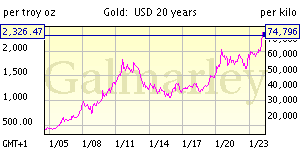
James Turk - What to Expect from Gold & Silver in 2012
With 2011 coming to a close and investors concerned about the recent plunge in both gold and silver, King World News interviewed James Turk out of Spain to get his take on what to look for in 2012. When asked what investors in gold and silver should expect in 2012, Turk stated, “Yeah, I think the big theme in 2012, Eric, is going to be the continuing problems here in Europe. Not only with the sovereign debts, but I think you are going to see increasing focus on the insolvency in the banks themselves. That’s going to be the big story in 2012.”
“The major drivers for the metals have been banking and financial problems worldwide. So, I see no reason to suspect that the metals are going to do anything except go higher next year. As we speak, gold is up 17% (for this year), so if we finish around here that will be the eleventh year gold has traded higher. The average annual rate of appreciation over those eleven years is just about 17% per annum.
But I’m actually looking for something much better than average next year, simply because people are increasingly understanding that Europe is spinning out of control. The US government’s own financial condition is (also) spinning out of control, Japan is spinning out of control, the UK is spinning out of control, there are no safe havens, except the precious metals.”
When asked about the recent smash in both gold and silver, Turk responded, “You know, Eric, we’ve seen so many of these takedowns over the past ten years and they are so contrived. They basically go to the various technical points that cause people to sell and you get all of the gurus on television saying the bull market (in gold) is over and we are starting a new bear market.
But you have to ask yourself, ‘What fundamentally has changed to make me want to sell my precious metals?’ If anything the fundamentals have become even better than they were at the beginning of the year, given the fact there are so many problems out there that haven’t been solved. Given the fact that when you own physical gold or physical silver you don’t have counterparty risk, that’s going to become an increasing issue in 2012 as well.
The last couple of weeks are no different than what we’ve seen many, many times before and to me, even if you look at it from a technical perspective, gold is still in an uptrend. (Also), that flag formation on silver is still forming very, very nicely. When we break out of that flag, I think you are going to see the price of silver double in (roughly) three months.
So, $70 silver by the end of March, is that realistic? Yes, I think so. Gold over $2,000 in 2012, probably in the first quarter, yeah. That’s very realistic as well because the things which have been driving the metals are still very much in place. So forget about a downdraft here and there, just see it as a buying opportunity.
View gold and silver as a form of savings and when is all said and done a few years from now, you are going to be very, very happy acquiring the precious metals at these prices.
I think the insights the ‘London Trader’ discussed with you are truly remarkable and I really recommend that everybody read that interview a couple of times to make sure all of the points he is making sink in...Yes there is tightness (in the physical market) and you see it in the interest rates.
There is nothing I can see out there that’s bearish for gold at the moment. In fact, the way I look at it is everything I see is very bullish and we are down to the level that you are starting to see that huge physical demand. That’s usually been a good sign you are at a major low and likely to go higher.”
![[Most Recent Quotes from www.kitco.com]](http://www.kitconet.com/images/quotes_7a.gif)
Click to Enlarge
Close Call For US Banks


Pento - Here is Why Gold Price Will Stay Strong & Not Retreat
KING WORLD NEWS - With 2011 coming to a close, today Michael Pento, of Pento Portfolio Strategies, writes for King World News to explain why the gold price is remaining firm, near $1,600, and why it is not likely to retreat much further from current levels: “Standard and Poor’s has been greatly vilified for their call to lower the U.S. credit rating to AA+ from AAA. The evidence, naysayers point to, for their justification of excoriating S&P is the performance of Treasuries since the downgrade occurred. Indeed, U.S. debt yields have fallen and the dollar has increased in the four months after being stripped of AAA.”
Michael Pento continues:
“In fact, foreigners increased their holdings of Treasuries in Q3 by $17.2 billion and now own nearly 50% of our marketable debt. And 60% of their currency reserves are in U.S. dollars. So there are no signs of panic yet.
The prevailing wisdom of today now yields to the conclusion that getting your debt downgraded automatically renders a boost to your currency and bond prices. Therefore, why worry? Their comfort is ridiculously based upon the notion that the U.S. has a printing press and can create unlimited amounts of inflation. Therefore, interest rates will never rise and debt service won’t ever be a problem.
I think that’s also what the government of Hungary believed after WWII. They had a printing press also and it was used to pay debts accumulated during the war. But their daily rate of inflation hit a global record of over 200%. I wonder if the mortgage rates in Hungary were low back in 1946?
I, of course, strongly applaud S&P for attempting to shed a light on our pernicious debt problem. The U.S. government seems completely inept at taking even the smallest baby step towards lowering our annual shortfall in revenue over spending—let alone paying off the debt....
“Recent examples of the paralysis in Washington include; the debt ceiling debate, Simpson Bowles Committee and the payroll tax holiday extension. Time after time D.C. manages to decide to increase the debt without cutting spending.
Our debt now exceeds GDP, and the annual deficits pile on an additional $1.3 trillion each year to that accumulated debt. Our publicly traded debt has increased 100% in the last 5 years!!! What is even worse is that our debt as a percentage of revenue is exploding. Back in 1971, the national debt was 218% of revenue. Today it has skyrocketed to about 700% of revenue, and if you think that is bad you are correct.
But just wait until interest rates start to rise. The average yield on U.S. debt is near 1% today. It was 6.5% in the year 2000. But given our record level of debt and Fed-led money creation, yields on Treasuries could go much higher than at any other point in U.S. history. Just imagine the instability that will arise when yields start to soar on corporate, consumer and government debt.
That’s the reason why I believe if there is any criticism to be placed on Standard and Poor’s it should be that their rating of U.S. debt is still too high and that the downgrade came way too late. It is also the most important reason why the price of gold is still just 20% off its all-time high. And why it’s likely not to retreat much lower than where it is today.”
KING WORLD NEWS - With 2011 coming to a close, today Michael Pento, of Pento Portfolio Strategies, writes for King World News to explain why the gold price is remaining firm, near $1,600, and why it is not likely to retreat much further from current levels: “Standard and Poor’s has been greatly vilified for their call to lower the U.S. credit rating to AA+ from AAA. The evidence, naysayers point to, for their justification of excoriating S&P is the performance of Treasuries since the downgrade occurred. Indeed, U.S. debt yields have fallen and the dollar has increased in the four months after being stripped of AAA.”
Michael Pento continues:
“In fact, foreigners increased their holdings of Treasuries in Q3 by $17.2 billion and now own nearly 50% of our marketable debt. And 60% of their currency reserves are in U.S. dollars. So there are no signs of panic yet.
The prevailing wisdom of today now yields to the conclusion that getting your debt downgraded automatically renders a boost to your currency and bond prices. Therefore, why worry? Their comfort is ridiculously based upon the notion that the U.S. has a printing press and can create unlimited amounts of inflation. Therefore, interest rates will never rise and debt service won’t ever be a problem.
I think that’s also what the government of Hungary believed after WWII. They had a printing press also and it was used to pay debts accumulated during the war. But their daily rate of inflation hit a global record of over 200%. I wonder if the mortgage rates in Hungary were low back in 1946?
I, of course, strongly applaud S&P for attempting to shed a light on our pernicious debt problem. The U.S. government seems completely inept at taking even the smallest baby step towards lowering our annual shortfall in revenue over spending—let alone paying off the debt....
“Recent examples of the paralysis in Washington include; the debt ceiling debate, Simpson Bowles Committee and the payroll tax holiday extension. Time after time D.C. manages to decide to increase the debt without cutting spending.
Our debt now exceeds GDP, and the annual deficits pile on an additional $1.3 trillion each year to that accumulated debt. Our publicly traded debt has increased 100% in the last 5 years!!! What is even worse is that our debt as a percentage of revenue is exploding. Back in 1971, the national debt was 218% of revenue. Today it has skyrocketed to about 700% of revenue, and if you think that is bad you are correct.
But just wait until interest rates start to rise. The average yield on U.S. debt is near 1% today. It was 6.5% in the year 2000. But given our record level of debt and Fed-led money creation, yields on Treasuries could go much higher than at any other point in U.S. history. Just imagine the instability that will arise when yields start to soar on corporate, consumer and government debt.
That’s the reason why I believe if there is any criticism to be placed on Standard and Poor’s it should be that their rating of U.S. debt is still too high and that the downgrade came way too late. It is also the most important reason why the price of gold is still just 20% off its all-time high. And why it’s likely not to retreat much lower than where it is today.”
Republicans and Democrats
Just a reminder to all my conservative friends not to be fooled by this latest crop of Republicans begging for your vote. (Ron Paul exempted!) They are wolves in sheep's clothing as history has proven over and over. Don't get me wrong. I am conservative and have never voted for a Democrat in my life. But, I refuse to vote for the lesser of two evils. In fact, I would argue that over the last 10 years, it is the Democratic party that has become the lesser of the two evils. (Obama and Hillary exempted!) I was reminded of that fact once again as I read the following from Doug Casey in his latest email update to his subscribers entitled "Getting Out of Dodge."
"The Johnson administration's so-called Great Society created vast new federal bureaucracies that promised Americans free food, shelter, medical care, education, and what-have-you. Americans became true wards of the state. But the real, final nail in the coffin for America was in 1971 - Nixon taking the US off the gold standard.
Nixon taking the US off the gold standard - open devaluation of the dollar, combined with wage and price controls for some months. And that was not long after the so-called Bank Secrecy Act, which abolished bank secrecy, and required the reporting of all foreign financial accounts. Nixon was, in many ways, even more of a disaster than Johnson. Republicans are usually worse than Democrats when it comes to freedom, partly because they like to couch their depredations in the rhetoric of defending the free market. While everyone understands that Democrats are socialists just under the surface, Republicans actually give capitalism a bad name. Baby Bush is a perfect, recent example."
Just a reminder to all my conservative friends not to be fooled by this latest crop of Republicans begging for your vote. (Ron Paul exempted!) They are wolves in sheep's clothing as history has proven over and over. Don't get me wrong. I am conservative and have never voted for a Democrat in my life. But, I refuse to vote for the lesser of two evils. In fact, I would argue that over the last 10 years, it is the Democratic party that has become the lesser of the two evils. (Obama and Hillary exempted!) I was reminded of that fact once again as I read the following from Doug Casey in his latest email update to his subscribers entitled "Getting Out of Dodge."
"The Johnson administration's so-called Great Society created vast new federal bureaucracies that promised Americans free food, shelter, medical care, education, and what-have-you. Americans became true wards of the state. But the real, final nail in the coffin for America was in 1971 - Nixon taking the US off the gold standard.
Nixon taking the US off the gold standard - open devaluation of the dollar, combined with wage and price controls for some months. And that was not long after the so-called Bank Secrecy Act, which abolished bank secrecy, and required the reporting of all foreign financial accounts. Nixon was, in many ways, even more of a disaster than Johnson. Republicans are usually worse than Democrats when it comes to freedom, partly because they like to couch their depredations in the rhetoric of defending the free market. While everyone understands that Democrats are socialists just under the surface, Republicans actually give capitalism a bad name. Baby Bush is a perfect, recent example."
The Ron Paul Portfolio
The Wall Street Journal's personal-finance blog
Republican presidential candidate Rep. Ron Paul marches to his own drummer in politics – and in his investment portfolio, too.
Here at Total Return, we’ve looked at hundreds of the annual financial-disclosure forms in which the members of Congress reveal their assets and trades – and we’ve never seen a more unorthodox portfolio than Ron Paul’s. (In fact, The Wall Street Journal revealed problematic trading in Congress more than a year and a half before the “60 Minutes” episode that recently raised a ruckus over the same topic, but that’s another matter.)
According to data available through his 2010 “Form A” financial disclosure statement, filed last May, Rep. Paul’s portfolio is valued between $2.44 million and $5.46 million. (Congressional disclosures are given in ranges, not precise amounts.)
Most members of Congress, like many Americans, hold some real estate, a few bonds or bond mutual funds, some individual stocks and a bundle of stock funds. Give or take a few percentage points, a typical Congressional portfolio might have 10% in cash, 10% in bonds or bond funds, 20% in real estate, and 60% in stocks or stock funds.
But Ron Paul’s portfolio isn’t merely different. It’s shockingly different.
Yes, about 21% of Rep. Paul’s holdings are in real estate and roughly 14% in cash. But he owns no bonds or bond funds and has only 0.1% in stock funds. Furthermore, the stock funds that Rep. Paul does own are all “short,” or make bets against, U.S. stocks. One is a “double inverse” fund that, on a daily basis, goes up twice as much as its stock benchmark goes down.
The remainder of Rep. Paul’s portfolio – fully 64% of his assets – is entirely in gold and silver mining stocks. He owns no Apple, no ExxonMobil, no Procter & Gamble, no General Electric, no Johnson & Johnson, not even a diversified mutual fund that holds a broad basket of stocks. Rep. Paul doesn’t own stock in any major companies at all except big precious-metals stocks like Barrick Gold, Goldcorp and Newmont Mining.
Rep. Paul also owns 23 other miners – many of them smaller, Canadian-based “juniors” whose stocks are highly risky. Ten of these stocks have total market valuations of less than $500 million, a common definition of a “microcap” stock. Mr. Paul has between $100,010 and $326,000 (roughly 5% of his assets) invested in these tiny, extremely volatile stocks.
Rep. Paul appears to be a strict buy-and-hold investor who rarely trades; he has held many of his mining stocks since at least 2002. But, as gold and silver prices have fallen sharply since September, precious-metals equities have also taken a pounding, with many dropping 20% or more. That exposes the risk in making a big bet on one narrow sector.
At our request, William Bernstein, an investment manager at Efficient Portfolio Advisors in Eastford, Conn., reviewed Rep. Paul’s portfolio as set out in the annual disclosure statement. Mr. Bernstein says he has never seen such an extreme bet on economic catastrophe. ”This portfolio is a half-step away from a cellar-full of canned goods and nine-millimeter rounds,” he says.
There are many possible doomsday scenarios for the U.S. economy and financial markets, explains Mr. Bernstein, and Rep. Paul’s portfolio protects against only one of them: unexpected inflation accompanied by a collapse in the value of the dollar. If deflation (to name one other possibility) occurs instead, “this portfolio is at great risk” because of its lack of bonds and high exposure to gold.
Running an investment portfolio that protects against only one bad outcome is like living in California and buying homeowner’s insurance that protects only against earthquakes, says Mr. Bernstein. You also want protection against fire and wind and theft and the full range of risks that houses are prone to. Likewise, he adds, investors should hold a broad mix of assets that will hold up under a variety of good and bad scenarios.
A spokeswoman for Rep. Paul didn’t respond to requests for comment. But you can say this for Ron Paul: In investing, as in politics, he has the courage of his convictions.
The Wall Street Journal's personal-finance blog
Republican presidential candidate Rep. Ron Paul marches to his own drummer in politics – and in his investment portfolio, too.
Here at Total Return, we’ve looked at hundreds of the annual financial-disclosure forms in which the members of Congress reveal their assets and trades – and we’ve never seen a more unorthodox portfolio than Ron Paul’s. (In fact, The Wall Street Journal revealed problematic trading in Congress more than a year and a half before the “60 Minutes” episode that recently raised a ruckus over the same topic, but that’s another matter.)
According to data available through his 2010 “Form A” financial disclosure statement, filed last May, Rep. Paul’s portfolio is valued between $2.44 million and $5.46 million. (Congressional disclosures are given in ranges, not precise amounts.)
Most members of Congress, like many Americans, hold some real estate, a few bonds or bond mutual funds, some individual stocks and a bundle of stock funds. Give or take a few percentage points, a typical Congressional portfolio might have 10% in cash, 10% in bonds or bond funds, 20% in real estate, and 60% in stocks or stock funds.
But Ron Paul’s portfolio isn’t merely different. It’s shockingly different.
Yes, about 21% of Rep. Paul’s holdings are in real estate and roughly 14% in cash. But he owns no bonds or bond funds and has only 0.1% in stock funds. Furthermore, the stock funds that Rep. Paul does own are all “short,” or make bets against, U.S. stocks. One is a “double inverse” fund that, on a daily basis, goes up twice as much as its stock benchmark goes down.
The remainder of Rep. Paul’s portfolio – fully 64% of his assets – is entirely in gold and silver mining stocks. He owns no Apple, no ExxonMobil, no Procter & Gamble, no General Electric, no Johnson & Johnson, not even a diversified mutual fund that holds a broad basket of stocks. Rep. Paul doesn’t own stock in any major companies at all except big precious-metals stocks like Barrick Gold, Goldcorp and Newmont Mining.
Rep. Paul also owns 23 other miners – many of them smaller, Canadian-based “juniors” whose stocks are highly risky. Ten of these stocks have total market valuations of less than $500 million, a common definition of a “microcap” stock. Mr. Paul has between $100,010 and $326,000 (roughly 5% of his assets) invested in these tiny, extremely volatile stocks.
Rep. Paul appears to be a strict buy-and-hold investor who rarely trades; he has held many of his mining stocks since at least 2002. But, as gold and silver prices have fallen sharply since September, precious-metals equities have also taken a pounding, with many dropping 20% or more. That exposes the risk in making a big bet on one narrow sector.
At our request, William Bernstein, an investment manager at Efficient Portfolio Advisors in Eastford, Conn., reviewed Rep. Paul’s portfolio as set out in the annual disclosure statement. Mr. Bernstein says he has never seen such an extreme bet on economic catastrophe. ”This portfolio is a half-step away from a cellar-full of canned goods and nine-millimeter rounds,” he says.
There are many possible doomsday scenarios for the U.S. economy and financial markets, explains Mr. Bernstein, and Rep. Paul’s portfolio protects against only one of them: unexpected inflation accompanied by a collapse in the value of the dollar. If deflation (to name one other possibility) occurs instead, “this portfolio is at great risk” because of its lack of bonds and high exposure to gold.
Running an investment portfolio that protects against only one bad outcome is like living in California and buying homeowner’s insurance that protects only against earthquakes, says Mr. Bernstein. You also want protection against fire and wind and theft and the full range of risks that houses are prone to. Likewise, he adds, investors should hold a broad mix of assets that will hold up under a variety of good and bad scenarios.
A spokeswoman for Rep. Paul didn’t respond to requests for comment. But you can say this for Ron Paul: In investing, as in politics, he has the courage of his convictions.
Why Debt MUST Increase!
You may have seen the following comparison that has been making its way around the internet.

It demonstrates something that is so simple and basic, yet completely overlooked.
Each president must increase the debt or the whole house of cards falls, because we live in a debt-based monetary system. In other words, we create money by creating debt. Of necessity, for interest to be paid on the debt, more money must be created, which means more debt must be issued. It is the nature of the beast.
So, regardless of who the next president is, you can look for HIS face to replace Obama's on the above comparison, for any president who does not increase the debt will be the president remembered for collapsing the monetary system. And since that's not gonna happen, look for debt to continue to grow and precious metals to continue to rise in response to the devaluation of the monetary base.
You may have seen the following comparison that has been making its way around the internet.

It demonstrates something that is so simple and basic, yet completely overlooked.
Each president must increase the debt or the whole house of cards falls, because we live in a debt-based monetary system. In other words, we create money by creating debt. Of necessity, for interest to be paid on the debt, more money must be created, which means more debt must be issued. It is the nature of the beast.
So, regardless of who the next president is, you can look for HIS face to replace Obama's on the above comparison, for any president who does not increase the debt will be the president remembered for collapsing the monetary system. And since that's not gonna happen, look for debt to continue to grow and precious metals to continue to rise in response to the devaluation of the monetary base.
London Trader - We are Witnessing a Historic Bottom in Gold
KING WORLD NEWS - With many investors worried the price of gold could head lower, today King World News interviewed the “London Trader” to get his take on the gold market. The source stated, “The Chinese have continued to take delivery of both physical gold and silver directly from the ETF’s GLD and SLV. They are also going directly to producers. Entities are bypassing the COMEX altogether and going straight to gold mining companies. Every single month producers have a certain amount of gold and silver they sell. Normally they sell it to the bullion banks and the bullion banks, of course, leverage this gold and sell up to 100 times that in paper markets to control prices.”
The London Trader continues:
“They (bullion banks) hold that little bit of physical gold and claim they are backed up on their position to the CFTC. I have all my large buyers now going to producers and saying to them, ‘Look, don’t sell it to the bullion banks, we’ll buy it from you.’ So we are buying directly from the producers and this includes some sovereign entities which are doing the same thing.
We’re struggling to get the physical out of these guys (producers) because they have so many people banging on their door, saying, ‘Sell it to us direct.’ What these buyers are doing is essentially taking gold out of the system, which means the bullion banks can’t leverage that gold anymore.
So this is a huge, dynamic shift that wasn’t there before. Now we are working on one other thing. We’re beginning to offer them forward contracts. If you are a sovereign entity, what you are saying to these producers, especially on new projects, is, ‘Why don’t you sell the gold to me in 12 months? Here’s the cash, just provide it to me 12 months from now.’
These buyers are now cutting off future gold supply from the bullion banks....
“This is a huge, tectonic shift in price dynamics going forward because it is taking price discovery away from the bullion banks. These large Chinese buyers and sovereign entities which are doing this are going to have a massive impact on the market.
Interestingly, so many people are bearish on gold right now and looking for a collapse in the price of gold. They don’t understand what is happening in the physical market. The bullish fundamentals I just described to you have enormous implications.
We are making a historic bottom right now. The paper gold, or virtual gold market, has diverged so far from the physical market that it’s no longer a credible marketplace. That’s the key thing that came out of a very important meeting I was in yesterday where we had some serious players. The people I was meeting with are all on the buy side and have been since the lows last week.
There are massive physical orders, sitting, waiting for any more discounts, and yet everyone else seems to be short. So you have huge fuel for a rally here.
You have to keep in mind this recent plunge was orchestrated with borrowed gold and that borrowed gold is now gone. That’s why gold can’t go much lower. Any dips in price will be aggressively purchased. As I said earlier, right now we are witnessing a historic bottom.”
(The London Trader previously told KWN on October 21st that China had purchased a massive amount of physical gold at the lows of the October 20th session. That marked the dead low for the price of gold in October and gold rallied roughly 10% in the following 8 trading sessions.)
KING WORLD NEWS - With many investors worried the price of gold could head lower, today King World News interviewed the “London Trader” to get his take on the gold market. The source stated, “The Chinese have continued to take delivery of both physical gold and silver directly from the ETF’s GLD and SLV. They are also going directly to producers. Entities are bypassing the COMEX altogether and going straight to gold mining companies. Every single month producers have a certain amount of gold and silver they sell. Normally they sell it to the bullion banks and the bullion banks, of course, leverage this gold and sell up to 100 times that in paper markets to control prices.”
The London Trader continues:
“They (bullion banks) hold that little bit of physical gold and claim they are backed up on their position to the CFTC. I have all my large buyers now going to producers and saying to them, ‘Look, don’t sell it to the bullion banks, we’ll buy it from you.’ So we are buying directly from the producers and this includes some sovereign entities which are doing the same thing.
We’re struggling to get the physical out of these guys (producers) because they have so many people banging on their door, saying, ‘Sell it to us direct.’ What these buyers are doing is essentially taking gold out of the system, which means the bullion banks can’t leverage that gold anymore.
So this is a huge, dynamic shift that wasn’t there before. Now we are working on one other thing. We’re beginning to offer them forward contracts. If you are a sovereign entity, what you are saying to these producers, especially on new projects, is, ‘Why don’t you sell the gold to me in 12 months? Here’s the cash, just provide it to me 12 months from now.’
These buyers are now cutting off future gold supply from the bullion banks....
“This is a huge, tectonic shift in price dynamics going forward because it is taking price discovery away from the bullion banks. These large Chinese buyers and sovereign entities which are doing this are going to have a massive impact on the market.
Interestingly, so many people are bearish on gold right now and looking for a collapse in the price of gold. They don’t understand what is happening in the physical market. The bullish fundamentals I just described to you have enormous implications.
We are making a historic bottom right now. The paper gold, or virtual gold market, has diverged so far from the physical market that it’s no longer a credible marketplace. That’s the key thing that came out of a very important meeting I was in yesterday where we had some serious players. The people I was meeting with are all on the buy side and have been since the lows last week.
There are massive physical orders, sitting, waiting for any more discounts, and yet everyone else seems to be short. So you have huge fuel for a rally here.
You have to keep in mind this recent plunge was orchestrated with borrowed gold and that borrowed gold is now gone. That’s why gold can’t go much lower. Any dips in price will be aggressively purchased. As I said earlier, right now we are witnessing a historic bottom.”
(The London Trader previously told KWN on October 21st that China had purchased a massive amount of physical gold at the lows of the October 20th session. That marked the dead low for the price of gold in October and gold rallied roughly 10% in the following 8 trading sessions.)
Are You Tempted to Sell, or Eager to Buy?
by Jeff Clark, Casey Research
It wasn't a fun week for gold. By the close on Friday, the metal was down 6.7% (based on London PM fix prices), the biggest weekly decline since September. It got downright irritating when the mainstream media seemingly rejoiced at gold's decline. Economist Nouriel Roubini poked fun at gold bugs in a Tweet. Über investor Dennis Gartman said he sold his holdings. CNBC ran an article proclaiming gold was no longer a safe-haven asset (talk about an overreaction).
While the worry may have been real, let's focus on facts. Have the reasons for gold's bull market changed in any material way such that we should consider exiting? Instead of me providing an answer, ask yourself some basic questions: Is the current support for the US dollar an honest indication of its health? Are the sovereign debt problems in Europe solved? How will the US repay its $15 trillion debt load without some level of currency dilution? Is there likely to be more money printing in the future, or less? Are real interest rates positive yet? Has gold really lost its safe haven status as a result of one bad week?
So why did gold, silver, and related stocks fall so hard?
The reasons outlined in this month's BIG GOLD are still in play (the MF Global fallout, a rising dollar, year-end tax-loss selling, and the need for cash and liquidity to meet margin calls or redemption requests). Last Wednesday's 3.5% fall took on a life of its own, selling begetting selling, fear adding to fear (especially the case with gold stocks). None of these reasons, however, have anything to do with the fundamental factors that ultimately drive this market. Once those issues shift, then we'll talk about exiting.
So, should we buy now? Is the bottom in?
Let's take a fresh look at gold's corrections and compare them to the recent one. I've updated the following chart to include the recent selloff.
[How do I calculate the data? I look for the periods in every annual gold chart that represent a distinct fall greater than 5%, then measure the highs and lows.]

(CLICK ON IMAGE TO ENLARGE)
Our recent drop equals 12.5%. This isn't to suggest that the correction is over, but it does show that we've already matched the average decline, which is also 12.5%. This comes on the heels of the 15.6% fall in September. You'll notice something else: We've now had three major corrections (greater than 5%) in one year, the first time that's happened in this bull market.
The worst-case scenario would be a drop that matched the biggest on record, 27.7%. From $1,795 – the recent interim peak price – that would take us to $1,295. That wouldn't be fun, but a fall to that level would not by any stretch signal the end of the bull market, nor a fall into unprofitability for our producers. And it would represent a true blood-in-the-streets buying opportunity. After all, that's exactly what happened in 2006 and again in 2008, and in both instances gold eventually powered much higher. The bears were wrong then, and they'll be wrong again this time, even if that extreme scenario were to come to pass.
These data should actually give you some comfort. We've been here before. We've seen worse before. And yet, in every instance, gold and silver eventually climbed higher. So, unless you really believe that Obama and Merkel have brought happy days back to the world economy, precious metals will resume their ascent, and probably sooner rather than later. And when they do, you may well never be able to buy at these prices again. Those who were too scared to buy at $560 in 2006 and $700 in 2008 missed out on what were some of the greatest buying opportunities of this bull market.
by Jeff Clark, Casey Research
It wasn't a fun week for gold. By the close on Friday, the metal was down 6.7% (based on London PM fix prices), the biggest weekly decline since September. It got downright irritating when the mainstream media seemingly rejoiced at gold's decline. Economist Nouriel Roubini poked fun at gold bugs in a Tweet. Über investor Dennis Gartman said he sold his holdings. CNBC ran an article proclaiming gold was no longer a safe-haven asset (talk about an overreaction).
While the worry may have been real, let's focus on facts. Have the reasons for gold's bull market changed in any material way such that we should consider exiting? Instead of me providing an answer, ask yourself some basic questions: Is the current support for the US dollar an honest indication of its health? Are the sovereign debt problems in Europe solved? How will the US repay its $15 trillion debt load without some level of currency dilution? Is there likely to be more money printing in the future, or less? Are real interest rates positive yet? Has gold really lost its safe haven status as a result of one bad week?
So why did gold, silver, and related stocks fall so hard?
The reasons outlined in this month's BIG GOLD are still in play (the MF Global fallout, a rising dollar, year-end tax-loss selling, and the need for cash and liquidity to meet margin calls or redemption requests). Last Wednesday's 3.5% fall took on a life of its own, selling begetting selling, fear adding to fear (especially the case with gold stocks). None of these reasons, however, have anything to do with the fundamental factors that ultimately drive this market. Once those issues shift, then we'll talk about exiting.
So, should we buy now? Is the bottom in?
Let's take a fresh look at gold's corrections and compare them to the recent one. I've updated the following chart to include the recent selloff.
[How do I calculate the data? I look for the periods in every annual gold chart that represent a distinct fall greater than 5%, then measure the highs and lows.]

(CLICK ON IMAGE TO ENLARGE)
Our recent drop equals 12.5%. This isn't to suggest that the correction is over, but it does show that we've already matched the average decline, which is also 12.5%. This comes on the heels of the 15.6% fall in September. You'll notice something else: We've now had three major corrections (greater than 5%) in one year, the first time that's happened in this bull market.
The worst-case scenario would be a drop that matched the biggest on record, 27.7%. From $1,795 – the recent interim peak price – that would take us to $1,295. That wouldn't be fun, but a fall to that level would not by any stretch signal the end of the bull market, nor a fall into unprofitability for our producers. And it would represent a true blood-in-the-streets buying opportunity. After all, that's exactly what happened in 2006 and again in 2008, and in both instances gold eventually powered much higher. The bears were wrong then, and they'll be wrong again this time, even if that extreme scenario were to come to pass.
These data should actually give you some comfort. We've been here before. We've seen worse before. And yet, in every instance, gold and silver eventually climbed higher. So, unless you really believe that Obama and Merkel have brought happy days back to the world economy, precious metals will resume their ascent, and probably sooner rather than later. And when they do, you may well never be able to buy at these prices again. Those who were too scared to buy at $560 in 2006 and $700 in 2008 missed out on what were some of the greatest buying opportunities of this bull market.
New Foreclosure Wave is Coming
CNBC - Despite a seasonal slowdown in overall foreclosure activity, and a process still bogged down and backed up by the "robo-signing" processing scandal, the U.S real estate market is about to be hit by another surge of bank repossessions, according to a new report from the online foreclosure sale site RealtyTrac. As banks resubmit millions of documents and courts begin hearing cases again, the backlog of over four million delinquent loans will start surging through the pipeline again.
Click HERE to read rest of article....
CNBC - Despite a seasonal slowdown in overall foreclosure activity, and a process still bogged down and backed up by the "robo-signing" processing scandal, the U.S real estate market is about to be hit by another surge of bank repossessions, according to a new report from the online foreclosure sale site RealtyTrac. As banks resubmit millions of documents and courts begin hearing cases again, the backlog of over four million delinquent loans will start surging through the pipeline again.
Click HERE to read rest of article....
A Million Reasons Why I Love Gold
by Peter Grandich, The Grandich Letter
December 14, 2011
Gold $1,565 Silver $28.50
In almost three decades in and around Wall Street, I’ve never seen such widespread distaste and outright hatred of an investment that for almost a decade has greatly outperformed just about every other investment vehicle: gold. I will discuss why I believe this is the case in a moment, but I want to first respond to what I can only describe as one of the “Three Stooges of Gold Forecasting’s” latest forecasts that has once again caused near hysteria among gold players and the media that follows it.
Dennis Gartman, a true master of self-promotion but who’s actual track record (if anyone in the media actually delved into it I believe they would see for themselves) better suits him for the lead role in “The Boy Who Cried Wolf,” has once again grabbed headlines with yet another the-gold-bull-market-is-over assertion.
Mr. Gartman is one of three people who many in the media continue to quote despite a nearly decade-long poor overall track record on gold. He, Jeff Christian and Jon Nadler have demonstrated to me (and I suspect many others) that a broken clock’s percentage of telling the correct time in any given day is about the same as their actual accurate forecasts for gold in the last decade.
Yours truly has called this the “mother” of all gold bull markets and, by making the following offer to the Three Stooges of gold forecasting, I would like to offer up a million reasons why:
I will wager any one of them (or a combination of all three) one million dollars U.S. that gold will hit $2000 before it hits $1,000 on the COMEX. I have arranged for the law firm of Lomurro, Davison, Eastman & Munoz of Freehold, New Jersey to hold the funds in trust. For once, let one or all of the most arrogant and often wrong gold forecasters truly put their money where their mouth is when it comes to gold forecasting. This offer shall be good until midnight, December 31, 2011 (I will donate my winnings to charities).
With regard to gold and the fact that I was supposed to be on vacation until January 3rd, I will be short and sweet: the great “Bull Run” won’t end until the price of gold has at least a “2” in the front ($2,000+).
In a nutshell, gold basically traded between $300 and $500 from the time in began free trading in the early 70s. It did briefly overall hit the mid $800s in early 80s. Up until the new millennium began, gold was greatly hindered by three factors, all of which are no longer negatives:
•Large-scale Central Bank selling;
•Gold producers cutting their noses to spite their faces by selling large quantities of production forward (hedging);
•No vehicle that could provide institutional type investors the ability to acquire/control large quantities of gold easily and provide liquidity. (The choices were purchasing physical bullion with costs and storage concerns and/or mining shares that proved more than once not to be exactly like owning gold).
These three former great negatives became major positives when:
•The Washington Accord was reached and Central Bank sales first became managed and then eventually turned into net buying;
•Producers like the old American Barrick (now Barrick Gold), who were more commodity traders than miners and used sophisticated hedging strategies to net much higher prices for gold than simply selling their production, were scorned for selling forward and it became evil to do so among investors;
•The creation of Exchange-Traded Funds (ETFs) allowed institutions to make gold part of their portfolios in an easy and liquidity-driven way and ended up tipping the scales heavily in favor of demand over supply.
The Three Stooges and the overwhelming negative gold pundits who think like them (Are all over the airwaves today) could only not ever grasp this changed landscape, but they could never also accept that despite widespread proof that all types of markets worldwide have been manipulated, that somehow manipulation didn’t occur in the gold market. Their favorite response was/is, “if gold is/was manipulated, how then did the market rise so much?” trying to suggest it should be much lower if people truly were trying to hold it down. These “pied pipers” of the hate gold crowd would want you to believe that the widespread corruption that has become evident in financial markets worldwide somehow doesn’t take place in gold and silver.
And that brings me to the final piece of the puzzle that has made up the gold game since it first started trading freely in the 1970s: gold is, and shall always be, hated by the overwhelming majority of people who work in the financial services industry and the media that follows it. You’re never ever, ever, ever, ever, ever, ever, ever going to find universal overall support for gold because to do so would equate to undermining what drives the financial services industry worldwide – the buying and selling of financial assets. Just like you will never hear a Ford dealer tell you to buy a Chevy or an Atheist tell you to love Jesus, an industry that makes its living selling stocks and bonds isn’t going to tell you to load up on something that usually benefits from their misfortunes. And neither shall the media in general who lives off those selling stocks and bonds.
So stop looking for the “crowd” to be gold lovers. In fact, when they come remotely close to that (like they did in September), it’s always a sign that a top of some type is near.
Instead, recognize the fundamental changes I spoke of that make up the gold market, throw in the fact that the world has gone mad with the printing of paper money and an epic crisis in the Middle East is coming in 2012, and use this correction in gold to add to or finally take ownership in the last great buying opportunity before the Three Stooges and their legion once again get bloodied and gored by the mother of all gold bull markets.
Because it’s that time of year when market moves can be exaggerated due to lack of liquidity, and the fact that the haters are having one of their “rare” opportunities to pound their chests (look at all the negative gold comments in the last 48 hours. Even Hulbert noted bullish sentiment near zero), it would come as no surprise to see the September lows of $1531 gold and $26 silver tested and/or broken briefly. One of the true best timers and good friend Mark Leibovit pointed out to me that cycle lows are not due for another month or so. Knowing this and the technical damage that has been done, there’s no need to rush and mortgage the house to buy gold. An accumulation program with time and price targets over the next several weeks should IMHO lead to a very nice capital gains Christmas present this time next year.
Finally, when the bears are once again proven wrong and we go over $2,000, the media shall finally ask them why they got it wrong yet again versus asking those of us who had it right for a decade why is it temporarily down….. NOT!
by Peter Grandich, The Grandich Letter
December 14, 2011
Gold $1,565 Silver $28.50
In almost three decades in and around Wall Street, I’ve never seen such widespread distaste and outright hatred of an investment that for almost a decade has greatly outperformed just about every other investment vehicle: gold. I will discuss why I believe this is the case in a moment, but I want to first respond to what I can only describe as one of the “Three Stooges of Gold Forecasting’s” latest forecasts that has once again caused near hysteria among gold players and the media that follows it.
Dennis Gartman, a true master of self-promotion but who’s actual track record (if anyone in the media actually delved into it I believe they would see for themselves) better suits him for the lead role in “The Boy Who Cried Wolf,” has once again grabbed headlines with yet another the-gold-bull-market-is-over assertion.
Mr. Gartman is one of three people who many in the media continue to quote despite a nearly decade-long poor overall track record on gold. He, Jeff Christian and Jon Nadler have demonstrated to me (and I suspect many others) that a broken clock’s percentage of telling the correct time in any given day is about the same as their actual accurate forecasts for gold in the last decade.
Yours truly has called this the “mother” of all gold bull markets and, by making the following offer to the Three Stooges of gold forecasting, I would like to offer up a million reasons why:
I will wager any one of them (or a combination of all three) one million dollars U.S. that gold will hit $2000 before it hits $1,000 on the COMEX. I have arranged for the law firm of Lomurro, Davison, Eastman & Munoz of Freehold, New Jersey to hold the funds in trust. For once, let one or all of the most arrogant and often wrong gold forecasters truly put their money where their mouth is when it comes to gold forecasting. This offer shall be good until midnight, December 31, 2011 (I will donate my winnings to charities).
With regard to gold and the fact that I was supposed to be on vacation until January 3rd, I will be short and sweet: the great “Bull Run” won’t end until the price of gold has at least a “2” in the front ($2,000+).
In a nutshell, gold basically traded between $300 and $500 from the time in began free trading in the early 70s. It did briefly overall hit the mid $800s in early 80s. Up until the new millennium began, gold was greatly hindered by three factors, all of which are no longer negatives:
•Large-scale Central Bank selling;
•Gold producers cutting their noses to spite their faces by selling large quantities of production forward (hedging);
•No vehicle that could provide institutional type investors the ability to acquire/control large quantities of gold easily and provide liquidity. (The choices were purchasing physical bullion with costs and storage concerns and/or mining shares that proved more than once not to be exactly like owning gold).
These three former great negatives became major positives when:
•The Washington Accord was reached and Central Bank sales first became managed and then eventually turned into net buying;
•Producers like the old American Barrick (now Barrick Gold), who were more commodity traders than miners and used sophisticated hedging strategies to net much higher prices for gold than simply selling their production, were scorned for selling forward and it became evil to do so among investors;
•The creation of Exchange-Traded Funds (ETFs) allowed institutions to make gold part of their portfolios in an easy and liquidity-driven way and ended up tipping the scales heavily in favor of demand over supply.
The Three Stooges and the overwhelming negative gold pundits who think like them (Are all over the airwaves today) could only not ever grasp this changed landscape, but they could never also accept that despite widespread proof that all types of markets worldwide have been manipulated, that somehow manipulation didn’t occur in the gold market. Their favorite response was/is, “if gold is/was manipulated, how then did the market rise so much?” trying to suggest it should be much lower if people truly were trying to hold it down. These “pied pipers” of the hate gold crowd would want you to believe that the widespread corruption that has become evident in financial markets worldwide somehow doesn’t take place in gold and silver.
And that brings me to the final piece of the puzzle that has made up the gold game since it first started trading freely in the 1970s: gold is, and shall always be, hated by the overwhelming majority of people who work in the financial services industry and the media that follows it. You’re never ever, ever, ever, ever, ever, ever, ever going to find universal overall support for gold because to do so would equate to undermining what drives the financial services industry worldwide – the buying and selling of financial assets. Just like you will never hear a Ford dealer tell you to buy a Chevy or an Atheist tell you to love Jesus, an industry that makes its living selling stocks and bonds isn’t going to tell you to load up on something that usually benefits from their misfortunes. And neither shall the media in general who lives off those selling stocks and bonds.
So stop looking for the “crowd” to be gold lovers. In fact, when they come remotely close to that (like they did in September), it’s always a sign that a top of some type is near.
Instead, recognize the fundamental changes I spoke of that make up the gold market, throw in the fact that the world has gone mad with the printing of paper money and an epic crisis in the Middle East is coming in 2012, and use this correction in gold to add to or finally take ownership in the last great buying opportunity before the Three Stooges and their legion once again get bloodied and gored by the mother of all gold bull markets.
Because it’s that time of year when market moves can be exaggerated due to lack of liquidity, and the fact that the haters are having one of their “rare” opportunities to pound their chests (look at all the negative gold comments in the last 48 hours. Even Hulbert noted bullish sentiment near zero), it would come as no surprise to see the September lows of $1531 gold and $26 silver tested and/or broken briefly. One of the true best timers and good friend Mark Leibovit pointed out to me that cycle lows are not due for another month or so. Knowing this and the technical damage that has been done, there’s no need to rush and mortgage the house to buy gold. An accumulation program with time and price targets over the next several weeks should IMHO lead to a very nice capital gains Christmas present this time next year.
Finally, when the bears are once again proven wrong and we go over $2,000, the media shall finally ask them why they got it wrong yet again versus asking those of us who had it right for a decade why is it temporarily down….. NOT!
Richard Russell - Gold Trading Above $1,500 is Bullish Action
With the recent plunge in gold and silver and continued stock market volatility, the Godfather of newsletter writers, Richard Russell, had this to say in his latest commentary regarding gold and stocks, “Do you remember the vicious bear market of 2007-2009? And do you remember how our brave and brainy Fed rushed in with trillions of computer-created dollars to halt the damage? I said halt but I didn't say end the bear market. A tremendous rally followed the 2009 low, and this rally took the Dow back to, and above, the 12,000 level.”
Richard Russell continues:
“This current bear market rally is comparable to the tragic fooler bear rally that followed the 1929 crash. But in extent, this bear market rally (I'm talking about the one that followed the 2009 low) was even greater than the 1929-1930 rally. And just as 1929-1930 fooled many investors, who re-entered the market thinking that they would recoup their 1929 losses, this giant 2009-2011 rally sucked in thousands of hopefuls back into the stock market again.
The great bear market rally is now about over, following a very long period of deceptive distribution. I am warning all my subscribers again that we are back in the grip of a vicious and ruthless bear. The bear has been held back for almost two years, due to the so-called quantitative easing of an anxious and ignorant Fed. There's no bear angrier than a frustrated bear. As a result, I believe we're going to see a brutal stock market that will shock the Fed and the bulls and the public -- and all who insist on remaining in this bear market.
I think we'll see selling of gold to cover losses (particular losses by the short sellers), but ultimately gold will be the last man standing. But most important -- GET OUT OF STOCKS.
I've been watching the Bloomberg TV channel all day. I 've heard nothing but gold is falling and is in a bear market plus a never-ending list of stocks to BUY! Nobody's talking about selling or the possibility that we're in a bear market.
I write about markets; this site is just not a substitute newspaper. Watch to see whether any newspaper or advisory comes out and declares that we are back in a major bear market. This bear market will leave its mark on everything: housing, commodities, banks, employment, consumers, retail sales, and nations around the world. It will go down in history. Sell your stocks. Get as liquid as you can. The ultimate liquidity is Constitutional money -- gold and silver.
I might be early, but I'm giving you the big picture -- the one that counts in the end.
I noted lots of cheering regarding the huge Black Friday retail "bargain" sales and then more cheering after the record Monday sales. I didn't think the huge sales were bullish. I took them as the public spending it's head off again -- instead of saving and acting out of austerity. The massive public spending is simply going to leave consumers with less money to spend in the future (and less savings). The more impressive action would have been the public acting conservatively.
The fading euro causes the dollar to strengthen, and in turn a strong dollar puts pressure on gold (gold that is measured in dollars). Gold holding above 1500 is bullish action.
Remember, the KEY number for the Dow is 10,000. Below 10,000, the bear really takes over. This early part of the resumption of the bear market will start very slowly and gingerly, and then later it will accelerate. Rallies will be frequent and disappointing.”
To subscribe to Richard Russell’s Dow Theory Letters CLICK HERE.
With the recent plunge in gold and silver and continued stock market volatility, the Godfather of newsletter writers, Richard Russell, had this to say in his latest commentary regarding gold and stocks, “Do you remember the vicious bear market of 2007-2009? And do you remember how our brave and brainy Fed rushed in with trillions of computer-created dollars to halt the damage? I said halt but I didn't say end the bear market. A tremendous rally followed the 2009 low, and this rally took the Dow back to, and above, the 12,000 level.”
Richard Russell continues:
“This current bear market rally is comparable to the tragic fooler bear rally that followed the 1929 crash. But in extent, this bear market rally (I'm talking about the one that followed the 2009 low) was even greater than the 1929-1930 rally. And just as 1929-1930 fooled many investors, who re-entered the market thinking that they would recoup their 1929 losses, this giant 2009-2011 rally sucked in thousands of hopefuls back into the stock market again.
The great bear market rally is now about over, following a very long period of deceptive distribution. I am warning all my subscribers again that we are back in the grip of a vicious and ruthless bear. The bear has been held back for almost two years, due to the so-called quantitative easing of an anxious and ignorant Fed. There's no bear angrier than a frustrated bear. As a result, I believe we're going to see a brutal stock market that will shock the Fed and the bulls and the public -- and all who insist on remaining in this bear market.
I think we'll see selling of gold to cover losses (particular losses by the short sellers), but ultimately gold will be the last man standing. But most important -- GET OUT OF STOCKS.
I've been watching the Bloomberg TV channel all day. I 've heard nothing but gold is falling and is in a bear market plus a never-ending list of stocks to BUY! Nobody's talking about selling or the possibility that we're in a bear market.
I write about markets; this site is just not a substitute newspaper. Watch to see whether any newspaper or advisory comes out and declares that we are back in a major bear market. This bear market will leave its mark on everything: housing, commodities, banks, employment, consumers, retail sales, and nations around the world. It will go down in history. Sell your stocks. Get as liquid as you can. The ultimate liquidity is Constitutional money -- gold and silver.
I might be early, but I'm giving you the big picture -- the one that counts in the end.
I noted lots of cheering regarding the huge Black Friday retail "bargain" sales and then more cheering after the record Monday sales. I didn't think the huge sales were bullish. I took them as the public spending it's head off again -- instead of saving and acting out of austerity. The massive public spending is simply going to leave consumers with less money to spend in the future (and less savings). The more impressive action would have been the public acting conservatively.
The fading euro causes the dollar to strengthen, and in turn a strong dollar puts pressure on gold (gold that is measured in dollars). Gold holding above 1500 is bullish action.
Remember, the KEY number for the Dow is 10,000. Below 10,000, the bear really takes over. This early part of the resumption of the bear market will start very slowly and gingerly, and then later it will accelerate. Rallies will be frequent and disappointing.”
To subscribe to Richard Russell’s Dow Theory Letters CLICK HERE.
What' Driving the Markets Lower?
With gold temporarily topping out a couple months ago at $1900 an ounce, and currently trading at $1570, many are probably concerned that the gold bull market is over. Nothing could be further from the truth.
The first explanation for the current downturn in prices is offered up by silver analyst Ted Butler:
"...the next logical downside trigger point in gold for selling by the technical funds and traders was the 200 day moving average ($1610). This particular moving average had not been broken in gold for almost three years, back to when gold was under $900. The longer a moving average remains unbroken, the more significance it holds to technical traders. This level has now been broken as well, encouraging those holding gold on technical or price movement grounds to sell. This selling begets other selling as fear of further losses resonates through the market as prices plunge. The price declines step up demands for more margin, prompting further long liquidation."
The translation of the above is this: This short term liquidation in gold is beginning to feed on itself. Since the gold market is moved in the short term by traders making purchases with borrowed money, and not long term investors, each time the market dips a bit lower, they are forced to sell more and more of their gold to cover their losses. So the cycle begins to feed on itself, because the more that is sold, the more the price is forced down, until all the hot money is forced out of the market. Once that happens, prices rebound. This happens every so often, but long term it is a non-issue.
In addition to the above, we are also in the midst of a dollar short-squeeze. In short, a dollar short-squeeze is where major global financial players have borrowed massive amounts of dollars and now they are being forced to buy back those dollars. To do so, they are being forced to liquidate asset, gold of course being one of those things being heavily liquidated at present to raise dollars. Again, this is a short-term issue and has no bearing on the long-term direction of the gold bull market.
Now, moving on, you might be asking, "so what started this little sell off to begin with?"
Well, the fact that we are in a once-in-a-lifetime gold bull market does not mean the market will not have its normal ups and downs along the way. No market ever goes straight up. In fact, in the last ten years that has seen gold up over 500%, there have been six corrections along the way of 15% or more. And after those six corrections, within three months the price of gold rebounded on average around 11%. (The following charts are from Casey Research's article entitled "Pullbacks in Perspective.")

That being said, you must also realize that sometimes these ups and downs are exacerbated by the anti-gold crowd that loves to beat the price down when one of these normal corrections come around.
Why? I'll let Peter Grandich of The Grandich Letter answer that one for you.
"And that brings me to the final piece of the puzzle that has made up the gold game since it first started trading freely in the 1970s: gold is, and shall always be, hated by the overwhelming majority of people who work in the financial services industry and the media that follows it. You’re never ever, ever, ever, ever, ever, ever, ever going to find universal overall support for gold because to do so would equate to undermining what drives the financial services industry worldwide – the buying and selling of financial assets. Just like you will never hear a Ford dealer tell you to buy a Chevy or an Atheist tell you to love Jesus, an industry that makes its living selling stocks and bonds isn’t going to tell you to load up on something that usually benefits from their misfortunes. And neither shall the media in general who lives off those selling stocks and bonds."
So, here's the bottom line gang. NONE of the financial difficulties that started the gold bull market 12 years ago are any better. In fact, they are worse. MUCH worse! Therefore, owning gold today makes more sense than it ever has before. The world's financial problems are much worse than they were even a year ago. So don't let this little bump in the road cloud your long term grasp of the fact that gold is your only lifeline in this sea of worthless paper money.
Keep the faith. You'll be glad you did.
With gold temporarily topping out a couple months ago at $1900 an ounce, and currently trading at $1570, many are probably concerned that the gold bull market is over. Nothing could be further from the truth.
The first explanation for the current downturn in prices is offered up by silver analyst Ted Butler:
"...the next logical downside trigger point in gold for selling by the technical funds and traders was the 200 day moving average ($1610). This particular moving average had not been broken in gold for almost three years, back to when gold was under $900. The longer a moving average remains unbroken, the more significance it holds to technical traders. This level has now been broken as well, encouraging those holding gold on technical or price movement grounds to sell. This selling begets other selling as fear of further losses resonates through the market as prices plunge. The price declines step up demands for more margin, prompting further long liquidation."
The translation of the above is this: This short term liquidation in gold is beginning to feed on itself. Since the gold market is moved in the short term by traders making purchases with borrowed money, and not long term investors, each time the market dips a bit lower, they are forced to sell more and more of their gold to cover their losses. So the cycle begins to feed on itself, because the more that is sold, the more the price is forced down, until all the hot money is forced out of the market. Once that happens, prices rebound. This happens every so often, but long term it is a non-issue.
In addition to the above, we are also in the midst of a dollar short-squeeze. In short, a dollar short-squeeze is where major global financial players have borrowed massive amounts of dollars and now they are being forced to buy back those dollars. To do so, they are being forced to liquidate asset, gold of course being one of those things being heavily liquidated at present to raise dollars. Again, this is a short-term issue and has no bearing on the long-term direction of the gold bull market.
Now, moving on, you might be asking, "so what started this little sell off to begin with?"
Well, the fact that we are in a once-in-a-lifetime gold bull market does not mean the market will not have its normal ups and downs along the way. No market ever goes straight up. In fact, in the last ten years that has seen gold up over 500%, there have been six corrections along the way of 15% or more. And after those six corrections, within three months the price of gold rebounded on average around 11%. (The following charts are from Casey Research's article entitled "Pullbacks in Perspective.")

That being said, you must also realize that sometimes these ups and downs are exacerbated by the anti-gold crowd that loves to beat the price down when one of these normal corrections come around.
Why? I'll let Peter Grandich of The Grandich Letter answer that one for you.
"And that brings me to the final piece of the puzzle that has made up the gold game since it first started trading freely in the 1970s: gold is, and shall always be, hated by the overwhelming majority of people who work in the financial services industry and the media that follows it. You’re never ever, ever, ever, ever, ever, ever, ever going to find universal overall support for gold because to do so would equate to undermining what drives the financial services industry worldwide – the buying and selling of financial assets. Just like you will never hear a Ford dealer tell you to buy a Chevy or an Atheist tell you to love Jesus, an industry that makes its living selling stocks and bonds isn’t going to tell you to load up on something that usually benefits from their misfortunes. And neither shall the media in general who lives off those selling stocks and bonds."
So, here's the bottom line gang. NONE of the financial difficulties that started the gold bull market 12 years ago are any better. In fact, they are worse. MUCH worse! Therefore, owning gold today makes more sense than it ever has before. The world's financial problems are much worse than they were even a year ago. So don't let this little bump in the road cloud your long term grasp of the fact that gold is your only lifeline in this sea of worthless paper money.
Keep the faith. You'll be glad you did.
Silver Sale: 75% Off!
Here's an excerpt from the most recent Delaire Report reminding us of just how undervalued precious metals really are.
There is no question the price of silver today at $32/oz. is cheap based on historical measures. Sure the nominal price of silver almost hit the 1980 highs of $50 back in April of this year. But when we’re comparing data from 30 years ago, we need to adjust for inflation to make sure we compare apples to apples. If we use the inflation-adjusted price of Silver from 1980 up and until now and if we use the Consumer Price Index (CPI)the price for silver adjusted for inflation should be around $140 an ounce and $114 if using the Producer Price Index (PPI).
Now when we compare Silver with more popular metrics like stocks, it is also relatively inexpensive. In 1980, the Dow to Silver ratio got as low as 18:1. In other words, one share of the Dow Jones Industrial Average bought you 18 ounces of Silver. Today, one share of the Dow buys as much 365 ounces. (Silver $33 & DJIA 12045).
If you compare it to a much broader index like the S&P 500, we see similar results. In 1980, one share of the S&P500 bought as little as 2.3 ounces of Silver. Today one share of the S&P500 buys us 33 ounces of Silver (SP 1246). Although these may seem like big numbers on the surface, silver has been outperforming stocks for 11 years. This is nothing new. For prudent investors, the trend in place for the last decade has been: Precious metals over equities and bonds.
Right now there is a lot of negative sentiment regarding silver, mainly due to the lack-lustre performance of the white metal over the last few months. But one good indicator for me is reports from major financial institutions. Usually they are so off the mark it is incredible. For example, recently HSBC raised its silver price targets in light of a “slight upward bias” it now sees for gold’s sister precious metal.
HSBC increased its 2012 silver estimate to $34.00 from $32.00 per ounce, and its 2013 target to $32.00 from $30.00 per ounce. The firm also introduced a 2014 silver estimate of $28.00 and reiterated its five-year forecast of $25.00 per ounce.
AS I have had mentioned in the past, we are all entitled to our own opinions but when you consider that the price of silver can jump more than 6% in one session, I find these price projections to be ridiculous. Silver is an extremely volatile metal and with the current financial crisis around the world prudent investors are looking to accumulate physical precious metals, in particular gold and silver. And, as I don’t see any solution any time soon, I maintain that investor demand for silver in 2012 will exceed investment demand of 2011, and this alone will push prices back above $40 an ounce.
While the near-term picture for silver remains uncertain the long-term drivers of silver's up trend is still in place. Enormous and growing Asian economies like China and India are getting richer... and they have deep cultural affinities for precious metals. Plus, the Western world has lived way beyond its means for a long time... the debts and liabilities it has taken on can only be paid back with devalued, debased money. This is bullish for "real money" assets like gold and silver.
With sentiment so negative toward silver (and just beginning to turn back up), it's a great time to take a position in this long-term bull market.
Here's an excerpt from the most recent Delaire Report reminding us of just how undervalued precious metals really are.
There is no question the price of silver today at $32/oz. is cheap based on historical measures. Sure the nominal price of silver almost hit the 1980 highs of $50 back in April of this year. But when we’re comparing data from 30 years ago, we need to adjust for inflation to make sure we compare apples to apples. If we use the inflation-adjusted price of Silver from 1980 up and until now and if we use the Consumer Price Index (CPI)the price for silver adjusted for inflation should be around $140 an ounce and $114 if using the Producer Price Index (PPI).
Now when we compare Silver with more popular metrics like stocks, it is also relatively inexpensive. In 1980, the Dow to Silver ratio got as low as 18:1. In other words, one share of the Dow Jones Industrial Average bought you 18 ounces of Silver. Today, one share of the Dow buys as much 365 ounces. (Silver $33 & DJIA 12045).
If you compare it to a much broader index like the S&P 500, we see similar results. In 1980, one share of the S&P500 bought as little as 2.3 ounces of Silver. Today one share of the S&P500 buys us 33 ounces of Silver (SP 1246). Although these may seem like big numbers on the surface, silver has been outperforming stocks for 11 years. This is nothing new. For prudent investors, the trend in place for the last decade has been: Precious metals over equities and bonds.
Right now there is a lot of negative sentiment regarding silver, mainly due to the lack-lustre performance of the white metal over the last few months. But one good indicator for me is reports from major financial institutions. Usually they are so off the mark it is incredible. For example, recently HSBC raised its silver price targets in light of a “slight upward bias” it now sees for gold’s sister precious metal.
HSBC increased its 2012 silver estimate to $34.00 from $32.00 per ounce, and its 2013 target to $32.00 from $30.00 per ounce. The firm also introduced a 2014 silver estimate of $28.00 and reiterated its five-year forecast of $25.00 per ounce.
AS I have had mentioned in the past, we are all entitled to our own opinions but when you consider that the price of silver can jump more than 6% in one session, I find these price projections to be ridiculous. Silver is an extremely volatile metal and with the current financial crisis around the world prudent investors are looking to accumulate physical precious metals, in particular gold and silver. And, as I don’t see any solution any time soon, I maintain that investor demand for silver in 2012 will exceed investment demand of 2011, and this alone will push prices back above $40 an ounce.
While the near-term picture for silver remains uncertain the long-term drivers of silver's up trend is still in place. Enormous and growing Asian economies like China and India are getting richer... and they have deep cultural affinities for precious metals. Plus, the Western world has lived way beyond its means for a long time... the debts and liabilities it has taken on can only be paid back with devalued, debased money. This is bullish for "real money" assets like gold and silver.
With sentiment so negative toward silver (and just beginning to turn back up), it's a great time to take a position in this long-term bull market.
Warning, They're Coming For Your Savings
I've written often in the past that governments always eventually steal from their citizens when faced with insurmountable budget shortfalls. I was reminded of this fact again when I read the following about Portugal's latest budget moves:
Portugal raids pension funds to meet deficit targets
The Delaire Report, Dec. 6, 2011
Portugal has raided €5.6bn (£4.8bn) of pension fund assets in a controversial scramble to meet its deficit targets. “The cabinet agreed to transfer the assets from four of Portugal’s biggest banks to the state balance sheet. The assets will be used to bridge a gap needed to meet the fiscal deficit target of 5.9% of GDP set by the terms of the country’s €78bn bail-out from around 10% in 2010. "This measure is more than sufficient to meet the budget deficit goal in 2011," said Helder Rosalino, secretary of state for central administration, on Friday. Portugal said it had informed the EU and IMF and assured them it would be a “one-off”. However the 2010 budget was met by shifting three pension plans from Portugal Telecom on to the public social security system. The liabilities don’t count, yet. There have been no complaints from Eurostat but Raoul Ruperal from Open Europe said: “This can’t be seen as a future revenue stream in any way.” A “one-off,” who are they kidding? This is only the beginning. The fact is you cannot trust the government to look after your interests. You must take control and act in your own interest. You need to protect your hard earned money before it is too late. Increased taxes as well as newly invented taxes are coming. More controls are on the way so governments can stick their grubby hands in your till.
Owning gold and silver are necessary steps you need to take in order to protect your wealth.
For you skeptics that think it can't happen here, it already has. Back in the early 70's Congress grabbed the Railroad Retirement Fund and merged it with Social Security. I remember my dad, a life-long railroad employee, was furious.
Theft is nothing new for governments, so don't be surprised when they come for yours! At present, the total income tax revenues collected by the US are not enough to even pay the interest on the debt.
Where will out government go for money? That's right, YOUR privately held accounts.
Your 401(k), your IRA and your pension plan is at risk of being seized. Act now while you still can. Move your wealth to privately held assets that Uncle Sam can't confiscate.
It's not a question of "if" this will happen. The only question is "when." Don't wait too late.
I've written often in the past that governments always eventually steal from their citizens when faced with insurmountable budget shortfalls. I was reminded of this fact again when I read the following about Portugal's latest budget moves:
Portugal raids pension funds to meet deficit targets
The Delaire Report, Dec. 6, 2011
Portugal has raided €5.6bn (£4.8bn) of pension fund assets in a controversial scramble to meet its deficit targets. “The cabinet agreed to transfer the assets from four of Portugal’s biggest banks to the state balance sheet. The assets will be used to bridge a gap needed to meet the fiscal deficit target of 5.9% of GDP set by the terms of the country’s €78bn bail-out from around 10% in 2010. "This measure is more than sufficient to meet the budget deficit goal in 2011," said Helder Rosalino, secretary of state for central administration, on Friday. Portugal said it had informed the EU and IMF and assured them it would be a “one-off”. However the 2010 budget was met by shifting three pension plans from Portugal Telecom on to the public social security system. The liabilities don’t count, yet. There have been no complaints from Eurostat but Raoul Ruperal from Open Europe said: “This can’t be seen as a future revenue stream in any way.” A “one-off,” who are they kidding? This is only the beginning. The fact is you cannot trust the government to look after your interests. You must take control and act in your own interest. You need to protect your hard earned money before it is too late. Increased taxes as well as newly invented taxes are coming. More controls are on the way so governments can stick their grubby hands in your till.
Owning gold and silver are necessary steps you need to take in order to protect your wealth.
For you skeptics that think it can't happen here, it already has. Back in the early 70's Congress grabbed the Railroad Retirement Fund and merged it with Social Security. I remember my dad, a life-long railroad employee, was furious.
Theft is nothing new for governments, so don't be surprised when they come for yours! At present, the total income tax revenues collected by the US are not enough to even pay the interest on the debt.
Where will out government go for money? That's right, YOUR privately held accounts.
Your 401(k), your IRA and your pension plan is at risk of being seized. Act now while you still can. Move your wealth to privately held assets that Uncle Sam can't confiscate.
It's not a question of "if" this will happen. The only question is "when." Don't wait too late.
Golden Returns
The following chart shows the net rate of return gold has delivered for the last 10 years after subtracting inflation. No other asset class even comes close, and at present, gold has still not been discovered by the average retail investor. When that finally happens, these numbers will be unimaginable.
CLICK ON CHARTS TO ENLARGE

Now, here's how bank CDs have fared over the same time period.

The only guarantee that investors can count on these days is that by putting their wealth in the bank, they are GUARANTEED to lose money!
The following chart shows the net rate of return gold has delivered for the last 10 years after subtracting inflation. No other asset class even comes close, and at present, gold has still not been discovered by the average retail investor. When that finally happens, these numbers will be unimaginable.
CLICK ON CHARTS TO ENLARGE

Now, here's how bank CDs have fared over the same time period.

The only guarantee that investors can count on these days is that by putting their wealth in the bank, they are GUARANTEED to lose money!
We Travel A Familiar Path
The following excerpt is from a They Thought They Were Free: The Germans, 1933-45 written in 1955 by Milton Mayer, a reporter who studied the lives and attitudes of ordinary Germans leading up to and through the Hitler regime. If this doesn't get you attention about the somber future we face, nothing will.
"What no one seemed to notice," said a colleague of mine, a philologist, "was the ever widening gap, after 1933, between the government and the people. Just think how very wide this gap was to begin with, here in Germany. And it became always wider. You know, it doesn’t make people close to their government to be told that this is a people’s government, a true democracy, or to be enrolled in civilian defense, or even to vote. All this has little, really nothing, to do with knowing one is governing.
"What happened here was the gradual habituation of the people, little by little, to being governed by surprise; to receiving decisions deliberated in secret; to believing that the situation was so complicated that the government had to act on information which the people could not understand, or so dangerous that, even if the people could not understand it, it could not be released because of national security. And their sense of identification with Hitler, their trust in him, made it easier to widen this gap and reassured those who would otherwise have worried about it.
"This separation of government from people, this widening of the gap, took place so gradually and so insensibly, each step disguised (perhaps not even intentionally) as a temporary emergency measure or associated with true patriotic allegiance or with real social purposes. And all the crises and reforms (real reforms, too) so occupied the people that they did not see the slow motion underneath, of the whole process of government growing remoter and remoter.
"You will understand me when I say that my Middle High German was my life. It was all I cared about. I was a scholar, a specialist. Then, suddenly, I was plunged into all the new activity, as the university was drawn into the new situation; meetings, conferences, interviews, ceremonies, and, above all, papers to be filled out, reports, bibliographies, lists, questionnaires. And on top of that were the demands in the community, the things in which one had to, was ‘expected to’ participate that had not been there or had not been important before. It was all rigmarole, of course, but it consumed all one’s energies, coming on top of the work one really wanted to do. You can see how easy it was, then, not to think about fundamental things. One had no time."
"Those," I said, "are the words of my friend the baker. ‘One had no time to think. There was so much going on.’"
"Your friend the baker was right," said my colleague. "The dictatorship, and the whole process of its coming into being, was above all diverting. It provided an excuse not to think for people who did not want to think anyway. I do not speak of your ‘little men,’ your baker and so on; I speak of my colleagues and myself, learned men, mind you. Most of us did not want to think about fundamental things and never had. There was no need to. Nazism gave us some dreadful, fundamental things to think about—we were decent people—and kept us so busy with continuous changes and ‘crises’ and so fascinated, yes, fascinated, by the machinations of the ‘national enemies,’ without and within, that we had no time to think about these dreadful things that were growing, little by little, all around us. Unconsciously, I suppose, we were grateful. Who wants to think?
"To live in this process is absolutely not to be able to notice it—please try to believe me—unless one has a much greater degree of political awareness, acuity, than most of us had ever had occasion to develop. Each step was so small, so inconsequential, so well explained or, on occasion, ‘regretted,’ that, unless one were detached from the whole process from the beginning, unless one understood what the whole thing was in principle, what all these ‘little measures’ that no ‘patriotic German’ could resent must some day lead to, one no more saw it developing from day to day than a farmer in his field sees the corn growing. One day it is over his head.
"How is this to be avoided, among ordinary men, even highly educated ordinary men? Frankly, I do not know. I do not see, even now. Many, many times since it all happened I have pondered that pair of great maxims, Principiis obsta and Finem respice—‘Resist the beginnings’ and ‘Consider the end.’ But one must foresee the end in order to resist, or even see, the beginnings. One must foresee the end clearly and certainly and how is this to be done, by ordinary men or even by extraordinary men? Things might have. And everyone counts on that might.
"Your ‘little men,’ your Nazi friends, were not against National Socialism in principle. Men like me, who were, are the greater offenders, not because we knew better (that would be too much to say) but because we sensed better. Pastor Niemöller spoke for the thousands and thousands of men like me when he spoke (too modestly of himself) and said that, when the Nazis attacked the Communists, he was a little uneasy, but, after all, he was not a Communist, and so he did nothing; and then they attacked the Socialists, and he was a little uneasier, but, still, he was not a Socialist, and he did nothing; and then the schools, the press, the Jews, and so on, and he was always uneasier, but still he did nothing. And then they attacked the Church, and he was a Churchman, and he did something—but then it was too late."
Continue reading the rest of the excerpt HERE.
"They thought they were free, the Germans, 1933 - 1945. But then it was too late." Milton Mayer
Friends, it's already too later here as well. All you can do is protect yourself with gold. It's private, portable and still available..... at least for now.
The following excerpt is from a They Thought They Were Free: The Germans, 1933-45 written in 1955 by Milton Mayer, a reporter who studied the lives and attitudes of ordinary Germans leading up to and through the Hitler regime. If this doesn't get you attention about the somber future we face, nothing will.
"What no one seemed to notice," said a colleague of mine, a philologist, "was the ever widening gap, after 1933, between the government and the people. Just think how very wide this gap was to begin with, here in Germany. And it became always wider. You know, it doesn’t make people close to their government to be told that this is a people’s government, a true democracy, or to be enrolled in civilian defense, or even to vote. All this has little, really nothing, to do with knowing one is governing.
"What happened here was the gradual habituation of the people, little by little, to being governed by surprise; to receiving decisions deliberated in secret; to believing that the situation was so complicated that the government had to act on information which the people could not understand, or so dangerous that, even if the people could not understand it, it could not be released because of national security. And their sense of identification with Hitler, their trust in him, made it easier to widen this gap and reassured those who would otherwise have worried about it.
"This separation of government from people, this widening of the gap, took place so gradually and so insensibly, each step disguised (perhaps not even intentionally) as a temporary emergency measure or associated with true patriotic allegiance or with real social purposes. And all the crises and reforms (real reforms, too) so occupied the people that they did not see the slow motion underneath, of the whole process of government growing remoter and remoter.
"You will understand me when I say that my Middle High German was my life. It was all I cared about. I was a scholar, a specialist. Then, suddenly, I was plunged into all the new activity, as the university was drawn into the new situation; meetings, conferences, interviews, ceremonies, and, above all, papers to be filled out, reports, bibliographies, lists, questionnaires. And on top of that were the demands in the community, the things in which one had to, was ‘expected to’ participate that had not been there or had not been important before. It was all rigmarole, of course, but it consumed all one’s energies, coming on top of the work one really wanted to do. You can see how easy it was, then, not to think about fundamental things. One had no time."
"Those," I said, "are the words of my friend the baker. ‘One had no time to think. There was so much going on.’"
"Your friend the baker was right," said my colleague. "The dictatorship, and the whole process of its coming into being, was above all diverting. It provided an excuse not to think for people who did not want to think anyway. I do not speak of your ‘little men,’ your baker and so on; I speak of my colleagues and myself, learned men, mind you. Most of us did not want to think about fundamental things and never had. There was no need to. Nazism gave us some dreadful, fundamental things to think about—we were decent people—and kept us so busy with continuous changes and ‘crises’ and so fascinated, yes, fascinated, by the machinations of the ‘national enemies,’ without and within, that we had no time to think about these dreadful things that were growing, little by little, all around us. Unconsciously, I suppose, we were grateful. Who wants to think?
"To live in this process is absolutely not to be able to notice it—please try to believe me—unless one has a much greater degree of political awareness, acuity, than most of us had ever had occasion to develop. Each step was so small, so inconsequential, so well explained or, on occasion, ‘regretted,’ that, unless one were detached from the whole process from the beginning, unless one understood what the whole thing was in principle, what all these ‘little measures’ that no ‘patriotic German’ could resent must some day lead to, one no more saw it developing from day to day than a farmer in his field sees the corn growing. One day it is over his head.
"How is this to be avoided, among ordinary men, even highly educated ordinary men? Frankly, I do not know. I do not see, even now. Many, many times since it all happened I have pondered that pair of great maxims, Principiis obsta and Finem respice—‘Resist the beginnings’ and ‘Consider the end.’ But one must foresee the end in order to resist, or even see, the beginnings. One must foresee the end clearly and certainly and how is this to be done, by ordinary men or even by extraordinary men? Things might have. And everyone counts on that might.
"Your ‘little men,’ your Nazi friends, were not against National Socialism in principle. Men like me, who were, are the greater offenders, not because we knew better (that would be too much to say) but because we sensed better. Pastor Niemöller spoke for the thousands and thousands of men like me when he spoke (too modestly of himself) and said that, when the Nazis attacked the Communists, he was a little uneasy, but, after all, he was not a Communist, and so he did nothing; and then they attacked the Socialists, and he was a little uneasier, but, still, he was not a Socialist, and he did nothing; and then the schools, the press, the Jews, and so on, and he was always uneasier, but still he did nothing. And then they attacked the Church, and he was a Churchman, and he did something—but then it was too late."
Continue reading the rest of the excerpt HERE.
"They thought they were free, the Germans, 1933 - 1945. But then it was too late." Milton Mayer
Friends, it's already too later here as well. All you can do is protect yourself with gold. It's private, portable and still available..... at least for now.
Lies, Damned Lies, and (Unemployment) Statistics
Mainstream media and Wall Street are salivating over the Bureau of Labor Statistics’ latest job growth numbers, which suggest that unemployment is on its fastest decline since the recession began in 2008.
There are three kinds of lies, wrote Mark Twain in 1906, “lies, damned lies, and statistics.” Take a page from his book and consider that the latest unemployment report is nothing more than an attempt by the custodians of our government, who are increasingly coming under fire from the populace, to hide the fact that their grand plans for centralizing social, financial and economic control are failing miserably.
The Head Lies could have just as easily read “315,000 give up searching for jobs and officially leave the workforce,” but that doesn’t play into the narrative, and we need to maintain appearances. How else are we supposed to keep the Dow Jones cranking amid a collapsing global economy?
This is a warning to our readers that trusting the Bureau of Labor Statistics could be dangerous to your financial health and personal well being.
Click HERE to read the rest of the article.
Mainstream media and Wall Street are salivating over the Bureau of Labor Statistics’ latest job growth numbers, which suggest that unemployment is on its fastest decline since the recession began in 2008.
There are three kinds of lies, wrote Mark Twain in 1906, “lies, damned lies, and statistics.” Take a page from his book and consider that the latest unemployment report is nothing more than an attempt by the custodians of our government, who are increasingly coming under fire from the populace, to hide the fact that their grand plans for centralizing social, financial and economic control are failing miserably.
The Head Lies could have just as easily read “315,000 give up searching for jobs and officially leave the workforce,” but that doesn’t play into the narrative, and we need to maintain appearances. How else are we supposed to keep the Dow Jones cranking amid a collapsing global economy?
This is a warning to our readers that trusting the Bureau of Labor Statistics could be dangerous to your financial health and personal well being.
Click HERE to read the rest of the article.
Canada's Gold Problem, It Has None
Eric Sprott with Sprott Asset Management discusses how Canada sold all of its gold and how that decision will impact the country. This is a MUST WATCH 5 minute video.
The direct link to the video is HERE.
The gold buying spree is still in its beginning stages. This is a trend that will continue for years, driving gold to previously unimagined higher prices..... if you can buy it at all!
Eric Sprott with Sprott Asset Management discusses how Canada sold all of its gold and how that decision will impact the country. This is a MUST WATCH 5 minute video.
The direct link to the video is HERE.
The gold buying spree is still in its beginning stages. This is a trend that will continue for years, driving gold to previously unimagined higher prices..... if you can buy it at all!
Faber Touts G-O-L-D
Legendary investor continues his support of gold. You may remember Faber as one of the few who correctly predicted the 1987 stock market crash. This 8 minute video is pretty technical stuff, and most of you won't really want to sit through the whole thing, but you can watch the video below if you are having trouble sleeping. Of interest is the following exchange with the host:
On whether he'd rather own euros or dollars, Faber responds:
"I have a very special stock tip for you. The symbol is g-o-l-d. That is what I prefer to hold. Both the euro and the dollar are long-term undesirable currencies, especially given zero interest rates in the U.S. Equities to some extent become like cash because they become a store of value compared to cash at a zero interest-rates. Paintings become a store of value, stamps become a store of value."
The direct link to the video is HERE.
Legendary investor continues his support of gold. You may remember Faber as one of the few who correctly predicted the 1987 stock market crash. This 8 minute video is pretty technical stuff, and most of you won't really want to sit through the whole thing, but you can watch the video below if you are having trouble sleeping. Of interest is the following exchange with the host:
On whether he'd rather own euros or dollars, Faber responds:
"I have a very special stock tip for you. The symbol is g-o-l-d. That is what I prefer to hold. Both the euro and the dollar are long-term undesirable currencies, especially given zero interest rates in the U.S. Equities to some extent become like cash because they become a store of value compared to cash at a zero interest-rates. Paintings become a store of value, stamps become a store of value."
The direct link to the video is HERE.
It's Time to Think in Terms of Gold
By Jeff Clark, BIG GOLD
A young woman – let's call her Andrea – inherited some money from her father in late 1997. She was only nineteen at the time. Not knowing the first thing about investing, she kept the money in stocks and bonds as her father had, wanting to hold on to it until she really needed it. She played it "safe."
She got married last year and so began to withdraw the money. She was pleased to see a chart from the broker that showed her portfolio was up about 20%. While admittedly not a great return over 12 years, her account had nevertheless survived both the 2000 tech crash and the 2008 market meltdown. She knew not all investors could not say the same thing.
Andrea began spending the money, thankful that she'd saved the money to start a family. But a cruel reality slowly began to set in: the money didn't seem to be going very far. She couldn't quite put her finger on why, but it all clicked when she saw the lofty price of a new SUV she wanted. She remembered her Dad's favorite vehicle back in the day – a Ford Ranger pickup – and recalled him boasting that he paid only $8,500 for it in 1992. A comparable vehicle today costs more than twice as much.
It hit her like a slap in the face. While the number of dollars in her portfolio was greater than what she inherited, they bought less stuff. It was such a revelation that she actually uttered the words out loud…
"My investments didn’t keep up with inflation… I LOST money!"
Gold Is the Benchmark
Whether they realize it or not, the same thing is happening to most people's investments. Over time, real returns are diluted because of inflation. The only reliable way to measure the value of investments is in terms of a financial intermediary that cannot be inflated: gold. That way, investors can tell how they're doing in real terms.
This has practical ramifications for all of us. Someday, we (or our heirs) are going to spend some of the wealth we are accumulating. How much we can actually buy with our gains will directly depend on how hard inflation has hit whatever our investments are denominated in. A 15% gain in dollars is only 9% in real terms if USD inflation was 6% during that time frame. A money-market return of 1% is a losing investment if denominated in something inflating at 3%. In Andrea's case, by keeping all her funds in dollars, her 20% gain turned into a 16% loss in purchasing power.
In other words, since most people don't adjust for inflation, their investments are not doing as well as they think.
In contrast, if Andrea had kept part of her inheritance in gold, that portion would have grown 332% (from December 1998 to June 2010, when she got married). More importantly, she would have lost no purchasing power during that time. In fact, after inflation and taxes, Andrea could've bought 50% more in goods and services than in 1998, if purchased using liquidated gold. She could buy two small pickup trucks today with the same number of gold coins it took her father to purchase the Ford Ranger in 1992. (This all while gold went nowhere for those first three years and lost a third of its value in the fall of 2008.)
With gold as her savings vehicle, she could have completely sidestepped the erosion in the dollar.
How have you done?
Re-Indexing in Gold – "This Changes Everything"
To demonstrate the effect of currency dilution, we've developed a tool for re-indexing popular indices from dollars to gold. Doing so provides a more accurate picture of the dilution of investments made in dollars (and would work just as well in euros or other currencies). We use gold in grams so the indices won't be priced in decimals.
Here's how the DOW has fared since 2000 when measured in both dollars and gold:

CLICK CHART TO ENLARGE
We also decided to look at some foreign markets. Are they doing better than the US?
The stock market for Hong Kong, one of the largest exchanges in Asia, shows an increase of 6% in dollars. However, it’s lost 82.3% when priced in gold.
The stock market for Hong Kong, one of the largest exchanges in Asia, shows an increase of 6% in dollars. However, it’s lost 82.3% when priced in gold.
The primary stock market for UK companies is down 22.4% since 2000 calculated in dollars, but has fallen 87.1% in gold grams.
Conclusions
Obviously, measuring portfolios in dollars exaggerates performance in real terms. This isn't to say that one shouldn't invest in stocks. It means that one must: a) be cognizant of how results compare to gold or other real assets that one might buy with whatever currency one is dealing with; b) adjust brokerage statements to allow for currency dilution; and c) not rely on stocks in general to outpace inflation.
In fact, it isn't just investments that are eroding. Our entire world is being devalued, even as one reads this article – from groceries and gas to cars and college. Someday we'll want to spend the gains we're making; how will we avoid the long-term erosion of the currencies we invest in?
The answer is simple: save in gold. The dollars you keep in a money-market account will steadily lose value year after year. In fact, monies deposited into a simple savings account in 2000 have lost an incredible 25% of their purchasing power since then. Conversely, if those savings were denominated in gold, the wealth would have not only been preserved but increased. We believe this trend will continue – and accelerate. It will become increasingly important to your financial future that you cash in earnings from time to time and save them in precious metals – not in dollars, euros, yen, yuan, or even Swiss francs.
Don't make the mistake Andrea did. Save in gold. That new car or retirement home or world travel you want to spend money on someday will be a lot easier to afford if your savings are denominated in the one asset that can't be debased, devalued or destroyed.
By Jeff Clark, BIG GOLD
A young woman – let's call her Andrea – inherited some money from her father in late 1997. She was only nineteen at the time. Not knowing the first thing about investing, she kept the money in stocks and bonds as her father had, wanting to hold on to it until she really needed it. She played it "safe."
She got married last year and so began to withdraw the money. She was pleased to see a chart from the broker that showed her portfolio was up about 20%. While admittedly not a great return over 12 years, her account had nevertheless survived both the 2000 tech crash and the 2008 market meltdown. She knew not all investors could not say the same thing.
Andrea began spending the money, thankful that she'd saved the money to start a family. But a cruel reality slowly began to set in: the money didn't seem to be going very far. She couldn't quite put her finger on why, but it all clicked when she saw the lofty price of a new SUV she wanted. She remembered her Dad's favorite vehicle back in the day – a Ford Ranger pickup – and recalled him boasting that he paid only $8,500 for it in 1992. A comparable vehicle today costs more than twice as much.
It hit her like a slap in the face. While the number of dollars in her portfolio was greater than what she inherited, they bought less stuff. It was such a revelation that she actually uttered the words out loud…
"My investments didn’t keep up with inflation… I LOST money!"
Gold Is the Benchmark
Whether they realize it or not, the same thing is happening to most people's investments. Over time, real returns are diluted because of inflation. The only reliable way to measure the value of investments is in terms of a financial intermediary that cannot be inflated: gold. That way, investors can tell how they're doing in real terms.
This has practical ramifications for all of us. Someday, we (or our heirs) are going to spend some of the wealth we are accumulating. How much we can actually buy with our gains will directly depend on how hard inflation has hit whatever our investments are denominated in. A 15% gain in dollars is only 9% in real terms if USD inflation was 6% during that time frame. A money-market return of 1% is a losing investment if denominated in something inflating at 3%. In Andrea's case, by keeping all her funds in dollars, her 20% gain turned into a 16% loss in purchasing power.
In other words, since most people don't adjust for inflation, their investments are not doing as well as they think.
In contrast, if Andrea had kept part of her inheritance in gold, that portion would have grown 332% (from December 1998 to June 2010, when she got married). More importantly, she would have lost no purchasing power during that time. In fact, after inflation and taxes, Andrea could've bought 50% more in goods and services than in 1998, if purchased using liquidated gold. She could buy two small pickup trucks today with the same number of gold coins it took her father to purchase the Ford Ranger in 1992. (This all while gold went nowhere for those first three years and lost a third of its value in the fall of 2008.)
With gold as her savings vehicle, she could have completely sidestepped the erosion in the dollar.
How have you done?
Re-Indexing in Gold – "This Changes Everything"
To demonstrate the effect of currency dilution, we've developed a tool for re-indexing popular indices from dollars to gold. Doing so provides a more accurate picture of the dilution of investments made in dollars (and would work just as well in euros or other currencies). We use gold in grams so the indices won't be priced in decimals.
Here's how the DOW has fared since 2000 when measured in both dollars and gold:

CLICK CHART TO ENLARGE
We also decided to look at some foreign markets. Are they doing better than the US?
The stock market for Hong Kong, one of the largest exchanges in Asia, shows an increase of 6% in dollars. However, it’s lost 82.3% when priced in gold.
The stock market for Hong Kong, one of the largest exchanges in Asia, shows an increase of 6% in dollars. However, it’s lost 82.3% when priced in gold.
The primary stock market for UK companies is down 22.4% since 2000 calculated in dollars, but has fallen 87.1% in gold grams.
Conclusions
Obviously, measuring portfolios in dollars exaggerates performance in real terms. This isn't to say that one shouldn't invest in stocks. It means that one must: a) be cognizant of how results compare to gold or other real assets that one might buy with whatever currency one is dealing with; b) adjust brokerage statements to allow for currency dilution; and c) not rely on stocks in general to outpace inflation.
In fact, it isn't just investments that are eroding. Our entire world is being devalued, even as one reads this article – from groceries and gas to cars and college. Someday we'll want to spend the gains we're making; how will we avoid the long-term erosion of the currencies we invest in?
The answer is simple: save in gold. The dollars you keep in a money-market account will steadily lose value year after year. In fact, monies deposited into a simple savings account in 2000 have lost an incredible 25% of their purchasing power since then. Conversely, if those savings were denominated in gold, the wealth would have not only been preserved but increased. We believe this trend will continue – and accelerate. It will become increasingly important to your financial future that you cash in earnings from time to time and save them in precious metals – not in dollars, euros, yen, yuan, or even Swiss francs.
Don't make the mistake Andrea did. Save in gold. That new car or retirement home or world travel you want to spend money on someday will be a lot easier to afford if your savings are denominated in the one asset that can't be debased, devalued or destroyed.
Unfixable
The following 1 hour video presentation is one of the best I have seen in a while. EVERYONE needs to watch it, and then watch it again. To watch it on Chris' page, click here.
The following 1 hour video presentation is one of the best I have seen in a while. EVERYONE needs to watch it, and then watch it again. To watch it on Chris' page, click here.
Gold Bull Alive and Well
Sean Boyd is CEO of $8 billion Agnico Eagle. When asked where he sees the gold bull market at this point, Boyd stated, “I believe we are in the middle of the bull run. Here we are and some people are saying gold is a bubble, but we’ve been maintaining over the last couple of years that we don’t see a lot of new people in terms of investment conferences, particularly among non-gold people.
So that means we are still early in the game and gold still has a lot further to run on the upside. When you have assets under management, which have allocations of gold at less than 1%, that means there is still much more room for gold in portfolios and we are still not there yet.
If you look at India and China, combined they took down about 52% of the annual mine supply last year. That’s a fair chunk and that’s up from where it was several years ago. That trend is likely to grow.
When you layer on top of that, eventually, more and more investors are feeling they need to diversify and get exposure to metal, that’s when gold will just take off. That will be the last phase of the bull market and it may still be two or three years away depending on how quickly this all unfolds.
That could take the price of gold into numbers that we can’t even imagine at the moment. We always talk about silver, and silver will go along with gold. Silver did have a big run and got ahead of itself, but silver, traditionally, will follow gold higher and the upside on silver will be greater in percentage terms than it is on gold.”
Sean Boyd is CEO of $8 billion Agnico Eagle. When asked where he sees the gold bull market at this point, Boyd stated, “I believe we are in the middle of the bull run. Here we are and some people are saying gold is a bubble, but we’ve been maintaining over the last couple of years that we don’t see a lot of new people in terms of investment conferences, particularly among non-gold people.
So that means we are still early in the game and gold still has a lot further to run on the upside. When you have assets under management, which have allocations of gold at less than 1%, that means there is still much more room for gold in portfolios and we are still not there yet.
If you look at India and China, combined they took down about 52% of the annual mine supply last year. That’s a fair chunk and that’s up from where it was several years ago. That trend is likely to grow.
When you layer on top of that, eventually, more and more investors are feeling they need to diversify and get exposure to metal, that’s when gold will just take off. That will be the last phase of the bull market and it may still be two or three years away depending on how quickly this all unfolds.
That could take the price of gold into numbers that we can’t even imagine at the moment. We always talk about silver, and silver will go along with gold. Silver did have a big run and got ahead of itself, but silver, traditionally, will follow gold higher and the upside on silver will be greater in percentage terms than it is on gold.”
Gold's Rise.... Inevitable
Here's a few paragraphs from the most recent Delaire Report.
When investors turn to cash in an attempt to minimise losses in their portfolios, and as strange as it may seem, they still turn to the perceived safety of government bonds and cash. In the short-term cash is a safe-haven asset, but in the longer term, the value will be eroded by inflation and currency debasement. And, when it comes to government bonds, I maintain that there is nothing safe about these debt instruments especially when the governments issuing these bonds are essentially bankrupt. But in addition, the current yields are so low that they barely cover for inflation, or they are so high that they indicate an inherent weakness which suggests that the risk of investing may also be too high. While investors flee the euro and turn to the US dollar, it is not going to be long before their attention turns from the Eurozone back to the USA. But, in addition to these two major global currencies, the Yen, and Sterling are not much better alternatives. In other words the fiat currencies of the world are crumbling and as individuals around the world recognise what is going on and lose confidence in these paper currencies, they will turn to holding real tangible assets, in particular gold and silver.
The fundamentals driving the price of gold have not changed and the main driving force still remains the problems going on in the global monetary system. The size of global debt is simply too large in relationship to the size of the various economies. The only way out at the moment is to print more money. This will debase the value of some currencies, causing other currencies to become overvalued. This is in turn will create havoc in the global currency system, and send prices of most commodities much higher.
As the fate of the European monetary union slides closer to the edge of a massive precipice, investors holding European sovereign debt are going to lose confidence and bail out of their bonds. As they seek safe haven investments, their first choice will no doubt be the US dollar as well as the Swiss franc, but there will be those who understand the value of owning gold as well and they will include it in their portfolios.
While the price of gold continues to consolidate, I believe that this is merely the calm before the storm. I am certain prices are headed much higher, and gold is nowhere close to being in a bubble.
Here's a few paragraphs from the most recent Delaire Report.
When investors turn to cash in an attempt to minimise losses in their portfolios, and as strange as it may seem, they still turn to the perceived safety of government bonds and cash. In the short-term cash is a safe-haven asset, but in the longer term, the value will be eroded by inflation and currency debasement. And, when it comes to government bonds, I maintain that there is nothing safe about these debt instruments especially when the governments issuing these bonds are essentially bankrupt. But in addition, the current yields are so low that they barely cover for inflation, or they are so high that they indicate an inherent weakness which suggests that the risk of investing may also be too high. While investors flee the euro and turn to the US dollar, it is not going to be long before their attention turns from the Eurozone back to the USA. But, in addition to these two major global currencies, the Yen, and Sterling are not much better alternatives. In other words the fiat currencies of the world are crumbling and as individuals around the world recognise what is going on and lose confidence in these paper currencies, they will turn to holding real tangible assets, in particular gold and silver.
The fundamentals driving the price of gold have not changed and the main driving force still remains the problems going on in the global monetary system. The size of global debt is simply too large in relationship to the size of the various economies. The only way out at the moment is to print more money. This will debase the value of some currencies, causing other currencies to become overvalued. This is in turn will create havoc in the global currency system, and send prices of most commodities much higher.
As the fate of the European monetary union slides closer to the edge of a massive precipice, investors holding European sovereign debt are going to lose confidence and bail out of their bonds. As they seek safe haven investments, their first choice will no doubt be the US dollar as well as the Swiss franc, but there will be those who understand the value of owning gold as well and they will include it in their portfolios.
While the price of gold continues to consolidate, I believe that this is merely the calm before the storm. I am certain prices are headed much higher, and gold is nowhere close to being in a bubble.
Gold/Silver Relationship
Here's a few paragraphs from silver analyst Ted Butler's mid-week commentary.
"The recent underperformance of silver relative to gold and other commodities presents an added reason to consider silver as undervalued. While many investors view relative price weakness as a reason to avoid purchase, that reaction is incorrect for a market already manipulated to the downside, like silver. In fact, an objective analysis of the relative price moves this year in gold and silver should bring that out. Silver and gold have more in common than any other commodity, making them an ideal relative comparison. As I write this, gold is up $325 (23%) year to date, while silver is up $2 (6.5%). (Admittedly, silver has generally outperformed gold on different time spans). Since there are 3 billion ounces of gold bullion in the world (out of 5 billion oz total), the value of those bullion ounces have increased this year by almost $1 trillion, to over $5.2 trillion. The total value of the world’s one billion ounces of silver bullion has increas ed by $2 billion to $33 billion. In other words, the increase alone in the value of the world’s gold bullion this year is 30 times greater than the total value of all the world’s silver bullion. Please think about that for a moment."
"My point is that there is not much difference in the investment merits of gold and silver to warrant such a mismatch in the value of each. Both are precious metals valued by world investors in times of economic stress and loss of confidence. That the dollar value of gold is almost 175 times greater than the dollar value of silver is absurd. Let me be clear in what I am saying. I am not saying that gold is valued at absurd levels; I am saying that silver is being valued at absurdly low levels relative to gold. It is absurd that a ten dollar change in the gold price is equal to the total value of all the world’s silver bullion. The true absurdity is that this mismatch in relative values is not yet recognized by the world’s investors, even the big and sharp hedge fund operators. As and when it is recognized, those investors will rush to buy silver. In a very real sense, the higher gold prices climb, the better it is for silver. A higher gold price is the silver investor’s best friend."
Here's a few paragraphs from silver analyst Ted Butler's mid-week commentary.
"The recent underperformance of silver relative to gold and other commodities presents an added reason to consider silver as undervalued. While many investors view relative price weakness as a reason to avoid purchase, that reaction is incorrect for a market already manipulated to the downside, like silver. In fact, an objective analysis of the relative price moves this year in gold and silver should bring that out. Silver and gold have more in common than any other commodity, making them an ideal relative comparison. As I write this, gold is up $325 (23%) year to date, while silver is up $2 (6.5%). (Admittedly, silver has generally outperformed gold on different time spans). Since there are 3 billion ounces of gold bullion in the world (out of 5 billion oz total), the value of those bullion ounces have increased this year by almost $1 trillion, to over $5.2 trillion. The total value of the world’s one billion ounces of silver bullion has increas ed by $2 billion to $33 billion. In other words, the increase alone in the value of the world’s gold bullion this year is 30 times greater than the total value of all the world’s silver bullion. Please think about that for a moment."
"My point is that there is not much difference in the investment merits of gold and silver to warrant such a mismatch in the value of each. Both are precious metals valued by world investors in times of economic stress and loss of confidence. That the dollar value of gold is almost 175 times greater than the dollar value of silver is absurd. Let me be clear in what I am saying. I am not saying that gold is valued at absurd levels; I am saying that silver is being valued at absurdly low levels relative to gold. It is absurd that a ten dollar change in the gold price is equal to the total value of all the world’s silver bullion. The true absurdity is that this mismatch in relative values is not yet recognized by the world’s investors, even the big and sharp hedge fund operators. As and when it is recognized, those investors will rush to buy silver. In a very real sense, the higher gold prices climb, the better it is for silver. A higher gold price is the silver investor’s best friend."
Ron Paul's Statement on the Fed's Continued Euro Bailout
"The Fed's latest actions in cooperating with foreign central banks to
undertake liquidity swaps of dollars for foreign currencies is another reason
why Congress needs enhanced power to oversee and audit the Fed. Under current
law Congress cannot examine these types of agreements. Those who would argue
that auditing the Fed or these agreements with central banks harms the Fed's
independence should reevaluate the Fed's supposed independence when the Fed
bails out Europe so soon after President Obama promised US assistance in
resolving the Euro crisis.
Rather than calming markets, these arrangements should indicate just how
frightened governments around the world are about the European financial
crisis. Central banks are grasping at straws, hoping that flooding the world
with money created out of thin air will somehow resolve a crisis caused by
uncontrolled government spending and irresponsible debt issuance. Congress
should not permit this type of open-ended commitment on the part of the Fed, a
commitment which could easily run into the trillions of dollars. These dollar
swaps are purely inflationary and will harm American consumers as much as any
form of quantitative easing.
The Fed is behaving much as it did during the 2008 financial crisis, only
this time instead of bailing out politically well-connected too-big-to-fail
firms it is bailing out profligate government spending. Citizens the world over
deserve better than this. They deserve sound money that cannot be manipulated
and created out of thin air by central planners who promise printed prosperity.
Fiat money caused this European crisis and the financial crisis before it. More
fiat money is not the cure. The global fiat currency system has proven itself a
failure, we need real monetary reform. We need sound money."
"The Fed's latest actions in cooperating with foreign central banks to
undertake liquidity swaps of dollars for foreign currencies is another reason
why Congress needs enhanced power to oversee and audit the Fed. Under current
law Congress cannot examine these types of agreements. Those who would argue
that auditing the Fed or these agreements with central banks harms the Fed's
independence should reevaluate the Fed's supposed independence when the Fed
bails out Europe so soon after President Obama promised US assistance in
resolving the Euro crisis.
Rather than calming markets, these arrangements should indicate just how
frightened governments around the world are about the European financial
crisis. Central banks are grasping at straws, hoping that flooding the world
with money created out of thin air will somehow resolve a crisis caused by
uncontrolled government spending and irresponsible debt issuance. Congress
should not permit this type of open-ended commitment on the part of the Fed, a
commitment which could easily run into the trillions of dollars. These dollar
swaps are purely inflationary and will harm American consumers as much as any
form of quantitative easing.
The Fed is behaving much as it did during the 2008 financial crisis, only
this time instead of bailing out politically well-connected too-big-to-fail
firms it is bailing out profligate government spending. Citizens the world over
deserve better than this. They deserve sound money that cannot be manipulated
and created out of thin air by central planners who promise printed prosperity.
Fiat money caused this European crisis and the financial crisis before it. More
fiat money is not the cure. The global fiat currency system has proven itself a
failure, we need real monetary reform. We need sound money."
Guess Who's Bailing Out Europe? You Are!
Below is a short excerpt from an article over at Rick Ackerman's site entitled Watch T-Bonds, Not the Criminally Insane Dow. Pay close attention to the last few lines. I know the average person on the streets doesn't understand credit swaps any more than I do, but here's the bottom line. No one will loan Europe any more money, so the Fed is stepping in and loaning them YOUR money. Again, all courtesy of the banksters who now control the world courtesy of YOUR money. If you have been reading this blog for any time at all and you still own financial assets (bank accounts, stocks, bonds, mutual funds, etc.), then you deserve what you are about to get because your refusal to educate yourself and opt out of the system is part of the problem! The only way to stop this game is to refuse to play it by storing your wealth in gold and/or silver that they can't create out of thin air.
"If DaBoyz can squeeze a 500-point Dow rally out of yesterday’s administered easing of dollar “swap” rates, just imagine what they can do with a little Santa seasonality and a dollop of year-end window-dressing. Let’s be straight about a couple of things. First, no one expects the latest easing of global credit lines to resolve Europe’s debt crisis. And second, the 800 points the Dow has tacked on this week represent little more than trading machines masturbating each other amidst a short-covering panic. Some observers merely yawned, noting that the swap arrangements that make it easy and cheap – and now even easier and cheaper, if such a thing were imaginable — for foreign banks to borrow dollars have been in place since 2007. However, others saw the announcement by the central banks as nothing less than a bold step by the Federal Reserve to begin monetizing the debt of Spain, Italy, Greece, France et al.
It’s a moot point whether the U.S. has begun bailing out Euro-deadbeats, however, since the U.S. is a deadbeat itself, albeit one in sole possession of the world’s reserve currency and therefore of the ability to gin up unlimited quantities of the stuff at will. Meanwhile, there’s little point in pretending that the U.S. is somehow not immersed in the bubbling cauldron of toxic global finance. U.S. banks had stopped lending to their European counterparts, and that’s why the Fed stepped in to pretend it has the situation under control. This may work for another week or so, if that long, but it’ll be interesting to see whether reducing swap rates to near-zero will help suppress sovereign borrowing rates that recently topped the 7% “red zone” for Italy. Would you lend the Italian government hundreds of billions of dollars at 7%? That’s what we thought. But if you live in Europe or the U.S., you’ll be doing it anyway – and for a lot less than 7% –courtesy of the bankers."
Below is a short excerpt from an article over at Rick Ackerman's site entitled Watch T-Bonds, Not the Criminally Insane Dow. Pay close attention to the last few lines. I know the average person on the streets doesn't understand credit swaps any more than I do, but here's the bottom line. No one will loan Europe any more money, so the Fed is stepping in and loaning them YOUR money. Again, all courtesy of the banksters who now control the world courtesy of YOUR money. If you have been reading this blog for any time at all and you still own financial assets (bank accounts, stocks, bonds, mutual funds, etc.), then you deserve what you are about to get because your refusal to educate yourself and opt out of the system is part of the problem! The only way to stop this game is to refuse to play it by storing your wealth in gold and/or silver that they can't create out of thin air.
"If DaBoyz can squeeze a 500-point Dow rally out of yesterday’s administered easing of dollar “swap” rates, just imagine what they can do with a little Santa seasonality and a dollop of year-end window-dressing. Let’s be straight about a couple of things. First, no one expects the latest easing of global credit lines to resolve Europe’s debt crisis. And second, the 800 points the Dow has tacked on this week represent little more than trading machines masturbating each other amidst a short-covering panic. Some observers merely yawned, noting that the swap arrangements that make it easy and cheap – and now even easier and cheaper, if such a thing were imaginable — for foreign banks to borrow dollars have been in place since 2007. However, others saw the announcement by the central banks as nothing less than a bold step by the Federal Reserve to begin monetizing the debt of Spain, Italy, Greece, France et al.
It’s a moot point whether the U.S. has begun bailing out Euro-deadbeats, however, since the U.S. is a deadbeat itself, albeit one in sole possession of the world’s reserve currency and therefore of the ability to gin up unlimited quantities of the stuff at will. Meanwhile, there’s little point in pretending that the U.S. is somehow not immersed in the bubbling cauldron of toxic global finance. U.S. banks had stopped lending to their European counterparts, and that’s why the Fed stepped in to pretend it has the situation under control. This may work for another week or so, if that long, but it’ll be interesting to see whether reducing swap rates to near-zero will help suppress sovereign borrowing rates that recently topped the 7% “red zone” for Italy. Would you lend the Italian government hundreds of billions of dollars at 7%? That’s what we thought. But if you live in Europe or the U.S., you’ll be doing it anyway – and for a lot less than 7% –courtesy of the bankers."
Notary who blew whistle on foreclosure fraud found dead
LAS VEGAS (KSNV MyNews3) -- The notary who signed tens of thousands of false documents in a massive robo-signing scandal case was found dead in her home on Monday.
The notary, 43-year-old Tracy Lawrence, was supposed to be in court at 8:30 Monday morning for her sentencing hearing. When her attorney did not hear from her for more than an hour, Sr. Deputy Attorney General Robert Giunta asked for a bench warrant to be issued for Lawrence. The judge denied the request.
Police were sent to Lawrence's house to check on her after her lawyer expressed concern for her client's well-being. They found her body inside her home.
Metro Homicide Detectives are working currently the case. It is unclear if her death was due to natural causes, or if it was a suicide.
Detectives said this afternoon that they have ruled out homicide as a cause of death.
Last Monday, Lawrence pled guilty to only one criminal charge of notary fraud.
Lawrence came forward earlier this month and admitted that she had notarized around 25,000 fraudulent documents as part of a foreclosure fraud scheme.
Title officers Gary Trafford and Geraldine Sheppard of California are allegedly behind the fraud that involved forging signatures on tens of thousands of notices of default between 2005 and 2008. The two were indicted on more than 600 charges in a 439-page indictment filed on November 16.
The Nevada Attorney General is negotiating the terms of surrender for the pair. Both are expected to surrender sometime in December.
LAS VEGAS (KSNV MyNews3) -- The notary who signed tens of thousands of false documents in a massive robo-signing scandal case was found dead in her home on Monday.
The notary, 43-year-old Tracy Lawrence, was supposed to be in court at 8:30 Monday morning for her sentencing hearing. When her attorney did not hear from her for more than an hour, Sr. Deputy Attorney General Robert Giunta asked for a bench warrant to be issued for Lawrence. The judge denied the request.
Police were sent to Lawrence's house to check on her after her lawyer expressed concern for her client's well-being. They found her body inside her home.
Metro Homicide Detectives are working currently the case. It is unclear if her death was due to natural causes, or if it was a suicide.
Detectives said this afternoon that they have ruled out homicide as a cause of death.
Last Monday, Lawrence pled guilty to only one criminal charge of notary fraud.
Lawrence came forward earlier this month and admitted that she had notarized around 25,000 fraudulent documents as part of a foreclosure fraud scheme.
Title officers Gary Trafford and Geraldine Sheppard of California are allegedly behind the fraud that involved forging signatures on tens of thousands of notices of default between 2005 and 2008. The two were indicted on more than 600 charges in a 439-page indictment filed on November 16.
The Nevada Attorney General is negotiating the terms of surrender for the pair. Both are expected to surrender sometime in December.
Subscribe to:
Posts (Atom)