The Four Harbingers Of The Apocalypse
by Bill Buckler, The Privateer
There are four indicators today which show as clearly as anything can be shown the state of our global debt-based monetary and financial system. Any one of them alone should be all the evidence one needs that the system is unsustainable. Put them together and much more than the canary is singing.
First, the most popular (measured by its nominal “value”) investment vehicle today is a combination of a bet that sovereign debt will go bankrupt and an “insurance policy” that if/when it does, the holders of the debt paper will be made whole. These are called “credit default swaps” or CDSs, conceived in the early 1990s and unleashed on the investment world shortly thereafter. The total of CDSs outstanding doubled every year from 2003 to 2007. This growth paused in 2008 - early 2009 and then exploded again with the onset of “quantitative easing”.
The second indicator is the mere fact that it is now universally accepted in the investment world that the only “safe” government debt is one issued by a government whose central bank has demonstrated its willingness to print money.
The third indicator is the fact that the “sovereign debt crisis” hype is focussed exclusively on Europe in a desperate attempt to prevent the discovery that everybody is in the same boat.
And the fourth and last is Gold. On the paper markets, the price of Gold can and is being manipulated. Beyond Gold’s price appreciation is the ever increasing global demand for physical Gold and the fact that central banks throughout Europe and Asia are ADDING to their supply.
The worse the situation gets, the more dangerous becomes a “promise to pay” which relies on nothing except a central bank’s ability and willingness to PRINT. In these circumstances, the last paper asset standing will be the “money” - the actual CASH money - itself. Everywhere today, cash is king. But that old saying comes from an era when there were still limits on how much of it governments could create. Those limits have long since been removed. For REAL markets - you need REAL money.
![[Most Recent Quotes from www.kitco.com]](http://www.kitconet.com/images/quotes_7a.gif)
Click to Enlarge
Close Call For US Banks


Investor's Digest of Canada
Here's a quote from the Investor's Digest of Canada by John Embry, Chief Investment Strategist of Sprott Asset Management in Toronto.
"I've always believed that the real move in gold and silver wouldn't occur until price discovery moved from the fraudulent paper market to the physical market.
And now there's abundant evidence that we're on the cusp of just such a development.
When that happens, I can assure you that many of the current non-believers in gold and silver will increasingly put their savings in these precious metals.
The impact of this shift will result in price moves in both metals that are now virtually unimaginable to most observers.
In fact, the numerous top-callers, along with those who view gold and silver as nothing more than bubbles, may be shocked when they discover that the price rises we've seen to date are merely a prelude to the price rise that's in store for us in the future."
Here's a quote from the Investor's Digest of Canada by John Embry, Chief Investment Strategist of Sprott Asset Management in Toronto.
"I've always believed that the real move in gold and silver wouldn't occur until price discovery moved from the fraudulent paper market to the physical market.
And now there's abundant evidence that we're on the cusp of just such a development.
When that happens, I can assure you that many of the current non-believers in gold and silver will increasingly put their savings in these precious metals.
The impact of this shift will result in price moves in both metals that are now virtually unimaginable to most observers.
In fact, the numerous top-callers, along with those who view gold and silver as nothing more than bubbles, may be shocked when they discover that the price rises we've seen to date are merely a prelude to the price rise that's in store for us in the future."
Richard Russell: Crumbling Debt to Crush Everything in its Path
With plunging stock markets and continued turmoil globally, the Godfather of newsletter writers, Richard Russell, is warning his subscribers in his latest commentary, “Stock market is just beginning to hint of the hard times that I see ahead. The almost insane world of debt is rolling close to the cliff and I see increasingly hard times ahead. Crumbling debt will act like a cement roller, crushing everything in its path. The occasional rebound or bounces on the lows will be sudden and short lived.”
“As of now, both the Dow and the S&P are down for the year. I call this Stage One. Stage Two will occur if the Dow sinks into the 10,000 (level). Stage Two Point Five will occur if the Dow starts trading below 10,000. I think if the Dow trades under 10,000, consumer sentiment will change from hope to fear and anxiety.
The big, smart money is choosing diversity. Their problem, diversify into what? The answer may be to diversify into something that is life sustaining...Sustaining may be a matter of food, water, and shelter.
I know much of the above sounds outrageous, but in 1980 the Dow at 10,000 sounded outrageous. We're moving into a world that today's generations will be dealing with matters that they've never had to deal with before.
Continue to accumulate gold and 10 ounce silver bars. I'm sorry for young people now, their biggest move has been to move back in to their parents homes, back into the nest is the fated move today. As far as the economy is concerned, the phrase is ‘Don't be a pest, go back into the nest.’
This is what occurred during the 1930s, and it's in full bloom today. My best advice if your kid moved back in with you, make them pay some rent. They must realize that there is no free lunch, and there are no free living quarters. Next week I will go into detail as to why a giant storm is brewing.”
To subscribe to Richard Russell’s Dow Theory Letters CLICK HERE.
With plunging stock markets and continued turmoil globally, the Godfather of newsletter writers, Richard Russell, is warning his subscribers in his latest commentary, “Stock market is just beginning to hint of the hard times that I see ahead. The almost insane world of debt is rolling close to the cliff and I see increasingly hard times ahead. Crumbling debt will act like a cement roller, crushing everything in its path. The occasional rebound or bounces on the lows will be sudden and short lived.”
“As of now, both the Dow and the S&P are down for the year. I call this Stage One. Stage Two will occur if the Dow sinks into the 10,000 (level). Stage Two Point Five will occur if the Dow starts trading below 10,000. I think if the Dow trades under 10,000, consumer sentiment will change from hope to fear and anxiety.
The big, smart money is choosing diversity. Their problem, diversify into what? The answer may be to diversify into something that is life sustaining...Sustaining may be a matter of food, water, and shelter.
I know much of the above sounds outrageous, but in 1980 the Dow at 10,000 sounded outrageous. We're moving into a world that today's generations will be dealing with matters that they've never had to deal with before.
Continue to accumulate gold and 10 ounce silver bars. I'm sorry for young people now, their biggest move has been to move back in to their parents homes, back into the nest is the fated move today. As far as the economy is concerned, the phrase is ‘Don't be a pest, go back into the nest.’
This is what occurred during the 1930s, and it's in full bloom today. My best advice if your kid moved back in with you, make them pay some rent. They must realize that there is no free lunch, and there are no free living quarters. Next week I will go into detail as to why a giant storm is brewing.”
To subscribe to Richard Russell’s Dow Theory Letters CLICK HERE.

Billionaire Eric Sprott Asking Silver Producers to Save in Silver
In what could be a critical turning point for the silver market, billionaire Eric Sprott, Chairman of Sprott Asset Management, informed King World News that he is writing a letter to silver producers requesting that they store their money in silver, rather than in cash at banks. Sprott brought up the letter when asked where he sees gold and silver headed, “It’s hard to define it, who knows? I mean if you had a printing scenario you have no idea where the price of gold goes because you have no idea how much they are going to print. If you had a total bust and people feared the banking system and started buying gold, I have no idea what they would take the price of gold to because, of course, by that time all of the currencies would almost be worthless as well.”
Eric Sprott continues:
“All you know is that there’s only a couple of things that you have to have your money in to be safe. For example, I’m writing a letter basically suggesting to the silver producers, you know you guys have all of this money in banks, why do you have it in banks?
Put it into silver, it’s a way better asset than having a bank deposit that pays zero interest rate and you take all of the risk of the bank on. You know if enough people accept that thinking, I mean, at the margin, you bring all of those buyers in (to silver), who knows where the price is going to go? But it won’t bear any relationship to where it is today.”
In what could be a critical turning point for the silver market, billionaire Eric Sprott, Chairman of Sprott Asset Management, informed King World News that he is writing a letter to silver producers requesting that they store their money in silver, rather than in cash at banks. Sprott brought up the letter when asked where he sees gold and silver headed, “It’s hard to define it, who knows? I mean if you had a printing scenario you have no idea where the price of gold goes because you have no idea how much they are going to print. If you had a total bust and people feared the banking system and started buying gold, I have no idea what they would take the price of gold to because, of course, by that time all of the currencies would almost be worthless as well.”
Eric Sprott continues:
“All you know is that there’s only a couple of things that you have to have your money in to be safe. For example, I’m writing a letter basically suggesting to the silver producers, you know you guys have all of this money in banks, why do you have it in banks?
Put it into silver, it’s a way better asset than having a bank deposit that pays zero interest rate and you take all of the risk of the bank on. You know if enough people accept that thinking, I mean, at the margin, you bring all of those buyers in (to silver), who knows where the price is going to go? But it won’t bear any relationship to where it is today.”
Is Politics Our Only Hope?
Here's an excerpt from an interview with Keith Neumeyer, CEO of First Majestic Silver Corp. I encourage you to read the full interview here, but I had to share the following quote. I agree with his analysis, but if our only hope of averting a world crontrolled by the banksters is for politicians to all of a sudden do the right thing, then we're doomed already. Politicians are not paid to "do the right thing." Politicians are paid to represent the interests of those who put up the money to get them elected, and that AIN'T us!
"I’m an optimist. I believe one day that governments will rewrite the rules and force the regulators to protect investors. That’s where we were back in the ‘70s and that’s where I think we have to be again to correct the problems that have arisen over the past 40 years. Silver is being revalued. It’s going to affect a lot of people along the way and it will change the financial system. Ultimately, we’re going to have a new financial system and, hopefully, we’ll go back to natural markets, completely driven by supply and demand. It may take another 20 years but I think it will happen."
"If I’m wrong, the banks will run the world, even more so than they do today, 10 or 20 years from now. God forbid that we ever get there because that’s a one currency, one government world that would absolutely be a disaster for the human race. There would be no freedoms at all to move or to invest. It would be like having shackles on our ankles. There is a movement to go in that direction, unfortunately. There are a number of very wealthy people that want to see that. I hope that we can find the politicians to prevent that type of world from coming to pass."
Here's an excerpt from an interview with Keith Neumeyer, CEO of First Majestic Silver Corp. I encourage you to read the full interview here, but I had to share the following quote. I agree with his analysis, but if our only hope of averting a world crontrolled by the banksters is for politicians to all of a sudden do the right thing, then we're doomed already. Politicians are not paid to "do the right thing." Politicians are paid to represent the interests of those who put up the money to get them elected, and that AIN'T us!
"I’m an optimist. I believe one day that governments will rewrite the rules and force the regulators to protect investors. That’s where we were back in the ‘70s and that’s where I think we have to be again to correct the problems that have arisen over the past 40 years. Silver is being revalued. It’s going to affect a lot of people along the way and it will change the financial system. Ultimately, we’re going to have a new financial system and, hopefully, we’ll go back to natural markets, completely driven by supply and demand. It may take another 20 years but I think it will happen."
"If I’m wrong, the banks will run the world, even more so than they do today, 10 or 20 years from now. God forbid that we ever get there because that’s a one currency, one government world that would absolutely be a disaster for the human race. There would be no freedoms at all to move or to invest. It would be like having shackles on our ankles. There is a movement to go in that direction, unfortunately. There are a number of very wealthy people that want to see that. I hope that we can find the politicians to prevent that type of world from coming to pass."
Chart of the Day
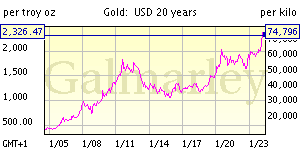
Today's chart provides some long-term perspective in regards to the gold market. As today's chart illustrates, the massive bull market in gold that began in early 2001 is alive and well. In fact, as today's chart illustrates, the pace of the gold bull market has only increased over time. Since peaking in early September 2011, however, gold has retreated. Each pullback has brought gold back down to support (green line) of its accelerated uptrend. Over the past two weeks, gold has declined once again and has crossed below the $1700 per ounce level and is once again testing support.

Today's chart provides some long-term perspective in regards to the gold market. As today's chart illustrates, the massive bull market in gold that began in early 2001 is alive and well. In fact, as today's chart illustrates, the pace of the gold bull market has only increased over time. Since peaking in early September 2011, however, gold has retreated. Each pullback has brought gold back down to support (green line) of its accelerated uptrend. Over the past two weeks, gold has declined once again and has crossed below the $1700 per ounce level and is once again testing support.

Beware the REAL Terrorists
Silver analyst Ted Butler had a fairly big report to subscribers on Saturday...and here are two and a half free paragraphs...
"It [has occurred] to me that it is financial terrorism that best describes the behavior of the manipulators in the silver market. When a world commodity, like silver, declines 30% in a matter of days [twice this year], or when it declines 7% in a day [Thursday] for no good economic reason, it is natural to wonder why that occurred. When the only plausible explanation is that the sell-offs occurred as a deliberate attempt to scare innocent holders out of the market through fear and intimidation [of further loss], is that not financial terrorism?"
"As I’ve indicated previously, the key to these sudden and sharp silver sell-offs is in the sequence of events. In every single instance, it is never a case of investors suddenly deciding to sell and that collective selling action which precipitates the price decline. Rather, it is always the case of the price first being suddenly rigged lower [at the quietest of trading times] and investors then reacting to those lower prices and selling after the price has come down. Also, in every single instance, those who initiated the suddenly lower prices [the COMEX commercials], then reap the whirlwind of their financial terrorism by buying all the positions they were able to intimidate into being sold. Scare folks into selling so that the financial terrorists can then buy from those that had been terrorized."
"This is a crooked, rotten racket that has been going on for decades in silver. The only difference is that it is not al Qaeda or some militant terrorist group at work, but a consortium of leading banks and firms financially terrorizing that segment of the public that has chosen to invest in silver. Instead of being organized by bin Laden, the silver terrorists are organized and protected by the CME Group."
Silver analyst Ted Butler had a fairly big report to subscribers on Saturday...and here are two and a half free paragraphs...
"It [has occurred] to me that it is financial terrorism that best describes the behavior of the manipulators in the silver market. When a world commodity, like silver, declines 30% in a matter of days [twice this year], or when it declines 7% in a day [Thursday] for no good economic reason, it is natural to wonder why that occurred. When the only plausible explanation is that the sell-offs occurred as a deliberate attempt to scare innocent holders out of the market through fear and intimidation [of further loss], is that not financial terrorism?"
"As I’ve indicated previously, the key to these sudden and sharp silver sell-offs is in the sequence of events. In every single instance, it is never a case of investors suddenly deciding to sell and that collective selling action which precipitates the price decline. Rather, it is always the case of the price first being suddenly rigged lower [at the quietest of trading times] and investors then reacting to those lower prices and selling after the price has come down. Also, in every single instance, those who initiated the suddenly lower prices [the COMEX commercials], then reap the whirlwind of their financial terrorism by buying all the positions they were able to intimidate into being sold. Scare folks into selling so that the financial terrorists can then buy from those that had been terrorized."
"This is a crooked, rotten racket that has been going on for decades in silver. The only difference is that it is not al Qaeda or some militant terrorist group at work, but a consortium of leading banks and firms financially terrorizing that segment of the public that has chosen to invest in silver. Instead of being organized by bin Laden, the silver terrorists are organized and protected by the CME Group."
Russell Says.....
Richard Russell has been in the investment advisory business for over 63 years. He is known as "the Godfather of newsletter writers," and is universally respected.
So what does a guy with this much knowledge of history have to say about the current state of affairs? Will America come back like we have countless times in the past?
"My advice: We are moving closer and closer to what I call "survival period" -- the period where the magic of compounding turns into what will be the poison of compounding. This isn't a time for timing. This is a time for action. Reduce your exposure to bonds and all items that provide fixed interest rates. Similarly, reduce your exposure to stocks except the gold miners. Look to expand your positions in inflation-protected assets, especially gold."
"Those who are holding stocks in the hopes of the usual rebound are going to be terribly disappointed in the years ahead. This bear market is going to be unlike anything we've ever seen before. In the end my survival vehicle will be gold. I say again, timing is hopeless. Gold will have purchasing power and true wealth as almost everything else is destroyed by this unprecedented bear market. The US Government is now so loaded with ever-growing debt that it has become a mathematical freak. We return to different times, when rising interest rates will eat up the US government. With $55 trillion in assorted debts, the US is in no shape to deal with rising interest rates. We are in a state of reverse compounding, leading to inevitable bankruptcy on a massive scale."
Richard Russell has been in the investment advisory business for over 63 years. He is known as "the Godfather of newsletter writers," and is universally respected.
So what does a guy with this much knowledge of history have to say about the current state of affairs? Will America come back like we have countless times in the past?
"My advice: We are moving closer and closer to what I call "survival period" -- the period where the magic of compounding turns into what will be the poison of compounding. This isn't a time for timing. This is a time for action. Reduce your exposure to bonds and all items that provide fixed interest rates. Similarly, reduce your exposure to stocks except the gold miners. Look to expand your positions in inflation-protected assets, especially gold."
"Those who are holding stocks in the hopes of the usual rebound are going to be terribly disappointed in the years ahead. This bear market is going to be unlike anything we've ever seen before. In the end my survival vehicle will be gold. I say again, timing is hopeless. Gold will have purchasing power and true wealth as almost everything else is destroyed by this unprecedented bear market. The US Government is now so loaded with ever-growing debt that it has become a mathematical freak. We return to different times, when rising interest rates will eat up the US government. With $55 trillion in assorted debts, the US is in no shape to deal with rising interest rates. We are in a state of reverse compounding, leading to inevitable bankruptcy on a massive scale."
John Embry - Get Ready for Extreme Money Creation Globally
from King World News
With gold trading down $50 and silver $1.50 lower, today King World News interviewed John Embry, Chief Investment Strategist of the $10 billion strong Sprott Asset Management to get his take on where he sees gold, silver, the US dollar and the mining shares headed. When asked about the smash in gold and silver, Embry responded, “Well I’m not terribly surprised. I mean they’ve got the perfect backdrop against which to drop gold and silver prices. They just lob it into the whole idea that they are risk assets and the whole risk on trade is being taken off because of all of the problems in the background.”
“The simple fact is we’ve got an option expiry on gold tomorrow and until that’s over we won’t have a true picture because they’ve got a vested interest in driving the prices down and they’ve got the environment in which to do it. This has been my mantra (buy the dips) for as long as the bull market has been on.
Do not buy strength in gold and silver because you always are subjected to these paper smashes which create fabulous buying opportunities. If you’ve had that discipline (to buy the dips) for the last ten years, you have accumulated fantastic positions in both gold and silver at (extremely) good prices.”
When asked about the significant volatility on the mining shares, Embry replied, “Well that’s typical. Basically with the stock market down the better part of 3%, this is the perfect environment to abuse the gold and silver shares, which as you correctly point out, in many cases, are relatively illiquid....
“The prices that are being created here are insignificant in the long-run. If anybody is on margin they’ve got a problem and if not and you are smart, you buy more.”
When asked about silver specifically, Embry stated, “The fundamentals are fantastic. It’s a very small market relative to all the other markets and there is a massive paper short who has been manipulating the market violently for years, and we all know who that is.
I mean we shouldn’t be surprised that in these difficult times these guys are throwing everything at it but the kitchen sink. It’s just creating an unbelievable opportunity and when silver is trading at 5 and 10 times these levels in a few years, this will just be a bad memory.”
When asked about Ben Davies comments regarding crash signals and money printing, Embry remarked, “Well I would open my comments by saying Ben Davies is one of the smartest guys I’ve ever met and I’m honored to agree with him.
I think there is no question that when push comes to shove here, and it’s getting real close, the only alternative to a massive deflationary collapse is extreme money creation at all levels and virtually throughout the world.”
from King World News
With gold trading down $50 and silver $1.50 lower, today King World News interviewed John Embry, Chief Investment Strategist of the $10 billion strong Sprott Asset Management to get his take on where he sees gold, silver, the US dollar and the mining shares headed. When asked about the smash in gold and silver, Embry responded, “Well I’m not terribly surprised. I mean they’ve got the perfect backdrop against which to drop gold and silver prices. They just lob it into the whole idea that they are risk assets and the whole risk on trade is being taken off because of all of the problems in the background.”
“The simple fact is we’ve got an option expiry on gold tomorrow and until that’s over we won’t have a true picture because they’ve got a vested interest in driving the prices down and they’ve got the environment in which to do it. This has been my mantra (buy the dips) for as long as the bull market has been on.
Do not buy strength in gold and silver because you always are subjected to these paper smashes which create fabulous buying opportunities. If you’ve had that discipline (to buy the dips) for the last ten years, you have accumulated fantastic positions in both gold and silver at (extremely) good prices.”
When asked about the significant volatility on the mining shares, Embry replied, “Well that’s typical. Basically with the stock market down the better part of 3%, this is the perfect environment to abuse the gold and silver shares, which as you correctly point out, in many cases, are relatively illiquid....
“The prices that are being created here are insignificant in the long-run. If anybody is on margin they’ve got a problem and if not and you are smart, you buy more.”
When asked about silver specifically, Embry stated, “The fundamentals are fantastic. It’s a very small market relative to all the other markets and there is a massive paper short who has been manipulating the market violently for years, and we all know who that is.
I mean we shouldn’t be surprised that in these difficult times these guys are throwing everything at it but the kitchen sink. It’s just creating an unbelievable opportunity and when silver is trading at 5 and 10 times these levels in a few years, this will just be a bad memory.”
When asked about Ben Davies comments regarding crash signals and money printing, Embry remarked, “Well I would open my comments by saying Ben Davies is one of the smartest guys I’ve ever met and I’m honored to agree with him.
I think there is no question that when push comes to shove here, and it’s getting real close, the only alternative to a massive deflationary collapse is extreme money creation at all levels and virtually throughout the world.”
Aaron Russo on The Federal Reserve
Here's a short 10 minute video clip that I hope you will copy and forward to everyone you know. In it is revealed the REAL problem that America faces, and the conclusion that partisan politics is NOT the answer.
Of course, my answer is even much simpler than Mr. Russo's. If Americans would store their wealth in gold, instead of paper, then the bankers would be out of business tomorrow.
I can't control you, and I can't control the politicians. I can only control me, and I choose to no longer give the bankers power over me by investing my wealth in their paper money.
If enough people quit playing, then it's game over.
Here's a short 10 minute video clip that I hope you will copy and forward to everyone you know. In it is revealed the REAL problem that America faces, and the conclusion that partisan politics is NOT the answer.
Of course, my answer is even much simpler than Mr. Russo's. If Americans would store their wealth in gold, instead of paper, then the bankers would be out of business tomorrow.
I can't control you, and I can't control the politicians. I can only control me, and I choose to no longer give the bankers power over me by investing my wealth in their paper money.
If enough people quit playing, then it's game over.
For Your Week-end Reading Pleasure
Here's some short excerpts from several articles that I encourage you to click on and read the full article.
It’s All About Gold Now
In a new book called “Currency Wars,” Wall Street insider Jim Rickards examines how countries try to get out of financial trouble by devaluing their currencies. Rickards says, “Today, as yesterday, countries are attempting to devalue their way out of trouble. Following the strategy of beggar-thy- neighbor, the U.S., Europe, China and Japan all want to weaken their currencies. The flaw in the tactic should be clear. “Not everyone could cheapen at once,” Rickards writes. “The circle still could not be squared.” (Click here to read a book review by Bloomberg.) Rickards predicts the U.S. dollar’s future is not bright, and if there were a “catastrophic collapse of investor confidence,” the dollar’s buying power could suffer suddenly and dramatically in a global sell off.
Gold would be the big beneficiary if the dollar declined, and Rickards’ top price for gold per ounce is–wait for it–$44,552! That price is the absolute highest possibility. Rickards and others predict that in the next few years, America will go back on some sort of gold standard. Meaning, the dollar will be backed by gold, but Rickards has stated on many occasions that there probably will not be a100% gold backed U.S. dollar. Instead, Rickards contends it will be more in the neighborhood of 40%. If that is the case, then gold would be $17,821 per ounce using Rickards numbers. It appears gold prices are going much higher.
US Federal Prosecutions For Financial Fraud In the Obama Administration Fall to 20 Year Lows
The declines in US Federal prosecutions for financial fraud that began under G.W. Bush have followed that down trend that in the first three years of the Obama Administration. That might make more sense if Obama had not been elected as a reform president in response to one of the greatest financial frauds in American history.
In the first three years of the Obama Administration, federal prosecutions have been running at new highs. Over half of the prosecutions involve illegal immigration. Another 17% are drug related.
Illegal immigrants and drug dealers have the reputation for being notoriously cheap in providing campaign contributions.
Prosecutions for financial fraud however have dropped to the lowest levels in over 20 years.
Gold and the Dot-Coms: Comparing the Bubbles
MarketWatch.com
Investor enthusiasm is particularly keen on the yellow metal, around $1,800 an ounce. How does gold's rise compare to the rise of the Nasdaq Composite Index during the 1990s? Mark Hulbert does the charting, and comes away with compelling findings. Laura Mandaro reports.
Here's some short excerpts from several articles that I encourage you to click on and read the full article.
It’s All About Gold Now
In a new book called “Currency Wars,” Wall Street insider Jim Rickards examines how countries try to get out of financial trouble by devaluing their currencies. Rickards says, “Today, as yesterday, countries are attempting to devalue their way out of trouble. Following the strategy of beggar-thy- neighbor, the U.S., Europe, China and Japan all want to weaken their currencies. The flaw in the tactic should be clear. “Not everyone could cheapen at once,” Rickards writes. “The circle still could not be squared.” (Click here to read a book review by Bloomberg.) Rickards predicts the U.S. dollar’s future is not bright, and if there were a “catastrophic collapse of investor confidence,” the dollar’s buying power could suffer suddenly and dramatically in a global sell off.
Gold would be the big beneficiary if the dollar declined, and Rickards’ top price for gold per ounce is–wait for it–$44,552! That price is the absolute highest possibility. Rickards and others predict that in the next few years, America will go back on some sort of gold standard. Meaning, the dollar will be backed by gold, but Rickards has stated on many occasions that there probably will not be a100% gold backed U.S. dollar. Instead, Rickards contends it will be more in the neighborhood of 40%. If that is the case, then gold would be $17,821 per ounce using Rickards numbers. It appears gold prices are going much higher.
US Federal Prosecutions For Financial Fraud In the Obama Administration Fall to 20 Year Lows
The declines in US Federal prosecutions for financial fraud that began under G.W. Bush have followed that down trend that in the first three years of the Obama Administration. That might make more sense if Obama had not been elected as a reform president in response to one of the greatest financial frauds in American history.
In the first three years of the Obama Administration, federal prosecutions have been running at new highs. Over half of the prosecutions involve illegal immigration. Another 17% are drug related.
Illegal immigrants and drug dealers have the reputation for being notoriously cheap in providing campaign contributions.
Prosecutions for financial fraud however have dropped to the lowest levels in over 20 years.
Gold and the Dot-Coms: Comparing the Bubbles
MarketWatch.com
Investor enthusiasm is particularly keen on the yellow metal, around $1,800 an ounce. How does gold's rise compare to the rise of the Nasdaq Composite Index during the 1990s? Mark Hulbert does the charting, and comes away with compelling findings. Laura Mandaro reports.
Agnico Eagle CEO - Gold Could Rise to Unimaginable Levels
KingWorldNews.com
With gold around the $1,780 level and silver trading near $35, today King World News interviewed Sean Boyd, CEO of $8 billion Agnico Eagle. When asked what he sees going forward with the price of gold, Boyd responded, “It’s still a very strong market. There was forced selling not too long ago by certain holders and that tended to spook the market. But we have been consistently sticking with the investment thesis that governments have too many obligations that they simply can’t meet and as a result we are going to see ongoing and continued debasement of paper money.”
Sean Boyd continues:
“The flip side of that is people are looking for hard assets and gold, being one of the primary hard assets, is a major beneficiary. So we don’t see any reason to believe this upward trend in gold won’t continue. I think it will continue and we will see $2,000 shortly.
So we’ve seen some volatility, I think that’s natural, but the general trend is more uncertainty, more debasement of paper currencies and gold is going to be one of the primary beneficiaries of that.”
When asked if he ever thought, years ago, the world financial situation would have deteriorated the way it has, Boyd replied, “No and we still had, like most people, confidence that the authorities, the government officials and central bankers would have been able to figure it out. And it’s clear they haven’t been able to figure it out.
They’ve tried things that have traditionally worked, so those are things they expected to work. But maybe it’s a function of the liabilities and obligations and promises they’ve made are so large now that the old ways of dealing with them just doesn’t work anymore and that’s the scary part. No one knows where this will end, that’s what is scary and this is getting people increasingly worried....
“There’s very little political will to come up with solutions. That is simply feeding the uncertainty and that uncertainty is causing people to look at ways to protect their wealth. So people that have money or are managing money are looking at ways to protect it. Obviously one of the ways individuals feel comfortable protecting their wealth is through owning gold.
When asked where he sees the gold bull market at this point, Boyd stated, “I believe we are in the middle of the bull run. Here we are and some people are saying gold is a bubble, but we’ve been maintaining over the last couple of years that we don’t see a lot of new people in terms of investment conferences, particularly among non-gold people.
So that means we are still early in the game and gold still has a lot further to run on the upside. When you have assets under management, which have allocations of gold at less than 1%, that means there is still much more room for gold in portfolios and we are still not there yet.
If you look at India and China, combined they took down about 52% of the annual mine supply last year. That’s a fair chunk and that’s up from where it was several years ago. That trend is likely to grow.
When you layer on top of that, eventually, more and more investors are feeling they need to diversify and get exposure to metal, that’s when gold will just take off. That will be the last phase of the bull market and it may still be two or three years away depending on how quickly this all unfolds.
That could take the price of gold into numbers that we can’t even imagine at the moment. We always talk about silver, and silver will go along with gold. Silver did have a big run and got ahead of itself, but silver, traditionally, will follow gold higher and the upside on silver will be greater in percentage terms than it is on gold.”
KingWorldNews.com
With gold around the $1,780 level and silver trading near $35, today King World News interviewed Sean Boyd, CEO of $8 billion Agnico Eagle. When asked what he sees going forward with the price of gold, Boyd responded, “It’s still a very strong market. There was forced selling not too long ago by certain holders and that tended to spook the market. But we have been consistently sticking with the investment thesis that governments have too many obligations that they simply can’t meet and as a result we are going to see ongoing and continued debasement of paper money.”
Sean Boyd continues:
“The flip side of that is people are looking for hard assets and gold, being one of the primary hard assets, is a major beneficiary. So we don’t see any reason to believe this upward trend in gold won’t continue. I think it will continue and we will see $2,000 shortly.
So we’ve seen some volatility, I think that’s natural, but the general trend is more uncertainty, more debasement of paper currencies and gold is going to be one of the primary beneficiaries of that.”
When asked if he ever thought, years ago, the world financial situation would have deteriorated the way it has, Boyd replied, “No and we still had, like most people, confidence that the authorities, the government officials and central bankers would have been able to figure it out. And it’s clear they haven’t been able to figure it out.
They’ve tried things that have traditionally worked, so those are things they expected to work. But maybe it’s a function of the liabilities and obligations and promises they’ve made are so large now that the old ways of dealing with them just doesn’t work anymore and that’s the scary part. No one knows where this will end, that’s what is scary and this is getting people increasingly worried....
“There’s very little political will to come up with solutions. That is simply feeding the uncertainty and that uncertainty is causing people to look at ways to protect their wealth. So people that have money or are managing money are looking at ways to protect it. Obviously one of the ways individuals feel comfortable protecting their wealth is through owning gold.
When asked where he sees the gold bull market at this point, Boyd stated, “I believe we are in the middle of the bull run. Here we are and some people are saying gold is a bubble, but we’ve been maintaining over the last couple of years that we don’t see a lot of new people in terms of investment conferences, particularly among non-gold people.
So that means we are still early in the game and gold still has a lot further to run on the upside. When you have assets under management, which have allocations of gold at less than 1%, that means there is still much more room for gold in portfolios and we are still not there yet.
If you look at India and China, combined they took down about 52% of the annual mine supply last year. That’s a fair chunk and that’s up from where it was several years ago. That trend is likely to grow.
When you layer on top of that, eventually, more and more investors are feeling they need to diversify and get exposure to metal, that’s when gold will just take off. That will be the last phase of the bull market and it may still be two or three years away depending on how quickly this all unfolds.
That could take the price of gold into numbers that we can’t even imagine at the moment. We always talk about silver, and silver will go along with gold. Silver did have a big run and got ahead of itself, but silver, traditionally, will follow gold higher and the upside on silver will be greater in percentage terms than it is on gold.”
World Bank President: Gold is Still a Good Investment
from the Economic Policy Journal
I spent some time Tuesday afternoon at the Wall Street Journal CEO Council, which was being held at the Four Seasons in Washington D.C. The usual suspects were there, everyone from Rupert Murdoch to Dick Cheney to Tim Geithner.
The most fascinating conversation I had was by far with Robert Zoellick, president of the World Bank. If you recall, a year ago he wrote an op-ed in the Financial Times stating that the Group of 20 leading economies should consider adopting a global reserve currency based on gold as part of structural reforms to the world’s foreign-exchange platform. He wrote that the increasing use of gold as a monetary asset was an “elephant in the room” that was being ignored by policymakers in the debate over how to correct global trade and fiscal imbalances.
No doubt under bankster pressure, he backed away from his gold stance two days later. He said that critics had misunderstood his proposal as a call for a return to the gold standard.
On the sidelines of Tuesday's WSJ event, I probed him on the topic. It's clear that Zoellick is a big fan of gold. I have asked many high profile officials and investment people about gold, they usually yawn. Zoellick seemed pleased with the topic. I asked him for his current view on gold, he smiled, stopped himself and said, "No, I better not."
But then he added, "Anybody who listened to me last year is showing a nice profit." Gold is up about $300 an ounce since he wrote the Op-Ed. I asked him if those who listened to him last year should sell?
He looked at me, thought for a minute then said, "The uncertainty is still making gold a good investment."
Folks, I think we have a gold bug at the World Bank.
from the Economic Policy Journal
I spent some time Tuesday afternoon at the Wall Street Journal CEO Council, which was being held at the Four Seasons in Washington D.C. The usual suspects were there, everyone from Rupert Murdoch to Dick Cheney to Tim Geithner.
The most fascinating conversation I had was by far with Robert Zoellick, president of the World Bank. If you recall, a year ago he wrote an op-ed in the Financial Times stating that the Group of 20 leading economies should consider adopting a global reserve currency based on gold as part of structural reforms to the world’s foreign-exchange platform. He wrote that the increasing use of gold as a monetary asset was an “elephant in the room” that was being ignored by policymakers in the debate over how to correct global trade and fiscal imbalances.
No doubt under bankster pressure, he backed away from his gold stance two days later. He said that critics had misunderstood his proposal as a call for a return to the gold standard.
On the sidelines of Tuesday's WSJ event, I probed him on the topic. It's clear that Zoellick is a big fan of gold. I have asked many high profile officials and investment people about gold, they usually yawn. Zoellick seemed pleased with the topic. I asked him for his current view on gold, he smiled, stopped himself and said, "No, I better not."
But then he added, "Anybody who listened to me last year is showing a nice profit." Gold is up about $300 an ounce since he wrote the Op-Ed. I asked him if those who listened to him last year should sell?
He looked at me, thought for a minute then said, "The uncertainty is still making gold a good investment."
Folks, I think we have a gold bug at the World Bank.
When You Wake Up Tomorrow
Just a quick heads up. I want to make sure all of you realize that when you wake up tomorrow that any "account" you have can be debited for whatever amount the powers-that-be choose, and there's not a thing you can do about it.
You see, that's the problem with "accounts." Your wealth is being held by someone else, and chances are pretty good that they are crooks. And even if they aren't crooks, they are controlled by the US Government which is the biggest crook of all. Which puts your assets at risk.
Think it can't happen? Ha! It's already happening! Check out the following video from Gerald Celente where he discusses how his account was "debited" for over six-figures due to the failure of an institution that he was not even invested in.
Any bank account, IRA, 401k, mutual fund, annuity or brokerage account that you own is just one computer keystroke away from becoming someone elses. If you don't hold it in your hand, you don't own it. It's as simple as that!
Just a quick heads up. I want to make sure all of you realize that when you wake up tomorrow that any "account" you have can be debited for whatever amount the powers-that-be choose, and there's not a thing you can do about it.
You see, that's the problem with "accounts." Your wealth is being held by someone else, and chances are pretty good that they are crooks. And even if they aren't crooks, they are controlled by the US Government which is the biggest crook of all. Which puts your assets at risk.
Think it can't happen? Ha! It's already happening! Check out the following video from Gerald Celente where he discusses how his account was "debited" for over six-figures due to the failure of an institution that he was not even invested in.
Any bank account, IRA, 401k, mutual fund, annuity or brokerage account that you own is just one computer keystroke away from becoming someone elses. If you don't hold it in your hand, you don't own it. It's as simple as that!
No Wonder Gold Is Rising
Here's a short excerpt from an article entitled "What's Driving Gold."
"Fear of Eurozone debt contagion is not the only factor driving the markets. There is also a major event looming for the US economy, namely the showdown of the Super Committee. With the deadline to craft the $1.5 Trillion debt reduction deal now nine days away, there seems to be little progress by the select lawmakers. In fact, the talks broke down when Democrats walked out this last week after ignoring the latest Republican proposal. The US budget battle is likely to reach center stage once again over the next ten days. An impasse will roil the markets once more.
The credit agencies may act before the Super Committee does. Many analysts believe a further downgrade of US sovereign debt is probable. Rather than taking the lead at this critical juncture, the president is taking a trip to Hawaii and Asia. It is becoming more apparent that the Administration would rather there is no deal; another example of the “do nothing opposition”. There was a time in this country when our leaders put needs of the country before politics. Those were the days…
So fasten your seat belt. We’re in for a bumpy ride. The stock market will remain highly volatile with daily triple digit swings. The bond market offers no escape. Treasury prices are bid up as funds flow out of Europe and equities into “safe” US notes, despite negative real interest rates for the instruments, and bid down when investors flood back into higher yielding stocks. Each trade represents a loss of capital (as well as a tax event).
It’s no wonder that prudent investors are once again turning to gold as the true safe-haven trade."
Here's a short excerpt from an article entitled "What's Driving Gold."
"Fear of Eurozone debt contagion is not the only factor driving the markets. There is also a major event looming for the US economy, namely the showdown of the Super Committee. With the deadline to craft the $1.5 Trillion debt reduction deal now nine days away, there seems to be little progress by the select lawmakers. In fact, the talks broke down when Democrats walked out this last week after ignoring the latest Republican proposal. The US budget battle is likely to reach center stage once again over the next ten days. An impasse will roil the markets once more.
The credit agencies may act before the Super Committee does. Many analysts believe a further downgrade of US sovereign debt is probable. Rather than taking the lead at this critical juncture, the president is taking a trip to Hawaii and Asia. It is becoming more apparent that the Administration would rather there is no deal; another example of the “do nothing opposition”. There was a time in this country when our leaders put needs of the country before politics. Those were the days…
So fasten your seat belt. We’re in for a bumpy ride. The stock market will remain highly volatile with daily triple digit swings. The bond market offers no escape. Treasury prices are bid up as funds flow out of Europe and equities into “safe” US notes, despite negative real interest rates for the instruments, and bid down when investors flood back into higher yielding stocks. Each trade represents a loss of capital (as well as a tax event).
It’s no wonder that prudent investors are once again turning to gold as the true safe-haven trade."
What's Up With Silver?
Here's a short paragraph from silver analyst Ted Butler:
"Leaving aside the fact that silver is more manipulated than gold for a moment, there are some ready explanations for why silver has been somewhat of a relative drag recently. For one thing, since the September price smash, silver has not been able to penetrate to the upside its important moving averages (50 and 200 day), while gold has been able to climb or remain over all its important moving averages. I’m not a technician or chartist, but many market participants are heavily influenced by such indicators. That makes it important to be aware of what these technical traders are up to. The fact that silver is below the moving averages while gold is above keeps these technical traders from buying silver and encourages them to buy gold. I think this explains, more than anything, the recent relative punk price performance in silver compared to gold. But the nature of this technical moving average approach portends changes ahead."
Here's a short paragraph from silver analyst Ted Butler:
"Leaving aside the fact that silver is more manipulated than gold for a moment, there are some ready explanations for why silver has been somewhat of a relative drag recently. For one thing, since the September price smash, silver has not been able to penetrate to the upside its important moving averages (50 and 200 day), while gold has been able to climb or remain over all its important moving averages. I’m not a technician or chartist, but many market participants are heavily influenced by such indicators. That makes it important to be aware of what these technical traders are up to. The fact that silver is below the moving averages while gold is above keeps these technical traders from buying silver and encourages them to buy gold. I think this explains, more than anything, the recent relative punk price performance in silver compared to gold. But the nature of this technical moving average approach portends changes ahead."
Why Wall Street Can't Handle the Truth
Longtime bank analyst Mike Mayo tells the inside story of why it's so hard to yell 'sell' in a crowded room—and lays out how Wall Street needs to change to avoid the next financial collapse.
Wall Street Journal - Over the past 12 years, longtime banking analyst Mike Mayo has issued numerous calls to sell bank stocks, a rarity in a system where nearly all stocks are rated buy or hold. His negative ratings have frequently gotten him in trouble with banks, clients and his own bosses, who didn't want to alienate those companies. In this excerpt from his new book, "Exile on Wall Street," Mr. Mayo gives an inside view of the fights, the scolding and the threatening phone calls he received as a result of yelling "sell"—and offers a proposal to fix the banking sector.
Taking a negative position doesn't win you many friends in the banking sector. I've worked as a bank analyst for the past 20 years, where my job is to study publicly traded financial firms and decide which ones would make the best investments. This research goes out to institutional investors: mutual fund companies, university endowments, public-employee retirement funds, hedge funds, and other organizations with large amounts of money. But for about the past decade, especially the past five years or so, most big banks haven't been good investments. In fact, they've been terrible investments, down 50%, 60%, 70% or more.
Analysts are supposed to be a check on the financial system—people who can wade through a company's financials and tell investors what's really going on. There are about 5,000 so-called sell-side analysts, about 5% of whom track the financial sector, serving as watchdogs over U.S. companies with combined market value of more than $15 trillion.
Unfortunately, some are little more than cheerleaders—afraid of rocking the boat at their firms, afraid of alienating the companies they cover and drawing the wrath of their superiors. The proportion of sell ratings on Wall Street remains under 5%, even today, despite the fact that any first-year MBA student can tell you that 95% of the stocks cannot be winners.
Over the years, I have pointed out certain problems in the banking sector—things like excessive risk, outsized compensation for bankers, more aggressive lending—and as a result been yelled at, conspicuously ignored, threatened with legal action and mocked by banking executives, all with the intent of persuading me to soften my stance.
Looking inside the world of finance—with its pressures to conform and stay quiet—may offer some insight into why so many others have fudged. And it may offer some answers as to how crisis after crisis has hit the economy over the past decade, taking the markets by surprise, despite what should have been plentiful warning signs.
***
It started in 1999, when I was managing director (the equivalent of partner) at Credit Suisse First Boston. At the time, what gave me the biggest concern was a sense that stocks within the banking sector were likely to turn downward.
Five years after the interstate banking law of 1994, which allowed banks to operate across state lines, the easy gains from consolidation were over. When banks couldn't maintain their growth momentum through mergers and cost cuts, they took the next logical step—they made more consumer loans. Logic dictated that this meant the quality of those loans would probably decrease, and, in turn, create a greater risk that some of them would result in losses. At the same time, executive pay was soaring, aided by stock options, which can encourage executives to take on greater risk.
For my 1,000-page report on the entire banking industry, with detailed reports of 47 banks, I wasn't just going to go negative on a few main stocks but the entire sector. This was completely the opposite of what most analysts were saying, not just about banks but about all sectors.
In decades past, the ratio of buy ratings to sell ratings had not been this lopsided, and in theory it should be roughly 50-50. That seems right, doesn't it? Some stocks go up, some go down, because of the overall market direction or competitive threats or issues specific to each company. In the late 1990s, though, the ratio was 100 buys or more for every sell. Merrill Lynch had buy ratings on 940 stocks and sell ratings on just 7. Salomon Smith Barney: 856 buy ratings, 4 sells. Morgan Stanley Dean Witter: 670 buys and exactly 0 sells.
Analysts almost never said to sell specific companies, because that would alienate those firms, which then might move business for bond offerings, equity deals, acquisitions, buybacks or other activity away from the analyst's brokerage firm. Say the word "sell" enough times, and you win a long, awkward elevator ride out of the building with your soon-to-be-former boss. And here I was, ready to go negative on the entire banking sector.
At the company's morning meeting between analysts and the sales staff, I gave a short presentation on the report. "In no uncertain terms," I said, "sell bank stocks. I'm downgrading the group. Sell Bank One, sell Chase Manhattan…." The message went out over the "hoot," or microphone, to more than 50 salespeople around the world. They would relay my thoughts to more than 300 money managers at some of the largest institutional investment firms in the business.
Afterward, I went back to my desk. Safe so far, I thought, and picked up the phone to call some of the biggest banks that had been downgraded, to give them a heads-up, along with some of the firm's institutional-investing clients. Not long after that, I was summoned back to the hoot for a special presentation to the sales force, something that had never happened before. They wanted me to clarify my thinking. Why not just leave the ratings at hold?
I laid out my case again: declining loan quality, excess executive compensation and headwinds for the industry after five years of major growth driven by mergers.
The counterattack started almost immediately. One portfolio manager said, "What's he trying to prove? Don't you know you only put a sell on a dog?" Another yelled, "I can't believe Mayo's doing this. He must be self-destructing!" One trader at a firm that owned a portfolio full of bank shares—which immediately began falling—printed out my photo and stuck it to her bulletin board with the word "WANTED" scribbled over it. I'd poked a stick into a hornets' nest.
That morning, I got a call from a client who runs a major endowment. "Check out the TV," he said. On CNBC, the commentators had picked up on the news and were now mocking me. Joe Kernen joked: "Who's Mike Mayo, and do we know whether he was turned down for a car loan?" I even got an ominous, anonymous voice mail from someone with a strong drawl cautioning, "Be careful with what you say."
Of course, the banks that I had downgraded were even more furious, and they let me know it. Routine meetings with management are a standard part of my work, yet when I requested these meetings after my call, several banks said no. Worse, a couple of big institutions in the Midwest and Southeast threatened to cut all ties with Credit Suisse—no more investment banking deals, no more fees.
Within a few months, the market began to experience problems. The Standard & Poor's bank index peaked in July 1999 and fell more than 20% by the end of the year. Regional banks, in particular, had their worst performance compared to the overall market in half a century.
***
I was still negative on the sector in 2001, when I moved over to Prudential, and I initiated my coverage with nine sell ratings. This was a tough stance to take at the time because bank stocks were on the rise. Soon enough, I would run into more of the usual problems.
After one meeting in New Jersey, one of the more senior portfolio managers offered to "advise" me about my views on the banking industry. The old-timer pulled me into a semidarkened room, just the two of us.
"I've been doing this a while," he said, "and you've gotta know when to change your view. You can't be so negative." He probably meant it as kindly advice from someone who had been around the block, but it came across more like a disciplinarian father scolding his son. His argument seemed to be that as long as the stock prices were going up, the banks' management and operating strategies didn't matter.
Other companies limited my access to senior executives. An analyst without access to executives—and the one-on-one insights that investors often pay for—can be perceived to be at a disadvantage compared to his or her peers. Goldman Sachs was fairly up front about it, a rarity in the industry. I had recently initiated coverage on the firm, so I had few established relationships I could leverage. When I told one point of contact at the company that I'd like to have more meetings with management, he told me that the firm wasn't singling me out—they treated everyone that way. When I pushed a little harder for a meeting, I received a message that we needed to "have a conversation."
Feeling like a student being reprimanded by a teacher, I was told that the most efficient use of management's time was for the executives to generate money for the firm instead of talking to the 20 or so analysts covering the company. An analyst like me would simply have to be patient. While I could live with this—to a degree—the gatekeeper added one more point: A consideration in granting analysts meetings with management of Goldman Sachs was the analyst's standing, influence and knowledge. "In other words," the gatekeeper added, "we evaluate you." (A spokesman for Goldman Sachs declined to comment for this article.)
***
As the financial crisis started rumbling in 2007, I was working at Deutsche Bank and went on CNBC in November to air my concerns. I said the total cost of the crisis could approach $400 billion, a number that was much higher than anyone else's estimate to that point—though one that still turned out to be too low.
I came up with this figure by combining losses not only from banks but from everywhere else in the financial system, as well, including mortgages and related securities. The project had been difficult and tedious, and members of my team had stayed at the office until midnight each night for weeks to dig up data.
The $400 billion number was an imperfect estimate, even with all that work, but at least I could be more vocal about my stance and help investors pull their money while the stock market—and the shares of most Wall Street banks—had yet to reflect these issues.
I also said that the banking industry had to come clean about the extent of its exposure to problem mortgages and other assets. After eight years of warning about an impending storm, I was now shouting from the mountaintop, saying that it was time to take cover.
Some of the attention my calls generated was not so positive, even within my own firm. My supervisors at Deutsche Bank told me that I should avoid making those kinds of strong, negative comments about the banking sector in the press.
Not long after that, I was summoned to a meeting on an upper floor of the building with a senior manager at Deutsche Bank. He said that the firm did not like to be seen as publicly negative on the U.S. banking sector at a time when it held certain short positions.
In the end, Deutsche Bank made $1.5 billion on one of its proprietary trades during the crisis by betting against mortgage-backed securities. The firm ended up losing about $4.5 billion overall, far less than most big banks, in part because of its aggressive short positions on the U.S. housing market.
But all I understood at the time was that I was in a cone of silence. The bank wouldn't interfere with my analysis of the sector or my research reports, but there was now a gag rule when it came to any more media spots. I could no longer talk to the broader financial community or to investors at large, only to institutional investors who were clients, and as a result, banks could more easily downplay their problems.
A spokesman for Deutsche Bank says, "We fully support our analysts' ability to publish independent research for the benefit of our clients."
Longtime bank analyst Mike Mayo tells the inside story of why it's so hard to yell 'sell' in a crowded room—and lays out how Wall Street needs to change to avoid the next financial collapse.
Wall Street Journal - Over the past 12 years, longtime banking analyst Mike Mayo has issued numerous calls to sell bank stocks, a rarity in a system where nearly all stocks are rated buy or hold. His negative ratings have frequently gotten him in trouble with banks, clients and his own bosses, who didn't want to alienate those companies. In this excerpt from his new book, "Exile on Wall Street," Mr. Mayo gives an inside view of the fights, the scolding and the threatening phone calls he received as a result of yelling "sell"—and offers a proposal to fix the banking sector.
Taking a negative position doesn't win you many friends in the banking sector. I've worked as a bank analyst for the past 20 years, where my job is to study publicly traded financial firms and decide which ones would make the best investments. This research goes out to institutional investors: mutual fund companies, university endowments, public-employee retirement funds, hedge funds, and other organizations with large amounts of money. But for about the past decade, especially the past five years or so, most big banks haven't been good investments. In fact, they've been terrible investments, down 50%, 60%, 70% or more.
Analysts are supposed to be a check on the financial system—people who can wade through a company's financials and tell investors what's really going on. There are about 5,000 so-called sell-side analysts, about 5% of whom track the financial sector, serving as watchdogs over U.S. companies with combined market value of more than $15 trillion.
Unfortunately, some are little more than cheerleaders—afraid of rocking the boat at their firms, afraid of alienating the companies they cover and drawing the wrath of their superiors. The proportion of sell ratings on Wall Street remains under 5%, even today, despite the fact that any first-year MBA student can tell you that 95% of the stocks cannot be winners.
Over the years, I have pointed out certain problems in the banking sector—things like excessive risk, outsized compensation for bankers, more aggressive lending—and as a result been yelled at, conspicuously ignored, threatened with legal action and mocked by banking executives, all with the intent of persuading me to soften my stance.
Looking inside the world of finance—with its pressures to conform and stay quiet—may offer some insight into why so many others have fudged. And it may offer some answers as to how crisis after crisis has hit the economy over the past decade, taking the markets by surprise, despite what should have been plentiful warning signs.
***
It started in 1999, when I was managing director (the equivalent of partner) at Credit Suisse First Boston. At the time, what gave me the biggest concern was a sense that stocks within the banking sector were likely to turn downward.
Five years after the interstate banking law of 1994, which allowed banks to operate across state lines, the easy gains from consolidation were over. When banks couldn't maintain their growth momentum through mergers and cost cuts, they took the next logical step—they made more consumer loans. Logic dictated that this meant the quality of those loans would probably decrease, and, in turn, create a greater risk that some of them would result in losses. At the same time, executive pay was soaring, aided by stock options, which can encourage executives to take on greater risk.
For my 1,000-page report on the entire banking industry, with detailed reports of 47 banks, I wasn't just going to go negative on a few main stocks but the entire sector. This was completely the opposite of what most analysts were saying, not just about banks but about all sectors.
In decades past, the ratio of buy ratings to sell ratings had not been this lopsided, and in theory it should be roughly 50-50. That seems right, doesn't it? Some stocks go up, some go down, because of the overall market direction or competitive threats or issues specific to each company. In the late 1990s, though, the ratio was 100 buys or more for every sell. Merrill Lynch had buy ratings on 940 stocks and sell ratings on just 7. Salomon Smith Barney: 856 buy ratings, 4 sells. Morgan Stanley Dean Witter: 670 buys and exactly 0 sells.
Analysts almost never said to sell specific companies, because that would alienate those firms, which then might move business for bond offerings, equity deals, acquisitions, buybacks or other activity away from the analyst's brokerage firm. Say the word "sell" enough times, and you win a long, awkward elevator ride out of the building with your soon-to-be-former boss. And here I was, ready to go negative on the entire banking sector.
At the company's morning meeting between analysts and the sales staff, I gave a short presentation on the report. "In no uncertain terms," I said, "sell bank stocks. I'm downgrading the group. Sell Bank One, sell Chase Manhattan…." The message went out over the "hoot," or microphone, to more than 50 salespeople around the world. They would relay my thoughts to more than 300 money managers at some of the largest institutional investment firms in the business.
Afterward, I went back to my desk. Safe so far, I thought, and picked up the phone to call some of the biggest banks that had been downgraded, to give them a heads-up, along with some of the firm's institutional-investing clients. Not long after that, I was summoned back to the hoot for a special presentation to the sales force, something that had never happened before. They wanted me to clarify my thinking. Why not just leave the ratings at hold?
I laid out my case again: declining loan quality, excess executive compensation and headwinds for the industry after five years of major growth driven by mergers.
The counterattack started almost immediately. One portfolio manager said, "What's he trying to prove? Don't you know you only put a sell on a dog?" Another yelled, "I can't believe Mayo's doing this. He must be self-destructing!" One trader at a firm that owned a portfolio full of bank shares—which immediately began falling—printed out my photo and stuck it to her bulletin board with the word "WANTED" scribbled over it. I'd poked a stick into a hornets' nest.
That morning, I got a call from a client who runs a major endowment. "Check out the TV," he said. On CNBC, the commentators had picked up on the news and were now mocking me. Joe Kernen joked: "Who's Mike Mayo, and do we know whether he was turned down for a car loan?" I even got an ominous, anonymous voice mail from someone with a strong drawl cautioning, "Be careful with what you say."
Of course, the banks that I had downgraded were even more furious, and they let me know it. Routine meetings with management are a standard part of my work, yet when I requested these meetings after my call, several banks said no. Worse, a couple of big institutions in the Midwest and Southeast threatened to cut all ties with Credit Suisse—no more investment banking deals, no more fees.
Within a few months, the market began to experience problems. The Standard & Poor's bank index peaked in July 1999 and fell more than 20% by the end of the year. Regional banks, in particular, had their worst performance compared to the overall market in half a century.
***
I was still negative on the sector in 2001, when I moved over to Prudential, and I initiated my coverage with nine sell ratings. This was a tough stance to take at the time because bank stocks were on the rise. Soon enough, I would run into more of the usual problems.
After one meeting in New Jersey, one of the more senior portfolio managers offered to "advise" me about my views on the banking industry. The old-timer pulled me into a semidarkened room, just the two of us.
"I've been doing this a while," he said, "and you've gotta know when to change your view. You can't be so negative." He probably meant it as kindly advice from someone who had been around the block, but it came across more like a disciplinarian father scolding his son. His argument seemed to be that as long as the stock prices were going up, the banks' management and operating strategies didn't matter.
Other companies limited my access to senior executives. An analyst without access to executives—and the one-on-one insights that investors often pay for—can be perceived to be at a disadvantage compared to his or her peers. Goldman Sachs was fairly up front about it, a rarity in the industry. I had recently initiated coverage on the firm, so I had few established relationships I could leverage. When I told one point of contact at the company that I'd like to have more meetings with management, he told me that the firm wasn't singling me out—they treated everyone that way. When I pushed a little harder for a meeting, I received a message that we needed to "have a conversation."
Feeling like a student being reprimanded by a teacher, I was told that the most efficient use of management's time was for the executives to generate money for the firm instead of talking to the 20 or so analysts covering the company. An analyst like me would simply have to be patient. While I could live with this—to a degree—the gatekeeper added one more point: A consideration in granting analysts meetings with management of Goldman Sachs was the analyst's standing, influence and knowledge. "In other words," the gatekeeper added, "we evaluate you." (A spokesman for Goldman Sachs declined to comment for this article.)
***
As the financial crisis started rumbling in 2007, I was working at Deutsche Bank and went on CNBC in November to air my concerns. I said the total cost of the crisis could approach $400 billion, a number that was much higher than anyone else's estimate to that point—though one that still turned out to be too low.
I came up with this figure by combining losses not only from banks but from everywhere else in the financial system, as well, including mortgages and related securities. The project had been difficult and tedious, and members of my team had stayed at the office until midnight each night for weeks to dig up data.
The $400 billion number was an imperfect estimate, even with all that work, but at least I could be more vocal about my stance and help investors pull their money while the stock market—and the shares of most Wall Street banks—had yet to reflect these issues.
I also said that the banking industry had to come clean about the extent of its exposure to problem mortgages and other assets. After eight years of warning about an impending storm, I was now shouting from the mountaintop, saying that it was time to take cover.
Some of the attention my calls generated was not so positive, even within my own firm. My supervisors at Deutsche Bank told me that I should avoid making those kinds of strong, negative comments about the banking sector in the press.
Not long after that, I was summoned to a meeting on an upper floor of the building with a senior manager at Deutsche Bank. He said that the firm did not like to be seen as publicly negative on the U.S. banking sector at a time when it held certain short positions.
In the end, Deutsche Bank made $1.5 billion on one of its proprietary trades during the crisis by betting against mortgage-backed securities. The firm ended up losing about $4.5 billion overall, far less than most big banks, in part because of its aggressive short positions on the U.S. housing market.
But all I understood at the time was that I was in a cone of silence. The bank wouldn't interfere with my analysis of the sector or my research reports, but there was now a gag rule when it came to any more media spots. I could no longer talk to the broader financial community or to investors at large, only to institutional investors who were clients, and as a result, banks could more easily downplay their problems.
A spokesman for Deutsche Bank says, "We fully support our analysts' ability to publish independent research for the benefit of our clients."
Why Gold?
Here's a little snippet from an article yesterday over at Bloomberg:
The cost of a Thanksgiving dinner in the U.S. will jump 13 percent this year, the biggest gain in two decades, as prices rose for everything from turkey to green peas to milk, the American Farm Bureau Federation said.
A meal for 10 people on the holiday, which falls on Nov. 24 this year, will rise to $49.20 from $43.47 last year, the biggest increase since 1990, based on foods traditionally served including stuffing and pumpkin pie, the farm group said today in a release. Turkey was the most expensive and had the biggest gain, with a 16-pound bird up 22 percent at $21.57.
As every shopper knows, and this story illustrates, the commodities sector is experiencing inflation at run-away levels. But what we really need to find out is "why." Are food and other commodity prices rising because of a supply shortage? Or, are they rising simply because the value of the currency is falling? The answer to these two questions are critical when it comes to proper analysis of the current inflationary trends and a proper investment response to it.
Well, we don't have to read much further in the article before we get our answer:
At a time when global food prices tracked by the United Nations fell 9.1 percent from a record in February, U.S. consumers are paying record prices, including hams, ground beef, bread, flour and cheese.
So, the answer to our first question is that there is not necessarily a shortage of supply driving up food prices here in the US. In fact, food prices have been on the decline worldwide due to recent over-supply. Therefore, we are left by default with our answer to question number two: Food prices IN THE US are rising because the currency (the DOLLAR) that American's pay for their food is falling in value.
Now, armed with this information we can make some informed decisions about investing. Since these rising commodities prices are monetarily based, one should invest in commodities to preserve one's purchasing power. Of course, as everyone knows, gold is the ultimate commodity as it is the antithesis to devaluing paper money. When paper money falls in value, gold increases proportionately, as do other relatively fixed-supply commodities such as food/oil/materials, etc. Said another way, when governments create an oversupply of their currency by excess monetary creation, everything that is priced in that currency will cost more IN TERMS OF THAT CURRENCY ONLY. That is the key point to understand. As stated above, food prices are rising at present only in the dollar currency but not in other currencies. Therefore, this inflation we are seeing is monetarily based, not supply based, which is very bullish for the dollar-price of gold.
Simply knowing that prices are rising is not enough to base investment decisions on. One must know WHY prices are rising, and then, armed with this information, position one's investment portfolio appropriately. In an environment of monetarily-induced inflation, like we are presently experiencing in the US, hard assets such as gold and silver offer the investor the best chance of preserving their wealth from further devaluation.
Here's a little snippet from an article yesterday over at Bloomberg:
The cost of a Thanksgiving dinner in the U.S. will jump 13 percent this year, the biggest gain in two decades, as prices rose for everything from turkey to green peas to milk, the American Farm Bureau Federation said.
A meal for 10 people on the holiday, which falls on Nov. 24 this year, will rise to $49.20 from $43.47 last year, the biggest increase since 1990, based on foods traditionally served including stuffing and pumpkin pie, the farm group said today in a release. Turkey was the most expensive and had the biggest gain, with a 16-pound bird up 22 percent at $21.57.
As every shopper knows, and this story illustrates, the commodities sector is experiencing inflation at run-away levels. But what we really need to find out is "why." Are food and other commodity prices rising because of a supply shortage? Or, are they rising simply because the value of the currency is falling? The answer to these two questions are critical when it comes to proper analysis of the current inflationary trends and a proper investment response to it.
Well, we don't have to read much further in the article before we get our answer:
At a time when global food prices tracked by the United Nations fell 9.1 percent from a record in February, U.S. consumers are paying record prices, including hams, ground beef, bread, flour and cheese.
So, the answer to our first question is that there is not necessarily a shortage of supply driving up food prices here in the US. In fact, food prices have been on the decline worldwide due to recent over-supply. Therefore, we are left by default with our answer to question number two: Food prices IN THE US are rising because the currency (the DOLLAR) that American's pay for their food is falling in value.
Now, armed with this information we can make some informed decisions about investing. Since these rising commodities prices are monetarily based, one should invest in commodities to preserve one's purchasing power. Of course, as everyone knows, gold is the ultimate commodity as it is the antithesis to devaluing paper money. When paper money falls in value, gold increases proportionately, as do other relatively fixed-supply commodities such as food/oil/materials, etc. Said another way, when governments create an oversupply of their currency by excess monetary creation, everything that is priced in that currency will cost more IN TERMS OF THAT CURRENCY ONLY. That is the key point to understand. As stated above, food prices are rising at present only in the dollar currency but not in other currencies. Therefore, this inflation we are seeing is monetarily based, not supply based, which is very bullish for the dollar-price of gold.
Simply knowing that prices are rising is not enough to base investment decisions on. One must know WHY prices are rising, and then, armed with this information, position one's investment portfolio appropriately. In an environment of monetarily-induced inflation, like we are presently experiencing in the US, hard assets such as gold and silver offer the investor the best chance of preserving their wealth from further devaluation.
Chart of the Day - European Debt
All the European austerity and bailout plans have not managed to stem the European debt crisis. In fact, the severity of the crisis has only increased over time with Italy, the world's eighth largest and the euro zone's third largest economy, now becoming the latest European nation to likely require a bailout.
Today's chart helps illustrate the risk of European debt by plotting out the 10-year government bond spread (versus the German Bund) for all the PIIGS (i.e. Portugal, Italy, Ireland, Greece, and Spain) from 2007 to the present.

For example, the Greek 10-year government bond yield (light blue line) is currently a whopping 32.5 percentage points greater than that of the relatively stable German Bund. That is a far cry from where it was back in the summer of 2009. However, even more important is the status of Italy (dark blue line). Italy has €1.9 trillion ($2.6 trillion) of debt outstanding. This level of debt is greater than that of all the other PIIGS combined. Due to the severity of the situation, the European Central Bank may ultimately be forced to print a significant amount of euros – something they are very much ideologically opposed to doing.
All the European austerity and bailout plans have not managed to stem the European debt crisis. In fact, the severity of the crisis has only increased over time with Italy, the world's eighth largest and the euro zone's third largest economy, now becoming the latest European nation to likely require a bailout.
Today's chart helps illustrate the risk of European debt by plotting out the 10-year government bond spread (versus the German Bund) for all the PIIGS (i.e. Portugal, Italy, Ireland, Greece, and Spain) from 2007 to the present.

For example, the Greek 10-year government bond yield (light blue line) is currently a whopping 32.5 percentage points greater than that of the relatively stable German Bund. That is a far cry from where it was back in the summer of 2009. However, even more important is the status of Italy (dark blue line). Italy has €1.9 trillion ($2.6 trillion) of debt outstanding. This level of debt is greater than that of all the other PIIGS combined. Due to the severity of the situation, the European Central Bank may ultimately be forced to print a significant amount of euros – something they are very much ideologically opposed to doing.
Buying up the world's gold - China's long term motive
LONDON - Gold imports into China via Hong Kong are continuing to boom with the total for the quarter to September exceeding the total amount for the whole of 2010. Ever since China loosened its restrictions on precious metals purchases, and indeed started selling the idea of gold and silver investment to the general populace via its state-owned banks (see: China pushes silver and gold investment to the masses), the Asian superpower has rapidly begun to challenge India as the world's largest consumer of gold. Given that it is largely believed that the Chinese state is taking in all its own mined gold (it is currently the world's largest gold producer) into its reserves without declaring the increase, the combined offtake within China of market purchases by the general population plus the amount being taken into its state coffers will soon be getting perhaps close to one third of total world gold output and rising ever faster.
China has always taken the long view and plans for eventualities years in advance. Nothing on the global front is unplanned. This has been seen with the ever increasing number of critical metals and minerals for which China has a virtual monopoly of the global market - rare earths is the most obvious example, but there are a number of other metals where China now provides around 90% of global supplies. Imposition of export quotas ostensibly to protect its own industries then follows, forcing prices up to unprecedented levels, and also forcing companies which require these metals as key parts of specific manufacturing processes to move their plants to China as that is the only way they can guarantee supplies, thus benefiting the Chinese economy as well as helping build employment in the world's most populous country.
Indeed, of the top 20 metals and minerals identified as being at significant supply risk compiled by the British Geological Survey in a recent report production of no less than 11 of them is dominated by China.
So what is China's plan with gold? There almost certainly is one. It can't be a case of tying up global supplies like it has with those critical metals because it doesn't, and can't, control enough of global supply to do that. The logical conclusion is that China is building its total reserves within the country in terms of both its government holdings and as an investment for individuals as it is convinced that the only way for the gold price to go is upwards, and perhaps the only way for the US Dollar and Euro to go is downwards - and ultimately, several years hence, it will move towards making the renminbi either the world's global reserve currency, or a significant part of it and reap the kind of benefits the USA has been able to since the dollar became the de facto global reserve currency.
China is a nation of gold believers, but is prepared to build its reserves gradually over a period of years to towards the purported 8,000 tons plus held by the U.S. Federal Reserve. It has a way to go yet and although it could do so more quickly by utilising its huge $3 trillion surplus to buy gold on the open market it would rather do so surreptitiously and gradually so as not to unduly accelerate the price of gold. This will thus allow its own citizens buying gold as an investment and inflation hedge to benefit and, importantly, allow it to filter down more as the Chinese middle class continues to build.
It has also set up the Pan Asian Gold Exchange (PAGE) which many feel is destined to be much more than that which its name suggests. Not only will it enable buyers to bypass the bullion banks and the LBMA, but it will also provide a path for the international investor to buy renminbi. As the financialsense.com website pointed out ahead of PAGE's opening "PAGE also provides a new way for international investors to own Chinese currency - the Renminbi (RMB). Here's how: The buyers will purchase gold contracts denominated in RMB. They can then hedge out the gold in the dollar-based gold markets. As a result, they effectively own RMB.
"We see here yet another example of multiple Beijing initiatives opening the RMB to world investors. Over time, these innovations will enhance the value of the RMB and create a deeper, more liquid foreign exchange presence for the Chinese currency. PAGE is another internationalization step forward for the RMB in the direction of world reserve currency status.
"The advantages of being the world reserve currency, as well as the responsibilities involved, have not been lost in the Chinese government."
As we said earlier in this article - China has always taken the long view and plans for eventualities years in advance. - The renminbi as the global world currency is probably many years away yet, but the day is getting closer and we would surmise that building its gold reserves is a key part of the long term Chinese plan to exert renminbi hegemony and replace that of the once-mighty dollar. And its people who are relentlessly hoovering up gold as it is sold off by the West will be double beneficiaries of this long term planning.
LONDON - Gold imports into China via Hong Kong are continuing to boom with the total for the quarter to September exceeding the total amount for the whole of 2010. Ever since China loosened its restrictions on precious metals purchases, and indeed started selling the idea of gold and silver investment to the general populace via its state-owned banks (see: China pushes silver and gold investment to the masses), the Asian superpower has rapidly begun to challenge India as the world's largest consumer of gold. Given that it is largely believed that the Chinese state is taking in all its own mined gold (it is currently the world's largest gold producer) into its reserves without declaring the increase, the combined offtake within China of market purchases by the general population plus the amount being taken into its state coffers will soon be getting perhaps close to one third of total world gold output and rising ever faster.
China has always taken the long view and plans for eventualities years in advance. Nothing on the global front is unplanned. This has been seen with the ever increasing number of critical metals and minerals for which China has a virtual monopoly of the global market - rare earths is the most obvious example, but there are a number of other metals where China now provides around 90% of global supplies. Imposition of export quotas ostensibly to protect its own industries then follows, forcing prices up to unprecedented levels, and also forcing companies which require these metals as key parts of specific manufacturing processes to move their plants to China as that is the only way they can guarantee supplies, thus benefiting the Chinese economy as well as helping build employment in the world's most populous country.
Indeed, of the top 20 metals and minerals identified as being at significant supply risk compiled by the British Geological Survey in a recent report production of no less than 11 of them is dominated by China.
So what is China's plan with gold? There almost certainly is one. It can't be a case of tying up global supplies like it has with those critical metals because it doesn't, and can't, control enough of global supply to do that. The logical conclusion is that China is building its total reserves within the country in terms of both its government holdings and as an investment for individuals as it is convinced that the only way for the gold price to go is upwards, and perhaps the only way for the US Dollar and Euro to go is downwards - and ultimately, several years hence, it will move towards making the renminbi either the world's global reserve currency, or a significant part of it and reap the kind of benefits the USA has been able to since the dollar became the de facto global reserve currency.
China is a nation of gold believers, but is prepared to build its reserves gradually over a period of years to towards the purported 8,000 tons plus held by the U.S. Federal Reserve. It has a way to go yet and although it could do so more quickly by utilising its huge $3 trillion surplus to buy gold on the open market it would rather do so surreptitiously and gradually so as not to unduly accelerate the price of gold. This will thus allow its own citizens buying gold as an investment and inflation hedge to benefit and, importantly, allow it to filter down more as the Chinese middle class continues to build.
It has also set up the Pan Asian Gold Exchange (PAGE) which many feel is destined to be much more than that which its name suggests. Not only will it enable buyers to bypass the bullion banks and the LBMA, but it will also provide a path for the international investor to buy renminbi. As the financialsense.com website pointed out ahead of PAGE's opening "PAGE also provides a new way for international investors to own Chinese currency - the Renminbi (RMB). Here's how: The buyers will purchase gold contracts denominated in RMB. They can then hedge out the gold in the dollar-based gold markets. As a result, they effectively own RMB.
"We see here yet another example of multiple Beijing initiatives opening the RMB to world investors. Over time, these innovations will enhance the value of the RMB and create a deeper, more liquid foreign exchange presence for the Chinese currency. PAGE is another internationalization step forward for the RMB in the direction of world reserve currency status.
"The advantages of being the world reserve currency, as well as the responsibilities involved, have not been lost in the Chinese government."
As we said earlier in this article - China has always taken the long view and plans for eventualities years in advance. - The renminbi as the global world currency is probably many years away yet, but the day is getting closer and we would surmise that building its gold reserves is a key part of the long term Chinese plan to exert renminbi hegemony and replace that of the once-mighty dollar. And its people who are relentlessly hoovering up gold as it is sold off by the West will be double beneficiaries of this long term planning.
Good Video On The Gold Market
Here's a great roundtable discusssion aired on CNBC - Africa on gold and silver between two gold and silver bulls and one non-believer. There's some good info available but the thing that really caught my eye was the inability of the so-called financial "expert" on this panel, co-host Simon Brown, to see the forest for the trees. Seems the only objection the host can come up with against owning gold is that it doesn't pay a dividend. I guess it makes more sense to own stocks that have fallen in value for the last 10 years but pay a 3-5% dividend than buy gold that is doubling in value every 3-5 years?
Seems that asking the "experts" to believe in gold is like asking folks to believe in God; it's just not cool, even though common sense tells you it's the only obvious thing to do. Again, like asking someone to believe in God, the objections against owning gold are actually quite amusing if you actually take a minute to analyze what is being said.
Here's a great roundtable discusssion aired on CNBC - Africa on gold and silver between two gold and silver bulls and one non-believer. There's some good info available but the thing that really caught my eye was the inability of the so-called financial "expert" on this panel, co-host Simon Brown, to see the forest for the trees. Seems the only objection the host can come up with against owning gold is that it doesn't pay a dividend. I guess it makes more sense to own stocks that have fallen in value for the last 10 years but pay a 3-5% dividend than buy gold that is doubling in value every 3-5 years?
Seems that asking the "experts" to believe in gold is like asking folks to believe in God; it's just not cool, even though common sense tells you it's the only obvious thing to do. Again, like asking someone to believe in God, the objections against owning gold are actually quite amusing if you actually take a minute to analyze what is being said.
Stay Ahead Of The Curve
This is a snippet of yesterday's commentary from the Casey Daily Dispatch.
It's fascinating that so many investors realize that gold matters, while many others try to knock it down. According to the naysayers, it's just a barbaric metal sought out by crazy gold bugs. Though this view has become less common, it's still present. And every time gold retreats, the media come out with article after article proclaiming the end of gold. With the price tipping over the $1,800 mark, the critics have been proven wrong again.
Just think about how important gold has become to the market. When I open up the Bloomberg website, I'm greeted by the prices of only a few indices and commodities: the DOW; S&P 500; Nasdaq; oil; the 10-year US Treasury note; and gold. The same is true of Morningstar, which lists the prices of gold, oil, and natural gas on the front page. Surely gold isn't on the front page because investors are concerned about the future price of gold jewelry. In many ways, gold has become a barometer of economic conditions.
Everyone now realizes that gold is important. The people still bashing it to the extreme are frankly in denial. No matter one's opinion on gold's investment-worthiness, gold has become a factor that market participants must follow closely. The market's perspective on the precious metal has come a long way, and we likely still have further to go. In the meantime, we'll continue to stay ahead of the curve.
This is a snippet of yesterday's commentary from the Casey Daily Dispatch.
It's fascinating that so many investors realize that gold matters, while many others try to knock it down. According to the naysayers, it's just a barbaric metal sought out by crazy gold bugs. Though this view has become less common, it's still present. And every time gold retreats, the media come out with article after article proclaiming the end of gold. With the price tipping over the $1,800 mark, the critics have been proven wrong again.
Just think about how important gold has become to the market. When I open up the Bloomberg website, I'm greeted by the prices of only a few indices and commodities: the DOW; S&P 500; Nasdaq; oil; the 10-year US Treasury note; and gold. The same is true of Morningstar, which lists the prices of gold, oil, and natural gas on the front page. Surely gold isn't on the front page because investors are concerned about the future price of gold jewelry. In many ways, gold has become a barometer of economic conditions.
Everyone now realizes that gold is important. The people still bashing it to the extreme are frankly in denial. No matter one's opinion on gold's investment-worthiness, gold has become a factor that market participants must follow closely. The market's perspective on the precious metal has come a long way, and we likely still have further to go. In the meantime, we'll continue to stay ahead of the curve.
Thomas Jefferson Warned The Nation To Beware The Power Of The Banks
(Forbes) - Before there was John Kenneth Galbraith or Joe Stiglitz or Nouriel Roubini, or Simon Johnson or Niall Ferguson or Occupy Wall Street– there was one of the Founding Fathers, Thomas Jefferson giving an advance warning of 2008 some 200 years ago. An awesome foreboding it was, too.
“I believe that banking institutions are more dangerous to our liberties than standing armies,” Jefferson wrote. ” If the American people ever allow private banks to control the issue of their currency, first by inflation, then by deflation, the banks and corporations that will grow up around(these banks) will deprive the people of all property until their children wake up homeless on the continent their fathers conquered.”
“ The issuing power of currency shall be taken from the banks and restored to the people, to whom it properly belongs.”
We should all meditate on that amazing prediction of things to come that are not necessarily beneficial to the 99%– but only to the 1%.
(Forbes) - Before there was John Kenneth Galbraith or Joe Stiglitz or Nouriel Roubini, or Simon Johnson or Niall Ferguson or Occupy Wall Street– there was one of the Founding Fathers, Thomas Jefferson giving an advance warning of 2008 some 200 years ago. An awesome foreboding it was, too.
“I believe that banking institutions are more dangerous to our liberties than standing armies,” Jefferson wrote. ” If the American people ever allow private banks to control the issue of their currency, first by inflation, then by deflation, the banks and corporations that will grow up around(these banks) will deprive the people of all property until their children wake up homeless on the continent their fathers conquered.”
“ The issuing power of currency shall be taken from the banks and restored to the people, to whom it properly belongs.”
We should all meditate on that amazing prediction of things to come that are not necessarily beneficial to the 99%– but only to the 1%.
The Law of Unintended Consequences and the Broad Brush of Regulation
Here is an interesting email I ran across talking about the effects of the Dodd-Frank Legislation and the damage it is already having on legitimate businesses. Looks like our politicians are making a bad situation even worse.....
FYI, we are getting the effects of Dodd-Frank in the shorts already (literally and figuratively).
As you know, we trade in the shipping world and use derivatives to hedge some of our physical forward ship and cargo positions because there isn't any other way do so. Our business requires us to take physical positions of ships and cargos for up to two or three years ahead, and it is very difficult if not impossible to back those up with counterbalancing physical positions, wherefore an active derivatives market sprang up about 25 years ago.
We clear the derivatives trade through one of the largest Scandinavian banks, with which we have dealt for a number of years quite successfully.
Just this week we were told that this bank can no longer trade with us on shipping derivatives because of Dodd-Frank; indeed, it cannot trade any longer with any entity controlled or beneficially owned by American interests. Furthermore, we have first and secondhand evidence that many of the largest international banks in Euroland and elsewhere around the world are refusing to open (legal, not secret) accounts for American citizens or companies controlled by same because of the raft of documentation and legal quagmire they are now required to comply with.
Yes, and indeed they are closing existing accounts with such entities to avoid having to deal with the US Godvernment!
This cannot be good for our recovery, our economy, or our international relationships, and is going to get much worse. The halls of Congress are littered with economic charlatans indeed! A little follow-up to our discussion: seems that there are two immediate problems faced by the foreign banks vis-à-vis "Doodie-Frankenstein": The 2,500-odd pages of regs are written so vaguely that the foreign banks cannot determine their liability nor their position as to whether they are coming under US regulation per D-F or not, and must await decisions and clarification on many aspects thereof; and the Volcker Rule with its 300 pages of footnotes - if it applies to the foreign banks, actually precludes them from trading as principals in any derivative transactions with American- or US-based entities. Thus the foreign banks for the moment choose to avoid making any deals with any such entities in order to prevent themselves from beco ming liable if all the legal wrangles end up making them so.
Furthermore, we are aware first- and secondhand that many are even refusing to open simple bank accounts for Americans for fear of falling afoul of D-F and exposing themselves to US regulation. As for our clients, they are for the moment shut out of hedging opportunities on the paper side, but will have to find either far less satisfactory or liquid physical hedges, or remain exposed on their existing and prospective physical positions... not a comfortable place to be in these volatile times.
This really is a huge problem. Not a minor annoyance at all. Likely to extend to trade financing and anything to do with banking, and will make USA more of a pariah than ever.
Here is an interesting email I ran across talking about the effects of the Dodd-Frank Legislation and the damage it is already having on legitimate businesses. Looks like our politicians are making a bad situation even worse.....
FYI, we are getting the effects of Dodd-Frank in the shorts already (literally and figuratively).
As you know, we trade in the shipping world and use derivatives to hedge some of our physical forward ship and cargo positions because there isn't any other way do so. Our business requires us to take physical positions of ships and cargos for up to two or three years ahead, and it is very difficult if not impossible to back those up with counterbalancing physical positions, wherefore an active derivatives market sprang up about 25 years ago.
We clear the derivatives trade through one of the largest Scandinavian banks, with which we have dealt for a number of years quite successfully.
Just this week we were told that this bank can no longer trade with us on shipping derivatives because of Dodd-Frank; indeed, it cannot trade any longer with any entity controlled or beneficially owned by American interests. Furthermore, we have first and secondhand evidence that many of the largest international banks in Euroland and elsewhere around the world are refusing to open (legal, not secret) accounts for American citizens or companies controlled by same because of the raft of documentation and legal quagmire they are now required to comply with.
Yes, and indeed they are closing existing accounts with such entities to avoid having to deal with the US Godvernment!
This cannot be good for our recovery, our economy, or our international relationships, and is going to get much worse. The halls of Congress are littered with economic charlatans indeed! A little follow-up to our discussion: seems that there are two immediate problems faced by the foreign banks vis-à-vis "Doodie-Frankenstein": The 2,500-odd pages of regs are written so vaguely that the foreign banks cannot determine their liability nor their position as to whether they are coming under US regulation per D-F or not, and must await decisions and clarification on many aspects thereof; and the Volcker Rule with its 300 pages of footnotes - if it applies to the foreign banks, actually precludes them from trading as principals in any derivative transactions with American- or US-based entities. Thus the foreign banks for the moment choose to avoid making any deals with any such entities in order to prevent themselves from beco ming liable if all the legal wrangles end up making them so.
Furthermore, we are aware first- and secondhand that many are even refusing to open simple bank accounts for Americans for fear of falling afoul of D-F and exposing themselves to US regulation. As for our clients, they are for the moment shut out of hedging opportunities on the paper side, but will have to find either far less satisfactory or liquid physical hedges, or remain exposed on their existing and prospective physical positions... not a comfortable place to be in these volatile times.
This really is a huge problem. Not a minor annoyance at all. Likely to extend to trade financing and anything to do with banking, and will make USA more of a pariah than ever.


THE TAX SYSTEM EXPLAINED IN BEER
Suppose that every day, ten men go out for beer and the bill for all ten comes to $100...
If they paid their bill the way we pay our taxes, it would go something like this...
... ...
The first four men (the poorest) would pay nothing.
The fifth would pay $1.
The sixth would pay $3.
The seventh would pay $7.
The eighth would pay $12.
The ninth would pay $18.
The tenth man (the richest) would pay $59.
So, that's what they decided to do…
The ten men drank in the bar every day and seemed quite happy with the arrangement, until one day, the owner threw them a curve ball. "Since you are all such good customers," he said, "I'm going to reduce the cost of your daily beer by $20". Drinks for the ten men would now cost just $80.
The group still wanted to pay their bill the way we pay our taxes. So the first four men were unaffected. They would still drink for free. But what about the other six men? The paying customers? How could they divide the $20 windfall so that everyone would get his fair share?
They realized that $20 divided by six is $3.33. But if they subtracted that from everybody's share, then the fifth man and the sixth man would each end up being paid to drink his beer.
So, the bar owner suggested that it would be fair to reduce each man's bill by a higher percentage the poorer he was, to follow the principle of the tax system they had been using, and he proceeded to work out the amounts he suggested that each should now pay.
And so the fifth man, like the first four, now paid nothing (100% saving).
The sixth now paid $2 instead of $3 (33% saving).
The seventh now paid $5 instead of $7 (28% saving).
The eighth now paid $9 instead of $12 (25% saving).
The ninth now paid $14 instead of $18 (22% saving).
The tenth now paid $49 instead of $59 (16% saving).
Each of the six was better off than before. And the first four continued to drink for free. But, once outside the bar, the men began to compare their savings.
"I only got a dollar out of the $20 saving," declared the sixth man. He pointed to the tenth man,” but he got $10!"
"Yeah, that's right," exclaimed the fifth man. "I only saved a dollar too. It's unfair that he got ten times more benefit than me!"
"That's true!" shouted the seventh man. "Why should he get $10 back, when I got only $2? The wealthy get all the breaks!"
"Wait a minute," yelled the first four men in unison, "we didn't get anything at all. This new tax system exploits the poor!"
The nine men surrounded the tenth and beat him up.
The next night the tenth man didn't show up for drinks, so the nine sat down and had their beers without him. But when it came time to pay the bill, they discovered something important. They didn't have enough money between all of them for even half of the bill!
And that, boys and girls, journalists and government ministers, is how our tax system works. The people who already pay the highest taxes will naturally get the most benefit from a tax reduction. Tax them too much, attack them for being wealthy, and they just may not show up anymore. In fact, they might start drinking overseas, where the atmosphere is somewhat friendlier.
David R. Kamerschen, Ph.D.
Professor of Economics.
For those who understand, no explanation is needed.
For those who do not understand, no explanation is possible
Suppose that every day, ten men go out for beer and the bill for all ten comes to $100...
If they paid their bill the way we pay our taxes, it would go something like this...
... ...
The first four men (the poorest) would pay nothing.
The fifth would pay $1.
The sixth would pay $3.
The seventh would pay $7.
The eighth would pay $12.
The ninth would pay $18.
The tenth man (the richest) would pay $59.
So, that's what they decided to do…
The ten men drank in the bar every day and seemed quite happy with the arrangement, until one day, the owner threw them a curve ball. "Since you are all such good customers," he said, "I'm going to reduce the cost of your daily beer by $20". Drinks for the ten men would now cost just $80.
The group still wanted to pay their bill the way we pay our taxes. So the first four men were unaffected. They would still drink for free. But what about the other six men? The paying customers? How could they divide the $20 windfall so that everyone would get his fair share?
They realized that $20 divided by six is $3.33. But if they subtracted that from everybody's share, then the fifth man and the sixth man would each end up being paid to drink his beer.
So, the bar owner suggested that it would be fair to reduce each man's bill by a higher percentage the poorer he was, to follow the principle of the tax system they had been using, and he proceeded to work out the amounts he suggested that each should now pay.
And so the fifth man, like the first four, now paid nothing (100% saving).
The sixth now paid $2 instead of $3 (33% saving).
The seventh now paid $5 instead of $7 (28% saving).
The eighth now paid $9 instead of $12 (25% saving).
The ninth now paid $14 instead of $18 (22% saving).
The tenth now paid $49 instead of $59 (16% saving).
Each of the six was better off than before. And the first four continued to drink for free. But, once outside the bar, the men began to compare their savings.
"I only got a dollar out of the $20 saving," declared the sixth man. He pointed to the tenth man,” but he got $10!"
"Yeah, that's right," exclaimed the fifth man. "I only saved a dollar too. It's unfair that he got ten times more benefit than me!"
"That's true!" shouted the seventh man. "Why should he get $10 back, when I got only $2? The wealthy get all the breaks!"
"Wait a minute," yelled the first four men in unison, "we didn't get anything at all. This new tax system exploits the poor!"
The nine men surrounded the tenth and beat him up.
The next night the tenth man didn't show up for drinks, so the nine sat down and had their beers without him. But when it came time to pay the bill, they discovered something important. They didn't have enough money between all of them for even half of the bill!
And that, boys and girls, journalists and government ministers, is how our tax system works. The people who already pay the highest taxes will naturally get the most benefit from a tax reduction. Tax them too much, attack them for being wealthy, and they just may not show up anymore. In fact, they might start drinking overseas, where the atmosphere is somewhat friendlier.
David R. Kamerschen, Ph.D.
Professor of Economics.
For those who understand, no explanation is needed.
For those who do not understand, no explanation is possible
Debt Increased $203 Billion in Oct.--$650 for Every Man, Woman and Child in America
(CNSNews.com) - The federal government’s debt increased by $203,368,715,583.63 in the month of October, according to the U.S. Treasury.
That equals about $650 per person for each of the 312,542,760 people the Census Bureau now estimates live in the United States.
At the end of September, the total national debt stood at $14,790,340,328,557.15, according to the Bureau of the Public Debt. By the end of October, it had risen to $14,993,709,044,140.78.
The debt increased far more this October than it did last October. Between the last day of September 2010 and the last day of October, the debt rose from $13,561,623,030,891.79 to 13,668,825,497,341.36—for an increase of $107,202,466, 449.57.
October is the first month of the federal fiscal year. If the debt were to increase by an average of $203 billion for the remaining 11 months of the year, the national debt would increase by $2.436 trillion for the year.
_____________________________________________
My comments: Rest assured that as long as we continue to increase debt, gold will continue to climb. Since there appears to be no political will to reduce the debt, then it would stand to reason that there is no end yet in sight for gold's ascent.
In addition to the above article's implications for gold, I would like to point out that deficit spending is what creates inflation: More and more dollars chasing the same amount of goods. Therefore, it takes more money to buy the same amount of goods. This is a hidden tax that the public does not perceive. Said another way, the government just spent $650 of every man, woman and child's wealth in October and no one even raises a voice in protest. Why? Because American are ignorant of the implications of deficit spending to them personally. They think it is someone else's problem. They couldn't be more wrong.
Now again, back to gold, this is why those who understand these implications have traded in their dollar based assets for gold. Gold can't be created out of thin air like paper assets. It can't be de-based by politicians. In fact, gold is the only protection available to protect you from the politicians. The smart money is in gold, as it is the only investment available that is increasing at a rate greater than our purchasing power is decreasing.
Far from being a "get rich quit" scheme, gold simply allows one to keep his head above the water in the ever-rising sea of paper money inflation. All other assets are anchored to the bottom of the sea, therefore GUARANTEEING that the holder of those assets loses wealth over time.
When clients tell me they want to invest in a "guaranteed" investment, I tell them to invest in anything other than gold because all other investments are "guaranteed" to lose over time.
(CNSNews.com) - The federal government’s debt increased by $203,368,715,583.63 in the month of October, according to the U.S. Treasury.
That equals about $650 per person for each of the 312,542,760 people the Census Bureau now estimates live in the United States.
At the end of September, the total national debt stood at $14,790,340,328,557.15, according to the Bureau of the Public Debt. By the end of October, it had risen to $14,993,709,044,140.78.
The debt increased far more this October than it did last October. Between the last day of September 2010 and the last day of October, the debt rose from $13,561,623,030,891.79 to 13,668,825,497,341.36—for an increase of $107,202,466, 449.57.
October is the first month of the federal fiscal year. If the debt were to increase by an average of $203 billion for the remaining 11 months of the year, the national debt would increase by $2.436 trillion for the year.
_____________________________________________
My comments: Rest assured that as long as we continue to increase debt, gold will continue to climb. Since there appears to be no political will to reduce the debt, then it would stand to reason that there is no end yet in sight for gold's ascent.
In addition to the above article's implications for gold, I would like to point out that deficit spending is what creates inflation: More and more dollars chasing the same amount of goods. Therefore, it takes more money to buy the same amount of goods. This is a hidden tax that the public does not perceive. Said another way, the government just spent $650 of every man, woman and child's wealth in October and no one even raises a voice in protest. Why? Because American are ignorant of the implications of deficit spending to them personally. They think it is someone else's problem. They couldn't be more wrong.
Now again, back to gold, this is why those who understand these implications have traded in their dollar based assets for gold. Gold can't be created out of thin air like paper assets. It can't be de-based by politicians. In fact, gold is the only protection available to protect you from the politicians. The smart money is in gold, as it is the only investment available that is increasing at a rate greater than our purchasing power is decreasing.
Far from being a "get rich quit" scheme, gold simply allows one to keep his head above the water in the ever-rising sea of paper money inflation. All other assets are anchored to the bottom of the sea, therefore GUARANTEEING that the holder of those assets loses wealth over time.
When clients tell me they want to invest in a "guaranteed" investment, I tell them to invest in anything other than gold because all other investments are "guaranteed" to lose over time.
The Virtue of Patience
As you can see from the following charts, patience is usually rewarded when investing in gold. The first chart highlights the major price corrections of the current gold bull market.
CLICK ON CHARTS TO ENLARGE

The second chart shows the returns for the next three months following those corrections.

Bottom line: Buy gold for the long term and ignore the peaks and valleys unless you plan on using those valleys to buy more!
As you can see from the following charts, patience is usually rewarded when investing in gold. The first chart highlights the major price corrections of the current gold bull market.
CLICK ON CHARTS TO ENLARGE

The second chart shows the returns for the next three months following those corrections.

Bottom line: Buy gold for the long term and ignore the peaks and valleys unless you plan on using those valleys to buy more!
CHART OF THE DAY: Why John Paulson Says There's No Gold Bubble
Business Insider, Joe Weisenthal, Oct. 31, 2011
John Paulson gave a speech last night to the Chinese Finance Association, where he discussed gold, inflation, the outlook for the economy, and what he's investing in.
A key point: He's still a big believer in gold, and he thinks talk of a bubble is ludicrous.
Why?
This picture was taken by trader and twitterer Brenna Hardman, and in it you can see what Paulson is getting at. Gold holdings as a percentage of pension and money market funds remains ultra-tiny. You can make a case about whether or not this matters or not, but the gist of his argument is that you can't have a bubble when ownership is this tiny.

Business Insider, Joe Weisenthal, Oct. 31, 2011
John Paulson gave a speech last night to the Chinese Finance Association, where he discussed gold, inflation, the outlook for the economy, and what he's investing in.
A key point: He's still a big believer in gold, and he thinks talk of a bubble is ludicrous.
Why?
This picture was taken by trader and twitterer Brenna Hardman, and in it you can see what Paulson is getting at. Gold holdings as a percentage of pension and money market funds remains ultra-tiny. You can make a case about whether or not this matters or not, but the gist of his argument is that you can't have a bubble when ownership is this tiny.

Fleckenstein - One or Two Year End Game for Money Printing
With stocks tanking and gold and silver consolidate recent gains, today King World News interviewed Bill Fleckenstein, President of Fleckenstein Capital to get his take on where we are headed from here. When asked about the action in the metals, Fleckenstein responded, “First of all gold was down in dollar terms but it was up in terms of many other foreign currencies. Sometimes people will say how can gold be down given what’s going on, a lot of chaos. So if somebody has to liquidate their account because it’s related to MF Global or some other problem related to losses in another market, when there is this much chaos on any one day, what a market does on any one day doesn’t tell you that much.”
“Now we are just on a pure printing press standard. This will end, this is the end game for that. It could take a year or two. Maybe if the euro has to implode and they all have to take printing presses back and use them for the people to revolt because in the end the printing press is no panacea, otherwise Zimbabwe wouldn’t have collapsed.
Greece has had many defaults over the last couple of centuries and they had a printing press. We are continuing down the path of always using the printing press, but its day will end too. In the interim, gold is the way to protect yourself from that outcome.”
When asked if gold and silver are a good buy at these levels, Fleckenstein stated, “Yeah, I mean what’s the alternative? None of this paper is worth anything and they are just going to debase it some more. I mean every day that you walk into a long position you are basically re-buying your position at the last price on the board, even though there is not a transaction. If somebody came to me and said, ‘Look, I don’t hold any,‘ I would say well you’ve got to step up and buy some.”
With stocks tanking and gold and silver consolidate recent gains, today King World News interviewed Bill Fleckenstein, President of Fleckenstein Capital to get his take on where we are headed from here. When asked about the action in the metals, Fleckenstein responded, “First of all gold was down in dollar terms but it was up in terms of many other foreign currencies. Sometimes people will say how can gold be down given what’s going on, a lot of chaos. So if somebody has to liquidate their account because it’s related to MF Global or some other problem related to losses in another market, when there is this much chaos on any one day, what a market does on any one day doesn’t tell you that much.”
“Now we are just on a pure printing press standard. This will end, this is the end game for that. It could take a year or two. Maybe if the euro has to implode and they all have to take printing presses back and use them for the people to revolt because in the end the printing press is no panacea, otherwise Zimbabwe wouldn’t have collapsed.
Greece has had many defaults over the last couple of centuries and they had a printing press. We are continuing down the path of always using the printing press, but its day will end too. In the interim, gold is the way to protect yourself from that outcome.”
When asked if gold and silver are a good buy at these levels, Fleckenstein stated, “Yeah, I mean what’s the alternative? None of this paper is worth anything and they are just going to debase it some more. I mean every day that you walk into a long position you are basically re-buying your position at the last price on the board, even though there is not a transaction. If somebody came to me and said, ‘Look, I don’t hold any,‘ I would say well you’ve got to step up and buy some.”
Subscribe to:
Posts (Atom)