Gold, God's Currency
Heard the following joke recently:
A KGB officer is walking in the park and he sees and old Jewish man reading a book.
The KGB says, "What are you reading, old man?"
The old man says, "I am trying to teach myself Hebrew."
KGB says, "Why are you trying to learn Hebrew? It takes years to get a visa for Israel. You would die before the paperwork got done."
"I am learning Hebrew so that when I die and go to heaven I will be able to speak to Abraham and Moses. Hebrew is the language they speak in heaven," the old man replies.
"But what if when you die you go to hell?" asks KGB.
And the old man replies, "Russian I already know."
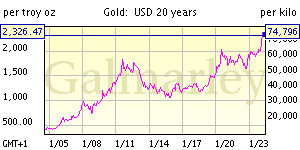
Just as Hebrew is the language of God's economy, in the not too distant future, gold will once again be the language of the world's economy as the paper money of today's world yields once again to the money of last resort..... gold.
Consider the following comments this week from Casey Research's Daily Dispatch:
"Morgan Stanley reported in 2009 that there's "no historical precedent" for an economy that exceeds a 250% debt-to-GDP ratio without experiencing some sort of financial crisis or high inflation. Our total debt now exceeds GDP by roughly 400%."
"Investment legend Marc Faber reports that once a country's payments on debt exceed 30% of tax revenue, the currency is "done for." On our current path, analyst Michael Murphy projects we'll hit that figure by October."
It's a sad day for us as Americans when we must concede that our dollar is the equivalent of the Russian language in the above joke.... a cheap impostor. But as investors in gold already know, just as Hebrew is the perfect heavenly language, so also was gold created by God as perfect money and the day is fast approaching when all will understand this truth.
Got gold?
![[Most Recent Quotes from www.kitco.com]](http://www.kitconet.com/images/quotes_7a.gif)
Ed Steer's Gold and Silver Daily
24hGold.com RSS Feed - Gold and Silver Market Analysis
24hGold.com RSS Feed - Gold and Silver Editorials
Whiskey & Gunpowder
Numismatic News
Click to Enlarge
Close Call For US Banks


Will You Get Paid?
The following article points out the real possibility that some government obligations might be unpaid. Will that be your Social Security check? Your retirement check? Your bank CD?
All good questions that again point out the need to own an asset that is not dependent upon the government for its survival: GOLD.
Federal Reserve Actively Preparing For The Possibility Of U.S. Default
REUTERS - The Federal Reserve is actively preparing for the possibility that the United States could default as a deadline for raising the government's $14.3 trillion borrowing limit looms, a top Fed policymaker said on Wednesday.
Philadelphia Federal Reserve Bank President Charles Plosser said the Fed has for the past few months been working closely with Treasury, ironing out what to do if the world's biggest economy runs out of cash on August 2.
"We are in contingency planning mode," Plosser told Reuters in an interview at the regional central bank's headquarters in Philadelphia. "We are all engaged ... It's a very active process."
Plosser said his "gut feeling" was that President Barack Obama and Congress will come to an agreement to increase the Treasury's borrowing authority in time to avert a default on government obligations.
Obama was due to meet with top Republicans in Congress on Wednesday to discuss the latest attempts to end the dispute over raising the country's debt ceiling, a row which has raised the prospect of the Treasury Department running out of money to pay its bills next month.
The Treasury has repeatedly said default was unthinkable and that there was no alternative to raising the debt ceiling, and Plosser's remarks marked the most extensive public comments on the matter from a U.S. official.
One aspect of the Fed's contingency planning is purely operational: the Fed is developing procedures about how the Treasury will let it know which checks will get cleared and which won't, Plosser said.
The Fed effectively acts as the Treasury's bank -- it clears the government's checks to everyone from social security recipients to government workers.
"We are developing processes and procedures by which the Treasury communicates to us what we are going to do," Plosser said, adding that the task was manageable. "How the Fed is going to go about clearing government checks. Which ones are going to be good? Which ones are not going to be good?"
"There are a lot of people working on what we would do and how we would do it," he said.
Plosser added that there are difficult questions that the Fed itself had to grapple with.
The Fed lends to banks at the discount window against good collateral. But what happens if U.S. Treasuries no longer fit that bill?
"Do we treat them as if they didn't default, in which case we would be saying we are pretending it never happened? Or do we treat them as if they defaulted and don't lend against them?" Plosser said. "Those are more policy questions."
Plosser, who was a vocal critic of some of the Fed's extraordinary lending during the financial crisis -- which he said veered into fiscal policy and risked the central bank's independence -- warned it would be crucial for the Fed not to do the Treasury's work for it.
"We have to be very careful that we don't become, that we don't conduct fiscal policy in this context," he said. "That we don't substitute for the inability of the Treasury to borrow in some circumstances."
That said, the Fed, which is charged with ensuring financial stability, would clearly feel the responsibility to step in as a lender of last resort if markets seized up after a U.S. default, he added.
Fed Chairman Ben Bernanke last week warned that a default could have "catastrophic" effects on financial markets.
Plosser, a former dean of the Simon School of Business at Rochester University, was more circumspect.
"It could be very bad. At some level we don't really know what the consequences could be. It could be very serious. It could be less serious. Do we really want to run that experiment?"
Plosser is a voting member of the Fed's monetary policy-setting committee this year.
The following article points out the real possibility that some government obligations might be unpaid. Will that be your Social Security check? Your retirement check? Your bank CD?
All good questions that again point out the need to own an asset that is not dependent upon the government for its survival: GOLD.
Federal Reserve Actively Preparing For The Possibility Of U.S. Default
REUTERS - The Federal Reserve is actively preparing for the possibility that the United States could default as a deadline for raising the government's $14.3 trillion borrowing limit looms, a top Fed policymaker said on Wednesday.
Philadelphia Federal Reserve Bank President Charles Plosser said the Fed has for the past few months been working closely with Treasury, ironing out what to do if the world's biggest economy runs out of cash on August 2.
"We are in contingency planning mode," Plosser told Reuters in an interview at the regional central bank's headquarters in Philadelphia. "We are all engaged ... It's a very active process."
Plosser said his "gut feeling" was that President Barack Obama and Congress will come to an agreement to increase the Treasury's borrowing authority in time to avert a default on government obligations.
Obama was due to meet with top Republicans in Congress on Wednesday to discuss the latest attempts to end the dispute over raising the country's debt ceiling, a row which has raised the prospect of the Treasury Department running out of money to pay its bills next month.
The Treasury has repeatedly said default was unthinkable and that there was no alternative to raising the debt ceiling, and Plosser's remarks marked the most extensive public comments on the matter from a U.S. official.
One aspect of the Fed's contingency planning is purely operational: the Fed is developing procedures about how the Treasury will let it know which checks will get cleared and which won't, Plosser said.
The Fed effectively acts as the Treasury's bank -- it clears the government's checks to everyone from social security recipients to government workers.
"We are developing processes and procedures by which the Treasury communicates to us what we are going to do," Plosser said, adding that the task was manageable. "How the Fed is going to go about clearing government checks. Which ones are going to be good? Which ones are not going to be good?"
"There are a lot of people working on what we would do and how we would do it," he said.
Plosser added that there are difficult questions that the Fed itself had to grapple with.
The Fed lends to banks at the discount window against good collateral. But what happens if U.S. Treasuries no longer fit that bill?
"Do we treat them as if they didn't default, in which case we would be saying we are pretending it never happened? Or do we treat them as if they defaulted and don't lend against them?" Plosser said. "Those are more policy questions."
Plosser, who was a vocal critic of some of the Fed's extraordinary lending during the financial crisis -- which he said veered into fiscal policy and risked the central bank's independence -- warned it would be crucial for the Fed not to do the Treasury's work for it.
"We have to be very careful that we don't become, that we don't conduct fiscal policy in this context," he said. "That we don't substitute for the inability of the Treasury to borrow in some circumstances."
That said, the Fed, which is charged with ensuring financial stability, would clearly feel the responsibility to step in as a lender of last resort if markets seized up after a U.S. default, he added.
Fed Chairman Ben Bernanke last week warned that a default could have "catastrophic" effects on financial markets.
Plosser, a former dean of the Simon School of Business at Rochester University, was more circumspect.
"It could be very bad. At some level we don't really know what the consequences could be. It could be very serious. It could be less serious. Do we really want to run that experiment?"
Plosser is a voting member of the Fed's monetary policy-setting committee this year.
Subscribe to:
Posts (Atom)