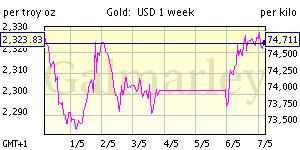
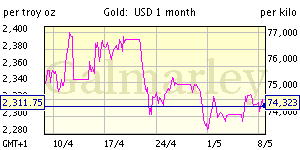
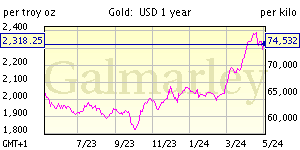
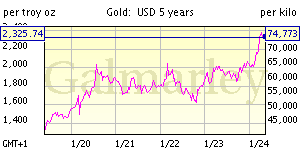
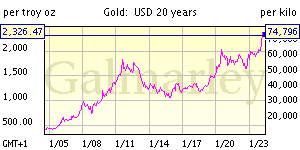
Short Term Rally
This most recent rally has a lot of us gold bulls wondering if we might see a short term correction here pretty soon. I thought this little paragraph from Rick's Picks had a good insight into that question:
As a practical matter, the best we can do for now is monitor gold and silver prices very closely whenever they reach our proprietary rally targets. Our current forecast leaves room for both to achieve at least somewhat higher highs before there’s reason for caution. (If you are not a subscriber but would like to access Rick’s Picks’ precise numbers and detailed trading instructions, click here for a free trial to the service. And if you want to learn more about our forecasting technique itself, click here.) As always, if the price targets should be easily exceeded, that will allow us to stick confidently with the trend. It is only when the corrective selloffs overshoot their respective targets that we might raise a yellow flag. So far, however, sellers have been unable to push either gold or silver beyond the midpoint of corrective patterns, and that is why we continue to urge subscribers to stay aboard.
![[Most Recent Quotes from www.kitco.com]](http://www.kitconet.com/images/quotes_7a.gif)
Click to Enlarge
Close Call For US Banks


Monetary Base Reveals The Future of Gold
Gold is a financial thermometer. It measures monetary responsibility. Money/currency is simply a measure of the wealth of a country. When too much money is printed, it becomes an inaccurate measure of wealth, therefore the prices of the wealth that the paper money is supposed to represent have to be adjusted. That is the purpose of gold. When a country prints money in excess of the true wealth that the country produces, then gold adjusts upwards in price to account for the discrepancy.
Below is a chart of the US money supply. Notice that it has almost tripled in the last three years.

Click chart to enlarge
Unless our economy miraculously begins to produce triple its current output, then you can look for gold and other natural resources to increase in price to account for the difference.
How much of an increase?
Gold should level out around $2,800/ounce assuming da boyz in DC curtain their overspending, but, seeing how that is highly unlikely, I feel $2,800 gold is already baked into the cake. Any further monetary shenanigans ensure that gold will eventually settle much higher than this level.
Enjoy the ride!
Gold Is Risky
Here's an excerpt from Casey Research's recent missive on gold. Click here to read the rest of the article.
Risk is largely a function of price. And, as a general rule, the higher the price the higher the risk, simply because the supply is likely to go up and the demand to go down – leading to a lower price. So, yes, gold is riskier now, at $1,400, than it was at $700 or at $200. But even when it was at $35, there was a well-known financial commentator named Eliot Janeway (I always thought he was a fool and a blowhard) who was crowing that if the U.S. government didn’t support it at $35, it would fall to $8. In any event, risk is relative. Stocks are very risky today. Bonds are ultra risky. Real estate is in an ongoing bear market. And the dollar is on its way to reaching its intrinsic value. Yes, gold is risky at $1,400. But it is actually less risky than most alternatives.
Here's an excerpt from Casey Research's recent missive on gold. Click here to read the rest of the article.
Risk is largely a function of price. And, as a general rule, the higher the price the higher the risk, simply because the supply is likely to go up and the demand to go down – leading to a lower price. So, yes, gold is riskier now, at $1,400, than it was at $700 or at $200. But even when it was at $35, there was a well-known financial commentator named Eliot Janeway (I always thought he was a fool and a blowhard) who was crowing that if the U.S. government didn’t support it at $35, it would fall to $8. In any event, risk is relative. Stocks are very risky today. Bonds are ultra risky. Real estate is in an ongoing bear market. And the dollar is on its way to reaching its intrinsic value. Yes, gold is risky at $1,400. But it is actually less risky than most alternatives.
Standard & Poor’s Hacks Downgrade..... America!
From Rick's Picks Daily Commentary
And now we learn that Standard & Poor’s, the same unprincipled hacks whose grossly inflated triple-A ratings made America’s real estate boom and still-busting bust possible, has downgraded the USA itself. Or to be more precise, their long-term outlook fell from “stable” to “negative” – a Kremlinesque way of hinting that an actual downgrade from AAA is possible if the U.S. doesn’t get its fiscal house in order (as though that were even possible, given that the Federal debt is $14.3 trillion and climbing, and that the economy is on a permanent respirator). And whose payroll is S&P on, we wonder? Until yesterday, we thought they were so busy putting the screws to Europe’s financial cripples that there wasn’t time or manpower enough to pore over America’s books. Now, it would appear, they’ve found actual fiscal problems to worry about even if the real worries eupted like Vesuvius three years ago. And another thing: Whenever they slam the PIIGS by taking their credit ratings down a peg or two, it is usually to buoy the U.S. dollar that day so that Little Timmy Geithner’s pep talk at some Rotary Club luncheon gets good press. Whatever the reason for yesterday’s downgrade – about as shocking to millions of Americans as the revelation that Liberace was gay – it was fun to watch the bond market react.
From Rick's Picks Daily Commentary
And now we learn that Standard & Poor’s, the same unprincipled hacks whose grossly inflated triple-A ratings made America’s real estate boom and still-busting bust possible, has downgraded the USA itself. Or to be more precise, their long-term outlook fell from “stable” to “negative” – a Kremlinesque way of hinting that an actual downgrade from AAA is possible if the U.S. doesn’t get its fiscal house in order (as though that were even possible, given that the Federal debt is $14.3 trillion and climbing, and that the economy is on a permanent respirator). And whose payroll is S&P on, we wonder? Until yesterday, we thought they were so busy putting the screws to Europe’s financial cripples that there wasn’t time or manpower enough to pore over America’s books. Now, it would appear, they’ve found actual fiscal problems to worry about even if the real worries eupted like Vesuvius three years ago. And another thing: Whenever they slam the PIIGS by taking their credit ratings down a peg or two, it is usually to buoy the U.S. dollar that day so that Little Timmy Geithner’s pep talk at some Rotary Club luncheon gets good press. Whatever the reason for yesterday’s downgrade – about as shocking to millions of Americans as the revelation that Liberace was gay – it was fun to watch the bond market react.
More Spin
Hey everybody! Good news! The recession is over!
How do I know this? Because Bloomberg said so! (They wouldn't lie would they?)
[Bloomberg] In the nation’s capitals, from Trenton, New Jersey, to Phoenix, Arizon, tax-leery businesses and the Republican politics of fiscal restraint are making unemployment benefits the next program to face cuts because of the fiscal turmoil that’s persisted since the recession ended almost two years ago.
Did you catch that? "The recession ended almost two years ago!"
And this comment is buried in an article discussing how states no longer have enough funds to continue to play unemployment benefits because the number of unemployed continues to rise!
Wow. Talk about journalistic schizophrenia, this article should win an award. But again, as long as it keeps the sheeple blind to the truth, that let's the rest of us continue to quietly accumulate precious metals at these ridiculously depressed prices.
You go Bloomberg!
Hey everybody! Good news! The recession is over!
How do I know this? Because Bloomberg said so! (They wouldn't lie would they?)
[Bloomberg] In the nation’s capitals, from Trenton, New Jersey, to Phoenix, Arizon, tax-leery businesses and the Republican politics of fiscal restraint are making unemployment benefits the next program to face cuts because of the fiscal turmoil that’s persisted since the recession ended almost two years ago.
Did you catch that? "The recession ended almost two years ago!"
And this comment is buried in an article discussing how states no longer have enough funds to continue to play unemployment benefits because the number of unemployed continues to rise!
Wow. Talk about journalistic schizophrenia, this article should win an award. But again, as long as it keeps the sheeple blind to the truth, that let's the rest of us continue to quietly accumulate precious metals at these ridiculously depressed prices.
You go Bloomberg!
Reader Email
Got an email recently alerting me to the latest push by our beloved Washington leadership toward smart chip technology. The reader's concern was that pretty soon they'd have complete control over everything we do. Here's my responding email.
Dear Friend,
Thanks for the article! Scanned it. Looks like pretty much of an upgrade of what we already have with credit cards and social security numbers. To me though, it’s not really any scarier than what we have now, just much more efficient. Should be an easy sell to the public. Anything that makes life easier and “safer” will be welcomed.
Regarding the mark of the beast and their ultimate control of us, most Americans are already there! I’d say that if cash were to be outlawed now and everyone forced to use credit cards or something like them, then they’d have full control already without any chips. Chips are just the logical next step. Already, hardly anyone uses cash anymore and as soon as cash is eliminated, then they have full control, WITH OR WITHOUT chips.
I see this same principle at work in my business. This is no different than the fact that most employees today contribute to company sponsored retirement plans without even being forced. They WILLINGLY enslave themselves! LOL.
Employees take the bribe (matching contribution) and then the govt knows exactly what you have and were it is. They will control how much tax you pay on it when you take it out, and they even control what it is invested in. Never forget, you can only choose what your employer provides, and that list of approved investments is decided by whoever the investment firm is that is handling that account. And what are they gonna push? Mutual funds and all kinds of other worthless paper investments that will ultimately leave you penniless…..by design.
Of course, these investment guys are in bed with the same Fed that is pumping up this worthless stock and bond market. If they can keep the unaware public continuing to invest in worthless stocks and mutual funds, then the markets keep going higher, thereby continuing the illusion of prosperity. All the while, the unsuspecting public keeps putting their hard earned money in traditional types of investments that are targeted for extinction.
At some point in the future, the powers-that-be will pull the plug on this house of cards. Of course, in the meantime, they’ve socked their wealth away in precious metals, all the while, publicly ridiculing anyone who does the same. Rest assured, Wall Street’s money is not invested in Wall Street. No, theirs is tucked safely away outside of the system.
Then, ultimately, when they get ready to confiscate employee investments so as to have the average American completely destitute and dependent upon the government (can you say slavery?), here’s how it will be done:
1. Stock and bond markets will quit being propped up by the fed through their complicit banking puppets and allowed to “crash”
2. Fear rules the day until employees cry out to the govt for help after seeing their 401k statements fall by 50 – 90%.
3. Govt rides in on the white horse offering to exchange what’s left in your plan for “safe” govt bonds (worthless IOUs).
4. Govt bonds, indexed to artificially low inflation figures, guarantee that the average Joe will never be able to retire which keeps him a serf forever.
Complete control without a shot being fired or even a voice of opposition!
When will that be? Tomorrow? Ten years from now? Who knows.
Oh it’s coming, but I have elected not to participate. You shouldn’t either.
Got gold?
DT
Got an email recently alerting me to the latest push by our beloved Washington leadership toward smart chip technology. The reader's concern was that pretty soon they'd have complete control over everything we do. Here's my responding email.
Dear Friend,
Thanks for the article! Scanned it. Looks like pretty much of an upgrade of what we already have with credit cards and social security numbers. To me though, it’s not really any scarier than what we have now, just much more efficient. Should be an easy sell to the public. Anything that makes life easier and “safer” will be welcomed.
Regarding the mark of the beast and their ultimate control of us, most Americans are already there! I’d say that if cash were to be outlawed now and everyone forced to use credit cards or something like them, then they’d have full control already without any chips. Chips are just the logical next step. Already, hardly anyone uses cash anymore and as soon as cash is eliminated, then they have full control, WITH OR WITHOUT chips.
I see this same principle at work in my business. This is no different than the fact that most employees today contribute to company sponsored retirement plans without even being forced. They WILLINGLY enslave themselves! LOL.
Employees take the bribe (matching contribution) and then the govt knows exactly what you have and were it is. They will control how much tax you pay on it when you take it out, and they even control what it is invested in. Never forget, you can only choose what your employer provides, and that list of approved investments is decided by whoever the investment firm is that is handling that account. And what are they gonna push? Mutual funds and all kinds of other worthless paper investments that will ultimately leave you penniless…..by design.
Of course, these investment guys are in bed with the same Fed that is pumping up this worthless stock and bond market. If they can keep the unaware public continuing to invest in worthless stocks and mutual funds, then the markets keep going higher, thereby continuing the illusion of prosperity. All the while, the unsuspecting public keeps putting their hard earned money in traditional types of investments that are targeted for extinction.
At some point in the future, the powers-that-be will pull the plug on this house of cards. Of course, in the meantime, they’ve socked their wealth away in precious metals, all the while, publicly ridiculing anyone who does the same. Rest assured, Wall Street’s money is not invested in Wall Street. No, theirs is tucked safely away outside of the system.
Then, ultimately, when they get ready to confiscate employee investments so as to have the average American completely destitute and dependent upon the government (can you say slavery?), here’s how it will be done:
1. Stock and bond markets will quit being propped up by the fed through their complicit banking puppets and allowed to “crash”
2. Fear rules the day until employees cry out to the govt for help after seeing their 401k statements fall by 50 – 90%.
3. Govt rides in on the white horse offering to exchange what’s left in your plan for “safe” govt bonds (worthless IOUs).
4. Govt bonds, indexed to artificially low inflation figures, guarantee that the average Joe will never be able to retire which keeps him a serf forever.
Complete control without a shot being fired or even a voice of opposition!
When will that be? Tomorrow? Ten years from now? Who knows.
Oh it’s coming, but I have elected not to participate. You shouldn’t either.
Got gold?
DT
Spin 101
US consumer inflation gains most in 15 months as food and petrol prices increase
The US Labor Department said that consumer prices climbed a higher-than-expected 2.7pc in March from a year before. Almost three quarters of the rise was due to surging food and petrol prices, with petrol costs climbing 5.6pc, the ninth straight month of increases. Food rose 0.8pc in March, the largest gain since July 2008.
The above headline and paragraph was from a story posted at The Telegraph in Great Britain on Friday afternoon. However, such negative truth-telling cannot be allowed on US shores. The Bloomberg "spin" on the same numbers was entirely different. Their headline read "Inflation Cooled in March Outside of Food, Fuel". It's hard to believe that both stories are referring to the same subject...but they are.
Since most of the US public gets their news from "trusted" US sources, it's no wonder that the average American still doesn't own gold. Why should they? Everything is improving, right?
I've got a feeling that such blindness on the part of the US public will continue right up till the end, and then the resulting stampede for gold and silver will result in no supply at any price. And for the rest of us? Well, "spin" is our friend, allowing us to continue to accumulate at these suppressed prices!
Yes, spin is our friend!
US consumer inflation gains most in 15 months as food and petrol prices increase
The US Labor Department said that consumer prices climbed a higher-than-expected 2.7pc in March from a year before. Almost three quarters of the rise was due to surging food and petrol prices, with petrol costs climbing 5.6pc, the ninth straight month of increases. Food rose 0.8pc in March, the largest gain since July 2008.
The above headline and paragraph was from a story posted at The Telegraph in Great Britain on Friday afternoon. However, such negative truth-telling cannot be allowed on US shores. The Bloomberg "spin" on the same numbers was entirely different. Their headline read "Inflation Cooled in March Outside of Food, Fuel". It's hard to believe that both stories are referring to the same subject...but they are.
Since most of the US public gets their news from "trusted" US sources, it's no wonder that the average American still doesn't own gold. Why should they? Everything is improving, right?
I've got a feeling that such blindness on the part of the US public will continue right up till the end, and then the resulting stampede for gold and silver will result in no supply at any price. And for the rest of us? Well, "spin" is our friend, allowing us to continue to accumulate at these suppressed prices!
Yes, spin is our friend!
Wall St. Stands at the Pinnacle of 5,000 Years of Human Exploitation
Most of the economic, social, and
environmental pathologies of our time—including sexism, racism, economic
injustice, violence, and environmental destruction—originate in the institutions
of Empire. The resulting exploitation has reached the limits that the social
fabric and Earth’s natural systems will endure.
As powerful as Wall Street appears to be, its
abuse of power has so eroded the economic, social, and environmental foundations
of its own existence that its fate is sealed. We the People have a choice. We
can allow Wall Street to maintain its grip until it brings down the whole of
human civilization in irrevocable social and environmental collapse. Or we can
take control of our future and replace the Wall Street economy with the values and institutions of a New Economy comprised of
locally owned businesses devoted to serving their communities by investing in
the use of local resources to produce real goods and services responsive to
local needs.
Either way, Wall Street’s days are numbered.
Ours need not be.
Can You Pass The 2011 Gold Quiz?
By Jeff Clark, BIG GOLD
CPM Group recently released their 2011 Gold Yearbook, an invaluable resource for us gold analysts. Mostly a reference book, even a gold enthusiast might find it dry reading. But I loved it, and as I studied it on a plane, I kept finding data that made me perk up.
To have a little fun with it, I thought I’d summarize what I read in the form of a quiz. See how many you can get correct. Regardless of your score, I’m sure you’ll agree with the ramifications each point makes for the gold market.
I’ll start off easy…
Worldwide investment demand for gold totaled 44 million ounces in 2010. Because of the growing demand by investors, prices have been forced upward.
→Five exchanges began trading gold contracts for the first time in 2010, and three more introduced mini contracts, collectively the largest number launched since the early ‘80s. There are now 24 gold vending machines in seven countries, with three more countries adding machines this year.
Households in developing countries are now moving away from gold jewelry and buying coins and bars for their savings. I could go on, but suffice it to say that investment demand will continue to be very strong.
Scrap rose three consecutive years in a row – until last year. Gold supply from scrap fell 2.1%, to 42.2 million ounces.
→This is significant because gold prices were higher, which would normally increase the amount of scrap coming to market. One of the primary reasons scrap dropped is because investors are holding on to their metal, reportedly because they believe prices are headed higher. Isn’t that one reason you’re holding on to your bullion?
Global fears increasingly led investors to purchase large volumes of gold in 2010 for safe-haven purposes, despite record price levels.
→High levels of investment buying are expected to continue in 2011 because virtually none of the economic, political, and monetary concerns have been resolved.
If you got all three answers correct, you’re an investor who understands the basic reasons for owning gold and that those reasons are still in play.
Now let’s step it up a little…
→While up nine years in a row and triple what it represented in 2001, gold is still a miniscule portion of the world’s private wealth. It represented 2.8% of global assets in 1980, four times what it does today.
Russia, Thailand, Belarus, Bangladesh, Venezuela, Tajikistan, Ukraine, Jordan, Philippines, South Africa, Sri Lanka, Germany, Kazakhstan, Mexico, Greece, Pakistan, Belgium, Czech Republic, and Malta = 19. Central banks as a group are expected to continue to be net buyers of the metal for the foreseeable future.
→It’s interesting that most purchases were from developing countries, unsurprising when you consider they’ve accumulated over $5 trillion in foreign exchange reserves just since 2002.
The U.S. Mint sold 1.43 million ounces last year, down 12% from the 1.62 million ounces sold in 2009. You might think this is negative until you realize that global coin sales rose 21% last year, reaching 6.3 million ounces. Makes you wonder what other countries know that many North Americans don’t.
→Supply problems continue to plague the U.S. Mint, evidenced by the fact that Buffalo sales were suspended for half the year.What happens when the greater population begins to clamor to buy gold? Bottleneck, meet desperation.
Rigid social contracts are so deeply ingrained, especially in the developed world, that it will take decades to resolve the monetary imbalances.
→This sobering fact means gold will likely be in a bull market for many years to come. There are very few options to deal with the overwhelming debt burden in most of these countries: raise taxes, cut spending, increase growth, or print money. Guess which one is most likely? Inflation from currency dilution is baked in the cake and will spur further gold demand and light a fire under the price.
If you got these four questions correct, I think it means you’re an astute investor who doesn’t worry about day-to-day price fluctuations and instead focuses on owning enough ounces to protect your assets from the huge and intractable fiscal problems that still have to be faced.
This data clarifies and confirms why many investors own gold and continue buying it. It paints a decidedly bullish picture for the metal, in spite of record price levels. Monetary issues are far from over, won’t be easily resolved, and will take years to play out. Banks continue buying, and investors aren’t selling. The U.S. Mint can’t keep up with demand, and yet gold is underowned when compared to other major asset classes. Costs are rising for the producers, but margins are rising faster for the better-run companies.
When looking at the big picture for gold, I for one draw comfort from knowing I’ve got some ounces tucked away. I hope you, too, see gold for what it is – protection against unsustainable fiscal imbalances and massive currency debasement, and a profit center for years to come.
By Jeff Clark, BIG GOLD
CPM Group recently released their 2011 Gold Yearbook, an invaluable resource for us gold analysts. Mostly a reference book, even a gold enthusiast might find it dry reading. But I loved it, and as I studied it on a plane, I kept finding data that made me perk up.
To have a little fun with it, I thought I’d summarize what I read in the form of a quiz. See how many you can get correct. Regardless of your score, I’m sure you’ll agree with the ramifications each point makes for the gold market.
I’ll start off easy…
1) The main driver behind rising gold prices over the past decade is:
a) Increased jewelry demand in India
b) Greater industrial uses of the metal
c) Investment demand
b) Greater industrial uses of the metal
c) Investment demand
→Five exchanges began trading gold contracts for the first time in 2010, and three more introduced mini contracts, collectively the largest number launched since the early ‘80s. There are now 24 gold vending machines in seven countries, with three more countries adding machines this year.
Households in developing countries are now moving away from gold jewelry and buying coins and bars for their savings. I could go on, but suffice it to say that investment demand will continue to be very strong.
2) True or false: recovery from gold scrap was lower in 2010 than 2009.
→This is significant because gold prices were higher, which would normally increase the amount of scrap coming to market. One of the primary reasons scrap dropped is because investors are holding on to their metal, reportedly because they believe prices are headed higher. Isn’t that one reason you’re holding on to your bullion?
3) There are many reasons investors have been buying gold over the past 10 years, but what is the #1 reason?
a) Safe-haven asset
b) Gold coins and bars have become more intricate, widespread, and beautiful
c) Supply and demand imbalance
b) Gold coins and bars have become more intricate, widespread, and beautiful
c) Supply and demand imbalance
→High levels of investment buying are expected to continue in 2011 because virtually none of the economic, political, and monetary concerns have been resolved.
If you got all three answers correct, you’re an investor who understands the basic reasons for owning gold and that those reasons are still in play.
Now let’s step it up a little…
4) Gold represented what percent of global financial assets at the end of 2010?
a) 3.1%
b) 0.7%
c) 1.6%
d) 2.4%
The estimated value of investor gold holdings stood at $1.5 trillion at the end of last year, about 0.7% of global financial assets.b) 0.7%
c) 1.6%
d) 2.4%
→While up nine years in a row and triple what it represented in 2001, gold is still a miniscule portion of the world’s private wealth. It represented 2.8% of global assets in 1980, four times what it does today.
5) How many central banks increased their gold holdings in 2010?
a) 9
b) 12
c) 15
d) 19
b) 12
c) 15
d) 19
→It’s interesting that most purchases were from developing countries, unsurprising when you consider they’ve accumulated over $5 trillion in foreign exchange reserves just since 2002.
6) Compared to 2009,U.S. Mint gold coin sales in 2010 were:
a) Down 12%
b) Up 8%
c) Up 5%
d) Up 3%
b) Up 8%
c) Up 5%
d) Up 3%
→Supply problems continue to plague the U.S. Mint, evidenced by the fact that Buffalo sales were suspended for half the year.What happens when the greater population begins to clamor to buy gold? Bottleneck, meet desperation.
7) CPM estimates that the fiscal and monetary imbalances, especially in developed countries, could take how long to resolve?
a) 1 year
b) Decades
c) 5 years
d) 2 years
b) Decades
c) 5 years
d) 2 years
→This sobering fact means gold will likely be in a bull market for many years to come. There are very few options to deal with the overwhelming debt burden in most of these countries: raise taxes, cut spending, increase growth, or print money. Guess which one is most likely? Inflation from currency dilution is baked in the cake and will spur further gold demand and light a fire under the price.
If you got these four questions correct, I think it means you’re an astute investor who doesn’t worry about day-to-day price fluctuations and instead focuses on owning enough ounces to protect your assets from the huge and intractable fiscal problems that still have to be faced.
This data clarifies and confirms why many investors own gold and continue buying it. It paints a decidedly bullish picture for the metal, in spite of record price levels. Monetary issues are far from over, won’t be easily resolved, and will take years to play out. Banks continue buying, and investors aren’t selling. The U.S. Mint can’t keep up with demand, and yet gold is underowned when compared to other major asset classes. Costs are rising for the producers, but margins are rising faster for the better-run companies.
When looking at the big picture for gold, I for one draw comfort from knowing I’ve got some ounces tucked away. I hope you, too, see gold for what it is – protection against unsustainable fiscal imbalances and massive currency debasement, and a profit center for years to come.
Gold Returns

Gold's has averaged an 18.37% return for the last 10 years. With gold beginning 2011 at $1388/ounce, an 18.37% return will put gold at $1,643 by year end. Of course, that's just the average. Any number of political, economic and military events could send it much higher. So the question remains, "what are you waiting for?"

Richard Russell - Buy Pullbacks in Gold & Ignore the Top Callers
With gold and silver consolidating recent gains, the Godfather of newsletter writers Richard Russell had some interesting things to say in his latest commentary, “In all my years of investing, I have never seen an asset hit record highs, as gold has done recently, with less fanfare. There were no front page stories in the Wall Street Journal or Financial Times, heralding the new milestones." Fred Hickey, editor of the High-Tech Strategist and a member of Barron's Roundtable.”
After quoting Hickey, Russell continued:
“Gold is another story. The daily chart (above) shows gold breaking out of a head-and-shoulders bottom to the upside. Course of action -- sit with your precious metal position. Buy more on any pull-back toward the line of support (line of support is now at about 1450).
Russell comments on gold and silver -- Because the precious metals are in a massive bull market, many eager amateur analysts are now trying their hand on calling "the top." This is a hopeless and ridiculous endeavor during a powerful bull market. Much of this top-calling is done by an anti-gold element: Those who dislike gold or those who have missed the entire gold bull market. My advice all along has been to "ride the bull" and to ignore the "top callers."
The precious metals will correct when they are ready, and I might add that in ten years of closely following gold and silver, I have never come across anyone who has successfully called tops or who has successfully traded in-and-out of the metals. Advice -- stay invested in the metals until they exhaust themselves in panic buying.
Even then, what would you sell you gold for -- more fiat paper? We'll talk about selling precious metals when the time comes, which may be months or even years in the future.
Last, we turn to the Dollar Index...The Index is perched precariously above the critical 75 level with MACD in the process of turning negative.
A much longer view of the Dollar Index....Major critical support comes in at 70.69. I would think anything below 70 might set off a dollar panic.”
Gold has broken out above the $1,450 area and as Russell says, generally you want to buy on pullbacks toward that level. The public might be too skittish to do that, but the professionals certainly will. If that level holds, it will provide the base for the next leg higher in gold. For the non-professionals, simply accumulate each month on the same day and dollar cost average your purchases over time. This is a huge secular bull market, enjoy the ride. As far as the US dollar goes, God help us when we finally break 70 on that index.
With gold and silver consolidating recent gains, the Godfather of newsletter writers Richard Russell had some interesting things to say in his latest commentary, “In all my years of investing, I have never seen an asset hit record highs, as gold has done recently, with less fanfare. There were no front page stories in the Wall Street Journal or Financial Times, heralding the new milestones." Fred Hickey, editor of the High-Tech Strategist and a member of Barron's Roundtable.”
After quoting Hickey, Russell continued:
“Gold is another story. The daily chart (above) shows gold breaking out of a head-and-shoulders bottom to the upside. Course of action -- sit with your precious metal position. Buy more on any pull-back toward the line of support (line of support is now at about 1450).
Russell comments on gold and silver -- Because the precious metals are in a massive bull market, many eager amateur analysts are now trying their hand on calling "the top." This is a hopeless and ridiculous endeavor during a powerful bull market. Much of this top-calling is done by an anti-gold element: Those who dislike gold or those who have missed the entire gold bull market. My advice all along has been to "ride the bull" and to ignore the "top callers."
The precious metals will correct when they are ready, and I might add that in ten years of closely following gold and silver, I have never come across anyone who has successfully called tops or who has successfully traded in-and-out of the metals. Advice -- stay invested in the metals until they exhaust themselves in panic buying.
Even then, what would you sell you gold for -- more fiat paper? We'll talk about selling precious metals when the time comes, which may be months or even years in the future.
Last, we turn to the Dollar Index...The Index is perched precariously above the critical 75 level with MACD in the process of turning negative.
A much longer view of the Dollar Index....Major critical support comes in at 70.69. I would think anything below 70 might set off a dollar panic.”
Gold has broken out above the $1,450 area and as Russell says, generally you want to buy on pullbacks toward that level. The public might be too skittish to do that, but the professionals certainly will. If that level holds, it will provide the base for the next leg higher in gold. For the non-professionals, simply accumulate each month on the same day and dollar cost average your purchases over time. This is a huge secular bull market, enjoy the ride. As far as the US dollar goes, God help us when we finally break 70 on that index.
$10,000 Gold?
excerpted from Rick Ackerman's daily column
And how about all of those dreamers who think gold will soar to $10,000 an ounce or more when the financial day of reckoning arrives? I used to believe this impossible, but the forum discussion got me to thinking: Suppose the dollar is falling apart one day and all of those who hold paper gold in the form of futures contracts determine to take delivery? Would gold get short-squeezed into the ionosphere under such circumstances? Or would the futures exchanges simply change the rules, letting those who are short contracts slip the noose? No one can say for sure.
Nor can anyone predict how politicians will react if and when the financial system collapses. Will they push the Fed to hyperinflate, effectively bailing out homeowners? And if they do, will the legislated action succeed? One thing’s for sure: hyperinflation cannot possible occur by accident; it can only be enabled by political decision. Under the circumstances, it is impossible to predict exactly what will happen if the dollar crashes.
excerpted from Rick Ackerman's daily column
And how about all of those dreamers who think gold will soar to $10,000 an ounce or more when the financial day of reckoning arrives? I used to believe this impossible, but the forum discussion got me to thinking: Suppose the dollar is falling apart one day and all of those who hold paper gold in the form of futures contracts determine to take delivery? Would gold get short-squeezed into the ionosphere under such circumstances? Or would the futures exchanges simply change the rules, letting those who are short contracts slip the noose? No one can say for sure.
Nor can anyone predict how politicians will react if and when the financial system collapses. Will they push the Fed to hyperinflate, effectively bailing out homeowners? And if they do, will the legislated action succeed? One thing’s for sure: hyperinflation cannot possible occur by accident; it can only be enabled by political decision. Under the circumstances, it is impossible to predict exactly what will happen if the dollar crashes.
Where Is America's Gold?: The Mystery of Ft. Knox
by Chris Weber Global Opportunities Report
What Do They Have to Hide? In a few months we'll "celebrate" the 40th anniversary of the day when the US Government declared bankruptcy. Oh, they didn't call it that at the time. But what happened on August 15, 1971 was that the US defaulted on its promise to pay gold for dollars. It is now clear that they didn't have very much gold left to pay.
My new book, Good As Gold? is now available. I've tried to make it a clear and readable history of what happened to the gold confiscated from Americans and put into Fort Knox in the 1930s. I've used the government's own words and statements to paint a picture I think is shocking. There has never been an accounting of this gold. There has never been a real audit of it. (I know people say there was one in 1953, but after reading my book, I wonder if anyone really can believe this.)
At every turn when the government was asked to provide proof of either the amount of gold they have left, or the quality of it, they have answered with lies and evasions. They have been acting like they have something to hide.
What we do know is that until August 15, 1971 any foreign central bank could go to the US Treasury and buy official US gold at $35 per ounce. It was the last link to the international gold standard. Before then, all currencies were defined in terms of the US dollar, and the US dollar was defined in terms of gold. A dollar equaled 1/35th of an ounce of gold; $35 equaled one troy ounce of gold.
But on that day the gold window closed. Since then, no more US government gold has been exchanged for US paper money. In my book, I uncover a 1975 letter from the Washington DC director of the General Accounting Office. Quoting US Treasury sources, the GAO director pretty much comes out and says that there was almost no more "good delivery" gold left. This means that the gold that would be acceptable on international markets and have a purity of .995 or better was almost gone by the time Nixon closed the gold window. They knew that there was almost nothing left that was of a purity acceptable to foreign central banks.
We can only guess at what remains, and the purity of it. In fact, we could do more than guess, if the government only let sunlight in. The technology now exists to scan each bar of gold and see how much gold it really contains. There could be independent accountants and a generally public procedure to show how much the US government has.
To be sure, the US government puts out a report each year detailing the official numbers of what they have. Here is the latest one from a few weeks ago:

Deep Storage: Deep-Storage gold is the portion of the U.S. government-owned Gold Bullion Reserve that the U.S. Mint secures in sealed vaults, which are examined annually by the Department of Treasury's Office of the Inspector General. Deep-Storage gold comprises the vast majority of the Reserve and consists primarily of gold bars. This portion was formerly called "Bullion Reserve" or "Custodial Gold Bullion Reserve."
Working Stock: Working-Stock gold is the portion of the U.S. government-owned Gold Bullion Reserve that the U.S. Mint uses as the raw material for minting congressionally authorized coins. Working-Stock gold comprises only about 1 percent of the Reserve and consists of bars, blanks, unsold coins, and condemned coins. This portion was formerly listed as individual coins and blanks or called "PEF Gold."
So this is what the US government says they have, and where they have it. In fact, by their own words, nearly all of it is in what they call "Deep Storage". The gold here is not examined annually. Instead, the "sealed vaults" are examined annually. But what this means is that they just do a cursory check to see if the seal has been broken.
By the way, the "book value" of this gold is absurd. It is officially valued at $42.22 per ounce. This is because that was the last "official" value of the US dollar. A few months after the August 15, 1971 closing of the gold window, Nixon devalued the US dollar. This was on December 17, 1971. The official gold price was raised from $35 to $42.22.
But this new price meant nothing. They still weren't going to sell gold at this new, slightly higher rate. It was really a sham. Other countries had long been after the US to raise the official gold price, so Nixon finally did it. But what good did that do when this was the price at which the US would not – repeat, not – redeem its paper dollars into gold?
As I hope my book shows, there has been the atmosphere of a sham – even a fraud – about the US policy toward gold for generations. The Nixon fraud was only one in a series of sham acts.
I don't understand why today's government would be afraid to open the vaults and publicly count and assay the gold. After all, if a lie was revealed they could say that it wasn't their fault: they weren't even born when these policies were put into place.
Officially, the US has by far the largest government reserves of gold in the world. Here are the top eight nations and the amount they have in millions of troy ounces:

So, officially, the US has much more than twice its nearest rival, Germany. It has nearly eight times as much as China – again, officially.
But China has quietly become the world's largest producer of gold, and the Chinese central bank buys 100% of all production at the market price. I'm sure they make certain this gold is of the utmost purity. I'm suspicious of the "official" Chinese total, which I really believe is a state secret, and may be much higher than they state here.
In any event, it is the US gold this article is all about. We need to finally see what is left of the gold that was confiscated from the American people in 1933. We need to know how much is left from the 702 million ounces the US had in 1949, when this was by far the most gold held by one owner in history.
There are elected members of Congress, in both parties, who are ready to try to open the vaults. One of them, Ron Paul, wrote the forward to my book.
Even if a person doesn't understand the importance of gold as an investment, this is a sort of mystery story: What Happened to the Gold? Why have they been acting as if they had something to hide?
by Chris Weber Global Opportunities Report
What Do They Have to Hide? In a few months we'll "celebrate" the 40th anniversary of the day when the US Government declared bankruptcy. Oh, they didn't call it that at the time. But what happened on August 15, 1971 was that the US defaulted on its promise to pay gold for dollars. It is now clear that they didn't have very much gold left to pay.
My new book, Good As Gold? is now available. I've tried to make it a clear and readable history of what happened to the gold confiscated from Americans and put into Fort Knox in the 1930s. I've used the government's own words and statements to paint a picture I think is shocking. There has never been an accounting of this gold. There has never been a real audit of it. (I know people say there was one in 1953, but after reading my book, I wonder if anyone really can believe this.)
At every turn when the government was asked to provide proof of either the amount of gold they have left, or the quality of it, they have answered with lies and evasions. They have been acting like they have something to hide.
What we do know is that until August 15, 1971 any foreign central bank could go to the US Treasury and buy official US gold at $35 per ounce. It was the last link to the international gold standard. Before then, all currencies were defined in terms of the US dollar, and the US dollar was defined in terms of gold. A dollar equaled 1/35th of an ounce of gold; $35 equaled one troy ounce of gold.
But on that day the gold window closed. Since then, no more US government gold has been exchanged for US paper money. In my book, I uncover a 1975 letter from the Washington DC director of the General Accounting Office. Quoting US Treasury sources, the GAO director pretty much comes out and says that there was almost no more "good delivery" gold left. This means that the gold that would be acceptable on international markets and have a purity of .995 or better was almost gone by the time Nixon closed the gold window. They knew that there was almost nothing left that was of a purity acceptable to foreign central banks.
We can only guess at what remains, and the purity of it. In fact, we could do more than guess, if the government only let sunlight in. The technology now exists to scan each bar of gold and see how much gold it really contains. There could be independent accountants and a generally public procedure to show how much the US government has.
To be sure, the US government puts out a report each year detailing the official numbers of what they have. Here is the latest one from a few weeks ago:

Deep Storage: Deep-Storage gold is the portion of the U.S. government-owned Gold Bullion Reserve that the U.S. Mint secures in sealed vaults, which are examined annually by the Department of Treasury's Office of the Inspector General. Deep-Storage gold comprises the vast majority of the Reserve and consists primarily of gold bars. This portion was formerly called "Bullion Reserve" or "Custodial Gold Bullion Reserve."
Working Stock: Working-Stock gold is the portion of the U.S. government-owned Gold Bullion Reserve that the U.S. Mint uses as the raw material for minting congressionally authorized coins. Working-Stock gold comprises only about 1 percent of the Reserve and consists of bars, blanks, unsold coins, and condemned coins. This portion was formerly listed as individual coins and blanks or called "PEF Gold."
So this is what the US government says they have, and where they have it. In fact, by their own words, nearly all of it is in what they call "Deep Storage". The gold here is not examined annually. Instead, the "sealed vaults" are examined annually. But what this means is that they just do a cursory check to see if the seal has been broken.
By the way, the "book value" of this gold is absurd. It is officially valued at $42.22 per ounce. This is because that was the last "official" value of the US dollar. A few months after the August 15, 1971 closing of the gold window, Nixon devalued the US dollar. This was on December 17, 1971. The official gold price was raised from $35 to $42.22.
But this new price meant nothing. They still weren't going to sell gold at this new, slightly higher rate. It was really a sham. Other countries had long been after the US to raise the official gold price, so Nixon finally did it. But what good did that do when this was the price at which the US would not – repeat, not – redeem its paper dollars into gold?
As I hope my book shows, there has been the atmosphere of a sham – even a fraud – about the US policy toward gold for generations. The Nixon fraud was only one in a series of sham acts.
I don't understand why today's government would be afraid to open the vaults and publicly count and assay the gold. After all, if a lie was revealed they could say that it wasn't their fault: they weren't even born when these policies were put into place.
Officially, the US has by far the largest government reserves of gold in the world. Here are the top eight nations and the amount they have in millions of troy ounces:

So, officially, the US has much more than twice its nearest rival, Germany. It has nearly eight times as much as China – again, officially.
But China has quietly become the world's largest producer of gold, and the Chinese central bank buys 100% of all production at the market price. I'm sure they make certain this gold is of the utmost purity. I'm suspicious of the "official" Chinese total, which I really believe is a state secret, and may be much higher than they state here.
In any event, it is the US gold this article is all about. We need to finally see what is left of the gold that was confiscated from the American people in 1933. We need to know how much is left from the 702 million ounces the US had in 1949, when this was by far the most gold held by one owner in history.
There are elected members of Congress, in both parties, who are ready to try to open the vaults. One of them, Ron Paul, wrote the forward to my book.
Even if a person doesn't understand the importance of gold as an investment, this is a sort of mystery story: What Happened to the Gold? Why have they been acting as if they had something to hide?

Guvamint Furloughs
I hate to sound callous, but the truth is, when it comes to guvamint employees, well, I am. Therefore, I found the following story quite an enjoyable read. Only an excerpt is posted. The full story can be found here.
On Furloughs
from the Casey Daily Dispatch
With the furloughs ready to start, I’m again disappointed by the media – as usual. Furloughs are a perk, a privilege of being in the employment of the government. Yet, they are being paraded around as some form of cruel injustice. Don’t even get me started on the articles lamenting how federal employees won’t be allowed to use their government-issued Blackberries. Oh, the horror!
If the government shuts down on Friday, every non-essential government employee should wake up really late in the day, turn on the TV, relax and smile in bliss. After all, they are lucky. When private companies have budget problems, the people on the non-essential worker list don’t get a three-day weekend. They get a six-month “vacation” of filling out resumes, eating Ramen noodles, and worrying about their mortgages.
In comparison, the furloughed government workers will get an extra day to enjoy the Cherry Blossom Festival in D.C. What perfect timing.
On Furloughs
from the Casey Daily Dispatch
With the furloughs ready to start, I’m again disappointed by the media – as usual. Furloughs are a perk, a privilege of being in the employment of the government. Yet, they are being paraded around as some form of cruel injustice. Don’t even get me started on the articles lamenting how federal employees won’t be allowed to use their government-issued Blackberries. Oh, the horror!
If the government shuts down on Friday, every non-essential government employee should wake up really late in the day, turn on the TV, relax and smile in bliss. After all, they are lucky. When private companies have budget problems, the people on the non-essential worker list don’t get a three-day weekend. They get a six-month “vacation” of filling out resumes, eating Ramen noodles, and worrying about their mortgages.
In comparison, the furloughed government workers will get an extra day to enjoy the Cherry Blossom Festival in D.C. What perfect timing.
Gold, Oil and the Arabs
[Source] The Wikileaks/Financial Times revelations on significant gold buying interest in the Middle East — notably Iran’s central bank, Jordan’s central bank and Qatar’s sovereign wealth fund — brought to mind the story of Saudi Arabia’s King Ibn Saud and his sale of oil concessions to the major oil companies. In payment he received 35,000 British sovereigns — a coin many of you hold in your own sovereign wealth fund. The good king understood the difference between the value of gold and the value of a paper promise. At the time (1933), the British sovereign’s value stood at $8.24 each, or $288,365 for the lot. The price of oil was about 85¢ a barrel, and a British sovereign could buy about ten barrels. Today those same sovereigns would bring a little less than $12 million at melt value ($338.00 each) and a barrel of oil is selling for about $115. Thus, a British sovereign can buy a little under three barrels of oil — a statistic which gives you an inkling of gold’s current undervaluation. For gold to buy the same amount of oil now that it did in 1933, the price would have to go to nearly $5000 per ounce — an interesting calculation for those who think gold is overvalued and in a bubble.
[Source] The Wikileaks/Financial Times revelations on significant gold buying interest in the Middle East — notably Iran’s central bank, Jordan’s central bank and Qatar’s sovereign wealth fund — brought to mind the story of Saudi Arabia’s King Ibn Saud and his sale of oil concessions to the major oil companies. In payment he received 35,000 British sovereigns — a coin many of you hold in your own sovereign wealth fund. The good king understood the difference between the value of gold and the value of a paper promise. At the time (1933), the British sovereign’s value stood at $8.24 each, or $288,365 for the lot. The price of oil was about 85¢ a barrel, and a British sovereign could buy about ten barrels. Today those same sovereigns would bring a little less than $12 million at melt value ($338.00 each) and a barrel of oil is selling for about $115. Thus, a British sovereign can buy a little under three barrels of oil — a statistic which gives you an inkling of gold’s current undervaluation. For gold to buy the same amount of oil now that it did in 1933, the price would have to go to nearly $5000 per ounce — an interesting calculation for those who think gold is overvalued and in a bubble.
Subscribe to:
Posts (Atom)