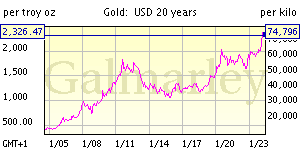
Is Gold's Run-up An Aberation, Or, The Norm?
From the big picture point of view it's becoming increasingly clear that the system is broken and the tools that central banks are using are not the right tools. When you have a broken system, you have to sort of step back and take a look at what's going on. Similarly, if you're driving a car and you press on the throttle and the car doesn't go anywhere - there's something wrong. Well central banks have been pressing on the throttle now for years and the economy is doing nothing - there's obviously something wrong so the talk about more quantitative easing is absolutely foolhardy in my point of view. And when people see central banks talking about more quantitative easing and that it's not doing anything to the economy, the impact means that it's going to destroy the purchasing power of crises from inflation and other problems. So it's quite natural and understandable that in reaction to central bank actions, people are moving back to gold. From a longer-term point of view as well, you have to consider that for thousands of years gold has been the centre of global commerce. We've had four decades now where gold has certainly moved to the side - now are we going to deny thousands of years of history and say the four decades is really the basis for going forward, or are we going to say these four decades have been aberration and in fact are going to come back to gold as a centre of global commerce. I think it's clearly the latter - gold is going to continue emerge because there are attributes that you can find with gold, that have not been lost even though we've ignored those attributes over the past couple of decades - and those are attributes like there is no counter-party risk when you own gold. It's outside the control of governments although they do influence the price, they can't control the price. So as a consequence you're going to see gold continue to move towards its traditional role as money.
Whether we hit that $1,800 or $2,000 target this year or next year really doesn't matter. You're running a bull market and what people have to focus on is continue to accumulate gold because it's still relatively cheap and that's the key thing.
Source
![[Most Recent Quotes from www.kitco.com]](http://www.kitconet.com/images/quotes_7a.gif)
Click to Enlarge
Close Call For US Banks


WSJ Finally Notices Gold’s Bull Market
by Rick Ackerman on September 30, 2010
Should we be worried now that the Wall Street Journal has “discovered” the bull market in gold? Relax. This bull market has years to go. It’s so powerful, in fact, that it will easily be able to shrug off yesterday’s front-page headline in the Journal, “Gold Vaults to New High,” and continue into the ozone. With the price of gold up 353% since 2000, the Journal was bound to notice the bull market sooner or later. A related headline on page two further qualified gold’s leap to new record highs as being related to “global worries.” This is true as far as it goes, but it overlooks the fact that gold has risen even in years when we weren’t so worried. And that is what we like most about the bull market in bullion: Whatever investment “story” has been out there over the last decade, gold as an asset class has led the pack. It has flourished during periods when investors were worried about inflation, but also when they were worried about deflation. The rally has weathered good economic times and bad, high and low unemployment, and a secular decline in interest rates. Gold has performed well when corporate bonds were in favor, and when they were not. Its price has risen when muni bonds and Treasurys were all the rage, and when both have been out of favor. If hell or high water lie ahead, we expect that neither will diminish gold’s allure.
All of which makes it difficult to put the knock on the stuff. Not that we can blame the Journal and their ilk for trying. For how could they not when Gold’s price has quintupled off the lows? However, the arguments that skeptics are trotting out are so feeble that gold bulls should only laugh. For instance, a broker at J.P. Morgan was quoted as saying that “a change in investor attitudes could cause a significant correction in gold prices.” This from a spokesman for a firm which, in its role as bullion banker, makes huge profits by lending out gold promiscuously. Under the circumstances, we’re surprised the broker didn’t try to pull out all the stops with some cautionary tales concerning the fate of King Midas. Or Tilly Masterson. So, besides the supposedly scary fact of gold’s decade-long run-up, what other reasons are there to be cautious? For one, silver has been acting pretty frisky, and this can be a sign that gold’s rally is in its final stages. While it is true that silver’s price has climbed 50% this year, from $14.74 per ounce in February to a recent $22.07, it’s possible the rally is just warming up and that a blow-off top lies as far above as $50, or even $100. If so, gold at yesterday’s $1310 settlement price may yet prove to be the best investment bargain of 2010-12.
Whatever the case, we’re encouraged to see that these good times for precious metals are bringing out the nervous Nellies. Imagine how nervous they’ll be when gold and silver are enjoying very good times…then great times – and, finally, spectacular times. We may be ready to part with some coins and ingots ourselves at that point, but if we’re reading the signs correctly, that day could still be a few years off.
by Rick Ackerman on September 30, 2010
Should we be worried now that the Wall Street Journal has “discovered” the bull market in gold? Relax. This bull market has years to go. It’s so powerful, in fact, that it will easily be able to shrug off yesterday’s front-page headline in the Journal, “Gold Vaults to New High,” and continue into the ozone. With the price of gold up 353% since 2000, the Journal was bound to notice the bull market sooner or later. A related headline on page two further qualified gold’s leap to new record highs as being related to “global worries.” This is true as far as it goes, but it overlooks the fact that gold has risen even in years when we weren’t so worried. And that is what we like most about the bull market in bullion: Whatever investment “story” has been out there over the last decade, gold as an asset class has led the pack. It has flourished during periods when investors were worried about inflation, but also when they were worried about deflation. The rally has weathered good economic times and bad, high and low unemployment, and a secular decline in interest rates. Gold has performed well when corporate bonds were in favor, and when they were not. Its price has risen when muni bonds and Treasurys were all the rage, and when both have been out of favor. If hell or high water lie ahead, we expect that neither will diminish gold’s allure.
All of which makes it difficult to put the knock on the stuff. Not that we can blame the Journal and their ilk for trying. For how could they not when Gold’s price has quintupled off the lows? However, the arguments that skeptics are trotting out are so feeble that gold bulls should only laugh. For instance, a broker at J.P. Morgan was quoted as saying that “a change in investor attitudes could cause a significant correction in gold prices.” This from a spokesman for a firm which, in its role as bullion banker, makes huge profits by lending out gold promiscuously. Under the circumstances, we’re surprised the broker didn’t try to pull out all the stops with some cautionary tales concerning the fate of King Midas. Or Tilly Masterson. So, besides the supposedly scary fact of gold’s decade-long run-up, what other reasons are there to be cautious? For one, silver has been acting pretty frisky, and this can be a sign that gold’s rally is in its final stages. While it is true that silver’s price has climbed 50% this year, from $14.74 per ounce in February to a recent $22.07, it’s possible the rally is just warming up and that a blow-off top lies as far above as $50, or even $100. If so, gold at yesterday’s $1310 settlement price may yet prove to be the best investment bargain of 2010-12.
Whatever the case, we’re encouraged to see that these good times for precious metals are bringing out the nervous Nellies. Imagine how nervous they’ll be when gold and silver are enjoying very good times…then great times – and, finally, spectacular times. We may be ready to part with some coins and ingots ourselves at that point, but if we’re reading the signs correctly, that day could still be a few years off.
NCUA Seizes Biggest Credit Unions
This warning comes in the form of stern action: On Friday, the National Credit Union Administration (NCUA) seized three wholesale credit unions that provide financing and investment services to more than 7,000 retail credit unions around the country.
The problem: Like the bailed-out banks and failed mortgage giants of recent years, these giant credit unions made big bets on commercial and residential mortgages. Their mortgages collapsed in value. They ran out of cash to cover the losses. And on Friday, regulators decided they were too far gone to save.
Result: All three will be shuttered … their executives will be fired … and their toxic assets will be scooped up by the government.
Moreover, this wasn’t the first time the government has been forced to act. All told, since March of last year, FIVE of the nation’s largest wholesale credit unions have gone under, representing a whopping SEVENTY percent of the assets among ALL of the nation’s wholesale credit unions.
Smaller retail credit unions, which deal directly with the public, are in better financial shape. But the large failed credit unions are at the core of the entire industry. They are the institutions that thousands of credit unions depend upon for financing and other services. And they are mostly in ruins, with the entire industry relying on yet ANOTHER government bailout to keep it running.
It’s a stark reminder of what happens when banks treat your money like a speculative game. And it’s one of many telltale signs that the financial crisis is NOT over. Quite the contrary, as Mike Larson has detailed here repeatedly, the housing bust, which triggered the crisis in the first place, is continuing — and so are its repercussions. Meanwhile, banks that have not gone under are doing the only logical thing: They’re cutting back on lending, making it ever more difficult for consumers and businesses to get credit.
This warning comes in the form of stern action: On Friday, the National Credit Union Administration (NCUA) seized three wholesale credit unions that provide financing and investment services to more than 7,000 retail credit unions around the country.
The problem: Like the bailed-out banks and failed mortgage giants of recent years, these giant credit unions made big bets on commercial and residential mortgages. Their mortgages collapsed in value. They ran out of cash to cover the losses. And on Friday, regulators decided they were too far gone to save.
Result: All three will be shuttered … their executives will be fired … and their toxic assets will be scooped up by the government.
Moreover, this wasn’t the first time the government has been forced to act. All told, since March of last year, FIVE of the nation’s largest wholesale credit unions have gone under, representing a whopping SEVENTY percent of the assets among ALL of the nation’s wholesale credit unions.
Smaller retail credit unions, which deal directly with the public, are in better financial shape. But the large failed credit unions are at the core of the entire industry. They are the institutions that thousands of credit unions depend upon for financing and other services. And they are mostly in ruins, with the entire industry relying on yet ANOTHER government bailout to keep it running.
It’s a stark reminder of what happens when banks treat your money like a speculative game. And it’s one of many telltale signs that the financial crisis is NOT over. Quite the contrary, as Mike Larson has detailed here repeatedly, the housing bust, which triggered the crisis in the first place, is continuing — and so are its repercussions. Meanwhile, banks that have not gone under are doing the only logical thing: They’re cutting back on lending, making it ever more difficult for consumers and businesses to get credit.
17 Reasons Why Gold Will Continue To Rise - Part 3
12. Large Short Positions.
Despite dramatic de-hedging by the gold producers, whose original excessive hedging was ostensibly the reason for the proliferation of gold derivatives, the notional value of OTC gold derivatives still remains elevated. This suggests either a major legitimate bet against the secular trend of the gold price or ongoing nefarious activity (i.e. price suppression by the usual suspects).
The existence of large concentrated short positions on the Comex held by a few bullion banks makes it reasonable to assume that it is the latter. If the longs were to ever call for delivery, the shorts’ position would be extremely problematic due to the increasing physical shortage of gold.
13. Increasing Recognition That Gold Price Has Been Seriously Suppressed.
More and more members of the financial establishment have been forced to concede that gold has been subjected to constant price management by western governments, their central banks and their bullion bank surrogates. The increasingly egregious activities in this area are forcing any thoughtful person to acknowledge what is occurring. The work of the Gold Anti-Trust Action Committee (GATA), which has been remarkably accurate over the past ten years, is finally receiving belated acknowledgment following years of being studiously ignored.
The extent of the suppression has been so great that it virtually guarantees a far greater upward explosion in the gold price than would otherwise have occurred.
14. Suppression Causing Extreme Undervaluation Of Gold.
Measured by any number of metrics (gold price in relation to the staggering amount of money and credit that has been created over the past several decades, gold’s extreme undervaluation relative to platinum, the gold producers’ pathetic returns on capital at the current price, etc.), gold is far behind where we believe it should be.
If gold had merely kept up with the reported rate of U.S. inflation since its peak price in 1980, it would presently be trading in excess of $2,300 per ounce.
15. The Relatively Small Size Of The Gold Market.
In the past, gold’s small market footprint has actually been a negative because it more easily facilitated the price suppression activity. This is about to change, however, as gold becomes the asset of choice for more and moreinvestors for all the aforementioned reasons.
All the gold mined since the beginning of time is worth less than $6 trillion currently and the total capitalization of all the world’s gold stocks barely exceeds that of Walmart. This pales in comparison to the amount of paper money that could seek refuge in the world’s eternal money.
16. Gold Is In An Established Powerful Bull Market.
Gold is in the tenth year of a powerful bull market since it double bottomed at just over $250 per ounce in early 2001. It is most definitely a stealth bull market as the sentiment remains remarkably subdued, a fact illustrated by an extensive worldwide poll conducted by Commodities Online in the spring of 2010 that revealed that 93% of the respondents expected the gold price to fall.
Gold has been climbing a classic “wall of worry”, a climb made steeper by the stout resistance of the anti-gold cartel and the constant negative propaganda emanating from its mainstream apologists.
17. Gold Has Endured.
Gold is indestructible, possesses a high value-to-weight ratio (which makes it easy to store and transport), is not anyone’s liability, can be easily hidden (which has been a considerable attribute in the past) and, most importantly, has provided protection against the destruction of wealth for centuries.
Conclusion: The fundamentals for gold are impeccable, the long term technical picture is exceptional and gold remains very inexpensive when compared to almost every other alternative.
12. Large Short Positions.
Despite dramatic de-hedging by the gold producers, whose original excessive hedging was ostensibly the reason for the proliferation of gold derivatives, the notional value of OTC gold derivatives still remains elevated. This suggests either a major legitimate bet against the secular trend of the gold price or ongoing nefarious activity (i.e. price suppression by the usual suspects).
The existence of large concentrated short positions on the Comex held by a few bullion banks makes it reasonable to assume that it is the latter. If the longs were to ever call for delivery, the shorts’ position would be extremely problematic due to the increasing physical shortage of gold.
13. Increasing Recognition That Gold Price Has Been Seriously Suppressed.
More and more members of the financial establishment have been forced to concede that gold has been subjected to constant price management by western governments, their central banks and their bullion bank surrogates. The increasingly egregious activities in this area are forcing any thoughtful person to acknowledge what is occurring. The work of the Gold Anti-Trust Action Committee (GATA), which has been remarkably accurate over the past ten years, is finally receiving belated acknowledgment following years of being studiously ignored.
The extent of the suppression has been so great that it virtually guarantees a far greater upward explosion in the gold price than would otherwise have occurred.
14. Suppression Causing Extreme Undervaluation Of Gold.
Measured by any number of metrics (gold price in relation to the staggering amount of money and credit that has been created over the past several decades, gold’s extreme undervaluation relative to platinum, the gold producers’ pathetic returns on capital at the current price, etc.), gold is far behind where we believe it should be.
If gold had merely kept up with the reported rate of U.S. inflation since its peak price in 1980, it would presently be trading in excess of $2,300 per ounce.
15. The Relatively Small Size Of The Gold Market.
In the past, gold’s small market footprint has actually been a negative because it more easily facilitated the price suppression activity. This is about to change, however, as gold becomes the asset of choice for more and moreinvestors for all the aforementioned reasons.
All the gold mined since the beginning of time is worth less than $6 trillion currently and the total capitalization of all the world’s gold stocks barely exceeds that of Walmart. This pales in comparison to the amount of paper money that could seek refuge in the world’s eternal money.
16. Gold Is In An Established Powerful Bull Market.
Gold is in the tenth year of a powerful bull market since it double bottomed at just over $250 per ounce in early 2001. It is most definitely a stealth bull market as the sentiment remains remarkably subdued, a fact illustrated by an extensive worldwide poll conducted by Commodities Online in the spring of 2010 that revealed that 93% of the respondents expected the gold price to fall.
Gold has been climbing a classic “wall of worry”, a climb made steeper by the stout resistance of the anti-gold cartel and the constant negative propaganda emanating from its mainstream apologists.
17. Gold Has Endured.
Gold is indestructible, possesses a high value-to-weight ratio (which makes it easy to store and transport), is not anyone’s liability, can be easily hidden (which has been a considerable attribute in the past) and, most importantly, has provided protection against the destruction of wealth for centuries.
Conclusion: The fundamentals for gold are impeccable, the long term technical picture is exceptional and gold remains very inexpensive when compared to almost every other alternative.
How High Will Gold Go This Fall?’
from Casey Research
The gold price has been hitting ever-new records over the past couple weeks, now closing in on the $1,300 mark. Some gold followers are saying this is extremely bullish for the near-term price since it broke so decisively through its June 28th high of $1,261. If they're right, how high might this particular surge go?
While the endgame for gold is far off in my opinion, it's worth looking at short-term surges, especially if you're trying to determine to buy at a particular level. Plus, it's just darn fun…
from Casey Research
The gold price has been hitting ever-new records over the past couple weeks, now closing in on the $1,300 mark. Some gold followers are saying this is extremely bullish for the near-term price since it broke so decisively through its June 28th high of $1,261. If they're right, how high might this particular surge go?
While the endgame for gold is far off in my opinion, it's worth looking at short-term surges, especially if you're trying to determine to buy at a particular level. Plus, it's just darn fun…
17 REASONS WHY GOLD WILL CONTINUE TO RISE - Part 2
6. Investment Demand For Gold Is Rapidly Accelerating.
Despite the fact that gold has been rising steadily for ten years and sophisticated investors are climbing aboard to protect themselves from the ravages of monetary debasement, conventional institutions and the average citizen remain largely unaware of gold’s utility.
When the next leg of the global financial crisis arrives and stocks and bonds come under severe pressure, investment demand for gold could potentially rise exponentially.
7. Growing Recognition That Many Paper Gold Products Are Not Backed By Gold.
At the March CFTC hearing with respect to position limits on gold and silver on the Comex, Jeffrey Christian of CPM Metals, advertised on his firm’s website as “an expert on precious metals”, openly acknowledged that transactions on the London Bullion Market Association (L.B.M.A.) are minimally backed by available physical gold. Given that the L.B.M.A. has long been regarded as the exchange where physical gold is transacted, that qualifies as a remarkable admission.
Investors should also have strong reservations about gold ETF’s, gold pooled accounts and gold certificates where the gold is unallocated and thus not specifically accounted for.
8. Mine Supply Is Not Anticipated To Rise For Several Years, If At All.
Despite gold prices surging from a low of $252 per ounce in 1999 to over $1,200 recently, mine production has been eroding for nearly a decade. This suggests that mine supply is insensitive to higher gold prices, a fact confirmed in the 70’s when mine supply actually fell as gold made its historic rise from $35 per ounce to $850.
Aaron Regent, the head of the world’s largest gold company, Barrick Gold, was quoted at a conference in late 2009 lamenting the state of the gold mining business. He went so far as to suggest that global gold production was in terminal decline despite record prices and the Herculean efforts by mining companies to discover new ore bodies in remote areas. He actually alluded to “peak gold” by implying that production has already reached levels that can’t be exceeded, an expression that is now commonplace in the oil industry.
9. Central Banks Running Short of The Gold Necessary To Keep Market In Equilibrium.
The western central banks, who have supplied massive quantities of gold to the market over the past fifteen years, both to meet burgeoning demand and to suppress the price, are running dangerously short. Their activities were reminiscent of the late 60’s when central banks expended over 100 million ounces in an ultimately failed attempt to hold gold at $35 per ounce. We believe that this time they have disposed of far more gold and did so clandestinely, employing swaps, leases and opaque accounting.
This era’s central bankers have obviously learned nothing from the past but are clearly considerably more desperate due to the dramatically worse situation on the financial and economic fronts. It is telling that the annual selling quotas under the European Central Bank Agreement are 400 tonnes per annum and the banks, after meeting their past quotas for years, are selling nothing.
10. Increasing Liklihood Of Accelerating Purchases Of Gold By Asian Central Banks.
The enormous concentration of U.S. dollars in the reserves of a number of Asian central banks in conjunction with low gold exposure virtually ensures that they will be more aggressive purchasers of gold in the future. Russia and China have already revealed their intentions and India may have stolen a march on everyone when it announced late last year that it had purchased 200 tonnes of the well advertised IMF sale.
What appears to be a huge swing from collective heavy selling by the central bank community to net accumulation is going to have an extremely salutary impact on the gold price.
11. Increasing Skepticism About U.S. Gold Reserves.
The U.S. has long been the world’s largest gold holder with a current reported position of 8,133 tonnes (over $300 billion worth). However, there have been recurrent rumors that the U.S. has mobilized an unknown portion of their gold reserves via swaps to facilitate leasing, a key component in the gold price suppression scheme.
The absence of any outside audit of the reserves since the 1950’s and the Fed’s current intransigence towards being subjected to an audit only heighten suspicions that the U.S. does not have nearly as much gold as they claim.
{Part 3 tomorrow)
6. Investment Demand For Gold Is Rapidly Accelerating.
Despite the fact that gold has been rising steadily for ten years and sophisticated investors are climbing aboard to protect themselves from the ravages of monetary debasement, conventional institutions and the average citizen remain largely unaware of gold’s utility.
When the next leg of the global financial crisis arrives and stocks and bonds come under severe pressure, investment demand for gold could potentially rise exponentially.
7. Growing Recognition That Many Paper Gold Products Are Not Backed By Gold.
At the March CFTC hearing with respect to position limits on gold and silver on the Comex, Jeffrey Christian of CPM Metals, advertised on his firm’s website as “an expert on precious metals”, openly acknowledged that transactions on the London Bullion Market Association (L.B.M.A.) are minimally backed by available physical gold. Given that the L.B.M.A. has long been regarded as the exchange where physical gold is transacted, that qualifies as a remarkable admission.
Investors should also have strong reservations about gold ETF’s, gold pooled accounts and gold certificates where the gold is unallocated and thus not specifically accounted for.
8. Mine Supply Is Not Anticipated To Rise For Several Years, If At All.
Despite gold prices surging from a low of $252 per ounce in 1999 to over $1,200 recently, mine production has been eroding for nearly a decade. This suggests that mine supply is insensitive to higher gold prices, a fact confirmed in the 70’s when mine supply actually fell as gold made its historic rise from $35 per ounce to $850.
Aaron Regent, the head of the world’s largest gold company, Barrick Gold, was quoted at a conference in late 2009 lamenting the state of the gold mining business. He went so far as to suggest that global gold production was in terminal decline despite record prices and the Herculean efforts by mining companies to discover new ore bodies in remote areas. He actually alluded to “peak gold” by implying that production has already reached levels that can’t be exceeded, an expression that is now commonplace in the oil industry.
9. Central Banks Running Short of The Gold Necessary To Keep Market In Equilibrium.
The western central banks, who have supplied massive quantities of gold to the market over the past fifteen years, both to meet burgeoning demand and to suppress the price, are running dangerously short. Their activities were reminiscent of the late 60’s when central banks expended over 100 million ounces in an ultimately failed attempt to hold gold at $35 per ounce. We believe that this time they have disposed of far more gold and did so clandestinely, employing swaps, leases and opaque accounting.
This era’s central bankers have obviously learned nothing from the past but are clearly considerably more desperate due to the dramatically worse situation on the financial and economic fronts. It is telling that the annual selling quotas under the European Central Bank Agreement are 400 tonnes per annum and the banks, after meeting their past quotas for years, are selling nothing.
10. Increasing Liklihood Of Accelerating Purchases Of Gold By Asian Central Banks.
The enormous concentration of U.S. dollars in the reserves of a number of Asian central banks in conjunction with low gold exposure virtually ensures that they will be more aggressive purchasers of gold in the future. Russia and China have already revealed their intentions and India may have stolen a march on everyone when it announced late last year that it had purchased 200 tonnes of the well advertised IMF sale.
What appears to be a huge swing from collective heavy selling by the central bank community to net accumulation is going to have an extremely salutary impact on the gold price.
11. Increasing Skepticism About U.S. Gold Reserves.
The U.S. has long been the world’s largest gold holder with a current reported position of 8,133 tonnes (over $300 billion worth). However, there have been recurrent rumors that the U.S. has mobilized an unknown portion of their gold reserves via swaps to facilitate leasing, a key component in the gold price suppression scheme.
The absence of any outside audit of the reserves since the 1950’s and the Fed’s current intransigence towards being subjected to an audit only heighten suspicions that the U.S. does not have nearly as much gold as they claim.
{Part 3 tomorrow)
Tax Alert
excerpted from The Kiplinger Letter
On January 1, 2011, the largest tax hikes in the history of America will take effect.
They will hit families and small businesses in three great waves.
On January 1, 2011, here’s what happens... (read it to the end, so you see all three waves)...
First Wave:
Expiration of 2001 and 2003 Tax Relief
In 2001 and 2003, the GOP Congress enacted several tax cuts for investors, small business owners, and families.
These will all expire on January 1, 2011.
Personal income tax rates will rise.
The top income tax rate will rise from 35 to 39.6 percent (this is also the rate at which two-thirds of small business profits are taxed).
The lowest rate will rise from 10 to 15 percent.
All the rates in between will also rise.
Itemized deductions and personal exemptions will again phase out, which has the same mathematical effect as higher marginal tax rates.
The full list of marginal rate hikes is below:
• The 10% bracket rises to an expanded 15%
•
• The 25% bracket rises to 28%
•
• The 28% bracket rises to 31%
•
• The 33% bracket rises to 36%
•
• The 35% bracket rises to 39.6%
Higher taxes on marriage and family.
The "marriage penalty" (narrower tax brackets for married couples) will return from the first dollar of income.
The child tax credit will be cut in half from $1000 to $500 per child.
The standard deduction will no longer be doubled for married couples relative to the single level.
The dependent care and adoption tax credits will be cut.
The return of the Death Tax.
This year only, there is no death tax. (It’s a quirk!) For those dying on or after January 1, 2011, there is a 55 percent top death tax rate on estates over $1 million. A person leaving behind two homes, a business, a retirementaccount, could easily pass along a death tax bill to their loved ones. Think of the farmers who don’t make much money, but their land, which they purchased years ago with after-tax dollars, is now worth a lot of money. Their children will have to sell the farm, which may be their livelihood, just to pay the estate tax if they don’t have the cash sitting around to pay the tax. Think about your own family’s assets. Maybe your family owns real estate, or a business that doesn’t make much money, but the building and equipment are worth $1 million. Upon their death, you can inherit the $1 million business tax free, but if they own a home, stock, cash worth $500K on top of the $1 million business, then you will owe the government $275,000 cash! That’s 55% of the value of the assets over $1 million! Do you have that kind of cash sitting around waiting to pay the estate tax?
Higher tax rates on savers and investors.
The capital gains tax will rise from 15 percent this year to 20 percent in 2011.
The dividends tax will rise from 15 percent this year to 39.6 percent in 2011.
These rates will rise another 3.8 percent in 2013.
Second Wave:
Obamacare
There are over twenty new or higher taxes in Obamacare. Several will first go into effect on January 1, 2011. They include:
The "Medicine Cabinet Tax"
Thanks to Obamacare, Americans will no longer be able to use health savings account (HSA), flexible spending account (FSA), or health reimbursement (HRA) pre-tax dollars to purchase non-prescription,over-the-counter medicines (except insulin).
The "Special Needs Kids Tax"
This provision of Obamacare imposes a cap on flexible spending accounts (FSAs) of $2500 (Currently, there is no federal government limit). There is one group of FSA owners for whom this new cap will be particularly cruel and onerous: parents of special needs children.
There are thousands of families with special needs children in the United States, and many of them use FSAs to pay for special needs education.
Tuition rates at one leading school that teaches special needs children in Washington , D.C. ( National Child Research Center ) can easily exceed $14,000 per year.
Under tax rules, FSA dollars can not be used to pay for this type of special needs education.
The HSA (Health Savings Account) Withdrawal Tax Hike.
This provision of Obamacare increases the additional tax on non-medical early withdrawals from an HSA from 10 to 20 percent, disadvantaging them relative to IRAs and other tax-advantaged accounts, which remain at 10 percent.
Third Wave:
The Alternative Minimum Tax (AMT) and Employer Tax Hikes
When Americans prepare to file their tax returns in January of 2011, they'll be in for a nasty surprise-the AMT won't be held harmless, and many tax relief provisions will have expired.
The major items include:
The AMT will ensnare over 28 million families, up from 4 million last year.
According to the left-leaning Tax Policy Center, Congress' failure to index the AMT will lead to an explosion of AMT taxpaying families-rising from 4 million last year to 28.5 million. These families will have to calculate their tax burdens twice, and pay taxes at the higher level. The AMT was created in 1969 to ensnare a handful of taxpayers.
Small business expensing will be slashed and 50% expensing will disappear.
Small businesses can normally expense (rather than slowly-deduct, or "depreciate") equipment purchases up to $250,000.
This will be cut all the way down to $25,000. Larger businesses can currently expense half of their purchases of equipment.
In January of 2011, all of it will have to be "depreciated."
Taxes will be raised on all types of businesses.
There are literally scores of tax hikes on business that will take place. The biggest is the loss of the "research and experimentation tax credit," but there are many, many others. Combining high marginal tax rates with the loss of this tax relief will cost jobs.
Tax Benefits for Education and Teaching Reduced.
The deduction for tuition and fees will not be available.
Tax credits for education will be limited.
Teachers will no longer be able to deduct classroom expenses.
Coverdell Education Savings Accounts will be cut.
Employer-provided educational assistance is curtailed.
The student loan interest deduction will be disallowed for hundreds of thousands of families.
Charitable Contributions from IRAs no longer allowed.
Under current law, a retired person with an IRA can contribute up to $100,000 per year directly to a charity from their IRA.
This contribution also counts toward an annual "required minimum distribution." This ability will no longer be there.
And worse yet?
Now, your insurance will be INCOME on your W2's!
One of the surprises we'll find come next year, is what follows - - a little "surprise" that 99% of us had no idea was included in the "new and improved" healthcare legislation . . . the dupes, er, dopes, who backed this administration will be astonished!
Starting in 2011, (next year folks), your W-2 tax form sent by your employer will be increased to show the value of whatever health insurance you are given by the company. It does not matter if that's a private concern or governmental body of some sort.
If you're retired? So what... your gross will go up by the amount of insurance you get.
You will be required to pay taxes on a large sum of money that you have never seen. Take your tax form you just finished and see what $15,000 or $20,000 additional gross does to your tax debt. That's what you'll pay next year.
For many, it also puts you into a new higher bracket so it's even worse.
This is how the government is going to buy insurance for the15% that don't have insurance and it's only part of the tax increases.
Not believing this??? Here is a research of the summaries.....
On page 25 of 29: TITLE IX REVENUE PROVISIONS- SUBTITLE A: REVENUE OFFSET PROVISIONS-(sec. 9001,
as modified by sec. 10901) Sec.9002 "requires employers to include in the W-2 form of each employee the aggregate cost of applicable employer sponsored group health coverage that is excludable from the employees gross income."
excerpted from The Kiplinger Letter
On January 1, 2011, the largest tax hikes in the history of America will take effect.
They will hit families and small businesses in three great waves.
On January 1, 2011, here’s what happens... (read it to the end, so you see all three waves)...
First Wave:
Expiration of 2001 and 2003 Tax Relief
In 2001 and 2003, the GOP Congress enacted several tax cuts for investors, small business owners, and families.
These will all expire on January 1, 2011.
Personal income tax rates will rise.
The top income tax rate will rise from 35 to 39.6 percent (this is also the rate at which two-thirds of small business profits are taxed).
The lowest rate will rise from 10 to 15 percent.
All the rates in between will also rise.
Itemized deductions and personal exemptions will again phase out, which has the same mathematical effect as higher marginal tax rates.
The full list of marginal rate hikes is below:
• The 10% bracket rises to an expanded 15%
•
• The 25% bracket rises to 28%
•
• The 28% bracket rises to 31%
•
• The 33% bracket rises to 36%
•
• The 35% bracket rises to 39.6%
Higher taxes on marriage and family.
The "marriage penalty" (narrower tax brackets for married couples) will return from the first dollar of income.
The child tax credit will be cut in half from $1000 to $500 per child.
The standard deduction will no longer be doubled for married couples relative to the single level.
The dependent care and adoption tax credits will be cut.
The return of the Death Tax.
This year only, there is no death tax. (It’s a quirk!) For those dying on or after January 1, 2011, there is a 55 percent top death tax rate on estates over $1 million. A person leaving behind two homes, a business, a retirementaccount, could easily pass along a death tax bill to their loved ones. Think of the farmers who don’t make much money, but their land, which they purchased years ago with after-tax dollars, is now worth a lot of money. Their children will have to sell the farm, which may be their livelihood, just to pay the estate tax if they don’t have the cash sitting around to pay the tax. Think about your own family’s assets. Maybe your family owns real estate, or a business that doesn’t make much money, but the building and equipment are worth $1 million. Upon their death, you can inherit the $1 million business tax free, but if they own a home, stock, cash worth $500K on top of the $1 million business, then you will owe the government $275,000 cash! That’s 55% of the value of the assets over $1 million! Do you have that kind of cash sitting around waiting to pay the estate tax?
Higher tax rates on savers and investors.
The capital gains tax will rise from 15 percent this year to 20 percent in 2011.
The dividends tax will rise from 15 percent this year to 39.6 percent in 2011.
These rates will rise another 3.8 percent in 2013.
Second Wave:
Obamacare
There are over twenty new or higher taxes in Obamacare. Several will first go into effect on January 1, 2011. They include:
The "Medicine Cabinet Tax"
Thanks to Obamacare, Americans will no longer be able to use health savings account (HSA), flexible spending account (FSA), or health reimbursement (HRA) pre-tax dollars to purchase non-prescription,over-the-counter medicines (except insulin).
The "Special Needs Kids Tax"
This provision of Obamacare imposes a cap on flexible spending accounts (FSAs) of $2500 (Currently, there is no federal government limit). There is one group of FSA owners for whom this new cap will be particularly cruel and onerous: parents of special needs children.
There are thousands of families with special needs children in the United States, and many of them use FSAs to pay for special needs education.
Tuition rates at one leading school that teaches special needs children in Washington , D.C. ( National Child Research Center ) can easily exceed $14,000 per year.
Under tax rules, FSA dollars can not be used to pay for this type of special needs education.
The HSA (Health Savings Account) Withdrawal Tax Hike.
This provision of Obamacare increases the additional tax on non-medical early withdrawals from an HSA from 10 to 20 percent, disadvantaging them relative to IRAs and other tax-advantaged accounts, which remain at 10 percent.
Third Wave:
The Alternative Minimum Tax (AMT) and Employer Tax Hikes
When Americans prepare to file their tax returns in January of 2011, they'll be in for a nasty surprise-the AMT won't be held harmless, and many tax relief provisions will have expired.
The major items include:
The AMT will ensnare over 28 million families, up from 4 million last year.
According to the left-leaning Tax Policy Center, Congress' failure to index the AMT will lead to an explosion of AMT taxpaying families-rising from 4 million last year to 28.5 million. These families will have to calculate their tax burdens twice, and pay taxes at the higher level. The AMT was created in 1969 to ensnare a handful of taxpayers.
Small business expensing will be slashed and 50% expensing will disappear.
Small businesses can normally expense (rather than slowly-deduct, or "depreciate") equipment purchases up to $250,000.
This will be cut all the way down to $25,000. Larger businesses can currently expense half of their purchases of equipment.
In January of 2011, all of it will have to be "depreciated."
Taxes will be raised on all types of businesses.
There are literally scores of tax hikes on business that will take place. The biggest is the loss of the "research and experimentation tax credit," but there are many, many others. Combining high marginal tax rates with the loss of this tax relief will cost jobs.
Tax Benefits for Education and Teaching Reduced.
The deduction for tuition and fees will not be available.
Tax credits for education will be limited.
Teachers will no longer be able to deduct classroom expenses.
Coverdell Education Savings Accounts will be cut.
Employer-provided educational assistance is curtailed.
The student loan interest deduction will be disallowed for hundreds of thousands of families.
Charitable Contributions from IRAs no longer allowed.
Under current law, a retired person with an IRA can contribute up to $100,000 per year directly to a charity from their IRA.
This contribution also counts toward an annual "required minimum distribution." This ability will no longer be there.
And worse yet?
Now, your insurance will be INCOME on your W2's!
One of the surprises we'll find come next year, is what follows - - a little "surprise" that 99% of us had no idea was included in the "new and improved" healthcare legislation . . . the dupes, er, dopes, who backed this administration will be astonished!
Starting in 2011, (next year folks), your W-2 tax form sent by your employer will be increased to show the value of whatever health insurance you are given by the company. It does not matter if that's a private concern or governmental body of some sort.
If you're retired? So what... your gross will go up by the amount of insurance you get.
You will be required to pay taxes on a large sum of money that you have never seen. Take your tax form you just finished and see what $15,000 or $20,000 additional gross does to your tax debt. That's what you'll pay next year.
For many, it also puts you into a new higher bracket so it's even worse.
This is how the government is going to buy insurance for the15% that don't have insurance and it's only part of the tax increases.
Not believing this??? Here is a research of the summaries.....
On page 25 of 29: TITLE IX REVENUE PROVISIONS- SUBTITLE A: REVENUE OFFSET PROVISIONS-(sec. 9001,
as modified by sec. 10901) Sec.9002 "requires employers to include in the W-2 form of each employee the aggregate cost of applicable employer sponsored group health coverage that is excludable from the employees gross income."
17 REASONS WHY GOLD WILL CONTINUE TO RISE
OK. So gold traded through $1,300. What now?
Here are 17 reasons (to start with) why the price of gold will continue to rise....
1. Gold Returning To Historic Role As Money.
The role of gold in society was succinctly summed up by J.P. Morgan in 1912 when the renowned financier stated that “Gold is money and nothing else” yet there have been long periods (1980-2000 being one) when this immutable fact was dismissed.
The fact remains, however, that every fiat currency system in history has ended in ruins. Our current experiment seems to be headed down the same disastrous path, thus allowing gold to reemerge as a currency once again.
2. Collapse of U.S. Dollar Inevitable.
The U.S. dollar is the world’s reserve currency and thus anchors the world’s monetary system. Unfortunately, by virtually any measurement we look at, the United States is beyond ‘the point of no return’ with respect to its financial position.
Imbedded federal government debt of nearly $13 trillion, unfunded future liabilities in medicare, social security, etc. well in excess of $50 trillion and a current budget deficit of over 10% of GDP virtually ensures ongoing massive monetary debasement. When the near bankruptcy of the majority of the fifty states in the union is factored in, the situation looks even more dire.
3. No Other World Currencies Offer Refuge.
The current travails of the European Union are well advertised. The recent pledge of nearly $1 trillion in potential bailout money by Eurozone members and the IMF in the wake of Greece’s problems, coupled with the fear of contagion throughout southern Europe, effectively disqualifies the Euro from serious consideration.
Britain is in such disarray that it doesn’t even deserve comment. Japan has a rapidly aging population and embedded government debt that already exceeds 200% of GDP. Even China, that paragon of all things financial and economic, is suspect. As the result of its bank lending spree in 2009, the country is dealing with considerable overcapacity, an emerging inflation issue and a potential bad debt crisis in its banking system.
4. Massive Deficits and Quantitative Easing May Ultimately Result In Hyperinflation.
As the result of the global financial crisis which enveloped the world between late 2007 and early 2009, the world’sgovernments were forced to step in and bail out the financial sector while propping up overall demand in the face of the collapse in the private sector. Unfortunately, this occurred as their own revenue streams were under severe pressure due to the issues in the private sector.
To combat the massive deficits that inevitably resulted, widespread quantitative easing (i.e. unfettered moneyprinting) was undertaken. That policy is here to stay and the fiscal deficits in many countries have now reached percentages of GDP that have almost always resulted in eventual currency collapse. Thus, the frightening term ‘hyperinflation’ is now being heard with increasing frequency.
5. True Impact Of Malign Side Of Derivatives Has Yet To Express Itself.
Remarkably, the notional value of derivatives has continued to grow, both throughout the global financial crisis and during the ensuing recovery period. The fact that derivatives played a major role in the financial meltdown seems to have been conveniently forgotten. Attempts to regulate OTC derivatives, which Congressional committees have been warned are “ticking time bombs” and “financial weapons of mass destruction,” surprisingly continue to meet resistance.
The fact that many derivatives are essentially worthless but are being carried on the books as ‘marked to model’ is creating an extremely distorted picture of the health of the financial sector.
Continued tomorrow.......
OK. So gold traded through $1,300. What now?
Here are 17 reasons (to start with) why the price of gold will continue to rise....
1. Gold Returning To Historic Role As Money.
The role of gold in society was succinctly summed up by J.P. Morgan in 1912 when the renowned financier stated that “Gold is money and nothing else” yet there have been long periods (1980-2000 being one) when this immutable fact was dismissed.
The fact remains, however, that every fiat currency system in history has ended in ruins. Our current experiment seems to be headed down the same disastrous path, thus allowing gold to reemerge as a currency once again.
2. Collapse of U.S. Dollar Inevitable.
The U.S. dollar is the world’s reserve currency and thus anchors the world’s monetary system. Unfortunately, by virtually any measurement we look at, the United States is beyond ‘the point of no return’ with respect to its financial position.
Imbedded federal government debt of nearly $13 trillion, unfunded future liabilities in medicare, social security, etc. well in excess of $50 trillion and a current budget deficit of over 10% of GDP virtually ensures ongoing massive monetary debasement. When the near bankruptcy of the majority of the fifty states in the union is factored in, the situation looks even more dire.
3. No Other World Currencies Offer Refuge.
The current travails of the European Union are well advertised. The recent pledge of nearly $1 trillion in potential bailout money by Eurozone members and the IMF in the wake of Greece’s problems, coupled with the fear of contagion throughout southern Europe, effectively disqualifies the Euro from serious consideration.
Britain is in such disarray that it doesn’t even deserve comment. Japan has a rapidly aging population and embedded government debt that already exceeds 200% of GDP. Even China, that paragon of all things financial and economic, is suspect. As the result of its bank lending spree in 2009, the country is dealing with considerable overcapacity, an emerging inflation issue and a potential bad debt crisis in its banking system.
4. Massive Deficits and Quantitative Easing May Ultimately Result In Hyperinflation.
As the result of the global financial crisis which enveloped the world between late 2007 and early 2009, the world’sgovernments were forced to step in and bail out the financial sector while propping up overall demand in the face of the collapse in the private sector. Unfortunately, this occurred as their own revenue streams were under severe pressure due to the issues in the private sector.
To combat the massive deficits that inevitably resulted, widespread quantitative easing (i.e. unfettered moneyprinting) was undertaken. That policy is here to stay and the fiscal deficits in many countries have now reached percentages of GDP that have almost always resulted in eventual currency collapse. Thus, the frightening term ‘hyperinflation’ is now being heard with increasing frequency.
5. True Impact Of Malign Side Of Derivatives Has Yet To Express Itself.
Remarkably, the notional value of derivatives has continued to grow, both throughout the global financial crisis and during the ensuing recovery period. The fact that derivatives played a major role in the financial meltdown seems to have been conveniently forgotten. Attempts to regulate OTC derivatives, which Congressional committees have been warned are “ticking time bombs” and “financial weapons of mass destruction,” surprisingly continue to meet resistance.
The fact that many derivatives are essentially worthless but are being carried on the books as ‘marked to model’ is creating an extremely distorted picture of the health of the financial sector.
Continued tomorrow.......
As we said before, there has been about $1 trillion of debt deleveraging that has occurred in the U.S. household sector over the past two years and to normalize debt/asset and debt/income ratios, there is another $6 trillion to go, and likely to last another five years if the historical record is any indication. - David Rosenberg, Gluskin Sheff & Associates
Watch $21 Silver
James Turk - “Here We Go Again”
Gold is at new record highs in European trading and silver is attempting a move towards $21. In an interview with King World News from Spain, James Turk stated, “While gold is moving higher, I am really focused on the $21 level in silver...” James has three and a half decades of experience in both gold and silver so he truly is a veteran of these markets. The following are his thoughts on where we are...
September 16, 2010
James Turk:
“The bears tried taking it down again last night but the demand for both physical gold and silver are too strong and here we go again taking out the previous highs.”
“The gold and silver mining shares are also moving higher and therefore confirming the strength in the metals themselves.”
“Eric, you just put out a piece this morning titled ‘Gold and Silver Takeovers Heating Up.’ The takeovers are being driven by the desire to control costs, and by combining two companies and reducing overhead on a greater level of revenue you increase profitability...This is known as synergy on Wall Street.”
“All of the important sentiment indicators are showing that the metals still have a long way to run, meaning we are not showing the exuberance to indicate a top.”
When I reminded Turk that two day ago he mentioned the time was at hand for gold to break $1,260 he stated, “While gold is moving higher, I am really focused on the $21 level in silver to be hurdled because that’s when the upside explosion that we have been talking about is really going to start.”
As Turk continues to indicate, pullbacks are still proving to be short and shallow in the metals and then the markets immediately turn higher. This market action has run over a great many locals who have been attempting to short with the commercials as they normally do. Many of those traders have already capitulated, covering their shorts and licking their wounds. I guess we will have to sit back now and see what the next move by the commercials will be.
Eric King
KingWorldNews.com
James Turk - “Here We Go Again”
Gold is at new record highs in European trading and silver is attempting a move towards $21. In an interview with King World News from Spain, James Turk stated, “While gold is moving higher, I am really focused on the $21 level in silver...” James has three and a half decades of experience in both gold and silver so he truly is a veteran of these markets. The following are his thoughts on where we are...
September 16, 2010
James Turk:
“The bears tried taking it down again last night but the demand for both physical gold and silver are too strong and here we go again taking out the previous highs.”
“The gold and silver mining shares are also moving higher and therefore confirming the strength in the metals themselves.”
“Eric, you just put out a piece this morning titled ‘Gold and Silver Takeovers Heating Up.’ The takeovers are being driven by the desire to control costs, and by combining two companies and reducing overhead on a greater level of revenue you increase profitability...This is known as synergy on Wall Street.”
“All of the important sentiment indicators are showing that the metals still have a long way to run, meaning we are not showing the exuberance to indicate a top.”
When I reminded Turk that two day ago he mentioned the time was at hand for gold to break $1,260 he stated, “While gold is moving higher, I am really focused on the $21 level in silver to be hurdled because that’s when the upside explosion that we have been talking about is really going to start.”
As Turk continues to indicate, pullbacks are still proving to be short and shallow in the metals and then the markets immediately turn higher. This market action has run over a great many locals who have been attempting to short with the commercials as they normally do. Many of those traders have already capitulated, covering their shorts and licking their wounds. I guess we will have to sit back now and see what the next move by the commercials will be.
Eric King
KingWorldNews.com
$2,500 Gold Could Easily Result in $178.50 Silver – Here’s Why!
More than 95 respected economists, academics, analysts and market commentators are of the firm opinion that gold will go to $2,500 and beyond before the parabolic peak is reached. In fact, the majority (55) think a price of $5,000 or more - even as high as $15,000 – is actually more likely! As such, just imagine what is in store for silver given its historical price relationship with gold!
Precious metal bull markets have 3 distinct demand-driven stages and we are now quickly approaching or perhaps even in the very early part of the last stage which occurs when the general public around the world starts investing in gold and this deluge of capital into gold causes it to escalate dramatically (i.e. go parabolic) in price.
Gold
Gold went up 24% in 2009 and is up 16% YTD and, as such, there are no shortage of prognosticators who see gold going parabolic reminiscent of 1979 when gold rose 289.3% in the course of just over a year (from a $216.55 closing price on Jan. 1, 1979 to a closing price of $843 per ounce barely a year later on Jan. 21, 1980) and 128% higher in a late-1979 parabolic blow-off of just under 11 weeks! A 289% increase in the price of gold from $1275 would put gold at $4,960. (More on what that might mean for the future price of silver is analyzed below.) That being the case what appear on the surface to be rather outlandish projections of what the bull market in gold will top out at don’t seem quite so far-fetched. (For a complete list of the economists, academics, market analysts and financial commentators who maintain that gold will go parabolic to $2,500 -$15,000 in the near future please see: http://www.munknee.com/2010/09/5000-gold-bandwagon-now-includes-these-55-analysts-got-gold/
Silver
Silver has proven itself, time and again, to be a safe haven for investors during times of economic uncertainty and, as such, with the current economy in difficulty the silver market has become a flight to quality investment vehicle along with gold. The 49% increase in silver in 2009 (and 23% YTD) attests to that in spades. During the last parabolic phase for silver in 1979/80 it went from a low of $5.94 on January 2nd, 1979 to a close of $49.45 in early January, 1980 which represented an increase of 732.5% in just over one year. Such a percentage increase from the current price of almost $21 would represent a future parabolic top price of $175. (For what that might mean for the future price of gold see the analysis below.) Frankly, such prices seem impossible in practical terms but that is what the numbers tell us.
Gold:Silver Ratio
The current gold:silver ratio has been range-bound between 70:1 and 60:1 for quite some time which is way out of whack with the historical relationship between the two precious metals. It begs the question: “Is now the perfect time to buy silver instead of the much more expensive gold metal?”
How both gold and silver perform, in and of themselves, does not tell the complete picture by a long shot, however. More important is the price relationship – the correlation – of one to the other over time which is called the gold:silver ratio. Based on silver’s historical correlation r-square with gold of approximately 90 – 95% silver’s daily trading action almost always mirrors, and usually amplifies, underlying moves in gold. With significant increases in the price of gold expected over the next few years even greater increases are anticipated in silver’s price movement in the months and years to come because silver is currently seriously undervalued relative to gold as the following historical relationships attest.
Let’s look at the gold:silver ratio from several different perspectives:
- Over the past 125 years the mean gold:silver ratio (i.e. 50% above and 50% below) has been 45.69 ounces of silver to 1 ounce of gold.
- In the last 25 years (since 1985) the mean gold:silver ratio has increased to 45.69:1
- The present gold:silver ratio has been range-bound between 60:1 and 70:1 (61.3:1 as of September 17/10).
- Interestingly, during the build-up to the parabolic blow-off in 1979/80 silver outpaced gold going up 732.5% vs. gold’s 289.3% causing the ratio to drop from 38:1 in January 1979 to 13.99:1 at the parabolic peak for both metals in January,1980.
Let’s now look at the various price levels for gold and the various silver:gold ratios mentioned above one by one and see what conclusions we can draw.
First let’s use the Sept. 17, 2010 price of $1276.50 for gold and apply the various gold:silver ratios mentioned above and see what they do for the potential % increase in, and price of, silver.
Gold @ $1276.50 using the current 61.3:1 gold:silver ratio puts silver at $20.82 (Sept. 17/10)
Gold @ $1276.50 using the above 45.69:1 gold:silver ratio puts silver at $27.94 (i.e. +34.2%)
Gold @ $1276.50 using the above 13.99:1 gold:silver ratio puts silver at $91.24 (i.e. +338.2%)
Now let’s apply the projected potential parabolic peaks of $2,500, $5,000 and $10,000 to the various gold:silver ratios and see what they suggest is the parabolic top for silver.
@ $2,500 Gold
Gold @ $2,500 using the gold:silver ratio of 61:1 puts silver at $41
Gold @ $2,500 using the gold:silver ratio of 45:1 puts silver at $55.50
Gold @ $2,500 using the gold:silver ratio of 14:1 puts silver at $178.50
Before we go any further the above analyses bears closer scrutiny. In paragraph four above it was noted that “During the last parabolic phase for silver in 1979/80 it went from a low of $5.94 on January 2nd, 1979 to a close of $49.45 in early January, 1980 which represented an increase of 732.5% in just over one year.” Such a percentage increase from the current price of almost $21 would represent a future parabolic top price of $175.
It is interesting to note that the above $175 is almost identical to the $178.50 that would result from a reversion to the mean in the gold:silver ratio with gold at $2,500. For the gold bugs who believe that gold is going to go even higher it can only mean a very much higher price for silver as the analyses below suggest.
@ $5,000 Gold
Gold @ $5,000 using the gold:silver ratio of 61.1 puts silver at $82
Gold @ $5,000 using the gold:silver ratio of 45:1 puts silver at $111
Gold @ $5,000 using the gold:silver ratio of 14:1 puts silver at $357
@ $10,000 Gold
Gold @ $10,000 using the gold:silver ratio of 61:1 puts silver at $164
Gold @ $10,000 using the gold:silver ratio of 45:1 puts silver at $222
Gold @ $10,000 using the gold:silver ratio of 14:1 puts silver at $714!!
From the above it seems that, any way we look at it, physical silver is currently undervalued compared to gold bullion and is in position to generate substantially greater returns than investing in gold bullion.
Summary
History will look back at the artificially high gold:silver ratio of the past century as an anomaly, caused by the dollar bubble and the world being deceived into believing that fiat currencies are real money, when in fact they are all an illusion. This fiat currency experiment will end badly in a currency crisis and when that happens, as it surely will, gold will go parabolic and silver along with it but even more so as the gold:silver ratio adjusts itself to a more historical correlation. The wealthiest people in the future will be those who put 10% to 15% (or perhaps more – much more!) of their portfolio dollars into physical silver today and were smart enough to research and pick the best silver mining/royalty stocks and warrants to maximize their returns.
Indeed, while gold’s meteoric rise still has room to run, silver’s run is yet to get started. As such, it certainly appears evident that now is the time to buy all things silver.
Lorimer Wilson
MunKnee.com
Lorimer Wilson is Editor of www.FinancialArticleSummariesToday.com (F.A.S.T.) and http://www.munknee.com/ (Money, Monnee, Munknee!) and an economic analyst and financial writer. He is also a frequent contributor to this site and can be reached at editor@munknee.com.
More than 95 respected economists, academics, analysts and market commentators are of the firm opinion that gold will go to $2,500 and beyond before the parabolic peak is reached. In fact, the majority (55) think a price of $5,000 or more - even as high as $15,000 – is actually more likely! As such, just imagine what is in store for silver given its historical price relationship with gold!
Precious metal bull markets have 3 distinct demand-driven stages and we are now quickly approaching or perhaps even in the very early part of the last stage which occurs when the general public around the world starts investing in gold and this deluge of capital into gold causes it to escalate dramatically (i.e. go parabolic) in price.
Gold
Gold went up 24% in 2009 and is up 16% YTD and, as such, there are no shortage of prognosticators who see gold going parabolic reminiscent of 1979 when gold rose 289.3% in the course of just over a year (from a $216.55 closing price on Jan. 1, 1979 to a closing price of $843 per ounce barely a year later on Jan. 21, 1980) and 128% higher in a late-1979 parabolic blow-off of just under 11 weeks! A 289% increase in the price of gold from $1275 would put gold at $4,960. (More on what that might mean for the future price of silver is analyzed below.) That being the case what appear on the surface to be rather outlandish projections of what the bull market in gold will top out at don’t seem quite so far-fetched. (For a complete list of the economists, academics, market analysts and financial commentators who maintain that gold will go parabolic to $2,500 -$15,000 in the near future please see: http://www.munknee.com/2010/09/5000-gold-bandwagon-now-includes-these-55-analysts-got-gold/
Silver
Silver has proven itself, time and again, to be a safe haven for investors during times of economic uncertainty and, as such, with the current economy in difficulty the silver market has become a flight to quality investment vehicle along with gold. The 49% increase in silver in 2009 (and 23% YTD) attests to that in spades. During the last parabolic phase for silver in 1979/80 it went from a low of $5.94 on January 2nd, 1979 to a close of $49.45 in early January, 1980 which represented an increase of 732.5% in just over one year. Such a percentage increase from the current price of almost $21 would represent a future parabolic top price of $175. (For what that might mean for the future price of gold see the analysis below.) Frankly, such prices seem impossible in practical terms but that is what the numbers tell us.
Gold:Silver Ratio
The current gold:silver ratio has been range-bound between 70:1 and 60:1 for quite some time which is way out of whack with the historical relationship between the two precious metals. It begs the question: “Is now the perfect time to buy silver instead of the much more expensive gold metal?”
How both gold and silver perform, in and of themselves, does not tell the complete picture by a long shot, however. More important is the price relationship – the correlation – of one to the other over time which is called the gold:silver ratio. Based on silver’s historical correlation r-square with gold of approximately 90 – 95% silver’s daily trading action almost always mirrors, and usually amplifies, underlying moves in gold. With significant increases in the price of gold expected over the next few years even greater increases are anticipated in silver’s price movement in the months and years to come because silver is currently seriously undervalued relative to gold as the following historical relationships attest.
Let’s look at the gold:silver ratio from several different perspectives:
- Over the past 125 years the mean gold:silver ratio (i.e. 50% above and 50% below) has been 45.69 ounces of silver to 1 ounce of gold.
- In the last 25 years (since 1985) the mean gold:silver ratio has increased to 45.69:1
- The present gold:silver ratio has been range-bound between 60:1 and 70:1 (61.3:1 as of September 17/10).
- Interestingly, during the build-up to the parabolic blow-off in 1979/80 silver outpaced gold going up 732.5% vs. gold’s 289.3% causing the ratio to drop from 38:1 in January 1979 to 13.99:1 at the parabolic peak for both metals in January,1980.
Let’s now look at the various price levels for gold and the various silver:gold ratios mentioned above one by one and see what conclusions we can draw.
First let’s use the Sept. 17, 2010 price of $1276.50 for gold and apply the various gold:silver ratios mentioned above and see what they do for the potential % increase in, and price of, silver.
Gold @ $1276.50 using the current 61.3:1 gold:silver ratio puts silver at $20.82 (Sept. 17/10)
Gold @ $1276.50 using the above 45.69:1 gold:silver ratio puts silver at $27.94 (i.e. +34.2%)
Gold @ $1276.50 using the above 13.99:1 gold:silver ratio puts silver at $91.24 (i.e. +338.2%)
Now let’s apply the projected potential parabolic peaks of $2,500, $5,000 and $10,000 to the various gold:silver ratios and see what they suggest is the parabolic top for silver.
@ $2,500 Gold
Gold @ $2,500 using the gold:silver ratio of 61:1 puts silver at $41
Gold @ $2,500 using the gold:silver ratio of 45:1 puts silver at $55.50
Gold @ $2,500 using the gold:silver ratio of 14:1 puts silver at $178.50
Before we go any further the above analyses bears closer scrutiny. In paragraph four above it was noted that “During the last parabolic phase for silver in 1979/80 it went from a low of $5.94 on January 2nd, 1979 to a close of $49.45 in early January, 1980 which represented an increase of 732.5% in just over one year.” Such a percentage increase from the current price of almost $21 would represent a future parabolic top price of $175.
It is interesting to note that the above $175 is almost identical to the $178.50 that would result from a reversion to the mean in the gold:silver ratio with gold at $2,500. For the gold bugs who believe that gold is going to go even higher it can only mean a very much higher price for silver as the analyses below suggest.
@ $5,000 Gold
Gold @ $5,000 using the gold:silver ratio of 61.1 puts silver at $82
Gold @ $5,000 using the gold:silver ratio of 45:1 puts silver at $111
Gold @ $5,000 using the gold:silver ratio of 14:1 puts silver at $357
@ $10,000 Gold
Gold @ $10,000 using the gold:silver ratio of 61:1 puts silver at $164
Gold @ $10,000 using the gold:silver ratio of 45:1 puts silver at $222
Gold @ $10,000 using the gold:silver ratio of 14:1 puts silver at $714!!
From the above it seems that, any way we look at it, physical silver is currently undervalued compared to gold bullion and is in position to generate substantially greater returns than investing in gold bullion.
Summary
History will look back at the artificially high gold:silver ratio of the past century as an anomaly, caused by the dollar bubble and the world being deceived into believing that fiat currencies are real money, when in fact they are all an illusion. This fiat currency experiment will end badly in a currency crisis and when that happens, as it surely will, gold will go parabolic and silver along with it but even more so as the gold:silver ratio adjusts itself to a more historical correlation. The wealthiest people in the future will be those who put 10% to 15% (or perhaps more – much more!) of their portfolio dollars into physical silver today and were smart enough to research and pick the best silver mining/royalty stocks and warrants to maximize their returns.
Indeed, while gold’s meteoric rise still has room to run, silver’s run is yet to get started. As such, it certainly appears evident that now is the time to buy all things silver.
Lorimer Wilson
MunKnee.com
Lorimer Wilson is Editor of www.FinancialArticleSummariesToday.com (F.A.S.T.) and http://www.munknee.com/ (Money, Monnee, Munknee!) and an economic analyst and financial writer. He is also a frequent contributor to this site and can be reached at editor@munknee.com.
Third world America
Collapsing bridges, street lights turned off, cuts to basic services: the decline of a superpower
In February, the board of commissioners of Ohio’s Ashtabula County faced a scene familiar to local governments across America: a budget shortfall. They began to cut spending and reduced the sheriff’s budget by 20 per cent. A law enforcement agency staff that only a few years ago numbered 112, and had subsequently been pared down to 70, was cut again to 49 people and just one squad car for a county of 1,900 sq. km along the shore of Lake Erie. The sheriff’s department adapted. “We have no patrol units. There is no one on the streets. We respond to only crimes in progress. We don’t respond to property crimes,” deputy sheriff Ron Fenton told Maclean’s. The county once had a “very proactive” detective division in narcotics. Now, there is no detective division. “We are down to one evidence officer and he just runs the evidence room in case someone wants to claim property,” said Fenton. “People are getting property stolen, their houses broken into, and there is no one investigating. We are basically just writing up a report for the insurance company.”
Full Article
But where does that leave people like the good citizens of Ashtabula County, Ohio? How can they be safe from criminals without a fully staffed local police force, TV station WKYC asked a local judge in April. “Arm yourselves,” came the reply from Ashtabula County Common Pleas Judge Alfred Mackey. “Be very careful, be vigilant, get in touch with your neighbors, because we’re going to have to look after each other.”
And so they did. In July, a group of farmers removed the safeties from their shotgun triggers and surrounded a trailer in which a suspected house robber was hiding while they waited for the county’s last, lone squad car to arrive.
Collapsing bridges, street lights turned off, cuts to basic services: the decline of a superpower
In February, the board of commissioners of Ohio’s Ashtabula County faced a scene familiar to local governments across America: a budget shortfall. They began to cut spending and reduced the sheriff’s budget by 20 per cent. A law enforcement agency staff that only a few years ago numbered 112, and had subsequently been pared down to 70, was cut again to 49 people and just one squad car for a county of 1,900 sq. km along the shore of Lake Erie. The sheriff’s department adapted. “We have no patrol units. There is no one on the streets. We respond to only crimes in progress. We don’t respond to property crimes,” deputy sheriff Ron Fenton told Maclean’s. The county once had a “very proactive” detective division in narcotics. Now, there is no detective division. “We are down to one evidence officer and he just runs the evidence room in case someone wants to claim property,” said Fenton. “People are getting property stolen, their houses broken into, and there is no one investigating. We are basically just writing up a report for the insurance company.”
Full Article
But where does that leave people like the good citizens of Ashtabula County, Ohio? How can they be safe from criminals without a fully staffed local police force, TV station WKYC asked a local judge in April. “Arm yourselves,” came the reply from Ashtabula County Common Pleas Judge Alfred Mackey. “Be very careful, be vigilant, get in touch with your neighbors, because we’re going to have to look after each other.”
And so they did. In July, a group of farmers removed the safeties from their shotgun triggers and surrounded a trailer in which a suspected house robber was hiding while they waited for the county’s last, lone squad car to arrive.
Yeah! The Recession is Over. LOL!
Click here to listen to David McAlvany's recent audio podcast where he takes the establishment's talking heads to task for claiming the recession is over.
Click here to listen to David McAlvany's recent audio podcast where he takes the establishment's talking heads to task for claiming the recession is over.
Stock Market Propped Up
from Ed Steer at Casey Research
Here's a short item I picked up from yesterday's King Report. It's a one-paragraph posting from Wednesday over at zerohedge.com headlined "Wonder Why Market Just Surged? One Word - POMO". POMO is an acronym for 'Permanent Open-Mark Operation'... which basically means that the Fed is giving free money to the primary dealers so they can prop up the stock market for the rest of September. This will prevent hedge funds from receiving "a tsunami of redemptions requests" at the end of the third quarter. As you know, money is flowing out of the stock market by the billions every week... and huge redemptions out of hedge funds would only multiply the losses and force these very same hedge funds to liquidate even more stock. I guess they don't want a market crash for this November's elections. The link to this short read is here.
from Ed Steer at Casey Research
Here's a short item I picked up from yesterday's King Report. It's a one-paragraph posting from Wednesday over at zerohedge.com headlined "Wonder Why Market Just Surged? One Word - POMO". POMO is an acronym for 'Permanent Open-Mark Operation'... which basically means that the Fed is giving free money to the primary dealers so they can prop up the stock market for the rest of September. This will prevent hedge funds from receiving "a tsunami of redemptions requests" at the end of the third quarter. As you know, money is flowing out of the stock market by the billions every week... and huge redemptions out of hedge funds would only multiply the losses and force these very same hedge funds to liquidate even more stock. I guess they don't want a market crash for this November's elections. The link to this short read is here.
How Much Gold Should You Own?
According to Harry Schultz, author of the International Harry Schultz Letter, that figure lies at 40-50%!
Schultz: Deflation Now, Hyperinflation Soon
By: Dan Weil MoneyNews.com
Deflation is the biggest worry now but it will turn into hyperinflation soon, says Harry Schultz, author of the successful International Harry Schultz Letter.
"We are poised at a heart-stopping moment in economic times,” Schultz writes.
“On one extreme side, the world is on the edge of massive deflation and depression. At the other extreme, hyperinflation.”
Schultz’ view: “Both these extremes are possible.”
Deflation is the issue now because money supply is actually declining, he says, according to a MarketWatch report.
“Hyperinflation seems impossible when there is not much inflation in most economies. But hyperinflation is a monetary event, not an economic one and will happen on an overnight basis, not via a general uptrend in inflation data."
The recent rise of gold prices to a new record high and the decline in most stock markets are ominous signs, Schultz says.
“This implies the unexpected hyper is pending, because if it were exclusively deflation ahead, gold action would be less buoyant.” He sees the precious metal ultimately reaching $6,000.
Schultz recommends that investors now devote 40-50 percent of their portfolio to gold stocks and bullion.
Many disagree with Schultz’ inflation worries after consumer prices fell 0.1 percent in April.
“I think what you are seeing is a continuation of a very soft trend,” Michael Feroli, chief U.S. economist at JPMorgan Chase, told The New York Times.
“And there is no evidence that it is about to turn around any time soon.”
© Moneynews. All rights reserved.
According to Harry Schultz, author of the International Harry Schultz Letter, that figure lies at 40-50%!
Schultz: Deflation Now, Hyperinflation Soon
By: Dan Weil MoneyNews.com
Deflation is the biggest worry now but it will turn into hyperinflation soon, says Harry Schultz, author of the successful International Harry Schultz Letter.
"We are poised at a heart-stopping moment in economic times,” Schultz writes.
“On one extreme side, the world is on the edge of massive deflation and depression. At the other extreme, hyperinflation.”
Schultz’ view: “Both these extremes are possible.”
Deflation is the issue now because money supply is actually declining, he says, according to a MarketWatch report.
“Hyperinflation seems impossible when there is not much inflation in most economies. But hyperinflation is a monetary event, not an economic one and will happen on an overnight basis, not via a general uptrend in inflation data."
The recent rise of gold prices to a new record high and the decline in most stock markets are ominous signs, Schultz says.
“This implies the unexpected hyper is pending, because if it were exclusively deflation ahead, gold action would be less buoyant.” He sees the precious metal ultimately reaching $6,000.
Schultz recommends that investors now devote 40-50 percent of their portfolio to gold stocks and bullion.
Many disagree with Schultz’ inflation worries after consumer prices fell 0.1 percent in April.
“I think what you are seeing is a continuation of a very soft trend,” Michael Feroli, chief U.S. economist at JPMorgan Chase, told The New York Times.
“And there is no evidence that it is about to turn around any time soon.”
© Moneynews. All rights reserved.
Richard Russell - “There’s No Fever Like Gold Fever”
In Richard Russell’s commentary this week, the Godfather of newsletter writers stated, “This great gold bull market is something that one sees maybe once or twice in a lifetime.” Russell also lays out the roadmap of exactly where we are today in this three stage bull market. He also explains the ongoing destruction of the dollar and what people need to do to protect themselves. Here are a few snippets from this week’s commentary...
September 17, 2010
Richard Russell:
This great gold bull market is something that one sees maybe once or twice in a lifetime. I want to congratulate those of my subscribers who had the confidence and guts to ride the great gold bull market with me.
I've said before that we've already gone through the first psychological phase of the gold bull market, and that we're now deep in the second (usually the longest) phase of a bull market. If my instincts are correct, the third speculative phase in gold lies somewhere ahead. Forget timing for the third phase, it doesn't matter -- somewhere ahead new comers will know the meaning of the phrase, "THERE'S NO FEVER LIKE GOLD FEVER." Often during the third phase, the item makes more for investors than all their profits through the first and second phase.
When the primary bear market started, I said that the primary trend will have its way no matter what, and that the best strategy was to leave it alone and let it fully express itself. "No, no," insisted Bernanke and the administration, "We know how to circumvent a severe recession or another great depression, we'll spend our way out of it."
The result -- the Bernanke Fed and the Obama administration (Keynesian advisors Summers and Geithner) are destroying their own fiat dollar. In the end, they'll have done much more damage than another great depression would have done.
Those who claim that we're in a new bull market don't understand what is actually happening. We're in a subtle bear market in purchasing power as our currency goes down the drain. And what if the dollar loses its reserve status and nobody will accept the fiat paper that we grind out? Talk about trouble, we haven't seen trouble yet.
In the face of the destruction-of-the-dollar path that the Fed and the Obama administration have followed, the best way to save our purchasing power is by owning the only true "safe-haven" currency, and that currency is gold.
Like Russell, I hope his subscribers have listened to him since he identified the gold bull from the beginning, and was pushing his subscribers hard to enter gold from those early moments.
Investors must protect themselves but the question some may be asking is what do I do now that the metals are running? Don’t worry about that, just dollar cost average and purchase gold and silver each month, that way you will get an average net price over time which also removes the emotions from the decision making process.
To subscribe to Richard Russell’s Dow Theory Letters CLICK HERE.
Eric King
KingWorldNews.com
To return to BLOG click here.
In Richard Russell’s commentary this week, the Godfather of newsletter writers stated, “This great gold bull market is something that one sees maybe once or twice in a lifetime.” Russell also lays out the roadmap of exactly where we are today in this three stage bull market. He also explains the ongoing destruction of the dollar and what people need to do to protect themselves. Here are a few snippets from this week’s commentary...
September 17, 2010
Richard Russell:
This great gold bull market is something that one sees maybe once or twice in a lifetime. I want to congratulate those of my subscribers who had the confidence and guts to ride the great gold bull market with me.
I've said before that we've already gone through the first psychological phase of the gold bull market, and that we're now deep in the second (usually the longest) phase of a bull market. If my instincts are correct, the third speculative phase in gold lies somewhere ahead. Forget timing for the third phase, it doesn't matter -- somewhere ahead new comers will know the meaning of the phrase, "THERE'S NO FEVER LIKE GOLD FEVER." Often during the third phase, the item makes more for investors than all their profits through the first and second phase.
When the primary bear market started, I said that the primary trend will have its way no matter what, and that the best strategy was to leave it alone and let it fully express itself. "No, no," insisted Bernanke and the administration, "We know how to circumvent a severe recession or another great depression, we'll spend our way out of it."
The result -- the Bernanke Fed and the Obama administration (Keynesian advisors Summers and Geithner) are destroying their own fiat dollar. In the end, they'll have done much more damage than another great depression would have done.
Those who claim that we're in a new bull market don't understand what is actually happening. We're in a subtle bear market in purchasing power as our currency goes down the drain. And what if the dollar loses its reserve status and nobody will accept the fiat paper that we grind out? Talk about trouble, we haven't seen trouble yet.
In the face of the destruction-of-the-dollar path that the Fed and the Obama administration have followed, the best way to save our purchasing power is by owning the only true "safe-haven" currency, and that currency is gold.
Like Russell, I hope his subscribers have listened to him since he identified the gold bull from the beginning, and was pushing his subscribers hard to enter gold from those early moments.
Investors must protect themselves but the question some may be asking is what do I do now that the metals are running? Don’t worry about that, just dollar cost average and purchase gold and silver each month, that way you will get an average net price over time which also removes the emotions from the decision making process.
To subscribe to Richard Russell’s Dow Theory Letters CLICK HERE.
Eric King
KingWorldNews.com
To return to BLOG click here.
Why A Bottom In Housing Is A Long Way Off
From Rick's Picks (One of the sharpest investors we know, a local financial advisor who is also a close friend and collaborator of economist David Rosenberg, thinks the housing market is nowhere near a bottom. In the essay below, one of several we have presented by the same author, he amply supports his thesis)
Over the last few weeks there have been a larger number of articles written about the housing market. The increased volume is probably attributable to recent data showing that home sales have dropped off sharply since the Home Buyer Credits expired. In addition, we are witnessing increasing foreclosures and a general lack of success in mortgage modification efforts. Certainly economic recovery and housing market recovery go hand in hand, so the spin on housing has tended toward the affirmative in most analysis. Most articles place an emphasis on affordability, which is at or near record levels by most measures, as the primary reason for optimism. The primary deterrents to a more robust turnaround (in addition to the unemployment dilemma) are typically identified as more stringent underwriting conditions and a deflationary mindset among qualified buyers, causing them to hold off on making offers.
What seems to be missing in the analysis is the obvious fact that the overwhelming majority of potential homebuyers also have one to sell. While that has typically been the case, there are several factors that make it substantially more critical to market dynamics now than it has been in the past. When we were experiencing a secular bull market in real estate combined with a secular credit expansion, having a home to sell was an enormous positive because the capital gain on the current home was the source of the increased equity needed to move to a more expensive pad. Between first-time, move-up and second- home buyers, we had a virtuous food chain. Things are much different, post-bubble.
Downsizing Is Where It’s At
I am reminded of my Grandfather and his Kodak Super 8. Many of us Baby Boomers were fortunate to have someone in the family who took movies. We would sit around on the living room floor after dinner and watch past events, with a particular interest in seeing ourselves look funny, or cool. But Grandpa Seeley had created something that we always clamored to watch: a backward movie! It was hilarious and surreal. People filling up Coke bottles with their mouths, cars racing down the street in reverse, Doug emerging from the deep end and landing straight up on the diving board. Of course it was all rather impossible, and the housing market is no different. In order for the housing market to function normally — and this is key — at the margin, there must be a preponderance of first-time and move-up buyers that are willing and able to increase indebtedness to fund the move up. But in the post-bubble reality that we currently face, most market participants, at the margin, wish to downsize.
There are several reasons for this. Most important, during the housing mania, purchases tended to be much more aggressive than would be justified by normal and appropriate shelter requirements. This was because the investment component to home ownership had such enormous allure. Now that it is becoming obvious that prices don’t just go up, most people who overindulged or merely intended to cash out at some point are appropriately interested in reducing their investment exposure. For a large number of market participants, the desire is acute. Similarly, the supply of first-time and move-up buyers was pulled from the future by the bubble, leaving a vacuum of current candidates. After all, at the peak, creative financing made it cheaper for even the fork-lift operator to own than rent. This was exacerbated by the tax credits extended this year and last.
Deflationary Mindset
Returning to concerns by the pundits over the existence of a developing deflationary mindset, it may be fear rather than opportunism that is keeping potential buyers on the sidelines. That may sound like semantics, but, particularly for first-time buyers, a home purchase does entail substantial mobility risk. Unless prices are appreciating, moves relating both to career change and family size can become too expensive. For the move-up (or down) buyer, putting an offer in before they have a contract on their existing home could end up being a nightmare. During the mania, the passion stirred up by finding that perfect house often clouded judgment enough to ignore the risk of being stuck with two houses. That is certainly no longer the case.
Finally, demographics are a major negative. During the bull market, housing became the retirement investment of choice, not only for Baby Boomers preparing for retirement, but also for current retirees living the dream. Ray DeVoe has always said that Mother Nature seeks out and exploits the hidden flaw. She is a hanging judge. It is therefore understandable that the bubble would burst when the Baby Boomers only had a few short years to go before reaching the finish line. Real Estate Analyst John Woloshin points out that historically 20% of the 65+ cohort rents, but that that percentage is likely to increase substantially. In addition, the percentage of the population 18 to 29 years old and attending college has increased dramatically during the last few years, and because of the debt load they are taking on, they are expected to be renters for a longer period of time, post-education. So affordability is not the defining issue. It is a consequence.
Bob Farrell’s Rule #2
Unfortunately, Mr. Market is the issue and at the margin, the film is jammed, the screen looks like bubbling molasses. We never did stop to figure out how Grandpa did that, but I suppose he just wound the film on the reel backwards. Ultimately the market has to clear and — wouldn’t you know it? — that just leads us right back to Bob Farrell’s Market Rules to Remember. Rule #2 is operative, particularly when viewing the Case Shiller Housing Price Chart. “Excesses in one direction will lead to an opposite excess in the other direction.” Rule #2 is based on a common sense understanding of supply and demand. Normal human perception dictates that the longer and steeper a market appreciates (or depreciates) the more linear the belief in the trend becomes. Of course, that is not the way the universe actually works. During periods of extreme linear belief, supply explodes (or implodes in the case exponentially rapidly falling markets). Compounding the human perception problem is the fact that, once the market exposes the flaw of linear thinking, belief then retreats to the concept of “fair value.”
But Mr. Market won’t be satisfied until supply is cleared. That is why “extremely cheap” has to follow “manically expensive.” “Fair value” is just a rest stop along the way. The rent/buy calculus, even though it is a moving target, is a central equation in trying to determine “fair value” in the housing market. But just as this metric for fair value was completely abandoned in the face of the marvelous process of capital appreciation during the secular bull market, prices will reflect overwhelming concerns about devaluation, maintenance expense and vacancy risk as well as a general deflationary mentality toward rent at the bottom extreme. It ain’t easy being human. That is why it is good to have rules. In addition to correcting prices, correcting excesses in things such as size, configuration and location will have to occur as well.
We have spoken in the past about the 1973 Lincoln Continental syndrome. The housing bubble resulted in a dramatic increase in the average square footage of homes, even as the average number of people in the family got smaller. Standard equipment became more opulent at all levels. A perception developed that second homes were broadly affordable so vacation and retirement spots were dramatically overbuilt. For all these reasons, supply across the spectrum is extremely large and growing. Much of it is obsolete. Think McMansion developments in marginal neighborhoods. It is very difficult to envision the housing market making a positive contribution to economic growth over the next several years.
From Rick's Picks (One of the sharpest investors we know, a local financial advisor who is also a close friend and collaborator of economist David Rosenberg, thinks the housing market is nowhere near a bottom. In the essay below, one of several we have presented by the same author, he amply supports his thesis)
Over the last few weeks there have been a larger number of articles written about the housing market. The increased volume is probably attributable to recent data showing that home sales have dropped off sharply since the Home Buyer Credits expired. In addition, we are witnessing increasing foreclosures and a general lack of success in mortgage modification efforts. Certainly economic recovery and housing market recovery go hand in hand, so the spin on housing has tended toward the affirmative in most analysis. Most articles place an emphasis on affordability, which is at or near record levels by most measures, as the primary reason for optimism. The primary deterrents to a more robust turnaround (in addition to the unemployment dilemma) are typically identified as more stringent underwriting conditions and a deflationary mindset among qualified buyers, causing them to hold off on making offers.
What seems to be missing in the analysis is the obvious fact that the overwhelming majority of potential homebuyers also have one to sell. While that has typically been the case, there are several factors that make it substantially more critical to market dynamics now than it has been in the past. When we were experiencing a secular bull market in real estate combined with a secular credit expansion, having a home to sell was an enormous positive because the capital gain on the current home was the source of the increased equity needed to move to a more expensive pad. Between first-time, move-up and second- home buyers, we had a virtuous food chain. Things are much different, post-bubble.
Downsizing Is Where It’s At
I am reminded of my Grandfather and his Kodak Super 8. Many of us Baby Boomers were fortunate to have someone in the family who took movies. We would sit around on the living room floor after dinner and watch past events, with a particular interest in seeing ourselves look funny, or cool. But Grandpa Seeley had created something that we always clamored to watch: a backward movie! It was hilarious and surreal. People filling up Coke bottles with their mouths, cars racing down the street in reverse, Doug emerging from the deep end and landing straight up on the diving board. Of course it was all rather impossible, and the housing market is no different. In order for the housing market to function normally — and this is key — at the margin, there must be a preponderance of first-time and move-up buyers that are willing and able to increase indebtedness to fund the move up. But in the post-bubble reality that we currently face, most market participants, at the margin, wish to downsize.
There are several reasons for this. Most important, during the housing mania, purchases tended to be much more aggressive than would be justified by normal and appropriate shelter requirements. This was because the investment component to home ownership had such enormous allure. Now that it is becoming obvious that prices don’t just go up, most people who overindulged or merely intended to cash out at some point are appropriately interested in reducing their investment exposure. For a large number of market participants, the desire is acute. Similarly, the supply of first-time and move-up buyers was pulled from the future by the bubble, leaving a vacuum of current candidates. After all, at the peak, creative financing made it cheaper for even the fork-lift operator to own than rent. This was exacerbated by the tax credits extended this year and last.
Deflationary Mindset
Returning to concerns by the pundits over the existence of a developing deflationary mindset, it may be fear rather than opportunism that is keeping potential buyers on the sidelines. That may sound like semantics, but, particularly for first-time buyers, a home purchase does entail substantial mobility risk. Unless prices are appreciating, moves relating both to career change and family size can become too expensive. For the move-up (or down) buyer, putting an offer in before they have a contract on their existing home could end up being a nightmare. During the mania, the passion stirred up by finding that perfect house often clouded judgment enough to ignore the risk of being stuck with two houses. That is certainly no longer the case.
Finally, demographics are a major negative. During the bull market, housing became the retirement investment of choice, not only for Baby Boomers preparing for retirement, but also for current retirees living the dream. Ray DeVoe has always said that Mother Nature seeks out and exploits the hidden flaw. She is a hanging judge. It is therefore understandable that the bubble would burst when the Baby Boomers only had a few short years to go before reaching the finish line. Real Estate Analyst John Woloshin points out that historically 20% of the 65+ cohort rents, but that that percentage is likely to increase substantially. In addition, the percentage of the population 18 to 29 years old and attending college has increased dramatically during the last few years, and because of the debt load they are taking on, they are expected to be renters for a longer period of time, post-education. So affordability is not the defining issue. It is a consequence.
Bob Farrell’s Rule #2
Unfortunately, Mr. Market is the issue and at the margin, the film is jammed, the screen looks like bubbling molasses. We never did stop to figure out how Grandpa did that, but I suppose he just wound the film on the reel backwards. Ultimately the market has to clear and — wouldn’t you know it? — that just leads us right back to Bob Farrell’s Market Rules to Remember. Rule #2 is operative, particularly when viewing the Case Shiller Housing Price Chart. “Excesses in one direction will lead to an opposite excess in the other direction.” Rule #2 is based on a common sense understanding of supply and demand. Normal human perception dictates that the longer and steeper a market appreciates (or depreciates) the more linear the belief in the trend becomes. Of course, that is not the way the universe actually works. During periods of extreme linear belief, supply explodes (or implodes in the case exponentially rapidly falling markets). Compounding the human perception problem is the fact that, once the market exposes the flaw of linear thinking, belief then retreats to the concept of “fair value.”
But Mr. Market won’t be satisfied until supply is cleared. That is why “extremely cheap” has to follow “manically expensive.” “Fair value” is just a rest stop along the way. The rent/buy calculus, even though it is a moving target, is a central equation in trying to determine “fair value” in the housing market. But just as this metric for fair value was completely abandoned in the face of the marvelous process of capital appreciation during the secular bull market, prices will reflect overwhelming concerns about devaluation, maintenance expense and vacancy risk as well as a general deflationary mentality toward rent at the bottom extreme. It ain’t easy being human. That is why it is good to have rules. In addition to correcting prices, correcting excesses in things such as size, configuration and location will have to occur as well.
We have spoken in the past about the 1973 Lincoln Continental syndrome. The housing bubble resulted in a dramatic increase in the average square footage of homes, even as the average number of people in the family got smaller. Standard equipment became more opulent at all levels. A perception developed that second homes were broadly affordable so vacation and retirement spots were dramatically overbuilt. For all these reasons, supply across the spectrum is extremely large and growing. Much of it is obsolete. Think McMansion developments in marginal neighborhoods. It is very difficult to envision the housing market making a positive contribution to economic growth over the next several years.
Why The DOW Is Going To 1000
Ian Gordon: It’s Winter, Own Gold
It might only be September, but as far as Ian Gordon is concerned we’re deep in winter. The Long Wave Analyst talks to Dominic Frisby about the Long Wave Cycle, the investment implications and why the Dow is going to 1000.
Ian Gordon: It’s Winter, Own Gold
It might only be September, but as far as Ian Gordon is concerned we’re deep in winter. The Long Wave Analyst talks to Dominic Frisby about the Long Wave Cycle, the investment implications and why the Dow is going to 1000.
Buy Gold Now, While You Still Can
(Source: Seeking Alpha) Just as the government is trying to prevent people from investing in anything other than T-Bills by raising taxes on taxable interest and dividends to confiscatory levels, it's also trying to prevent you from parking your wealth in assets, like gold, that compete with the paper dollars issued by the Federal Reserve and the Treasury. A press release from Rep. Anthony Weiner, Democrat of New York, not yet (as of this instant) posted on Mr. Weiner's Web site, announces that a September 23 hearing of the Subcommittee on Commerce, Trade, and Consumer Protection (a subcommittee of Rep. Henry Waxman's Commerce Committee) will focus on "legislation that would regulate gold-selling companies, an industry who's [sic] relentless advertising is now staple of cable television."
From the press release: "Under Rep. Weiner's bill, companies like Goldline would be required to disclose the reasonable resale value of items being sold." That's great. Are Mr. Weiner and Chairman Bernanke also going to agree to print on every dollar the reasonable expectation that its value will be eroded by inflation?
Gold investors (or speculators) are already punished by the federal government by having their investment, even in a gold exchange-traded-fund, taxed at the higher rates that apply to collectibles rather than long term capital gains.
Not to mention the fact that Mr. Weiner's regulatory push seems as much aimed at conservative journalists as at the gold-dealers. The press release says, "Goldline employs several conservative pundits to act as shills for its' [sic] precious metal business, including Glenn Beck, Mike Huckabee, Laura Ingraham, and Fred Thompson. By drumming up public fears during financially uncertain times, conservative pundits are able to drive a false narrative. Glenn Beck for example has dedicated entire segments of his program to explaining why the U.S. money supply is destined for hyperinflation with Barack Obama as president."
Imagine the uproar if a Republican-majority Congress started investigating and having a regulatory crackdown on big advertisers in liberal outlets such as the New York Times. The First Amendment freedom-of-the-press crowd would be marching in the streets.
The whole situation is amazing. If Mr. Weiner really wants to calm fears about hyperinflation, the last way to do it is to have a government hearing cracking down on the people warning of it.
The press release reports that "invitations to the hearing have been sent to the representatives of Goldline International, the Federal Trade Commission, the Consumers Union and other potential witnesses, including former Goldline employees." Mr. Weiner might also consider calling John Paulson and George Soros, who have also reportedly been buying gold lately, though Mr. Soros was also quoted as calling it a bubble. But Mr. Paulson saw the housing bubble coming so he might be right about the inflation risks, and Mr. Soros is a big funder of left-wing causes, so neither of them would fit with the objective of the hearing.
Anyway, we are looking forward to the hearing, which should be quite a show.
(Source: Seeking Alpha) Just as the government is trying to prevent people from investing in anything other than T-Bills by raising taxes on taxable interest and dividends to confiscatory levels, it's also trying to prevent you from parking your wealth in assets, like gold, that compete with the paper dollars issued by the Federal Reserve and the Treasury. A press release from Rep. Anthony Weiner, Democrat of New York, not yet (as of this instant) posted on Mr. Weiner's Web site, announces that a September 23 hearing of the Subcommittee on Commerce, Trade, and Consumer Protection (a subcommittee of Rep. Henry Waxman's Commerce Committee) will focus on "legislation that would regulate gold-selling companies, an industry who's [sic] relentless advertising is now staple of cable television."
From the press release: "Under Rep. Weiner's bill, companies like Goldline would be required to disclose the reasonable resale value of items being sold." That's great. Are Mr. Weiner and Chairman Bernanke also going to agree to print on every dollar the reasonable expectation that its value will be eroded by inflation?
Gold investors (or speculators) are already punished by the federal government by having their investment, even in a gold exchange-traded-fund, taxed at the higher rates that apply to collectibles rather than long term capital gains.
Not to mention the fact that Mr. Weiner's regulatory push seems as much aimed at conservative journalists as at the gold-dealers. The press release says, "Goldline employs several conservative pundits to act as shills for its' [sic] precious metal business, including Glenn Beck, Mike Huckabee, Laura Ingraham, and Fred Thompson. By drumming up public fears during financially uncertain times, conservative pundits are able to drive a false narrative. Glenn Beck for example has dedicated entire segments of his program to explaining why the U.S. money supply is destined for hyperinflation with Barack Obama as president."
Imagine the uproar if a Republican-majority Congress started investigating and having a regulatory crackdown on big advertisers in liberal outlets such as the New York Times. The First Amendment freedom-of-the-press crowd would be marching in the streets.
The whole situation is amazing. If Mr. Weiner really wants to calm fears about hyperinflation, the last way to do it is to have a government hearing cracking down on the people warning of it.
The press release reports that "invitations to the hearing have been sent to the representatives of Goldline International, the Federal Trade Commission, the Consumers Union and other potential witnesses, including former Goldline employees." Mr. Weiner might also consider calling John Paulson and George Soros, who have also reportedly been buying gold lately, though Mr. Soros was also quoted as calling it a bubble. But Mr. Paulson saw the housing bubble coming so he might be right about the inflation risks, and Mr. Soros is a big funder of left-wing causes, so neither of them would fit with the objective of the hearing.
Anyway, we are looking forward to the hearing, which should be quite a show.
Do Huge Volumes For Gold Indicate More Upside?
Gold prices are rising from the long-term perspective and it's no wonder. Central banks that had one time liked nothing better than to get rid of their gold reserves, are amassing major gold positions. The International Monetary Fund said last week that it sold 10 metric tons of gold to the central bank of Bangladesh raising $403 million. The IMF has already sold 212 tons of gold to the Reserve Bank of India, the Bank of Mauritius and the central bank of Sri Lanka, all in November last year.
So far in 2010 Russia has increased its gold holdings by 2.8 million ounces, $3.6 billion at current prices giving the Russian government a total of almost $30 billion. Saudi Arabia and the Philippines have disclosed new gold buying in 2010, plus India, Sri Lanka and Mauritius bought gold in 2009. We know that the People's Bank of China is also is a major accumulator of gold, gobbling up its local mining production in hopes of having a hedge for its huge mountain of fiat currency reserves.
It seems that demand for gold is rising faster than supply. Mine production has remained flat even as investor demand more than doubled so far in 2010 compared to a year earlier.
Full Article
Gold prices are rising from the long-term perspective and it's no wonder. Central banks that had one time liked nothing better than to get rid of their gold reserves, are amassing major gold positions. The International Monetary Fund said last week that it sold 10 metric tons of gold to the central bank of Bangladesh raising $403 million. The IMF has already sold 212 tons of gold to the Reserve Bank of India, the Bank of Mauritius and the central bank of Sri Lanka, all in November last year.
So far in 2010 Russia has increased its gold holdings by 2.8 million ounces, $3.6 billion at current prices giving the Russian government a total of almost $30 billion. Saudi Arabia and the Philippines have disclosed new gold buying in 2010, plus India, Sri Lanka and Mauritius bought gold in 2009. We know that the People's Bank of China is also is a major accumulator of gold, gobbling up its local mining production in hopes of having a hedge for its huge mountain of fiat currency reserves.
It seems that demand for gold is rising faster than supply. Mine production has remained flat even as investor demand more than doubled so far in 2010 compared to a year earlier.
Full Article
IRA & 401k Theft Plotted by US Government
(Now's the time to cash out your retirement for real silver, and gold.)
Silver Stock Report - by Jason Hommel, January 13th, 2010
The State of America is not good. Criminals rule, and the righteous are in prison.
I've warned in the past that the US government is more likely to confiscate your IRA and 401k than your silver or gold. Why? Because that's where the money is!
Personally speaking, I cashed out my own IRA over the last few years, after reading the handwriting on the wall, because the government began discussing confiscating IRA accounts. Well, they are at it again. Read the article in Businessweek, from Jan 8th:
http://www.businessweek.com/news/2010-01-08/americans-oppose-initiatives-limiting-401-k-choices-ici-says.html
4th paragraph down reads:
"The U.S. Treasury and Labor Departments will ask for public comment as soon as next week on ways to promote the conversion of 401(k) savings and Individual Retirement Accounts into annuities or other steady payment streams, according to Assistant Labor Secretary Phyllis C. Borzi and Deputy Assistant Treasury Secretary Mark Iwry, who are spearheading the effort."
They want to "get" people to invest their 401k's and IRA's into annuities, or likely into bonds, which are in the biggest overvalued bubble the world has ever seen.
They are doing this probably because they will have $2 Trillion in bonds to sell this year, and foreign buying is drying up. They will steal the assets in IRA accounts, and force conversions into bonds, and keep the real investments for themselves, no doubt about it.
If they force people's IRA's and 401k's into annuities, they will literally give over all the assets in the accounts to the insurance/brokerage industry, and they will give you only a "set dollar" payment until you die; it's called "fixed income". Fixed income, of course, will inflate to nothing in the coming hyperinflation, and you will lose your power to decide how to invest your money.
In actual fact, most of all of your stocks are already owned by one corporation, the DTCC.
This, and other reasons, are why I have exited the stock advisory business. You need to follow me out, into silver and gold only, at this point. I saw this coming a bit early, I was early, but it's getting rather late now, the darkness is clearly coming, and most investors will be wiped out by these coming "rule changes" where they will allow themselves to take everything you have in your retirement accounts.
Rest of article here
(Now's the time to cash out your retirement for real silver, and gold.)
Silver Stock Report - by Jason Hommel, January 13th, 2010
The State of America is not good. Criminals rule, and the righteous are in prison.
I've warned in the past that the US government is more likely to confiscate your IRA and 401k than your silver or gold. Why? Because that's where the money is!
Personally speaking, I cashed out my own IRA over the last few years, after reading the handwriting on the wall, because the government began discussing confiscating IRA accounts. Well, they are at it again. Read the article in Businessweek, from Jan 8th:
http://www.businessweek.com/news/2010-01-08/americans-oppose-initiatives-limiting-401-k-choices-ici-says.html
4th paragraph down reads:
"The U.S. Treasury and Labor Departments will ask for public comment as soon as next week on ways to promote the conversion of 401(k) savings and Individual Retirement Accounts into annuities or other steady payment streams, according to Assistant Labor Secretary Phyllis C. Borzi and Deputy Assistant Treasury Secretary Mark Iwry, who are spearheading the effort."
They want to "get" people to invest their 401k's and IRA's into annuities, or likely into bonds, which are in the biggest overvalued bubble the world has ever seen.
They are doing this probably because they will have $2 Trillion in bonds to sell this year, and foreign buying is drying up. They will steal the assets in IRA accounts, and force conversions into bonds, and keep the real investments for themselves, no doubt about it.
If they force people's IRA's and 401k's into annuities, they will literally give over all the assets in the accounts to the insurance/brokerage industry, and they will give you only a "set dollar" payment until you die; it's called "fixed income". Fixed income, of course, will inflate to nothing in the coming hyperinflation, and you will lose your power to decide how to invest your money.
In actual fact, most of all of your stocks are already owned by one corporation, the DTCC.
This, and other reasons, are why I have exited the stock advisory business. You need to follow me out, into silver and gold only, at this point. I saw this coming a bit early, I was early, but it's getting rather late now, the darkness is clearly coming, and most investors will be wiped out by these coming "rule changes" where they will allow themselves to take everything you have in your retirement accounts.
Rest of article here
THE GOLDEN HEDGE AGAINST CHAOS
In The Critical Path (St Martin’s Press 1981) Buckminster Fuller predicted the world’s power structures would fall, plunging the world into an unprecedented crisis. Communism collapsed in 1992. Now, capitalism is about to do the same. Bucky’s predicted crisis comes next.
In The Great Wave (Oxford University Press 1996), Professor David Hackett Fisher observed we are at the end of a great wave—a phenomena that separates historical epochs, a phenomena which always end in the complete economic collapse of the existing order. Great Waves last 80 to120 years. The current wave is 114 years old.
At the 2010 Aspen Ideas Festival last month, Harvard Professor Niall Ferguson warned the collapse of the American empire could be imminent.
I think this is a problem that is going to go live really soon,” Ferguson said. “In that sense, I mean within the next two years. Because the whole thing, fiscally and other ways, is very near the edge of chaos..
When America’s empire does collapse and, like all empires, it will, chaos will reign. Today, the US is the world’s super power, its dollar is the world’s reserve currency. The collapse of the US will change all this and more. This is why the price of gold has quintupled in only ten years. America’s failing grasp on power has been mirrored by gold’s rise during that same time. In 2000, America’s creditdriven prosperity began to falter with the collapse of the dot.com bubble. Ten years later, America has still not recovered. Indeed, as Niall Ferguson predicts, its demise is imminent.
Since the 1980s, the US has conspired with others to suppress the price of gold as it is an indicator of the failings of the fiat financial system upon which its power is based. This is akin to doctors icing the thermometer to convince others that the patient is not in danger; and while they have been successful in so doing, the patient is now about to expire.
When the US empire implodes, the global geopolitical matrix will collapse as will much of the world’s financial underpinnings. It will be a time of chaos; and gold—history’s hedge against chaos—will again perform its time-honored role.
source
In The Critical Path (St Martin’s Press 1981) Buckminster Fuller predicted the world’s power structures would fall, plunging the world into an unprecedented crisis. Communism collapsed in 1992. Now, capitalism is about to do the same. Bucky’s predicted crisis comes next.
In The Great Wave (Oxford University Press 1996), Professor David Hackett Fisher observed we are at the end of a great wave—a phenomena that separates historical epochs, a phenomena which always end in the complete economic collapse of the existing order. Great Waves last 80 to120 years. The current wave is 114 years old.
At the 2010 Aspen Ideas Festival last month, Harvard Professor Niall Ferguson warned the collapse of the American empire could be imminent.
I think this is a problem that is going to go live really soon,” Ferguson said. “In that sense, I mean within the next two years. Because the whole thing, fiscally and other ways, is very near the edge of chaos..
When America’s empire does collapse and, like all empires, it will, chaos will reign. Today, the US is the world’s super power, its dollar is the world’s reserve currency. The collapse of the US will change all this and more. This is why the price of gold has quintupled in only ten years. America’s failing grasp on power has been mirrored by gold’s rise during that same time. In 2000, America’s creditdriven prosperity began to falter with the collapse of the dot.com bubble. Ten years later, America has still not recovered. Indeed, as Niall Ferguson predicts, its demise is imminent.
Since the 1980s, the US has conspired with others to suppress the price of gold as it is an indicator of the failings of the fiat financial system upon which its power is based. This is akin to doctors icing the thermometer to convince others that the patient is not in danger; and while they have been successful in so doing, the patient is now about to expire.
When the US empire implodes, the global geopolitical matrix will collapse as will much of the world’s financial underpinnings. It will be a time of chaos; and gold—history’s hedge against chaos—will again perform its time-honored role.
source
Gold Confiscation: Straws in the Wind
While I don’t want to make too big a deal about it, there have been clear signs of late that the U.S. government is taking an unhealthy interest in your gold.
My recent article “I Smell a VAT” touched on one such straw. The relevant point being that, thanks to a regulation slipped into the healthcare legislation, coin dealers – and all businesses, for that matter – will have to begin reporting any purchases of $600 or more from anyone, including clients selling back their gold.
While I think the overriding intent is to pave the road for the implementation of a value-added tax (VAT), there’s no question that the legislation simultaneously paints a target on the back of the free trade of precious metals.
Rest of article here
While I don’t want to make too big a deal about it, there have been clear signs of late that the U.S. government is taking an unhealthy interest in your gold.
My recent article “I Smell a VAT” touched on one such straw. The relevant point being that, thanks to a regulation slipped into the healthcare legislation, coin dealers – and all businesses, for that matter – will have to begin reporting any purchases of $600 or more from anyone, including clients selling back their gold.
While I think the overriding intent is to pave the road for the implementation of a value-added tax (VAT), there’s no question that the legislation simultaneously paints a target on the back of the free trade of precious metals.
Rest of article here
Gold - The Big Picture
from King World News

Once in a while a chart is sent to us that say it all. This was forwarded to us by a gentleman out of Australia who picked it up from Casey Research. The latter stages of this chart reflect the eventual manic phase III behavior in gold that is anticipated by some professionals.
This chart also goes a long way towards dispelling the myth that gold is in a bubble. For investors that are accumulating on a long-term dollar cost basis, simply keep this chart in mind when people attempt to sell you on the idea that gold is in a bubble.
There can obviously be reactions, even major reactions in the price of gold but they will always be buying opportunities until the completion of the manic phase in gold.
from King World News

Once in a while a chart is sent to us that say it all. This was forwarded to us by a gentleman out of Australia who picked it up from Casey Research. The latter stages of this chart reflect the eventual manic phase III behavior in gold that is anticipated by some professionals.
This chart also goes a long way towards dispelling the myth that gold is in a bubble. For investors that are accumulating on a long-term dollar cost basis, simply keep this chart in mind when people attempt to sell you on the idea that gold is in a bubble.
There can obviously be reactions, even major reactions in the price of gold but they will always be buying opportunities until the completion of the manic phase in gold.
Richard Russell On The Gold Bull Market
In Richard Russell’s commentary this week, the Godfather of newsletter writers discusses a decade of losses, fiat money being put to the test, ending an era of frivolity and real money (gold). In a time of great uncertainty, sometimes it is a good idea to turn to those with decades of market experience. As usual Russell kept his eye on the big picture. Here are a few snippets from this week’s commentary...
September 10, 2010
Richard Russell:
What was the stock market telling us by handing us a decade of losses? The answer is that the stock market was telling us that the era of frivolity and good times in the US had come to an end. Something very fundamental had changed.
...To wipe out 10 years of stock gains is a most unusual feat. I think it means the end of equities as the magic and guaranteed road to riches. It's the end of Warren Buffet's thesis that you should "buy good stocks and hold 'em forever." What this means is that Americans can no longer be certain of their retirement. It means the end of the time-honored American dream that "My kids will have a better life than I had."
It may also herald the end of America's leadership on the world's stage. America will be just a republic as the Founding Fathers wanted it to be -- not an empire.
...In the big picture, I believe we're going to put fiat money to the test. Fiat money allowed the US to experience boom. Fiat money produced the tech bust, the equities bust and the housing bust. Fiat money is the vehicle that is created and sponsored by the world's central banks. Fiat money will prove to be a fraud. Out of the graveyard of fiat money will emerge real intrinsic money -- gold. But gold's time has not yet come.
The gold bull market is a very strange bull market. It's a bull market that has progressed without the participation of the US public. That will change. When it comes, we will finally experience the speculative third phase of the gold bull market.
...The more I see of Obama, Summers and Geithner, the more I want to have all my money in gold. The Washington establishment is a menace to this nation. Don't bother fighting them, just protect yourself. Remember, you can still swap fiat junk for real money.
Richard Russell has been writing about the markets for 52 years. For some time he has warned his subscribers to protect themselves against the fraud of paper money by owning gold, I hope they have listened.
To subscribe to Richard Russell’s Dow Theory Letters CLICK HERE.
In Richard Russell’s commentary this week, the Godfather of newsletter writers discusses a decade of losses, fiat money being put to the test, ending an era of frivolity and real money (gold). In a time of great uncertainty, sometimes it is a good idea to turn to those with decades of market experience. As usual Russell kept his eye on the big picture. Here are a few snippets from this week’s commentary...
September 10, 2010
Richard Russell:
What was the stock market telling us by handing us a decade of losses? The answer is that the stock market was telling us that the era of frivolity and good times in the US had come to an end. Something very fundamental had changed.
...To wipe out 10 years of stock gains is a most unusual feat. I think it means the end of equities as the magic and guaranteed road to riches. It's the end of Warren Buffet's thesis that you should "buy good stocks and hold 'em forever." What this means is that Americans can no longer be certain of their retirement. It means the end of the time-honored American dream that "My kids will have a better life than I had."
It may also herald the end of America's leadership on the world's stage. America will be just a republic as the Founding Fathers wanted it to be -- not an empire.
...In the big picture, I believe we're going to put fiat money to the test. Fiat money allowed the US to experience boom. Fiat money produced the tech bust, the equities bust and the housing bust. Fiat money is the vehicle that is created and sponsored by the world's central banks. Fiat money will prove to be a fraud. Out of the graveyard of fiat money will emerge real intrinsic money -- gold. But gold's time has not yet come.
The gold bull market is a very strange bull market. It's a bull market that has progressed without the participation of the US public. That will change. When it comes, we will finally experience the speculative third phase of the gold bull market.
...The more I see of Obama, Summers and Geithner, the more I want to have all my money in gold. The Washington establishment is a menace to this nation. Don't bother fighting them, just protect yourself. Remember, you can still swap fiat junk for real money.
Richard Russell has been writing about the markets for 52 years. For some time he has warned his subscribers to protect themselves against the fraud of paper money by owning gold, I hope they have listened.
To subscribe to Richard Russell’s Dow Theory Letters CLICK HERE.
Retail Capitulation: Stock Outflows Surge By Over $7.5 Billion In 18th Consecutive Week Of Record Stock Market Boycott
from zerohedge.com Submitted by Tyler Durden on 09/08/2010
This is getting really ridiculous. In the week ended September 1, domestic equity mutual funds saw $7.5 billion in outflows: the biggest one week outflow in 2010 since the $13.4 billion redeemed in the Flash Crash week. The trend developing is simple: retail investors withdraw increasingly greater numbers in weeks in which the market is down even a little, and withdraw just a little in weeks in which the low-volume melt up presents them with an opportunity to get out at a better price level. Of course, the common thread is that as we have said for 18 consecutive weeks, retail just wants out. And now that, courtesy of Mary Schapiro, retail has finally put two and two together, and knows that even the regulators are concerned about redemptions, which are perceived by the SEC as being a function of distrust in market structure, we now fully expect more and more redemptions.
Year to Date the total pulled out is a whopping $62 billion, incidentally with both inflows and the market having peaked at the same time in April. On thr other hand, if the market were tracking mutual fund redemptions (whose net liquidity is now down to just 3.5% of assets and getting worse by the day), the S&P would be in the 900 range. Once the destructive impact of the Fed's daily meddling in the stock market is eliminated, it will get there. The longer stocks are artificially held up at current artificial levels, the greater the crash when reality and anti-gravity finally meet.
PS, for those confused by contrary media reports elsewhere, ETFs, as we disclosed previously, saw a major outflow in August as well (except for notable gold ETF exclusions). This is a secular rotation out of stocks. Period.
from zerohedge.com Submitted by Tyler Durden on 09/08/2010
This is getting really ridiculous. In the week ended September 1, domestic equity mutual funds saw $7.5 billion in outflows: the biggest one week outflow in 2010 since the $13.4 billion redeemed in the Flash Crash week. The trend developing is simple: retail investors withdraw increasingly greater numbers in weeks in which the market is down even a little, and withdraw just a little in weeks in which the low-volume melt up presents them with an opportunity to get out at a better price level. Of course, the common thread is that as we have said for 18 consecutive weeks, retail just wants out. And now that, courtesy of Mary Schapiro, retail has finally put two and two together, and knows that even the regulators are concerned about redemptions, which are perceived by the SEC as being a function of distrust in market structure, we now fully expect more and more redemptions.
Year to Date the total pulled out is a whopping $62 billion, incidentally with both inflows and the market having peaked at the same time in April. On thr other hand, if the market were tracking mutual fund redemptions (whose net liquidity is now down to just 3.5% of assets and getting worse by the day), the S&P would be in the 900 range. Once the destructive impact of the Fed's daily meddling in the stock market is eliminated, it will get there. The longer stocks are artificially held up at current artificial levels, the greater the crash when reality and anti-gravity finally meet.
PS, for those confused by contrary media reports elsewhere, ETFs, as we disclosed previously, saw a major outflow in August as well (except for notable gold ETF exclusions). This is a secular rotation out of stocks. Period.
James Turk - Rare Trading Action, Explosion Imminent
Gold is attacking $1,260 in European trading and silver is moving towards $20. In a telephone interview with King World News from Spain, Turk, being a true veteran of these markets was able to follow up last week’s comments with more compelling observations:
September 8, 2010
James Turk: “Friday’s action was confirmation that the pattern has changed. Yesterday’s action verified that as well, as the dips were bought aggressively, and there is still this strong demand for physical metal at these levels.”
“The big money recognizes that the train is leaving the station. Every dip they are in there acquiring physical metal and this also substantiates that the pattern has in fact changed.”
“There is one last thing I would like to say about this pattern and this is why I keep coming back to it. This is exactly the type of trading action you would expect to see before the big breakout.”
“So, I am still expecting that upside explosion in silver as soon as we get above $20.5 to $21.”
“The action in gold is consistent with what is happening in silver, which also confirms it will break into new high ground as well.”
“In fact, gold is already there as we had an all-time record closing high yesterday in New York.”
When asked about the rarity of this type of trading pattern Turk responded, “It is very rare to see this type of trading action, and therefore you know it’s special because it means prices are about ready to take off to the upside.”
Gold is attacking $1,260 in European trading and silver is moving towards $20. In a telephone interview with King World News from Spain, Turk, being a true veteran of these markets was able to follow up last week’s comments with more compelling observations:
September 8, 2010
James Turk: “Friday’s action was confirmation that the pattern has changed. Yesterday’s action verified that as well, as the dips were bought aggressively, and there is still this strong demand for physical metal at these levels.”
“The big money recognizes that the train is leaving the station. Every dip they are in there acquiring physical metal and this also substantiates that the pattern has in fact changed.”
“There is one last thing I would like to say about this pattern and this is why I keep coming back to it. This is exactly the type of trading action you would expect to see before the big breakout.”
“So, I am still expecting that upside explosion in silver as soon as we get above $20.5 to $21.”
“The action in gold is consistent with what is happening in silver, which also confirms it will break into new high ground as well.”
“In fact, gold is already there as we had an all-time record closing high yesterday in New York.”
When asked about the rarity of this type of trading pattern Turk responded, “It is very rare to see this type of trading action, and therefore you know it’s special because it means prices are about ready to take off to the upside.”
Doug Casey's Thoughts On Real Estate
full article
Is now a good time to buy? Again, with the caveat that all markets are local, my general sense is that it’s too early, but maybe not by much
As a tangible, the price of your real estate is likely to rise in dollars’ terms, but only because the dollar is falling. However, the premium that our parents received as a result of the housing bubble will not rematerialize in our lifetimes. The overbuilding of the recent bubble years, coupled with fairly straightforward demographics related to the baby boom and bust – along with the inevitable return to sane, versus insane, lending standards – will conspire to keep the value of homes, regardless of their price in dollars, at or well below current levels for years and even decades to come.

Finally, one more reason why we may not have to wait overly long before real estate becomes at least a rational investment. And that reason is that there is a lot of money on the sidelines just now, both in the U.S. and abroad. Much of that money is in cash, and much is in bonds – a disaster in the making.
As interest rates start moving up, and the fiat currencies start to come down, investors will become fairly desperate to get out of bonds and into pretty much anything with a discernable heartbeat. Once housing prices have fallen by another 20%, 30%, real estate will be again considered a safe asset to own, and some percentage of money will certainly begin to flow back into it.
I agree with Doug's line of reasoning that cash will begin to look for investment alternatives to paper investments and into tangibles. But I think gold will be a bigger recipient of this move than residential real estate. Houses can't be hidden from the tax man, and gold doesn't require cash outflows for maintenance and insurance.
full article
Is now a good time to buy? Again, with the caveat that all markets are local, my general sense is that it’s too early, but maybe not by much
As a tangible, the price of your real estate is likely to rise in dollars’ terms, but only because the dollar is falling. However, the premium that our parents received as a result of the housing bubble will not rematerialize in our lifetimes. The overbuilding of the recent bubble years, coupled with fairly straightforward demographics related to the baby boom and bust – along with the inevitable return to sane, versus insane, lending standards – will conspire to keep the value of homes, regardless of their price in dollars, at or well below current levels for years and even decades to come.

Finally, one more reason why we may not have to wait overly long before real estate becomes at least a rational investment. And that reason is that there is a lot of money on the sidelines just now, both in the U.S. and abroad. Much of that money is in cash, and much is in bonds – a disaster in the making.
As interest rates start moving up, and the fiat currencies start to come down, investors will become fairly desperate to get out of bonds and into pretty much anything with a discernable heartbeat. Once housing prices have fallen by another 20%, 30%, real estate will be again considered a safe asset to own, and some percentage of money will certainly begin to flow back into it.
I agree with Doug's line of reasoning that cash will begin to look for investment alternatives to paper investments and into tangibles. But I think gold will be a bigger recipient of this move than residential real estate. Houses can't be hidden from the tax man, and gold doesn't require cash outflows for maintenance and insurance.
Leave The Casino ASAP!
the following excerpt can be found in its entirety here.
THE CASINO OF PAPER MONEY
Capitalism is similar to a giant casino where capital, i.e. paper chips, are issued by the house, i.e. banks, as interest-generating loans. The longer the chips remain in play, the more debt is created which accrues to the house as profit.
Most of those in the casino, i.e. workers, producers and savers, must “invest” their savings with professional gamblers, e.g. investment banks, insurance companies, and pension funds, who arbitrage the odds at various tables and are given additional credit by the house in order to do so.
The professional gamblers offer a small return to the workers, producers and savers and pocket the difference between their winnings and the returns offered; and, as long as the velocity and amount of capital bet increases, the house is profitable and can pay what is owed to the professional gamblers who pay what they owe and keep the rest.
Problems happen when the velocity of capital slows and the aggregate amount bet diminishes. This explains the obsessive concern of the house bookkeepers (central bank economists) regarding the velocity of money and the overall money supply.
After 1900, the velocity of money steadily fell until 1913 when America officially became a casino to be managed by the Federal Reserve, i.e. the house. The house fix, however, was temporary and lasted only 5 years. Note what happened to the velocity of money after 1971 when the casino’s chips are no longer backed by gold.
When the historic 1920s US stock market bubble collapsed in 1929, the money supply contracted 25 % by 1933; and, as a consequence, the US made the private ownership of gold illegal that year.
The US confiscation of gold was enforced by the casino to prevent Americans from taking their paper chips off the table to instead buy gold; as gold buying diminishes the overall money supply, i.e. the amount of paper chips in play, and the velocity of capital, i.e. the volume of paper money being bet with the house.
That the US could again confiscate gold is a possibility as America is still operated by the same managers, the Federal Reserve. However, there are differences between the 1930s and today and I discussed this possibility previously on a youtube video, see http://www.youtube.com/user/SchoonWorks#p/u/9/5o36Dj-ukPo.
If the US does outlaw the private ownership of gold, it will erode the ability of Americans to recover after the collapse. The US government, however, is primarily concerned with the ability of the Fed to loan the government money, not the well-being of its citizens. This should be obvious to most Americans. Unfortunately, it isn’t.
Capitalism is similar to a Ponzi-scheme where earnings and winnings must be constantly re-cycled, i.e. “re-invested”, in order to keep the scheme going. This is why the US is so upset with Asian nations with high savings rates—earnings in Asia are not being recycled as quickly as the West requires.
To Asians, savings are a sign of healthy economies and balanced living. To US and Western bankers, high Asian saving rates constitute a “savings glut”, causing the velocity of money and amount bet in the West to slow and threaten its global Ponzi-scheme
This is why China, Japan, Korea, and Middle-Eastern oil-producing nations are pressured to recycle their savings back to the US and/or other Western economies. By so doing, they become captive to the West as their increasingly indebted economies become dependent on the West’s paper driven demand.
In Asia, however, savings are still considered a virtue, not an under-leveraged asset as in the US and Europe. Gold, too, is held in high regard in Asia. Recently, Chinese households have more than doubled the percentage of their savings invested in gold.
The Chinese are investing in gold because in the 1940s the value of Chinese paper money plummeted 1,000-fold in a hyperinflationary collapse and they remember. Europe, too, suffered extreme monetary distress during the early 20th century, and the Europeans likewise understand that gold is the money of last resort; and, after global markets imploded in 2008, it is understandable why the European demand for gold quadrupled.
In America, however, the house is committed to keeping America’s savings invested in paper assets and paper promises, i.e. bonds, in order to keep its Ponzi-scheme alive. How long the house, i.e. the Fed, can do so is now the world’s quadrillion dollar question.
The house is now in trouble
Its chips are old and worn
Money’s replaced by IOUs
The management’s looking forlorn
Gamblers are looking elsewhere
For new houses to take their bets
Where payments are made in specie
Not irredeemable debt
Though the wheels of chance are still spinning
And the croupiers are ready to play
It’s rumored the house is bankrupt
And may not last the day
But the barkers are promising jackpots
For all who would still believe
That promises are as good as gold in the hand
And that bankers are better than thieves
THE STAGE IS SET
All the world's a stage,
And all the men and women merely players
William Shakespeare, As You Like It, 1599
the following excerpt can be found in its entirety here.
THE CASINO OF PAPER MONEY
Capitalism is similar to a giant casino where capital, i.e. paper chips, are issued by the house, i.e. banks, as interest-generating loans. The longer the chips remain in play, the more debt is created which accrues to the house as profit.
Most of those in the casino, i.e. workers, producers and savers, must “invest” their savings with professional gamblers, e.g. investment banks, insurance companies, and pension funds, who arbitrage the odds at various tables and are given additional credit by the house in order to do so.
The professional gamblers offer a small return to the workers, producers and savers and pocket the difference between their winnings and the returns offered; and, as long as the velocity and amount of capital bet increases, the house is profitable and can pay what is owed to the professional gamblers who pay what they owe and keep the rest.
Problems happen when the velocity of capital slows and the aggregate amount bet diminishes. This explains the obsessive concern of the house bookkeepers (central bank economists) regarding the velocity of money and the overall money supply.
After 1900, the velocity of money steadily fell until 1913 when America officially became a casino to be managed by the Federal Reserve, i.e. the house. The house fix, however, was temporary and lasted only 5 years. Note what happened to the velocity of money after 1971 when the casino’s chips are no longer backed by gold.
When the historic 1920s US stock market bubble collapsed in 1929, the money supply contracted 25 % by 1933; and, as a consequence, the US made the private ownership of gold illegal that year.
The US confiscation of gold was enforced by the casino to prevent Americans from taking their paper chips off the table to instead buy gold; as gold buying diminishes the overall money supply, i.e. the amount of paper chips in play, and the velocity of capital, i.e. the volume of paper money being bet with the house.
That the US could again confiscate gold is a possibility as America is still operated by the same managers, the Federal Reserve. However, there are differences between the 1930s and today and I discussed this possibility previously on a youtube video, see http://www.youtube.com/user/SchoonWorks#p/u/9/5o36Dj-ukPo.
If the US does outlaw the private ownership of gold, it will erode the ability of Americans to recover after the collapse. The US government, however, is primarily concerned with the ability of the Fed to loan the government money, not the well-being of its citizens. This should be obvious to most Americans. Unfortunately, it isn’t.
Capitalism is similar to a Ponzi-scheme where earnings and winnings must be constantly re-cycled, i.e. “re-invested”, in order to keep the scheme going. This is why the US is so upset with Asian nations with high savings rates—earnings in Asia are not being recycled as quickly as the West requires.
To Asians, savings are a sign of healthy economies and balanced living. To US and Western bankers, high Asian saving rates constitute a “savings glut”, causing the velocity of money and amount bet in the West to slow and threaten its global Ponzi-scheme
This is why China, Japan, Korea, and Middle-Eastern oil-producing nations are pressured to recycle their savings back to the US and/or other Western economies. By so doing, they become captive to the West as their increasingly indebted economies become dependent on the West’s paper driven demand.
In Asia, however, savings are still considered a virtue, not an under-leveraged asset as in the US and Europe. Gold, too, is held in high regard in Asia. Recently, Chinese households have more than doubled the percentage of their savings invested in gold.
The Chinese are investing in gold because in the 1940s the value of Chinese paper money plummeted 1,000-fold in a hyperinflationary collapse and they remember. Europe, too, suffered extreme monetary distress during the early 20th century, and the Europeans likewise understand that gold is the money of last resort; and, after global markets imploded in 2008, it is understandable why the European demand for gold quadrupled.
In America, however, the house is committed to keeping America’s savings invested in paper assets and paper promises, i.e. bonds, in order to keep its Ponzi-scheme alive. How long the house, i.e. the Fed, can do so is now the world’s quadrillion dollar question.
The house is now in trouble
Its chips are old and worn
Money’s replaced by IOUs
The management’s looking forlorn
Gamblers are looking elsewhere
For new houses to take their bets
Where payments are made in specie
Not irredeemable debt
Though the wheels of chance are still spinning
And the croupiers are ready to play
It’s rumored the house is bankrupt
And may not last the day
But the barkers are promising jackpots
For all who would still believe
That promises are as good as gold in the hand
And that bankers are better than thieves
THE STAGE IS SET
All the world's a stage,
And all the men and women merely players
William Shakespeare, As You Like It, 1599
Gold's Too High!
I really try not to laugh in people's faces when I ask them about buying gold and they say "gold's too high to buy now."
Yet, these same people have no problem buying real estate, the bubble to end all bubbles!
I really love stupid people. They make me feel so much better about myself just by their very presence. Oh well, I guess if everybody was smart, everybody'd be rich. I guess there's a good reason why the poor are poor and the rich are rich.
I really try not to laugh in people's faces when I ask them about buying gold and they say "gold's too high to buy now."
Yet, these same people have no problem buying real estate, the bubble to end all bubbles!
I really love stupid people. They make me feel so much better about myself just by their very presence. Oh well, I guess if everybody was smart, everybody'd be rich. I guess there's a good reason why the poor are poor and the rich are rich.

As Americans Celebrate Labor Day 2010, U.S. Factories Are Closing In Droves
Labor Day 2010 comes in the midst of a stunning wave of U.S. factory closings that stretches from coast to coast. Once upon a time America was the greatest manufacturing machine that the world has ever seen, but now it seems as though the only jobs available for working class Americans involve phrases such as "Welcome to Wal-Mart" and "Would you like fries with that?"
Even though the population of the United States has exploded over the last several decades, the number of Americans employed in the manufacturing sector today is smaller than it was in 1950. America has become a voracious economic black hole that "consumes" as much as possible and yet actually produces very little. The United States is becoming deindustrialized at a blinding pace, and it is becoming increasingly difficult for blue collar American workers to find jobs that will actually enable them to support their families. The sad truth is that American workers don't have a whole lot to actually celebrate this Labor Day. 14 million U.S. workers are "officially unemployed" and tens of millions of others have been forced to take part-time or temporary jobs that they are overqualified for just so they can survive. Unfortunately, this is not just a temporary situation for American workers. As millions of good jobs continue to get outsourced and offshored, Labor Day celebrations in coming years will be even more depressing.
The following are just some examples of the recent factory closings that have been sweeping the nation....
*Chrysler has announced that its plans to close an engine plant in Kenosha, Wisconisn are official. The factory will be shut down for good on approximately October 8th and about 575 jobs will be lost.
*The largest milk producer in the United States, Dean Foods, says that it will close a South Carolina dairy plant in October. That factory closing will eliminate 151 jobs. This is just the latest in a string of factory closings for Dean Foods. Over the past several years Dean Foods has closed factories in Michigan, Nebraska, Pennsylvania, Tennessee and Wisconsin.
*Continental Structural Plastics, a major producer of body panels for cars, is shutting down its plant in North Baltimore, Ohio in October and as a result 214 people will lose their jobs.
*Perfect Fit Industries (a prominent manufacturer of bedding accessories, pillows and comforters) has announced that it plans to close a factory in Loogootee, Indiana by the end of the year. As a result, 95 jobs will be lost.
*Ford Motor Company recently announced the closure of a factory that produces the Ford Ranger in St. Paul, Minnesota. Approximately 750 good paying jobs are going to be lost. Minnesota Governor Tim Pawlenty was so desperate to keep the plant open that he offered Ford a multi-million dollar incentive package full of tax cuts and job creation incentives to keep it open, but Ford rejected the offer, saying that the St. Paul plant just does not fit with Ford's new "global" manufacturing strategy.
*The city of Breckenridge, Texas has been shaken by news that Karsten Homes notified nearly 130 employees that their local factory will be closing in two months.
*It has been announced that there will be a new round of layoffs at the Whirlpool factory in Fort Smith, Arkansas, but at this point the company is not saying how many jobs will be lost. Whirlpool has been laying off workers at the plant steadily over the past few years as much of the work that was once done at the factory has been moved to a facility down in Mexico.
*Midcoast Aviation is closing its Savannah, Georgia factory by the end of the year. This move will affect approximately 362 jobs.
*Federal-Mogul has been making headlamps for automobiles and for industrial use since 1954 in Boyertown, Pennsylvania, but now that era is coming to an end. Federal-Mogual has announced that the Boyertown plant will close by the end of the year and 70 jobs will be lost.
*Duro Bag Manufacturing Co. plans to close its factory in Hudson, Wisconsin by October 22nd. As a result, 63 workers will be without jobs.
*Quad/Graphics is the second-largest commercial printer in the United States. It prints Newsweek, Rolling Stone, Sports Illustrated, Time and Wired magazines. Unfortunately, times are tough for Quad/Graphics and they have announced the closing of five plants. The facilities to be closed are located in Mississippi, Ohio, Nevada and Tennessee. As a result of the closings, 2,200 workers will lose their jobs.
Scenes such as these are being repeated over and over and over across the United States.
What we are witnessing is the slow-motion deindustrialization of the United States.
This is very bad news for American workers, and indeed it is very bad news for all Americans, because the truth is that any economy that consumes far more than it produces does not have a bright future.
Labor Day 2010 comes in the midst of a stunning wave of U.S. factory closings that stretches from coast to coast. Once upon a time America was the greatest manufacturing machine that the world has ever seen, but now it seems as though the only jobs available for working class Americans involve phrases such as "Welcome to Wal-Mart" and "Would you like fries with that?"
Even though the population of the United States has exploded over the last several decades, the number of Americans employed in the manufacturing sector today is smaller than it was in 1950. America has become a voracious economic black hole that "consumes" as much as possible and yet actually produces very little. The United States is becoming deindustrialized at a blinding pace, and it is becoming increasingly difficult for blue collar American workers to find jobs that will actually enable them to support their families. The sad truth is that American workers don't have a whole lot to actually celebrate this Labor Day. 14 million U.S. workers are "officially unemployed" and tens of millions of others have been forced to take part-time or temporary jobs that they are overqualified for just so they can survive. Unfortunately, this is not just a temporary situation for American workers. As millions of good jobs continue to get outsourced and offshored, Labor Day celebrations in coming years will be even more depressing.
The following are just some examples of the recent factory closings that have been sweeping the nation....
*Chrysler has announced that its plans to close an engine plant in Kenosha, Wisconisn are official. The factory will be shut down for good on approximately October 8th and about 575 jobs will be lost.
*The largest milk producer in the United States, Dean Foods, says that it will close a South Carolina dairy plant in October. That factory closing will eliminate 151 jobs. This is just the latest in a string of factory closings for Dean Foods. Over the past several years Dean Foods has closed factories in Michigan, Nebraska, Pennsylvania, Tennessee and Wisconsin.
*Continental Structural Plastics, a major producer of body panels for cars, is shutting down its plant in North Baltimore, Ohio in October and as a result 214 people will lose their jobs.
*Perfect Fit Industries (a prominent manufacturer of bedding accessories, pillows and comforters) has announced that it plans to close a factory in Loogootee, Indiana by the end of the year. As a result, 95 jobs will be lost.
*Ford Motor Company recently announced the closure of a factory that produces the Ford Ranger in St. Paul, Minnesota. Approximately 750 good paying jobs are going to be lost. Minnesota Governor Tim Pawlenty was so desperate to keep the plant open that he offered Ford a multi-million dollar incentive package full of tax cuts and job creation incentives to keep it open, but Ford rejected the offer, saying that the St. Paul plant just does not fit with Ford's new "global" manufacturing strategy.
*The city of Breckenridge, Texas has been shaken by news that Karsten Homes notified nearly 130 employees that their local factory will be closing in two months.
*It has been announced that there will be a new round of layoffs at the Whirlpool factory in Fort Smith, Arkansas, but at this point the company is not saying how many jobs will be lost. Whirlpool has been laying off workers at the plant steadily over the past few years as much of the work that was once done at the factory has been moved to a facility down in Mexico.
*Midcoast Aviation is closing its Savannah, Georgia factory by the end of the year. This move will affect approximately 362 jobs.
*Federal-Mogul has been making headlamps for automobiles and for industrial use since 1954 in Boyertown, Pennsylvania, but now that era is coming to an end. Federal-Mogual has announced that the Boyertown plant will close by the end of the year and 70 jobs will be lost.
*Duro Bag Manufacturing Co. plans to close its factory in Hudson, Wisconsin by October 22nd. As a result, 63 workers will be without jobs.
*Quad/Graphics is the second-largest commercial printer in the United States. It prints Newsweek, Rolling Stone, Sports Illustrated, Time and Wired magazines. Unfortunately, times are tough for Quad/Graphics and they have announced the closing of five plants. The facilities to be closed are located in Mississippi, Ohio, Nevada and Tennessee. As a result of the closings, 2,200 workers will lose their jobs.
Scenes such as these are being repeated over and over and over across the United States.
What we are witnessing is the slow-motion deindustrialization of the United States.
This is very bad news for American workers, and indeed it is very bad news for all Americans, because the truth is that any economy that consumes far more than it produces does not have a bright future.
Subscribe to:
Posts (Atom)