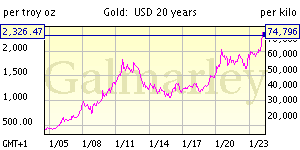
Gold Rallying to $1,500 as Soros's Bubble Inflates
Bloomberg - Investors are accumulating enough bullion to fill Switzerland’s vaults twice over as gold’s most- accurate forecasters say the longest rally in at least nine decades has further to go no matter what the economy holds.
Analysts raised their 2011 forecasts more than for any other precious metal the past two months, predicting a 10th annual advance, data compiled by Bloomberg show. The most widely held option on gold futures traded in New York is for $1,500 an ounce by December, or 18 percent more than the record $1,266.50 reached June 21. Holdings through bullion-backed exchange-traded products are already at more than 2,075 metric tons, within 0.1 percent of the all-time high.
continue
![[Most Recent Quotes from www.kitco.com]](http://www.kitconet.com/images/quotes_7a.gif)
Click to Enlarge
Close Call For US Banks


The Great Wealth Transfer
In Richard Russell’s latest commentary, the Godfather of newsletter writers discusses bear markets, gold, silver and fiat money. Russell is always focused on the big picture. This time he highlights the biggest fraud of the last half a century and how it will end. Here are a few snippets from his latest commentary...
Richard Russell:
Bear markets exist for the purpose of exposing and eliminating the greed, the corruption and the fraud that thrived in the preceding primary bull market. To my mind, the biggest fraud of the last fifty years has been the rise and acceptance of fiat "money." For that reason, I expect fiat money to meet its end before this bear market breathes its last. Judging by the size of the top, this could be the biggest bear market since the '30s. I believe this bear market means to take us back to basics and truth. That alone implies the end of central bank-created money and the rise of gold and probably silver. It may also end that immoral inflation machine, the Federal Reserve. Wall Street and its bankers now run the nation.
That too will end.
The history of money in the US is a legend of lies, manipulation, immorality and greed. I think this bear market will end those lies, one way or another.
This only suggests that gold could be rather wild between the months of December through April. Silver joins gold. This morning silver broke above out of a huge triangle. This is bullish for the whole precious metal spectrum.
Investors sometimes get caught up in the day to day and week to week movements in gold and silver. Don’t waste your time or energy on that, just accumulate. Standing in front of us is the greatest transfer of wealth in history. When the dust settles, those holding the gold will make the rules.
To subscribe to Richard Russell’s Dow Theory Letters CLICK HERE.
In Richard Russell’s latest commentary, the Godfather of newsletter writers discusses bear markets, gold, silver and fiat money. Russell is always focused on the big picture. This time he highlights the biggest fraud of the last half a century and how it will end. Here are a few snippets from his latest commentary...
Richard Russell:
Bear markets exist for the purpose of exposing and eliminating the greed, the corruption and the fraud that thrived in the preceding primary bull market. To my mind, the biggest fraud of the last fifty years has been the rise and acceptance of fiat "money." For that reason, I expect fiat money to meet its end before this bear market breathes its last. Judging by the size of the top, this could be the biggest bear market since the '30s. I believe this bear market means to take us back to basics and truth. That alone implies the end of central bank-created money and the rise of gold and probably silver. It may also end that immoral inflation machine, the Federal Reserve. Wall Street and its bankers now run the nation.
That too will end.
The history of money in the US is a legend of lies, manipulation, immorality and greed. I think this bear market will end those lies, one way or another.
This only suggests that gold could be rather wild between the months of December through April. Silver joins gold. This morning silver broke above out of a huge triangle. This is bullish for the whole precious metal spectrum.
Investors sometimes get caught up in the day to day and week to week movements in gold and silver. Don’t waste your time or energy on that, just accumulate. Standing in front of us is the greatest transfer of wealth in history. When the dust settles, those holding the gold will make the rules.
To subscribe to Richard Russell’s Dow Theory Letters CLICK HERE.
Uncle Scam - Pt. 2
If you have so far resisted our constant urgings to make gold – which is to say, real money – a core portfolio holding, it’s not too late. Just start buying on the inevitable dips. I can assure you that as the fiat monetary structures continue to crumble – and they will – more and more people will be turning to gold. The latest World Gold Council data is just a straw in the wind.
In fact, thanks to the convenience of the gold ETFs (which you should make an effort to understand before blindly investing in them – there are important differences between them), once the show really gets underway, the relative trickle of investment funds moving into gold today will quickly become a torrent, completely outrunning available gold supplies and sending prices much, much higher – and in a hurry.
While no one can say when the big spike in gold will occur, one can say accurately that, given the systematic frailty, it could literally happen on any given day. That’s what happens when scams are unveiled. Remember Bernie Madoff? How many people do you think tried to give him money the day after he was arrested, versus desperately scrambled to get their money out of his sticky web? The answers are “No one” and “Everyone” – that’s what happens when people lose faith in a currency.
If you have so far resisted our constant urgings to make gold – which is to say, real money – a core portfolio holding, it’s not too late. Just start buying on the inevitable dips. I can assure you that as the fiat monetary structures continue to crumble – and they will – more and more people will be turning to gold. The latest World Gold Council data is just a straw in the wind.
In fact, thanks to the convenience of the gold ETFs (which you should make an effort to understand before blindly investing in them – there are important differences between them), once the show really gets underway, the relative trickle of investment funds moving into gold today will quickly become a torrent, completely outrunning available gold supplies and sending prices much, much higher – and in a hurry.
While no one can say when the big spike in gold will occur, one can say accurately that, given the systematic frailty, it could literally happen on any given day. That’s what happens when scams are unveiled. Remember Bernie Madoff? How many people do you think tried to give him money the day after he was arrested, versus desperately scrambled to get their money out of his sticky web? The answers are “No one” and “Everyone” – that’s what happens when people lose faith in a currency.
Uncle Scam
by David Galland, Partner, Casey Research
The latest data on global gold trends, Q2 2010, just popped into my email box from the World Gold Council.
The bad news is that the higher nominal price of gold has caused a 5% decrease in jewelry sales over the prior year.
If you’re thinking “Hey, that’s not that bad!”, you’d be right. On this date last year, gold closed at $950… which is $286 below where it trades as I write. In other words, a 30% rise in price has resulted in a decrease of just 5% in jewelry sales.
And even that number is skewed, because the currency value of the gold purchased is up – way up. For example, India – the 800-pound gorilla in the global gold jewelry market – saw total gold jewelry sales fall only by 2%, but in local currency terms, there was a 20% increase in the nominal value of the gold trading hands. China, which only relatively recently reauthorized private gold purchases, saw a 5% increase in jewelry demand, but that translated into a 35% increase in local currency terms.
So, that’s the bad news.
The good news – at least for fiat money skeptics – is that total physical gold demand in Q2 rose by a whopping 36%. More tellingly, the increase was 77% when you take into account the dollar value of the ounces purchased.
As you’ve already figured out, the bulk of the physical demand is coming from investment – with the amount of gold held by ETFs growing 414% over the previous year.
Too far, too fast? I don’t think so.
In my opinion, as the fiat money monsters are brought to bay, the price of gold can really only go higher. Overly confident? I don’t think so.
rest of article
by David Galland, Partner, Casey Research
The latest data on global gold trends, Q2 2010, just popped into my email box from the World Gold Council.
The bad news is that the higher nominal price of gold has caused a 5% decrease in jewelry sales over the prior year.
If you’re thinking “Hey, that’s not that bad!”, you’d be right. On this date last year, gold closed at $950… which is $286 below where it trades as I write. In other words, a 30% rise in price has resulted in a decrease of just 5% in jewelry sales.
And even that number is skewed, because the currency value of the gold purchased is up – way up. For example, India – the 800-pound gorilla in the global gold jewelry market – saw total gold jewelry sales fall only by 2%, but in local currency terms, there was a 20% increase in the nominal value of the gold trading hands. China, which only relatively recently reauthorized private gold purchases, saw a 5% increase in jewelry demand, but that translated into a 35% increase in local currency terms.
So, that’s the bad news.
The good news – at least for fiat money skeptics – is that total physical gold demand in Q2 rose by a whopping 36%. More tellingly, the increase was 77% when you take into account the dollar value of the ounces purchased.
As you’ve already figured out, the bulk of the physical demand is coming from investment – with the amount of gold held by ETFs growing 414% over the previous year.
Too far, too fast? I don’t think so.
In my opinion, as the fiat money monsters are brought to bay, the price of gold can really only go higher. Overly confident? I don’t think so.
rest of article
Economic Collision Course: The “Crash of 2010”
KINGSTON, NY, 26 August 2010 — Following the “Panic of ’08” and the subsequent “Great Recession,” Washington, Wall Street and the media united to promote the belief that extreme crisis management measures enacted by governments had rescued the world, and staved off even worse disaster.
“Recovery” was in the air. “Recovery” was the word on the public’s lips. “Recovery” was fervently preached and endlessly pitched.
A very few argued that the measures could not work; that they would not live up to expectations. But only Gerald Celente predicted, from the onset, that they would fail completely, leading to the “Crash of 2010” and an inevitable descent into the “Greatest Depression.”
Now, with the data catching up to Celente and the economic skies falling, the “Recovery Hawks” have turned “Chicken Little.”
Celente plotted out the collision course and provided strategies for both steering clear of the dead end “Road to Recovery” and following roads less traveled that would lead to safety and success.
As every driver knows, in the moment before a collision there’s a gap – a split second – between recognition of the crash to come and the impact. In economic terms, that gap was the period between August 2007 (when we pinpointed an imminent financial crisis) and now … August 2010.
Now there is only the “split second.” On the macro-level, and for those who invested everything they had in “Recovery,” there will be no avoiding the “Crash of 2010.” On the individual level, there is still time to take both evasive action and proactive measures.
Be warned! While we see a split second left to take evasive action, some of the biggest names in business still blindly persist in minimizing the danger: Bloomberg, August 25 – “Durable-Goods Orders, Home Sales Signal Danger of Renewed U.S. Recession.” Even Nouriel Roubini, the media’s pet pessimist, put the odds of renewed recession at only 40 percent.
“Renewed recession”? Odds of recession? It’s bogus bookmaking – odds spun out of thin air and fobbed off as economics. The “Great Recession” never ended! The $13 trillion lent, spent and guaranteed by Washington and the Federal Reserve didn’t put an end to the recession, it just put it into a brief remission.
And what about the Dow that’s rebounded from its 2009 low of 6,830 and currently trades around 10,000? Touted as a recovery bellwether, in reality, the Dow was trading at 10,000 in 1999. Moreover, when adjusted for inflation, Dow 10,000 of 2010 is really the equivalent of only Dow 8,200 in 1999.
But Wall Street and the media do an excellent job of concealing such facts from the public. In their perpetually sunny financial skies, it is always, always, always a “buying opportunity.”
As Gerald Celente and The Trends Research Institute have been saying all along: insiders aside, investing in the stock market is a loser’s game. Just to get back to its 1999 level in real, inflation-adjusted terms, the Dow would have to hit 13,460.
What was not a loser’s game was gold. Trading at a $255 per ounce low in 1999, it trades at $1240 today. That is close to a 500 percent gross increase. Adjusted for inflation using the same rate applied to the Dow above, gold is currently worth around $880 in 1999 dollars… and heading higher.
We called the beginning of the “Gold Bull Run” in 2001, when gold was at $275 per ounce. The next breakout point for gold is $1300. From that point forward, depending upon which of a handful of wildcards get played, we forecast “Gold $2000” – and possibly higher.
Whatever your investment strategy may be, proactive measures taken now will minimize the impact of the “Crash of 2010” that, by the New Year, will be unmistakable and undeniable. Rather than debating the probabilities of a double-dip recession, the business media will be glomming onto the financial body counts littering Wall Street as though it were another Katrina.
©MMX The Trends Research Institute®
KINGSTON, NY, 26 August 2010 — Following the “Panic of ’08” and the subsequent “Great Recession,” Washington, Wall Street and the media united to promote the belief that extreme crisis management measures enacted by governments had rescued the world, and staved off even worse disaster.
“Recovery” was in the air. “Recovery” was the word on the public’s lips. “Recovery” was fervently preached and endlessly pitched.
A very few argued that the measures could not work; that they would not live up to expectations. But only Gerald Celente predicted, from the onset, that they would fail completely, leading to the “Crash of 2010” and an inevitable descent into the “Greatest Depression.”
Now, with the data catching up to Celente and the economic skies falling, the “Recovery Hawks” have turned “Chicken Little.”
Celente plotted out the collision course and provided strategies for both steering clear of the dead end “Road to Recovery” and following roads less traveled that would lead to safety and success.
As every driver knows, in the moment before a collision there’s a gap – a split second – between recognition of the crash to come and the impact. In economic terms, that gap was the period between August 2007 (when we pinpointed an imminent financial crisis) and now … August 2010.
Now there is only the “split second.” On the macro-level, and for those who invested everything they had in “Recovery,” there will be no avoiding the “Crash of 2010.” On the individual level, there is still time to take both evasive action and proactive measures.
Be warned! While we see a split second left to take evasive action, some of the biggest names in business still blindly persist in minimizing the danger: Bloomberg, August 25 – “Durable-Goods Orders, Home Sales Signal Danger of Renewed U.S. Recession.” Even Nouriel Roubini, the media’s pet pessimist, put the odds of renewed recession at only 40 percent.
“Renewed recession”? Odds of recession? It’s bogus bookmaking – odds spun out of thin air and fobbed off as economics. The “Great Recession” never ended! The $13 trillion lent, spent and guaranteed by Washington and the Federal Reserve didn’t put an end to the recession, it just put it into a brief remission.
And what about the Dow that’s rebounded from its 2009 low of 6,830 and currently trades around 10,000? Touted as a recovery bellwether, in reality, the Dow was trading at 10,000 in 1999. Moreover, when adjusted for inflation, Dow 10,000 of 2010 is really the equivalent of only Dow 8,200 in 1999.
But Wall Street and the media do an excellent job of concealing such facts from the public. In their perpetually sunny financial skies, it is always, always, always a “buying opportunity.”
As Gerald Celente and The Trends Research Institute have been saying all along: insiders aside, investing in the stock market is a loser’s game. Just to get back to its 1999 level in real, inflation-adjusted terms, the Dow would have to hit 13,460.
What was not a loser’s game was gold. Trading at a $255 per ounce low in 1999, it trades at $1240 today. That is close to a 500 percent gross increase. Adjusted for inflation using the same rate applied to the Dow above, gold is currently worth around $880 in 1999 dollars… and heading higher.
We called the beginning of the “Gold Bull Run” in 2001, when gold was at $275 per ounce. The next breakout point for gold is $1300. From that point forward, depending upon which of a handful of wildcards get played, we forecast “Gold $2000” – and possibly higher.
Whatever your investment strategy may be, proactive measures taken now will minimize the impact of the “Crash of 2010” that, by the New Year, will be unmistakable and undeniable. Rather than debating the probabilities of a double-dip recession, the business media will be glomming onto the financial body counts littering Wall Street as though it were another Katrina.
©MMX The Trends Research Institute®
INVESTING: Gold provides glint of hope during economic downturn
LAS VEGAS REVIEW-JOURNAL
As dark as the economic news has been lately, with jobless benefits claims rising and unemployment lingering, some investors see shine cutting through.
It's from gold.
Futures prices for the precious metal hit a seven-week high Thursday; Dow Jones Newswires said gold for December delivery, the most actively traded gold contract, rose $4 to settle at $1,235.40 an ounce on the New York Mercantile Exchange. On the spot market, gold prices were up $4.10 to $1,233.80 an ounce, a price gold and precious metals dealer Mark Scott will tell you is up about 30 percent from a year ago.
He's seen the rise right in his shop, Sahara Coins & Extraordinary Collectibles on West Sahara Avenue. On Jan. 4, the first shopping day of 2010, one-ounce American Eagle gold coins sold for $1,189. They cost $1,253 on Aug. 12, he said, and $1,305 on Thursday.
Scott said his shop buys and sells $300,000 to $400,000 in gold and other precious metals (silver, palladium and platinum) every day and has $2 million to $3 million on site and in stock. And he said he's seen a recent shift toward net gold buying and away from net gold selling.
Scott, 50, believes in gold so much as a long-term holding that 70 percent of his personal investing portfolio is in the metal. He says the metal holds its value and is tangible, which can assure investors in the long term and offer flexibility during disasters.
"Think of when (Hurricane) Katrina hit," he said. "You couldn't get to a bank because all of them were closed. And you couldn't ask your stockbroker to wire you $1,000. But if you had gold, you could go into a coin shop and get your $1,000."
Scott said he'd "bet his store" that gold spot prices will hit $1,300 an ounce by year's end.
Analysts suggest he may be spot-on. Richard Ross, a technical analyst with Auerbach Grayson in New York, said gold prices could challenge a mid-June intraday high of $1,265 by October. And analyst Jon Nadler of Kitco said some short-term charts see gold prices hitting $1,300 or $1,325.
LAS VEGAS REVIEW-JOURNAL
As dark as the economic news has been lately, with jobless benefits claims rising and unemployment lingering, some investors see shine cutting through.
It's from gold.
Futures prices for the precious metal hit a seven-week high Thursday; Dow Jones Newswires said gold for December delivery, the most actively traded gold contract, rose $4 to settle at $1,235.40 an ounce on the New York Mercantile Exchange. On the spot market, gold prices were up $4.10 to $1,233.80 an ounce, a price gold and precious metals dealer Mark Scott will tell you is up about 30 percent from a year ago.
He's seen the rise right in his shop, Sahara Coins & Extraordinary Collectibles on West Sahara Avenue. On Jan. 4, the first shopping day of 2010, one-ounce American Eagle gold coins sold for $1,189. They cost $1,253 on Aug. 12, he said, and $1,305 on Thursday.
Scott said his shop buys and sells $300,000 to $400,000 in gold and other precious metals (silver, palladium and platinum) every day and has $2 million to $3 million on site and in stock. And he said he's seen a recent shift toward net gold buying and away from net gold selling.
Scott, 50, believes in gold so much as a long-term holding that 70 percent of his personal investing portfolio is in the metal. He says the metal holds its value and is tangible, which can assure investors in the long term and offer flexibility during disasters.
"Think of when (Hurricane) Katrina hit," he said. "You couldn't get to a bank because all of them were closed. And you couldn't ask your stockbroker to wire you $1,000. But if you had gold, you could go into a coin shop and get your $1,000."
Scott said he'd "bet his store" that gold spot prices will hit $1,300 an ounce by year's end.
Analysts suggest he may be spot-on. Richard Ross, a technical analyst with Auerbach Grayson in New York, said gold prices could challenge a mid-June intraday high of $1,265 by October. And analyst Jon Nadler of Kitco said some short-term charts see gold prices hitting $1,300 or $1,325.
How Bad Is It?
The economy is so bad that I got a pre-declined credit card in the mail.
I ordered a burger at Burger King, and the kid behind the counter asked, "Can you afford fries with that?"
CEO's are now playing miniature golf.
If the bank returns your check marked "Insufficient Funds," you have to call them and ask if they mean you or them .
Hot Wheels and Matchbox stocks are trading higher than GM.
Burger King is selling the 1/4 'ouncer'.
Parents in Beverly Hills and Malibu are firing their nannies and learning their children's names.
A truckload of Americans was caught sneaking into Mexico .
Dick Cheney took his stockbroker hunting.
Motel Six won't leave the light on anymore.
The Mafia is laying off judges.
Exxon-Mobil laid off 25 Congressmen.
And, finally...
I was so depressed last night thinking about the economy, wars, jobs, my savings, Social Security, retirement funds, and our bleak future, that I called the Suicide Lifeline and was connected to a call center in Pakistan . When I told them I was suicidal, they got all excited, and asked if I could drive a truck.
I ordered a burger at Burger King, and the kid behind the counter asked, "Can you afford fries with that?"
CEO's are now playing miniature golf.
If the bank returns your check marked "Insufficient Funds," you have to call them and ask if they mean you or them .
Hot Wheels and Matchbox stocks are trading higher than GM.
Burger King is selling the 1/4 'ouncer'.
Parents in Beverly Hills and Malibu are firing their nannies and learning their children's names.
A truckload of Americans was caught sneaking into Mexico .
Dick Cheney took his stockbroker hunting.
Motel Six won't leave the light on anymore.
The Mafia is laying off judges.
Exxon-Mobil laid off 25 Congressmen.
And, finally...
I was so depressed last night thinking about the economy, wars, jobs, my savings, Social Security, retirement funds, and our bleak future, that I called the Suicide Lifeline and was connected to a call center in Pakistan . When I told them I was suicidal, they got all excited, and asked if I could drive a truck.
Existing-home sales plunge 27.2% - Inventory of unsold homes jumps to 11-year high
WASHINGTON (MarketWatch) -- The sale of existing U.S. homes sank 27.2% in July -- the biggest one-month drop ever -- largely because of the phase-out of a federal tax credit, according to an industry trade group.
The National Association of Realtors said existing-home sales fell to a seasonally adjusted annual rate of 3.83 million in July from 5.26 million the month before. Sales of single-family homes fell to the lowest rate in 15 years.
A year earlier, existing home sales totaled 5.14 million in July.
Inventories of unsold homes rose 2.5% to 3.98 million, representing a 12.5-month supply, the highest level since at least 1999, the trade group said. And the supply of unsold single-family homes reached its highest rate since 1982.
WASHINGTON (MarketWatch) -- The sale of existing U.S. homes sank 27.2% in July -- the biggest one-month drop ever -- largely because of the phase-out of a federal tax credit, according to an industry trade group.
The National Association of Realtors said existing-home sales fell to a seasonally adjusted annual rate of 3.83 million in July from 5.26 million the month before. Sales of single-family homes fell to the lowest rate in 15 years.
A year earlier, existing home sales totaled 5.14 million in July.
Inventories of unsold homes rose 2.5% to 3.98 million, representing a 12.5-month supply, the highest level since at least 1999, the trade group said. And the supply of unsold single-family homes reached its highest rate since 1982.
401(k) Withdrawals Spike
NEW YORK (CNNMoney.com) -- Hardship withdrawals from 401(k) retirement saving plans rose to the highest level in 10 years during the second quarter, Fidelity Investments said on Friday, in the latest sign of a dismal economy.
Fidelity reported that, as of the second quarter, 2.2% of all 401(k) participants had made a hardship withdrawal at some point over the preceding 12 months. That's up from 2% in the prior year, and was the highest level in 10 years.
At the same time, the percentage of 401(k) participants that had an outstanding loan from their account rose to a record high of 22% in the second quarter. The average loan amount was $8,650 at the end of the quarter.
Boston-based Fidelity has $844 billion in retirement assets under management.
The top reasons people took loans and made withdrawals were to prevent foreclosure or eviction, pay for college, or purchase a home, according to the firm.
"The current economy has forced some workers to borrow from their 401(k) accounts in order to pay for critical living expenses, ultimately jeopardizing their future retirement," said James MacDonald, president of workplace investing for Fidelity Investments.
He added that for some investors "taking a loan or a hardship withdrawal from their 401(k) may be their only option because it's their only form of savings.
NEW YORK (CNNMoney.com) -- Hardship withdrawals from 401(k) retirement saving plans rose to the highest level in 10 years during the second quarter, Fidelity Investments said on Friday, in the latest sign of a dismal economy.
Fidelity reported that, as of the second quarter, 2.2% of all 401(k) participants had made a hardship withdrawal at some point over the preceding 12 months. That's up from 2% in the prior year, and was the highest level in 10 years.
At the same time, the percentage of 401(k) participants that had an outstanding loan from their account rose to a record high of 22% in the second quarter. The average loan amount was $8,650 at the end of the quarter.
Boston-based Fidelity has $844 billion in retirement assets under management.
The top reasons people took loans and made withdrawals were to prevent foreclosure or eviction, pay for college, or purchase a home, according to the firm.
"The current economy has forced some workers to borrow from their 401(k) accounts in order to pay for critical living expenses, ultimately jeopardizing their future retirement," said James MacDonald, president of workplace investing for Fidelity Investments.
He added that for some investors "taking a loan or a hardship withdrawal from their 401(k) may be their only option because it's their only form of savings.
Buy Gold Now and Like It!
By Jeff Clark of Casey’s Gold & Resource Report.
So, is now the time to buy? It depends on your honest answer to another question: “Do you own enough gold?” By “enough” I mean an amount that lends meaningful protection on your assets. By ”meaningful” I mean that no matter what happens next – another financial blow-up, accelerating inflation, crushing deflation, war, a plummeting dollar, more reckless government spending – you won't worry about your investments.
continue
By Jeff Clark of Casey’s Gold & Resource Report.
So, is now the time to buy? It depends on your honest answer to another question: “Do you own enough gold?” By “enough” I mean an amount that lends meaningful protection on your assets. By ”meaningful” I mean that no matter what happens next – another financial blow-up, accelerating inflation, crushing deflation, war, a plummeting dollar, more reckless government spending – you won't worry about your investments.
continue
Housing Fades as a Means to Build Wealth, Analysts Say
The New York Times
Dean Baker, co-director of the Center for Economic and Policy Research, estimates that it will take 20 years to recoup the $6 trillion of housing wealth that has been lost since 2005. After adjusting for inflation, values will never catch up.
“People shouldn’t look at a home as a way to make money because it won’t,” Mr. Baker said.
If the long term is grim, the short term is grimmer. Housing experts are bracing themselves for Tuesday, when the sales figures for July will be released. The data is expected to show a drop of as much as 20 percent from last year.
The supply of homes sitting on the market might rise to as much as 12 months, about twice the level of a healthy market. That would push down prices as all those sellers compete to secure a buyer, adding to a slide that has already chopped off as much as 30 percent in home values.
The New York Times
Dean Baker, co-director of the Center for Economic and Policy Research, estimates that it will take 20 years to recoup the $6 trillion of housing wealth that has been lost since 2005. After adjusting for inflation, values will never catch up.
“People shouldn’t look at a home as a way to make money because it won’t,” Mr. Baker said.
If the long term is grim, the short term is grimmer. Housing experts are bracing themselves for Tuesday, when the sales figures for July will be released. The data is expected to show a drop of as much as 20 percent from last year.
The supply of homes sitting on the market might rise to as much as 12 months, about twice the level of a healthy market. That would push down prices as all those sellers compete to secure a buyer, adding to a slide that has already chopped off as much as 30 percent in home values.
Follow The Smart Money
"The Dow would crash and burn if so many people weren't handcuffed to their retirement plans. The tragedy is that the bull market is running out of steam. As innocent people continue to put money into their retirement plans, the rich and powerful smart money is getting out of the market. More lives will be ruined."
– Excerpt from Robert Kiyosaki’s Conspiracy of the Rich bulletin
"The Dow would crash and burn if so many people weren't handcuffed to their retirement plans. The tragedy is that the bull market is running out of steam. As innocent people continue to put money into their retirement plans, the rich and powerful smart money is getting out of the market. More lives will be ruined."
– Excerpt from Robert Kiyosaki’s Conspiracy of the Rich bulletin
Gold Readies For A Major Price Thrust To $1,325-$1,375 This Fall
by Roger Wiegand - Trader Tracks Newsletter
This is the time for real action by real men. Instead we have a bunch of stupid, wimpy, inexperienced, academic children playing with matches and gasoline. There is zero leadership, so get ready to run.
Technically, weekly gold is supported at $1,207 and capped at $1,265, (chart below) the former recent high price. However, by using more elaborate and technical charts (not shown) we find the new gold support on December, 2010, gold futures to be $1,175. Seasonally, gold should sell mildly once more to that projected number and then rebound in a new fall rally taking prices much higher.
Other more dominant market forces in bond credit and international stock markets could create unmeasured mayhem depending upon the ability of central bankers to keep things under control. These people are riding a bucking bronco and we think they are about to get tossed-off this horse. If in fact this occurs, our $1,325-$1,375 gold forecast could just be a door-opening beginning.
Continue
by Roger Wiegand - Trader Tracks Newsletter
This is the time for real action by real men. Instead we have a bunch of stupid, wimpy, inexperienced, academic children playing with matches and gasoline. There is zero leadership, so get ready to run.
Technically, weekly gold is supported at $1,207 and capped at $1,265, (chart below) the former recent high price. However, by using more elaborate and technical charts (not shown) we find the new gold support on December, 2010, gold futures to be $1,175. Seasonally, gold should sell mildly once more to that projected number and then rebound in a new fall rally taking prices much higher.
Other more dominant market forces in bond credit and international stock markets could create unmeasured mayhem depending upon the ability of central bankers to keep things under control. These people are riding a bucking bronco and we think they are about to get tossed-off this horse. If in fact this occurs, our $1,325-$1,375 gold forecast could just be a door-opening beginning.
Continue
Treasury Sales Hum, Even Without China
by Rick Ackerman - Rick's Picks
August 23, 2010 7:42 am GMT
Who’d have believed that small investors have deserted the stock market in droves this year? We’d thought just about everyone but Larry Kudlow was out of shares by early 2009, and that the only players left were the high-speed trading computers maintained by the likes of Goldman Sachs and J.P. Morgan. Apparently not. Investors pulled $33 billion from equity mutual funds so far in 2010, according to the New York Times. If they keep up the pace, it would be the biggest run on mutual funds in more than two decades, not counting the panic stirred up by the banking crisis in 2008. The little guys appear to be “losing their appetite for risk,” a spokesman from Credit Suisse told the Times, putting it mildly.
They’re in good company, it would seem, since money managers appear to have thrown in the towel on shares too. Take a gander at the chart above if you want to see where all of their cash has been going. The chart should hearten those who are worried the U.S. Government’s recent decision to embark on a second round of quantitative easing will require a blowout of printing-press money. In fact, the demand for Treasury debt from sources other than the Federal Reserve seems all but insatiable at the moment. Are we being churlish to suggest this mania will not last forever?
What Scares Geithner
Keep in mind that the T-Bond rally has occurred even as China has turned net seller. You heard that right. Their holdings peaked for the year in April at $900.2 billion, down from a record $939.9 billion in July of 2009, when Europe’s supposed debt crisis was peaking. China reportedly held $843.7 billion worth at the end of June, but what is most significant – or perhaps scary if you are Tim Geithner — is the pace at which the blowout has accelerated. “In the ten months between July 2009 and April 2010, Chinese holdings fell by $US $39.7 billion,” reported the Australia-based Privateer, one of our favorite newsletters. More recently, though, Privateer editor William Buckler notes, the selloff quickened at an alarming rate. “In the two months between April and June 2010,” [the reserves] fell by $US $56.5 Billion.”
No one could accuse the Chinese of being indecisive. In the meantime, domestic buyers have taken up much of the slack, as we noted above. Is it possible the Chinese know something that they don’t?
by Rick Ackerman - Rick's Picks
August 23, 2010 7:42 am GMT
Who’d have believed that small investors have deserted the stock market in droves this year? We’d thought just about everyone but Larry Kudlow was out of shares by early 2009, and that the only players left were the high-speed trading computers maintained by the likes of Goldman Sachs and J.P. Morgan. Apparently not. Investors pulled $33 billion from equity mutual funds so far in 2010, according to the New York Times. If they keep up the pace, it would be the biggest run on mutual funds in more than two decades, not counting the panic stirred up by the banking crisis in 2008. The little guys appear to be “losing their appetite for risk,” a spokesman from Credit Suisse told the Times, putting it mildly.
They’re in good company, it would seem, since money managers appear to have thrown in the towel on shares too. Take a gander at the chart above if you want to see where all of their cash has been going. The chart should hearten those who are worried the U.S. Government’s recent decision to embark on a second round of quantitative easing will require a blowout of printing-press money. In fact, the demand for Treasury debt from sources other than the Federal Reserve seems all but insatiable at the moment. Are we being churlish to suggest this mania will not last forever?
What Scares Geithner
Keep in mind that the T-Bond rally has occurred even as China has turned net seller. You heard that right. Their holdings peaked for the year in April at $900.2 billion, down from a record $939.9 billion in July of 2009, when Europe’s supposed debt crisis was peaking. China reportedly held $843.7 billion worth at the end of June, but what is most significant – or perhaps scary if you are Tim Geithner — is the pace at which the blowout has accelerated. “In the ten months between July 2009 and April 2010, Chinese holdings fell by $US $39.7 billion,” reported the Australia-based Privateer, one of our favorite newsletters. More recently, though, Privateer editor William Buckler notes, the selloff quickened at an alarming rate. “In the two months between April and June 2010,” [the reserves] fell by $US $56.5 Billion.”
No one could accuse the Chinese of being indecisive. In the meantime, domestic buyers have taken up much of the slack, as we noted above. Is it possible the Chinese know something that they don’t?

Richard Russell - The Stock Market Is Crumbling
by Eric King
The Godfather of newsletter writers, Richard Russell, summed up our situation as follows, “crumbling.” Again I will repeat what I have always liked about Russell is that he likes to focus on the big picture. What is the big picture? Here are a few snippets from his latest commentary...
August 21, 2010
Richard Russell:On to the markets. The stock market is crumbling -- actually crumbling before our very eyes.
...I'm saying that half the issues in the Dow, the NYSE, S&P and NASDAQ have now sunk below their important 200-day moving averages. And the same is true of the big stock averages.
And the incredible thing is that even as the stock market is falling apart, the experts and the media are taking in and believing the government reports, and they think everything is bright and sunny.. It's as if they can't see or take in what the market is doing -- the whole financial world seems to be brain-washed...I've never seen anything like it.
The Russell opinion. It's the markets that are telling the real story, not the analysts or the government..Believe me if the stock market continues the way its been going (particularly if it crashes) it's going to scare the living hell out of America's consumers. If consumers freeze up, you're going to see all the deflation you want. So who to believe, the analysts and economist or the stock and bond markets?
At this point, who's running the nation? It's not Obama, it's not Geithner or Bernanke, it's not even the Fed -- IT'S THE MARKETS. And we'll watch 'em as intently as a barn owl watches a mouse.
A final take -- It's simply uncanny to see the stock market (most stocks) falling apart while the media and the government tells us that "things are looking better." It's as if the nation is watching a horror movie and is reacting with a case of the giggles.
As for Richard Russell, he's resting easy. I've been urging my subscribers to "clean house" and be OUT of all stocks. I think (hope) I've got a lot of happy, solvent subscribers, which is exactly what I want as this market teeters on the edge of an historic collapse.
Question -- Russell, recently you wrote up certain utilities as a source of income. What are your latest thoughts now?
Answer -- My thoughts now is that I want subscribers OUT of all stocks and bonds except for gold and gold items. Before this bear market is over, it's going to take down everything. We're in cash and gold, and probably less cash as time goes along.
This is not a recession, but rather a depression. Recessions tend to break people, depressions on the other hand tend to consume them.
To subscribe to Richard Russell’s Dow Theory Letters CLICK HERE.
by Eric King
The Godfather of newsletter writers, Richard Russell, summed up our situation as follows, “crumbling.” Again I will repeat what I have always liked about Russell is that he likes to focus on the big picture. What is the big picture? Here are a few snippets from his latest commentary...
August 21, 2010
Richard Russell:On to the markets. The stock market is crumbling -- actually crumbling before our very eyes.
...I'm saying that half the issues in the Dow, the NYSE, S&P and NASDAQ have now sunk below their important 200-day moving averages. And the same is true of the big stock averages.
And the incredible thing is that even as the stock market is falling apart, the experts and the media are taking in and believing the government reports, and they think everything is bright and sunny.. It's as if they can't see or take in what the market is doing -- the whole financial world seems to be brain-washed...I've never seen anything like it.
The Russell opinion. It's the markets that are telling the real story, not the analysts or the government..Believe me if the stock market continues the way its been going (particularly if it crashes) it's going to scare the living hell out of America's consumers. If consumers freeze up, you're going to see all the deflation you want. So who to believe, the analysts and economist or the stock and bond markets?
At this point, who's running the nation? It's not Obama, it's not Geithner or Bernanke, it's not even the Fed -- IT'S THE MARKETS. And we'll watch 'em as intently as a barn owl watches a mouse.
A final take -- It's simply uncanny to see the stock market (most stocks) falling apart while the media and the government tells us that "things are looking better." It's as if the nation is watching a horror movie and is reacting with a case of the giggles.
As for Richard Russell, he's resting easy. I've been urging my subscribers to "clean house" and be OUT of all stocks. I think (hope) I've got a lot of happy, solvent subscribers, which is exactly what I want as this market teeters on the edge of an historic collapse.
Question -- Russell, recently you wrote up certain utilities as a source of income. What are your latest thoughts now?
Answer -- My thoughts now is that I want subscribers OUT of all stocks and bonds except for gold and gold items. Before this bear market is over, it's going to take down everything. We're in cash and gold, and probably less cash as time goes along.
This is not a recession, but rather a depression. Recessions tend to break people, depressions on the other hand tend to consume them.
To subscribe to Richard Russell’s Dow Theory Letters CLICK HERE.

The Stock Market Is For Fools
This is from Rick's Pick's Wednesday commentary..
As any sentient adult will have long since surmised, it is not the economy that is hanging in there, but the stock market. The Dow is trading above 10,000, so how bad could things be, right? Or so the thinking goes. We suspect that this argument is losing its hold on the nation, and that when Brian Williams or Katie Couric mentions that stocks jumped 1% on a given day, most viewers greet the item with a shrug. And those who truly understand the markets just shake their heads, wondering how anyone could be so naïve as to think the stock market is tied in some meaningful way to the economy’s ups and downs. Tied to institutional cash that has nowhere else to go — and to the machinations of half-intelligent machines — is more like it, and we shouldn’t be surprised that the machines themselves are not gifted by their programmers with the cynicism to see the downside of all this whoopin’-and-a-hollerin’ over a scrawny 3.6% increase in profits at Wal-Mart. For, how bad must things be when a bullish blip in the earning’s of the world’s largest discounter rates a 100-point rally in the Dow? Then again, maybe the computers are so smart that 10,000 of them asked that same question and in mere milliseconds improvised the game of “chicken” that caused the Dow’s 75-point sell-off in the final hour. Laugh if you want, but that is exactly how the world’s stock markets are being traded these days.
And people think GOLD is risky?
This is from Rick's Pick's Wednesday commentary..
As any sentient adult will have long since surmised, it is not the economy that is hanging in there, but the stock market. The Dow is trading above 10,000, so how bad could things be, right? Or so the thinking goes. We suspect that this argument is losing its hold on the nation, and that when Brian Williams or Katie Couric mentions that stocks jumped 1% on a given day, most viewers greet the item with a shrug. And those who truly understand the markets just shake their heads, wondering how anyone could be so naïve as to think the stock market is tied in some meaningful way to the economy’s ups and downs. Tied to institutional cash that has nowhere else to go — and to the machinations of half-intelligent machines — is more like it, and we shouldn’t be surprised that the machines themselves are not gifted by their programmers with the cynicism to see the downside of all this whoopin’-and-a-hollerin’ over a scrawny 3.6% increase in profits at Wal-Mart. For, how bad must things be when a bullish blip in the earning’s of the world’s largest discounter rates a 100-point rally in the Dow? Then again, maybe the computers are so smart that 10,000 of them asked that same question and in mere milliseconds improvised the game of “chicken” that caused the Dow’s 75-point sell-off in the final hour. Laugh if you want, but that is exactly how the world’s stock markets are being traded these days.
And people think GOLD is risky?
China Continues To Shun The Dollar
As you all know, China is continuing to diversify away from the dollar and is quietly accumumlating gold. Of course, they know that if they plunge head-long into gold, the price will skyrocket. Therefore, they are gradually making their gold purchases while also diversifying into other currencies as well. Here's a link to an article about their recent purchase of Korean bonds.
Again, that is more bad news for the dollar, which, indirectly, is good news for gold.
As you all know, China is continuing to diversify away from the dollar and is quietly accumumlating gold. Of course, they know that if they plunge head-long into gold, the price will skyrocket. Therefore, they are gradually making their gold purchases while also diversifying into other currencies as well. Here's a link to an article about their recent purchase of Korean bonds.
Again, that is more bad news for the dollar, which, indirectly, is good news for gold.
The Gold Report Interviews John Embry
excerpt:
TGR: Are we in a situation where, if we really implemented austerity measures, we could avoid debt default and/or inflation? Or are we just too far down the line?
JE: I think we're way too far down the line. If you were to go into a real austerity program in the United States by raising taxes, cutting spending and having interest rates that reflect the reality of the situation, you would go into a hard deflationary depression. I don't see an alternative. I've said many times that the middle ground has long since been lost. We've just had the greatest credit cycle in history, and as a result we're going to pay a huge, huge price for it.
TGR: But if the austerity program would throw us into a deflationary depression, then more quantitative easing would ultimately end in a deflationary depression.
JE: In the end you will end up with a new currency system. And those who invest in the right assets will come out intact at the other end. Those who invest in paper assets of any description will be wiped out.
_____________________________
John Embry is chief investment strategist at Sprott Asset Management and Sprott Gold and Precious Minerals Fund. He also co-chairs the Central GoldTrust Board of Trustees. An industry expert in precious metals, John's industry experience as a portfolio management specialist spans more than 45 years; he has simultaneously researched the gold sector for 30-plus of those years. He joined Sprott in 2003, after 15 years as vice-president of equities at RBC Global Investment.
excerpt:
TGR: Are we in a situation where, if we really implemented austerity measures, we could avoid debt default and/or inflation? Or are we just too far down the line?
JE: I think we're way too far down the line. If you were to go into a real austerity program in the United States by raising taxes, cutting spending and having interest rates that reflect the reality of the situation, you would go into a hard deflationary depression. I don't see an alternative. I've said many times that the middle ground has long since been lost. We've just had the greatest credit cycle in history, and as a result we're going to pay a huge, huge price for it.
TGR: But if the austerity program would throw us into a deflationary depression, then more quantitative easing would ultimately end in a deflationary depression.
JE: In the end you will end up with a new currency system. And those who invest in the right assets will come out intact at the other end. Those who invest in paper assets of any description will be wiped out.
_____________________________
John Embry is chief investment strategist at Sprott Asset Management and Sprott Gold and Precious Minerals Fund. He also co-chairs the Central GoldTrust Board of Trustees. An industry expert in precious metals, John's industry experience as a portfolio management specialist spans more than 45 years; he has simultaneously researched the gold sector for 30-plus of those years. He joined Sprott in 2003, after 15 years as vice-president of equities at RBC Global Investment.
Soros favoured gold in Q2, cut US equities
Gold now represents the billionaire investor's fund's biggest holding by dollar value and with the sale of so many other holdings, gold ETFs now represent almost 13% of the firms total equities
BOSTON (Reuters) - Billionaire investor George Soros in the second quarter stuck with his big bet on gold but slashed his holdings in dozens of major U.S. companies from Verizon Communications to Pfizer.
In a quarterly securities filing on Monday, Soros Fund Management reported owning substantially fewer U.S. listed stocks than three months earlier. The fund listed $5.1 billion of equities as of June 30, down 42 percent from $8.8 billion at the end of March.
The fund firm said it owned 5.24 million shares of the SPDR Gold Trust (GLD.P) worth $638 million as of June 30. Though down slightly from the fund's 5.59 million shares owned at the end of the first quarter, that was the fund's biggest holding by dollar value.
Gold now represents the billionaire investor's fund's biggest holding by dollar value and with the sale of so many other holdings, gold ETFs now represent almost 13% of the firms total equities
BOSTON (Reuters) - Billionaire investor George Soros in the second quarter stuck with his big bet on gold but slashed his holdings in dozens of major U.S. companies from Verizon Communications to Pfizer.
In a quarterly securities filing on Monday, Soros Fund Management reported owning substantially fewer U.S. listed stocks than three months earlier. The fund listed $5.1 billion of equities as of June 30, down 42 percent from $8.8 billion at the end of March.
The fund firm said it owned 5.24 million shares of the SPDR Gold Trust (GLD.P) worth $638 million as of June 30. Though down slightly from the fund's 5.59 million shares owned at the end of the first quarter, that was the fund's biggest holding by dollar value.
Florida – Much Worse Problems Than the Oil Spill
By Doug Hornig, Senior Editor, Casey Research
This in a state already confronted with the worst of the coming healthcare/taxation crunch. It has the second oldest population in the nation, and as its citizens retire, their earnings fall off, causing tax revenues to drop. At the same time, healthcare bills rise, stressing social service budgets.
Florida is ground zero for Baby Boomer demographics. With 600 seniors for every 1,000 workers now, and the number trending inexorably higher, soon every employed person in the state will essentially have to adopt one senior to care for out of his or her paycheck.
Housing? Naturally, rising unemployment amplifies the difficulties of maintaining homeownership. With further negative effects from the oil, we can only expect the situation to worsen. A tsunami of defaults and foreclosures – and bank failures – would not be a surprise.
Full Article
By Doug Hornig, Senior Editor, Casey Research
This in a state already confronted with the worst of the coming healthcare/taxation crunch. It has the second oldest population in the nation, and as its citizens retire, their earnings fall off, causing tax revenues to drop. At the same time, healthcare bills rise, stressing social service budgets.
Florida is ground zero for Baby Boomer demographics. With 600 seniors for every 1,000 workers now, and the number trending inexorably higher, soon every employed person in the state will essentially have to adopt one senior to care for out of his or her paycheck.
Housing? Naturally, rising unemployment amplifies the difficulties of maintaining homeownership. With further negative effects from the oil, we can only expect the situation to worsen. A tsunami of defaults and foreclosures – and bank failures – would not be a surprise.
Full Article
Here's a graph that came from John Williams over at shadowstats.com. It's the gold and silver chart going back to 1997.

The graph is pretty neat... but here's what John has to say about both the gold and silver price...
Gold and Silver Highs Adjusted for CPI-U/SGS Inflation. Despite the June 28th historic high gold price of $1,261.00 per troy ounce, gold and silver prices have yet to approach their historic high levels, adjusted for inflation. The London afternoon fix, per Kitco.com of January 21, 1980 would be $2,382 per troy ounce based on July 2010 CPI-U-adjusted dollars... and would be $7,727 per troy ounce in terms of SGS-Alternate-CPI-adjusted dollars [all series not seasonally adjusted].
In like manner, the all-time high price for silver in January 1980 of $49.45 per troy ounce [London afternoon fix, per silverinstitute.org] has not been hit since, including in terms of inflation-adjusted dollars. Based on July 2010 CPI-U inflation, the 1980 silver price peak would be $139 per troy ounce and would be $450 per troy ounce in terms of SGS-Alternate-CPI-adjusted dollars [again, all series not seasonally adjusted].
Food for thought, isn't it?

The graph is pretty neat... but here's what John has to say about both the gold and silver price...
Gold and Silver Highs Adjusted for CPI-U/SGS Inflation. Despite the June 28th historic high gold price of $1,261.00 per troy ounce, gold and silver prices have yet to approach their historic high levels, adjusted for inflation. The London afternoon fix, per Kitco.com of January 21, 1980 would be $2,382 per troy ounce based on July 2010 CPI-U-adjusted dollars... and would be $7,727 per troy ounce in terms of SGS-Alternate-CPI-adjusted dollars [all series not seasonally adjusted].
In like manner, the all-time high price for silver in January 1980 of $49.45 per troy ounce [London afternoon fix, per silverinstitute.org] has not been hit since, including in terms of inflation-adjusted dollars. Based on July 2010 CPI-U inflation, the 1980 silver price peak would be $139 per troy ounce and would be $450 per troy ounce in terms of SGS-Alternate-CPI-adjusted dollars [again, all series not seasonally adjusted].
Food for thought, isn't it?
Gold Buyers Push Through Concrete
by Rick Ackerman on August 17, 2010
Gold forced a few green shoots through concrete yesterday, setting the stage for a shot this month at June’s all-time highs near $1270. That would require a further rally of just 3.5 percent from current levels, based on yesterday’s $1226.90 settlement price for the Comex December contract. We’d anticipated Monday’s $13 push through resistance with the following forecast, disseminated to Rick’s Picks subscribers Sunday night: “Last week’s bullish finishing stroke brought into focus a minor Hidden Pivot target at $1229.10 that we should use as a minimum upside objective for the near term. That may seem like a conservative goal because it lies just $12 above Friday’s settlement price, but it would have decisively bullish implications, since the target is above heavy supply created over a two-week period in early July. The futures are almost certain to push above the supply zone this week, but the earlier in the week they do so, the more bullish the implications will be going forward.”
As it happened, the bulls’ successful use of the battering ram came earlier in the week than we might have expected — on a Monday – and this is indeed a sign that buyers are probably eager for more. By day’s end, they had pushed the December contract past our target by 40 cents, as well as through a supply zone near $1222 that had resisted their best efforts for nearly a month. Moreover, a subsequent pullback from the 1229.50 high amounted to just $6, more than half of which had been recouped by day’s end. All of this augurs more upside over the near term to at least 1244.20, a Hidden Pivot target that appears in the same sequence as yesterday’s.
Seasonal Factors
In the Rick’s Picks chat room — which has been quiet lately, as is often the case at this time of year — gold’s show of strength elicited some encouraging chatter, including the following technical observations, attributed to one Ashraf Laidi (who was said not to be a gold bug): “Gold seasonals of the last eight years indicate Q4 is the best quarter, showing gains in seven of the last eight years, followed by Q3 and Q1 rising in six of the last eights. The current gold rally could be especially powerful as it combines the onset of further Treasurys purchases by the Fed and broadening questions about Eurozone debt, this time from Ireland.”
We’ll be monitoring gold’s vital signs very closely in the days ahead, since there is always a chance that this rally is a bull trap. If you want to following along with us in the chat room and via updates in real time, you can sign up for a free seven-day trial to the service by clicking here.
by Rick Ackerman on August 17, 2010
Gold forced a few green shoots through concrete yesterday, setting the stage for a shot this month at June’s all-time highs near $1270. That would require a further rally of just 3.5 percent from current levels, based on yesterday’s $1226.90 settlement price for the Comex December contract. We’d anticipated Monday’s $13 push through resistance with the following forecast, disseminated to Rick’s Picks subscribers Sunday night: “Last week’s bullish finishing stroke brought into focus a minor Hidden Pivot target at $1229.10 that we should use as a minimum upside objective for the near term. That may seem like a conservative goal because it lies just $12 above Friday’s settlement price, but it would have decisively bullish implications, since the target is above heavy supply created over a two-week period in early July. The futures are almost certain to push above the supply zone this week, but the earlier in the week they do so, the more bullish the implications will be going forward.”
As it happened, the bulls’ successful use of the battering ram came earlier in the week than we might have expected — on a Monday – and this is indeed a sign that buyers are probably eager for more. By day’s end, they had pushed the December contract past our target by 40 cents, as well as through a supply zone near $1222 that had resisted their best efforts for nearly a month. Moreover, a subsequent pullback from the 1229.50 high amounted to just $6, more than half of which had been recouped by day’s end. All of this augurs more upside over the near term to at least 1244.20, a Hidden Pivot target that appears in the same sequence as yesterday’s.
Seasonal Factors
In the Rick’s Picks chat room — which has been quiet lately, as is often the case at this time of year — gold’s show of strength elicited some encouraging chatter, including the following technical observations, attributed to one Ashraf Laidi (who was said not to be a gold bug): “Gold seasonals of the last eight years indicate Q4 is the best quarter, showing gains in seven of the last eight years, followed by Q3 and Q1 rising in six of the last eights. The current gold rally could be especially powerful as it combines the onset of further Treasurys purchases by the Fed and broadening questions about Eurozone debt, this time from Ireland.”
We’ll be monitoring gold’s vital signs very closely in the days ahead, since there is always a chance that this rally is a bull trap. If you want to following along with us in the chat room and via updates in real time, you can sign up for a free seven-day trial to the service by clicking here.
If you will not fight for right when you can easily win without bloodshed; if you will not fight when your victory is sure and not too costly; you may come to the moment when you will have to fight with all the odds against you and only a precarious chance of survival. There may even be a worse case. You may have to fight when there in no hope of victory, because it is better to perish than to live as slaves. - Winston Churchill

Happy Hour at I-Hop
by Rick Ackerman
Ah, for the good old days! In sharp contrast, many of today’s Baby Boomers have postponed their retirements indefinitely, since they’d now need at least $3 million in the bank to live comfortably on the interest that sum would return parked in Treasurys, corporate bonds or dividend-yielding stocks. And by “live comfortably,” we don’t mean cruises in the Greek Isles, winters in St. Bart’s, and golf weekends in Vegas or Maui. More like, a condo in Atlantic City and happy-hour dinners at I-Hop, since today’s “safe” investments are returning no more than 2%-3%. And would that we all had enough left over to help the kids with their down payment on a $250,000 starter home! For millions who are about to retire, it’s challenging enough trying to figure out how to downsize our own homes — and lives.
Full Article
by Rick Ackerman
Ah, for the good old days! In sharp contrast, many of today’s Baby Boomers have postponed their retirements indefinitely, since they’d now need at least $3 million in the bank to live comfortably on the interest that sum would return parked in Treasurys, corporate bonds or dividend-yielding stocks. And by “live comfortably,” we don’t mean cruises in the Greek Isles, winters in St. Bart’s, and golf weekends in Vegas or Maui. More like, a condo in Atlantic City and happy-hour dinners at I-Hop, since today’s “safe” investments are returning no more than 2%-3%. And would that we all had enough left over to help the kids with their down payment on a $250,000 starter home! For millions who are about to retire, it’s challenging enough trying to figure out how to downsize our own homes — and lives.
Full Article
The Godfather Only Trusts Gold
The Godfather of newsletter writers, Richard Russell, had some insightful comments about where we are today with regards to deflation, fiat money and stocks. What I have always liked about Russell is that even though he chronicles the day to day action, in reality he likes to focus more on the big picture. Here are a few of his comments from this week...
August 11, 2010
Richard Russell:
The specter of deflation is cropping up in many media outlets today. In fact, I'd say that deflation talk has almost become popular. The key question is this -- Fed Chief Bernanke is obviously reading and hearing all about the "coming deflation." What will Bernanke do about it? I think he will fight deflation with all the weapons at his command. And Bennie has a lot of weapons, least of which is printing "money."
...Then (believe it or not) in the same issue of Barron's we see an article by my old friend, Robert Prechter, the guru of the Elliott Wave thesis. Robert explains how a great contraction in credit and debt will bring about deflation. Robert notes that the amount of dollar-denominated debt worldwide is some $57 trillion. . . The already-issued debt and potential debt is poised to overwhelm the possibility of management monetization. The Fed's assets amount to $2.3 trillion, a drop in the global debt bucket."
Robert concludes his frightening article as follows -- "If you are positioned for more inflation -- as the vast majority of investors are -- you are likely to find yourself on the wrong side of the monetary bet. Positioning for deflation simply means avoiding traditional investments, especially risky debt, and maintaining maximum safety in cash equivalents, held in the safest institutions. If you shed market and institutional risk, you can sail through deflationary times unscathed."
Russell Comment -- Whew, how's that for a scary contrary opinion? Robert believes that way to safety in a deflation is to have cash, and lots of it. My concern with this approach is that I question the safety of the US dollar (and all fiat money, for that matter). So in an all-out deflation, Robert Prechter will be sitting in all cash or US Federal Reserve notes. But the dollar is collapsing, and with a US that is deflating, none of our foreign creditors will want dollars (in fact, they will be trying to get rid of dollars). With fiat money in retreat all over the world -- and currencies devaluing against each other, the world's peoples will turn to the only money they can trust -- gold. I'm aware that Prechter believes gold will be heading down in a deflation, I disagree.
I was there during the Great Depression, and I can tell you nobody at that time had dollars. But if you did have dollars they were trusted and they were considered as good as gold. Today, it's different. The very validity of the dollar is in question.
...I distrust all scenarios and predictions, although I read 'em all and find many of them fascinating. In the end, I only trust the wisdom of the stock market. I haven't liked the recent action of the stock market, and I've advised my subscribers to get out of stocks.
Here is one of the true market veterans with over half a century of experience warning people not to believe in fiat money during this cycle. He is urging his followers instead to place their faith in real money, gold. Russell has been doing this since gold was in the 200’s, hopefully his subscribers have listened.
Subscribe to Russell's Dow Theory Letters
The Godfather of newsletter writers, Richard Russell, had some insightful comments about where we are today with regards to deflation, fiat money and stocks. What I have always liked about Russell is that even though he chronicles the day to day action, in reality he likes to focus more on the big picture. Here are a few of his comments from this week...
August 11, 2010
Richard Russell:
The specter of deflation is cropping up in many media outlets today. In fact, I'd say that deflation talk has almost become popular. The key question is this -- Fed Chief Bernanke is obviously reading and hearing all about the "coming deflation." What will Bernanke do about it? I think he will fight deflation with all the weapons at his command. And Bennie has a lot of weapons, least of which is printing "money."
...Then (believe it or not) in the same issue of Barron's we see an article by my old friend, Robert Prechter, the guru of the Elliott Wave thesis. Robert explains how a great contraction in credit and debt will bring about deflation. Robert notes that the amount of dollar-denominated debt worldwide is some $57 trillion. . . The already-issued debt and potential debt is poised to overwhelm the possibility of management monetization. The Fed's assets amount to $2.3 trillion, a drop in the global debt bucket."
Robert concludes his frightening article as follows -- "If you are positioned for more inflation -- as the vast majority of investors are -- you are likely to find yourself on the wrong side of the monetary bet. Positioning for deflation simply means avoiding traditional investments, especially risky debt, and maintaining maximum safety in cash equivalents, held in the safest institutions. If you shed market and institutional risk, you can sail through deflationary times unscathed."
Russell Comment -- Whew, how's that for a scary contrary opinion? Robert believes that way to safety in a deflation is to have cash, and lots of it. My concern with this approach is that I question the safety of the US dollar (and all fiat money, for that matter). So in an all-out deflation, Robert Prechter will be sitting in all cash or US Federal Reserve notes. But the dollar is collapsing, and with a US that is deflating, none of our foreign creditors will want dollars (in fact, they will be trying to get rid of dollars). With fiat money in retreat all over the world -- and currencies devaluing against each other, the world's peoples will turn to the only money they can trust -- gold. I'm aware that Prechter believes gold will be heading down in a deflation, I disagree.
I was there during the Great Depression, and I can tell you nobody at that time had dollars. But if you did have dollars they were trusted and they were considered as good as gold. Today, it's different. The very validity of the dollar is in question.
...I distrust all scenarios and predictions, although I read 'em all and find many of them fascinating. In the end, I only trust the wisdom of the stock market. I haven't liked the recent action of the stock market, and I've advised my subscribers to get out of stocks.
Here is one of the true market veterans with over half a century of experience warning people not to believe in fiat money during this cycle. He is urging his followers instead to place their faith in real money, gold. Russell has been doing this since gold was in the 200’s, hopefully his subscribers have listened.
Subscribe to Russell's Dow Theory Letters
Goldman Goes Goo-Goo For Gold: "Gold Market Poised For A Rally As US Real Rates Head Lower"
Goldman dedicates 9 pages to a regime change in which it goes openly bullish on gold. The report is attached, which we present without commentary but as always, if there is one flashing red light saying the peak price for any asset has been hit, it is a Strong Buy signal by Goldman. The report will likely result in a brief pop in spot over the next 24 hours as the idiot money rushes into the latest Goldman trap. Alas, it also means that GS is now offloading. Be very wary of market dynamics over the next month.
Goldman dedicates 9 pages to a regime change in which it goes openly bullish on gold. The report is attached, which we present without commentary but as always, if there is one flashing red light saying the peak price for any asset has been hit, it is a Strong Buy signal by Goldman. The report will likely result in a brief pop in spot over the next 24 hours as the idiot money rushes into the latest Goldman trap. Alas, it also means that GS is now offloading. Be very wary of market dynamics over the next month.
Welcome To The New America
source
Thousands Crowd Housing Authority For Section 8 WAITING LIST, Fights Break Out (VIDEO)
More than a thousand people gathered Wednesday outside a metro-Atlanta shopping mall in hopes of being placed on a waiting list for federal housing assistance.
Fights broke out, children were reportedly trampled, and police had to stop the crowd from storming a nightclub being used by the East Point Housing Authority in East Point, Ga, reports the Atlanta Journal-Constitution.
source
Thousands Crowd Housing Authority For Section 8 WAITING LIST, Fights Break Out (VIDEO)
More than a thousand people gathered Wednesday outside a metro-Atlanta shopping mall in hopes of being placed on a waiting list for federal housing assistance.
Fights broke out, children were reportedly trampled, and police had to stop the crowd from storming a nightclub being used by the East Point Housing Authority in East Point, Ga, reports the Atlanta Journal-Constitution.
Gold, Historically Strong In September
Looking at more than four decades of seasonality, September has been the best month of the year for gold and gold stocks.
The clear trend can be seen on the seasonality chart for spot gold. In a typical year, the September price rises 2.5 percent above the August price. And to make the case even more compelling, the gold price has risen in 17 of the 21 Septembers since 1989, by far the best success ratio of any month of the year.

In September 2009, the gold price jumped nearly 6 percent, well above the long-term average.
In 2010 the trend could be shaping up right on schedule. From a recent bottom of $1,157 per ounce in late July, spot gold had risen more than 4 percent through mid-afternoon on August 6 and the TSX/S&P Global Gold Index had gained more than 6 percent.
Bank of America-Merrill Lynch recently called for $1,300 gold by October-November 2010 as a result of the seasonal demand, and the gold watchers at CIBC World Markets in Toronto see $1,400 gold next year due to strong investment demand and inadequate supply response.
Given the current economic weakness, CIBC pointed out that during the Great Recession, "gold was one of the only investment classes that provided positive returns. This fact will not be forgotten if the next recession materializes."
Source
Looking at more than four decades of seasonality, September has been the best month of the year for gold and gold stocks.
The clear trend can be seen on the seasonality chart for spot gold. In a typical year, the September price rises 2.5 percent above the August price. And to make the case even more compelling, the gold price has risen in 17 of the 21 Septembers since 1989, by far the best success ratio of any month of the year.
In September 2009, the gold price jumped nearly 6 percent, well above the long-term average.
In 2010 the trend could be shaping up right on schedule. From a recent bottom of $1,157 per ounce in late July, spot gold had risen more than 4 percent through mid-afternoon on August 6 and the TSX/S&P Global Gold Index had gained more than 6 percent.
Bank of America-Merrill Lynch recently called for $1,300 gold by October-November 2010 as a result of the seasonal demand, and the gold watchers at CIBC World Markets in Toronto see $1,400 gold next year due to strong investment demand and inadequate supply response.
Given the current economic weakness, CIBC pointed out that during the Great Recession, "gold was one of the only investment classes that provided positive returns. This fact will not be forgotten if the next recession materializes."
Source
The Inmates Are Running The Asylum
It is incredible to me how the mainstream media is able to say the most idiotic things and people believe them.
Yesterday, Bloomberg ran the following article entitled "Gold Declines as Dollar's Rally Erodes Demand for Alternative Investment."
Here is a sentence that just defies common sense:
“People are losing confidence in the economy, going lower risk and buying the dollar. Everything else will be sold, and people are taking profit in gold.”
The truth is this. When the economy tanks, so does the dollar, and gold goes up as people lose confidence in the dollar/economy. That is FACT, and not up for discussion!
So for this idiot to suggest that people are losing confidence in the economy, and as a result are buying dollars and selling gold is simply absurd. That's like saying, "Quick! My house is on fire! Call our insurance agent honey and cancel the homeowners insurance."
The only question that needs to be answered is "Is Bloomberg really this stupid, or, are they deliberately trying to mislead people?"
I'd answer "yes" to both.
It is incredible to me how the mainstream media is able to say the most idiotic things and people believe them.
Yesterday, Bloomberg ran the following article entitled "Gold Declines as Dollar's Rally Erodes Demand for Alternative Investment."
Here is a sentence that just defies common sense:
“People are losing confidence in the economy, going lower risk and buying the dollar. Everything else will be sold, and people are taking profit in gold.”
The truth is this. When the economy tanks, so does the dollar, and gold goes up as people lose confidence in the dollar/economy. That is FACT, and not up for discussion!
So for this idiot to suggest that people are losing confidence in the economy, and as a result are buying dollars and selling gold is simply absurd. That's like saying, "Quick! My house is on fire! Call our insurance agent honey and cancel the homeowners insurance."
The only question that needs to be answered is "Is Bloomberg really this stupid, or, are they deliberately trying to mislead people?"
I'd answer "yes" to both.

More Printing
In light of the following information, we can all rest assured that gold will continue to go up in price for years to come. The billions of dollars of bailouts that the gov't is sure to provide the commercial real estate lenders guarantees that money printing will continue, the dollar will continue to be devalued, and the demand for gold will remain strong.
Commercial Real Estate Lobby Ask For Taxpayer Aid To Help Recapitalize Banks Saddled With Billions In Underwater CRE Loans
from ZeroHedge
The problem that nobody is talking about, yet everyone continues keeping a close eye on, namely the trillions in commercial real estate under water, is quietly starting to reemerge. In the attached letter from the Commercial Real Estate lobby, it reminds politicians that the hundreds of billions in loans that mature in the next several years won't roll on their own, and we see the first inkling of the lobby asking congress for much more taxpayer aid, in this case in the form of Shelley Berkley's proposed legislation to "enable banks to convert troubled loans into performing assets through modest tax incentives to attract new equity capital to existing commercial real estate projects." The letter tacitly reminds that there are thousands of regional banks whose balance sheets are chock full with underwater commercial real estate (and for the direct impact of this simply observe the 100+ banks on the FDIC's 2010 failed bank list). So in case taxpayers are wondering where the next fiscal stimulus will end up going, wonder no more: "The new investments would be specifically used to pay down debt, resulting in lower loan-to-value ratios of existing loans as well as improved debt coverage ratios." As the CRE lobby concludes: "By giving lenders the ability to responsibly refinance debt and rebalance capital reserve levels, the CRE Act will provide the opportunity for additional lending capacity that will help stimulate lending to small businesses, job formation and economic growth in communities across the country." In other words, it is time for taxpayers to help purge banks of existing toxic debt, so that these same banks can resume lending like drunken sailors, in unviable commercial real estate projects just to guarantee that the next major market blow up also destroys the regional banking system, in addition to the TBTFs.
In light of the following information, we can all rest assured that gold will continue to go up in price for years to come. The billions of dollars of bailouts that the gov't is sure to provide the commercial real estate lenders guarantees that money printing will continue, the dollar will continue to be devalued, and the demand for gold will remain strong.
Commercial Real Estate Lobby Ask For Taxpayer Aid To Help Recapitalize Banks Saddled With Billions In Underwater CRE Loans
from ZeroHedge
The problem that nobody is talking about, yet everyone continues keeping a close eye on, namely the trillions in commercial real estate under water, is quietly starting to reemerge. In the attached letter from the Commercial Real Estate lobby, it reminds politicians that the hundreds of billions in loans that mature in the next several years won't roll on their own, and we see the first inkling of the lobby asking congress for much more taxpayer aid, in this case in the form of Shelley Berkley's proposed legislation to "enable banks to convert troubled loans into performing assets through modest tax incentives to attract new equity capital to existing commercial real estate projects." The letter tacitly reminds that there are thousands of regional banks whose balance sheets are chock full with underwater commercial real estate (and for the direct impact of this simply observe the 100+ banks on the FDIC's 2010 failed bank list). So in case taxpayers are wondering where the next fiscal stimulus will end up going, wonder no more: "The new investments would be specifically used to pay down debt, resulting in lower loan-to-value ratios of existing loans as well as improved debt coverage ratios." As the CRE lobby concludes: "By giving lenders the ability to responsibly refinance debt and rebalance capital reserve levels, the CRE Act will provide the opportunity for additional lending capacity that will help stimulate lending to small businesses, job formation and economic growth in communities across the country." In other words, it is time for taxpayers to help purge banks of existing toxic debt, so that these same banks can resume lending like drunken sailors, in unviable commercial real estate projects just to guarantee that the next major market blow up also destroys the regional banking system, in addition to the TBTFs.
Re-establishing Righteous Money
Excerpt - Because gold and silver are limited in supply, and because they are useful and universally desirable, they have what is known as ‘inherent value.’ So long as the gold and sliver is of a known purity and the weights and scales used to measure them are accurate, specie metals form what is called ‘lawful money.’ That is, YHWH considers specie metals to be ‘honest.’
The American Founding Fathers were aware of the inherent desirablilty of gold and silver, and that YHWH honored it as lawful money, and this is one reason why the U.S. Constitution grants the federal government the right (and by implication, the responsibility) to coin money, and to regulate the value thereof. The word “coin” here refers specifically to specie metals.
Section 8. The Congress shall have power…To coin money, regulate the value thereof…and fix the standard of weights and measures….
Considered from another angle, perhaps the reason specie metals are lawful is that they constitute a pure form of barter. In essence, one exchanges a known quantity of metal for whatever other goods or services one wants to purchase, just as Avraham did. The only difference is that scales are not needed, as the purity and quantity is established and regulated by the mint.
So long as the metal is of known purity and weight, the only real issue with using specie metals in commerce is the inconvenience. Gold and silver are heavy, and bulky, and it is impractical to use them in electronic transactions. For these reasons, most governments issue both paper and electronic ‘currencies’ in place of gold and silver coins. Such currencies can be lawful, but only when they are backed one-to-one by gold and silver, and only when they can be exchanged for gold or silver at any time. When backed one-to-one, and when one can redeem them freely at any time, then such currencies are literally “as good as gold”; and this is what makes them lawful. However, when all of these things are not true, then the money is not lawful money, but what is called ‘fiat’ money.
Read full article
Excerpt - Because gold and silver are limited in supply, and because they are useful and universally desirable, they have what is known as ‘inherent value.’ So long as the gold and sliver is of a known purity and the weights and scales used to measure them are accurate, specie metals form what is called ‘lawful money.’ That is, YHWH considers specie metals to be ‘honest.’
The American Founding Fathers were aware of the inherent desirablilty of gold and silver, and that YHWH honored it as lawful money, and this is one reason why the U.S. Constitution grants the federal government the right (and by implication, the responsibility) to coin money, and to regulate the value thereof. The word “coin” here refers specifically to specie metals.
Section 8. The Congress shall have power…To coin money, regulate the value thereof…and fix the standard of weights and measures….
Considered from another angle, perhaps the reason specie metals are lawful is that they constitute a pure form of barter. In essence, one exchanges a known quantity of metal for whatever other goods or services one wants to purchase, just as Avraham did. The only difference is that scales are not needed, as the purity and quantity is established and regulated by the mint.
So long as the metal is of known purity and weight, the only real issue with using specie metals in commerce is the inconvenience. Gold and silver are heavy, and bulky, and it is impractical to use them in electronic transactions. For these reasons, most governments issue both paper and electronic ‘currencies’ in place of gold and silver coins. Such currencies can be lawful, but only when they are backed one-to-one by gold and silver, and only when they can be exchanged for gold or silver at any time. When backed one-to-one, and when one can redeem them freely at any time, then such currencies are literally “as good as gold”; and this is what makes them lawful. However, when all of these things are not true, then the money is not lawful money, but what is called ‘fiat’ money.
Read full article
If Gold's not at $1,500 and $2,000 in the next 18 months, I'm dead wrong - Embry
Gold's soggy summer days are coming to an end and the price is likely to begin a parabolic move upwards, says Sprott Asset Management's chief investment strategist, John Embry
Historically, summer isn't usually that kind to gold but, as the middle of August approaches, so the yellow metal tends to rise.
But, this year, according to Sprott Asset Management's chief investment strategist, John Embry, the rise is likely to be much stronger than usual.
Speaking on Mineweb.com's Gold Weekly podcast, "I would expect the last few months of the year to be quite robust which in a seasonal sense is often the case, but this time I think it's going to be more robust than usual... If it's not between $1,500 and $2,000 in the next 18 months, I'm dead wrong."
Such a forecast is in juxtaposition to those who are beginning again to see slow signs of recovery and suggest that this could well lead to a drop off in the investment demand for the yellow metal that has helped to push up the price.
However, Embry believes such arguments do not wash.
"If you can show me how we were going to have a sustainable economic recovery in the western world, then I would accept that line of reasoning, but as far as I'm concerned (and I'm a great supporter of the Austrian School of Economics which deals in credit cycles) our chances of having a sustainable economic recovery in the western world in the next few years is almost zero...The only way you're going to have any kind of recovery continuing is if they start throwing so much money at this, it's going to make your head spin.That couldn't be more bullish for gold.
He adds, "We're reflecting perhaps most importantly on an announcement late last week by James Bullard, one of the Federal Reserve governors - he is the president of the St Louis Federal Reserve - he came out and as much as said that the US was lapsing into a Japanese style deflation and that probably another bout of quantitative easing was necessary
"I don't think it was coincidental that the gold price was smashed in the month before he made that comment for the simple reason that had it not been, gold would probably be approaching $1,500 - that's the reality and people just don't want to go there."
Added to the dismal economic outlook, Embry says is the reaction to dips in the price of gold by the Eastern world.
"The Achilles heel of the whole paper gold charade is that physical gold demand, even through this last $100 US smash in the price, remains robust by all basic things that I've been looking at, particularly in the east. The Chinese were just out today [Tuesday] again with more suggestion that the public buy more and what have you, and basically physical gold is moving from the west to the east and when that process is largely finished, then the price is going to go nuts because gold always goes where wealth is being created and it's most assuredly being created in the eastern world."
Gold's soggy summer days are coming to an end and the price is likely to begin a parabolic move upwards, says Sprott Asset Management's chief investment strategist, John Embry
Historically, summer isn't usually that kind to gold but, as the middle of August approaches, so the yellow metal tends to rise.
But, this year, according to Sprott Asset Management's chief investment strategist, John Embry, the rise is likely to be much stronger than usual.
Speaking on Mineweb.com's Gold Weekly podcast, "I would expect the last few months of the year to be quite robust which in a seasonal sense is often the case, but this time I think it's going to be more robust than usual... If it's not between $1,500 and $2,000 in the next 18 months, I'm dead wrong."
Such a forecast is in juxtaposition to those who are beginning again to see slow signs of recovery and suggest that this could well lead to a drop off in the investment demand for the yellow metal that has helped to push up the price.
However, Embry believes such arguments do not wash.
"If you can show me how we were going to have a sustainable economic recovery in the western world, then I would accept that line of reasoning, but as far as I'm concerned (and I'm a great supporter of the Austrian School of Economics which deals in credit cycles) our chances of having a sustainable economic recovery in the western world in the next few years is almost zero...The only way you're going to have any kind of recovery continuing is if they start throwing so much money at this, it's going to make your head spin.That couldn't be more bullish for gold.
He adds, "We're reflecting perhaps most importantly on an announcement late last week by James Bullard, one of the Federal Reserve governors - he is the president of the St Louis Federal Reserve - he came out and as much as said that the US was lapsing into a Japanese style deflation and that probably another bout of quantitative easing was necessary
"I don't think it was coincidental that the gold price was smashed in the month before he made that comment for the simple reason that had it not been, gold would probably be approaching $1,500 - that's the reality and people just don't want to go there."
Added to the dismal economic outlook, Embry says is the reaction to dips in the price of gold by the Eastern world.
"The Achilles heel of the whole paper gold charade is that physical gold demand, even through this last $100 US smash in the price, remains robust by all basic things that I've been looking at, particularly in the east. The Chinese were just out today [Tuesday] again with more suggestion that the public buy more and what have you, and basically physical gold is moving from the west to the east and when that process is largely finished, then the price is going to go nuts because gold always goes where wealth is being created and it's most assuredly being created in the eastern world."
War Is Coming
Below are some interesting excerpts from Doug Casey's recent editorial entitled 'War Is Coming."
One thing that drew my attention to this possibility again at this time is not what's going on in Gaza but a friend of mine who had just been to a conference with an ex-director of the CIA, some high FBI officials, a whole bunch of defense department wonks, and similar types from Israel. He reports that all those spooks and military types really think Israel is going to attack Iran. The situation looks very serious to them. And one of Obama's top military advisors has just said the U.S. itself has plans formulated, and they would be put into effect should the Iranians be proved to have nukes.
You add that to all you see in the news, including Iran's new reactor plans and so forth, and we could be pretty close to the edge.
**************************************
Question: Okay, but isn't "military intelligence" usually an oxymoron? They got 9/11 completely wrong (unless you believe the conspiracy theories).
Doug: It usually is. With failures like Pearl Harbor, the Chinese invasion of Korea, the Cuban missile crisis, and the Tet offensive to its credit… I've long held the president of the U.S. would do just as well reading the New York Times for intelligence. And the fact that the U.S. now has a literal army of people in intelligence – about 854,000 with Top Secret clearances, according to a recent Washington Post series – doesn't mean the situation is going to get better. It means it's going to get worse, because none of these people know who's on first, and they all have competing agendas.
The U.S. government is far more out of control and byzantine than the Byzantines themselves could even have imagined.
Of course some of those guys are very good at what they do. But people rise in bureaucracies because of political infighting skills, not competence. What's needed for sound decisions is a wise man in command, not hundreds of thousands of bureaucrats. And we don't have a wise man in command, we have a glib ward healer from Chicago. If anything, he may be worse than Bush, which I didn't think was possible.
**************************************
The economic crisis is just getting going. It's important to remember that the whole world has been in a long boom, punctuated by relatively minor recessions, since 1946. What's happening now is not just another cyclical recession. As it gets worse, and I'm quite confident it will, people will look for others to blame, and politicians will look for distractions to appease the masses. These factors are actively fanning the flames.
Nothing like a good war to distract people from their own misery – and their own responsibility for their individual circumstances, at least until their house gets blown up or their son gets killed. Nothing like a good foreign war against an invariably evil and subhuman enemy to distract people from local problems. And, of course, there are actually fools out there that believe war stimulates economies.
Read entire article here.
Subscribe to Casey Research here.
Below are some interesting excerpts from Doug Casey's recent editorial entitled 'War Is Coming."
One thing that drew my attention to this possibility again at this time is not what's going on in Gaza but a friend of mine who had just been to a conference with an ex-director of the CIA, some high FBI officials, a whole bunch of defense department wonks, and similar types from Israel. He reports that all those spooks and military types really think Israel is going to attack Iran. The situation looks very serious to them. And one of Obama's top military advisors has just said the U.S. itself has plans formulated, and they would be put into effect should the Iranians be proved to have nukes.
You add that to all you see in the news, including Iran's new reactor plans and so forth, and we could be pretty close to the edge.
**************************************
Question: Okay, but isn't "military intelligence" usually an oxymoron? They got 9/11 completely wrong (unless you believe the conspiracy theories).
Doug: It usually is. With failures like Pearl Harbor, the Chinese invasion of Korea, the Cuban missile crisis, and the Tet offensive to its credit… I've long held the president of the U.S. would do just as well reading the New York Times for intelligence. And the fact that the U.S. now has a literal army of people in intelligence – about 854,000 with Top Secret clearances, according to a recent Washington Post series – doesn't mean the situation is going to get better. It means it's going to get worse, because none of these people know who's on first, and they all have competing agendas.
The U.S. government is far more out of control and byzantine than the Byzantines themselves could even have imagined.
Of course some of those guys are very good at what they do. But people rise in bureaucracies because of political infighting skills, not competence. What's needed for sound decisions is a wise man in command, not hundreds of thousands of bureaucrats. And we don't have a wise man in command, we have a glib ward healer from Chicago. If anything, he may be worse than Bush, which I didn't think was possible.
**************************************
The economic crisis is just getting going. It's important to remember that the whole world has been in a long boom, punctuated by relatively minor recessions, since 1946. What's happening now is not just another cyclical recession. As it gets worse, and I'm quite confident it will, people will look for others to blame, and politicians will look for distractions to appease the masses. These factors are actively fanning the flames.
Nothing like a good war to distract people from their own misery – and their own responsibility for their individual circumstances, at least until their house gets blown up or their son gets killed. Nothing like a good foreign war against an invariably evil and subhuman enemy to distract people from local problems. And, of course, there are actually fools out there that believe war stimulates economies.
Read entire article here.
Subscribe to Casey Research here.
Chicken Little
The following is an excerpt from a recent commentary by Howard Katz. It is a rather longish read, which is why I have waited till Friday to post it here. This is a MUST READ article if you are serious about understanding how the financial markets work. You can read the entire commentary here.
Chicken Little was full of alarm, but the science behind his prediction was not very good. And the same is true about Abelson and the other paper money bugs. The purpose of all the media hype against gold is to persuade us to sell out of our gold holdings and to head off a movement to return the country to the gold standard. The idea here is that the paper aristocracy wants to steal our wealth, and their fundamental tool is the counterfeiting of money via the Federal Reserve. Everything they say has this motive and is trying to make us poor. Listen to them, and you will fail.
The following is an excerpt from a recent commentary by Howard Katz. It is a rather longish read, which is why I have waited till Friday to post it here. This is a MUST READ article if you are serious about understanding how the financial markets work. You can read the entire commentary here.
Chicken Little was full of alarm, but the science behind his prediction was not very good. And the same is true about Abelson and the other paper money bugs. The purpose of all the media hype against gold is to persuade us to sell out of our gold holdings and to head off a movement to return the country to the gold standard. The idea here is that the paper aristocracy wants to steal our wealth, and their fundamental tool is the counterfeiting of money via the Federal Reserve. Everything they say has this motive and is trying to make us poor. Listen to them, and you will fail.
Richard Russell - Gold, the Dollar & Loss of Confidence
Richard Russell is the Godfather of newsletter writers, he has been at it for over half a century and his piece on July 28th was excellent. You have to remember that Richard penned this the day before the release of the critical QE piece from Fed Governor James Bullard. Russell could not have timed his comments any better.
"What will the Fed's reaction to all this be? My opinion is that the Bernanke Fed is becoming progressively more uncomfortable with the way the economy is going, and they are getting ready to pull out their "big anti-deflationary guns" in an other attempt to pre-empt deflation. The anti-deflation "guns" that the Fed manages are zero short rates, buying longer-term bonds and speeding up the money "printing presses."
But it is not stable to combine low yields, high deficits and governments that are happy to see their currencies depreciate. Something has to give.
"Something has to give." sticks in my mind. What is it that might give? Could it be the price of gold? Gold could rocket higher when it is widely accepted that it is the only real and trustworthy money, money that needs no counter-party and that gold is the only money that has no counter-party. Gold is wealth on its own. Every nation in the world can collapse and gold will still represent unquestioned and eternal wealth."
Richard Russell is the Godfather of newsletter writers, he has been at it for over half a century and his piece on July 28th was excellent. You have to remember that Richard penned this the day before the release of the critical QE piece from Fed Governor James Bullard. Russell could not have timed his comments any better.
"What will the Fed's reaction to all this be? My opinion is that the Bernanke Fed is becoming progressively more uncomfortable with the way the economy is going, and they are getting ready to pull out their "big anti-deflationary guns" in an other attempt to pre-empt deflation. The anti-deflation "guns" that the Fed manages are zero short rates, buying longer-term bonds and speeding up the money "printing presses."
But it is not stable to combine low yields, high deficits and governments that are happy to see their currencies depreciate. Something has to give.
"Something has to give." sticks in my mind. What is it that might give? Could it be the price of gold? Gold could rocket higher when it is widely accepted that it is the only real and trustworthy money, money that needs no counter-party and that gold is the only money that has no counter-party. Gold is wealth on its own. Every nation in the world can collapse and gold will still represent unquestioned and eternal wealth."

250% - 400% Return
The following is from the August 4th edition of the Delaire Report.
And, then there are those “students” of economics who fail to see gold as a store of value despite the fact that since 2001 it has risen in “value” between 250% and 400% no matter what part of the world you live in. And, then there are those commentators who repeatedly state that gold is a useless investment because it does not pay any interest.
According to my calculations if you invested in fixed interest bearing instruments such as bonds and you were lucky to get say 5% per annum, on a compounded basis it would take 15 years to double your money. My mathematics tells me that even though gold does not pay interest, I would ultimately be better off investing in gold than in bonds.
At the moment the yields for 10 year UK gilts are paying 3.32%. Australian 10 year paper is paying 5.2%, Switzerland 1.48%, US 2.91%, Germany 2.66% and France 2.95%. Of course there are government bonds that pay more than 5% pa, such as the Greek 10 year bonds that are currently 10.31%, but then you face the possibility of default. I cannot see the price of gold going to zero.
The following is from the August 4th edition of the Delaire Report.
And, then there are those “students” of economics who fail to see gold as a store of value despite the fact that since 2001 it has risen in “value” between 250% and 400% no matter what part of the world you live in. And, then there are those commentators who repeatedly state that gold is a useless investment because it does not pay any interest.
According to my calculations if you invested in fixed interest bearing instruments such as bonds and you were lucky to get say 5% per annum, on a compounded basis it would take 15 years to double your money. My mathematics tells me that even though gold does not pay interest, I would ultimately be better off investing in gold than in bonds.
At the moment the yields for 10 year UK gilts are paying 3.32%. Australian 10 year paper is paying 5.2%, Switzerland 1.48%, US 2.91%, Germany 2.66% and France 2.95%. Of course there are government bonds that pay more than 5% pa, such as the Greek 10 year bonds that are currently 10.31%, but then you face the possibility of default. I cannot see the price of gold going to zero.
China and the US
This is an excerpt from a recent commentary from Rick's Picks.
"The Chinese are moving out into the world. They are using their cash to acquire assets everywhere, particularly oil and minerals. They are gaining export markets in developing countries and are becoming major tourists. They acknowledge the somewhat symbiotic relationship that they have with the US and Europe and are sufficiently pragmatic to take actions that support those economies.

“In the final analysis, China will do what it perceives is best for China. If the West derives a benefit, then so be it.”
America’s Suicide
Contrast this with America’s economically suicidal policy of fighting debt deflation with the creation of yet more trillions in new debt. Clearly, America has no long-term plan or even a goal. Instead, the nation’s economic policies seem geared toward papering over problems rather than resolving them. The result, in nearly each and every instance over the last several years, has been that Government’s misguided efforts have failed miserably. The costs have yet to be borne by taxpayers, but when the bills start coming due next year, the tax burden that results will kill any remote chance the U.S. economy had of recovering."
Accordingly, look for gold to take another giant step forward in 2011.
 _____________________________________
"The Chinese are moving out into the world. They are using their cash to acquire assets everywhere, particularly oil and minerals. They are gaining export markets in developing countries and are becoming major tourists. They acknowledge the somewhat symbiotic relationship that they have with the US and Europe and are sufficiently pragmatic to take actions that support those economies.
“In the final analysis, China will do what it perceives is best for China. If the West derives a benefit, then so be it.”
America’s Suicide
Contrast this with America’s economically suicidal policy of fighting debt deflation with the creation of yet more trillions in new debt. Clearly, America has no long-term plan or even a goal. Instead, the nation’s economic policies seem geared toward papering over problems rather than resolving them. The result, in nearly each and every instance over the last several years, has been that Government’s misguided efforts have failed miserably. The costs have yet to be borne by taxpayers, but when the bills start coming due next year, the tax burden that results will kill any remote chance the U.S. economy had of recovering."
Accordingly, look for gold to take another giant step forward in 2011.
FDIC flashes SOS – 1,000 bank failures before recession is over
FDIC not too far away from tapping into U.S. Treasury $500 billion taxpayer lifeline. Georgia leads the pack with 40 bank failures since 2008.
By the end of the recession, there will be approximately 1,000 bank failures. Does this sound extreme? It should but the numbers don’t cover the entire story. Since 2008 the number of bank failures has reached 269 and this doesn’t include consolidations done through the FDIC where bigger banks ate up smaller banks before they officially failed. Last week, 7 banks failed. At that pace, we are looking at 364 bank failures per year and the actual number of closings per week has consistently gone up. The FDIC is in a precarious situation. The Deposit Insurance Fund (DIF) is technically speaking, broke. They have added additional cash reserves by front loading premiums on surviving banks but this can only stunt the financial bleeding for so long. The problems in the banking system run deep and many of the smaller regional banks are failing because of commercial real estate loans going bad.
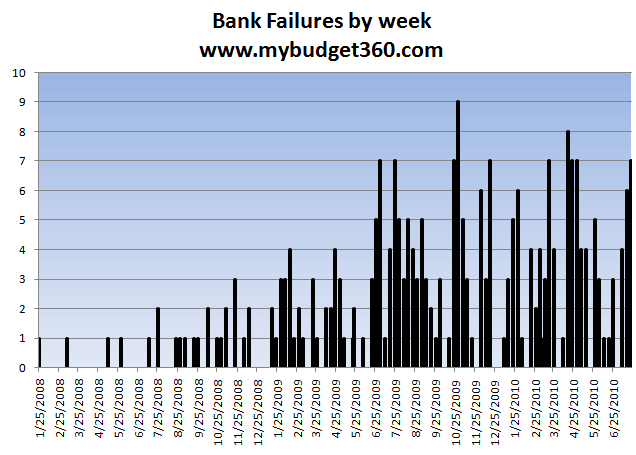
Source: FDIC
The trend is unmistakable.
It is a game of confidence that we have increased the actual amount of deposit insurance to $250,000 from $100,000 at a time when the actual insurance fund is negative. You would think that something this problematic will cause for a sense of urgency but the government is giving the FDIC until 2020 to get this fixed.
While the government gives the FDIC until 2020 to get their house in order, this is how the deposit insurance fund is looking:
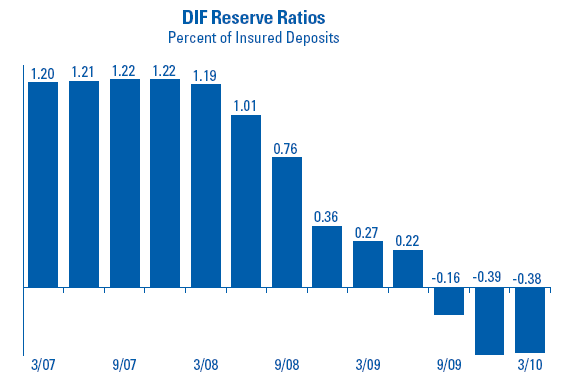
This is the third consecutive quarter in the absolute red. The banking system is starting to look like an imploding ponzi scheme and Wall Street is capitalizing on this vulnerability. How? If you were a big time investor would you invest in a too big to fail bank that may be performing poorly but has full government support or a smaller well run bank that has no support at all? The incentive is not necessarily with the best performing and that is usually a staple of a well run capitalist system. We are not operating in a capitalist system but a corporate oligarchy based on political connections between Wall Street and D.C. This kind of system has been prevalent for decades now and crosses both political parties.
FDIC not too far away from tapping into U.S. Treasury $500 billion taxpayer lifeline. Georgia leads the pack with 40 bank failures since 2008.
By the end of the recession, there will be approximately 1,000 bank failures. Does this sound extreme? It should but the numbers don’t cover the entire story. Since 2008 the number of bank failures has reached 269 and this doesn’t include consolidations done through the FDIC where bigger banks ate up smaller banks before they officially failed. Last week, 7 banks failed. At that pace, we are looking at 364 bank failures per year and the actual number of closings per week has consistently gone up. The FDIC is in a precarious situation. The Deposit Insurance Fund (DIF) is technically speaking, broke. They have added additional cash reserves by front loading premiums on surviving banks but this can only stunt the financial bleeding for so long. The problems in the banking system run deep and many of the smaller regional banks are failing because of commercial real estate loans going bad.
Source: FDIC
The trend is unmistakable.
It is a game of confidence that we have increased the actual amount of deposit insurance to $250,000 from $100,000 at a time when the actual insurance fund is negative. You would think that something this problematic will cause for a sense of urgency but the government is giving the FDIC until 2020 to get this fixed.
While the government gives the FDIC until 2020 to get their house in order, this is how the deposit insurance fund is looking:
This is the third consecutive quarter in the absolute red. The banking system is starting to look like an imploding ponzi scheme and Wall Street is capitalizing on this vulnerability. How? If you were a big time investor would you invest in a too big to fail bank that may be performing poorly but has full government support or a smaller well run bank that has no support at all? The incentive is not necessarily with the best performing and that is usually a staple of a well run capitalist system. We are not operating in a capitalist system but a corporate oligarchy based on political connections between Wall Street and D.C. This kind of system has been prevalent for decades now and crosses both political parties.

Good News, Bad News
The following is more bad news for Americans but it will ultimately be good news for those who have protected themselves with gold.
Cities threaten to cut 500,000 jobs
NEW YORK (CNNMoney.com) -- Cash-strapped cities and counties have been cutting jobs to cope with massive budget shortfalls -- and that tally could edge up to nearly 500,000 if Congress doesn't step up to help.
Local governments are looking to eliminate 8.6% of their total full-time equivalent positions by 2012, according to a new survey released Tuesday by the National League of Cities, the National Association of Counties and United States Conference of Mayors. continue
The following is more bad news for Americans but it will ultimately be good news for those who have protected themselves with gold.
Cities threaten to cut 500,000 jobs
NEW YORK (CNNMoney.com) -- Cash-strapped cities and counties have been cutting jobs to cope with massive budget shortfalls -- and that tally could edge up to nearly 500,000 if Congress doesn't step up to help.
Local governments are looking to eliminate 8.6% of their total full-time equivalent positions by 2012, according to a new survey released Tuesday by the National League of Cities, the National Association of Counties and United States Conference of Mayors. continue
The Silent Gold Rush is on
“ …It is, in short, the only unquestioned and generally acceptable means of payment among nations, as dollars are the only unquestioned and generally acceptable means of payment among Americans, francs among Frenchmen, sterling among the British, and so on.”
Peter Bernstein, ‘A Primer on Money, Banking and Gold.’
Peter Bernstein is no gold bug. Rather, he is one of the world’s foremost authorities on capital markets and economics. A Primer on Money, Banking and Gold was first written in 1965, when gold was still the international currency. It is our contention that in the years ahead, gold will once again resume that role.
Prior to 1971, gold was effectively the commodity with which international payments were made. The flow of gold into and out of countries said more about a nations’ economic health than anything else. Indeed, the outflow of gold from the US in the late 1960s ultimately triggered President Nixon’s decision to suspend gold convertibility. In a fateful decision, the global financial system’s link to sound money was broken.
Ever since, the world has been on a US dollar standard, a monetary system where only one country has the benefit of borrowing and repaying debt in its own currency. In order for this system to prosper, the true international currency, gold, needs to be discredited. We believe gold has been held down for many years in order to allow the US dollar based international financial system to survive. But the official grip on the gold price is beginning to weaken, perhaps this time for good.
The smart money knows this and is beginning to move into gold. There is a silent gold rush taking place all around the world. Investors who understand gold’s role as an international currency are selling their surplus paper dollars and buying the yellow metal. This has led to unprecedented demand for bullion and coin dealers everywhere are struggling to meet this demand.
The Australian newspaper reported over the weekend that the Perth Mint is not taking any more orders for gold until January. Our guess is that the Mint does not want to expose itself to higher future prices given that it does not have the inventory to meet the demand for bullion. In a recent report, The World Gold Council said investment demand for the September quarter was $10.7 billion, double last year’s quarterly total.
“ …It is, in short, the only unquestioned and generally acceptable means of payment among nations, as dollars are the only unquestioned and generally acceptable means of payment among Americans, francs among Frenchmen, sterling among the British, and so on.”
Peter Bernstein, ‘A Primer on Money, Banking and Gold.’
Peter Bernstein is no gold bug. Rather, he is one of the world’s foremost authorities on capital markets and economics. A Primer on Money, Banking and Gold was first written in 1965, when gold was still the international currency. It is our contention that in the years ahead, gold will once again resume that role.
Prior to 1971, gold was effectively the commodity with which international payments were made. The flow of gold into and out of countries said more about a nations’ economic health than anything else. Indeed, the outflow of gold from the US in the late 1960s ultimately triggered President Nixon’s decision to suspend gold convertibility. In a fateful decision, the global financial system’s link to sound money was broken.
Ever since, the world has been on a US dollar standard, a monetary system where only one country has the benefit of borrowing and repaying debt in its own currency. In order for this system to prosper, the true international currency, gold, needs to be discredited. We believe gold has been held down for many years in order to allow the US dollar based international financial system to survive. But the official grip on the gold price is beginning to weaken, perhaps this time for good.
The smart money knows this and is beginning to move into gold. There is a silent gold rush taking place all around the world. Investors who understand gold’s role as an international currency are selling their surplus paper dollars and buying the yellow metal. This has led to unprecedented demand for bullion and coin dealers everywhere are struggling to meet this demand.
The Australian newspaper reported over the weekend that the Perth Mint is not taking any more orders for gold until January. Our guess is that the Mint does not want to expose itself to higher future prices given that it does not have the inventory to meet the demand for bullion. In a recent report, The World Gold Council said investment demand for the September quarter was $10.7 billion, double last year’s quarterly total.
Subscribe to:
Posts (Atom)