Ed Steer's Gold and Silver Daily

24hGold.com RSS Feed - Gold and Silver Market Analysis

24hGold.com RSS Feed - Gold and Silver Editorials

Whiskey & Gunpowder

Numismatic News

Click to Enlarge

Close Call For US Banks
Coming Soon To A City Near You!


Does this scare you? I sure hope it does!

You need some gold stored up, cash, water, rice and beans and guns and ammo. Then, you might have a chance.

Am I a radical? Nahh. Just a realist.

Oh yeah, I almost forgot....... Happy New Year! LOL.


WHAT BEGAN ON JEKYLL ISLAND IS ABOUT TO FALL
excerpt:

The twenty-six commodities listed are only traded daily in one place—Wall Street. Read Revelation 18 carefully with Isaiah 47, and Jeremiah 50 and 51. End-time Babel/Babylon is America…and the great city of Revelation 18, a seaport, is New York City. Look at the timing in Jeremiah 50—this is a country after 1948, a country that is in existence when the Jews return to their homeland.

This is by no means a complete teaching on the events surrounding the fall of the American economy, and world economy before it’s all over. But, I want to give you some basics to watch for, since it is about to fall down around us like a deck of cards. The news is finally telling us softly that the dollar is failing. Wall Street is in turmoil, mortgages are failing and people’s homes are going into foreclosure, unemployment is at a high, and gas and food costs are rising steadily.


We are close to an economic Revelation 18, which will cause the world to tremble. This chapter is New York—Wall Street—and the economic/trade economy of America--is mirrored by Isaiah 47. The twenty-six commodities listed in Revelation 18 are only traded daily in one place—Wall Street. Number twenty-six in the list: The trafficking in the “souls of men” is American’s biggest “industry”—the selling of sex slaves including children, the overseas hiring of slave workers to work their fields and factories for as little as 30 cents a day—adults and children--slavery to drugs (America is the biggest trafficker of addictive drugs in the world), the biggest exporter of pornography of all types, as well as violent music and violent movies. I’ve been in 29 countries, many Third World countries, so I not only know these things by researching, but by seeing it up-front. “Babel” means “confusion by mixture”.

read full article here
It's About To Get Ugly! Got Gold?


Gold to reach $1800 - probably in Q1 2011 - James Turk
Analysis and comment on the latest Mineweb interview with James Turk who feels that $1800 gold is still just around the corner.

LONDON - Speaking on a Mineweb podcast this week, precious metals guru and Gold Money founder James Turk, reiterated his forecast of a US$1800 gold price in the near future. True it hasn't come about by the end of this year, but he feels it is only a matter of time and is confident that it will happen sooner rather than later. Now he reckons it should do so during the first quarter of next year as he notes that this is normally a strong period for gold and that there are a lot of fundamentals working in gold's favour at the moment which will drive it there. He still also feels that it is possible that gold could still hit $1500 by the end of this year in the short trading time available before the year-end.

On the fundamentals affecting the price at the moment Turk points to the burgeoning demand from China which is, he says, "importing so much gold now that even though the world's largest gold miner, the demand domestically is exceeding domestic production for the first time in quite some time, so as a consequence that's a major factor still rippling its way through the gold market". With the run up to the Chinese New Year, which this year starts quite early on February 3rd, Chinese demand is probably still rising and as we noted in an article here yesterday (see Chinese rush to gold as inflation fears bite) anecdotal evidence suggests that, if anything, the big surge in Chinese consumption apparent from the recent World Gold Council statistics which showed a huge increase in gold imports this year, is accelerating rather than diminishing.

The recent rises in commodity prices are also seen as a sign that serious inflation lies ahead, as does the sovereign debt crisis and the moves major Central Banks are taking to try and ward off recession and even financial collapse. Turk feels these are a sign of hyper-inflation to come - perhaps not on a Zimbabwean or Weimar Republic scale - but certainly in double digit figures. The Chinese purchasing s put down to inflation fears - and inflation is already rising there quite sharply and people see gold as some kind of protection - and as inflation builds in the West the same pattern could materialise.

On investor psychology and sentiment: "Sentiment is indeed very important and I follow that quite closely and as you know every bull market has three stages." Says Turk. "During the first stage you get apathy and neglect - very few people are paying attention. That's the stage that gold was in for most of this decade. It was up nine years in a row against the US dollar - double digit rates of appreciation against all of the world's major currencies and few people were paying attention, but when it went over $1,000 an ounce; that was a wake-up call. Gold went into its second stage an in the second stage more and more investors are starting to pay attention to gold - they are starting to pay attention because of other things that are happening and other asset classes which is the point that you were making but the third stage which is the speculative stage is still way in the future". He points to late 1979, early 1980 as what could happen in a true speculative stage of price advance, when the gold price tripled in a six-month period - although after that it crashed back so timing would be key were history to repeat itself.

Overall Turk sees demand for gold remaining strong virtually everywhere. Europe has seen a very sharp move into gold from big investors - particularly in Germany and Austria with the feeling that the European Central Bank is effectively debasing the Euro through its own QE programmes. Some Central Banks are increasing their gold holdings; gold purchasing in traditional buying areas like the Middle East and India seems to be on the up again with higher prices now gaining acceptance; and purchasing from what is effectively a relatively new market - China - beginning to have a significant impact on global demand.

"Wherever the monetary problems arise", Turk concluded, "that's where the demand flows from and there are so many different hot spots around the world in terms of potential monetary problems that you are going to see gold demand strong pretty much globally.

To listen to, or read the transcript of, James Turk's interview with Mineweb's Geoff Candy, click on: 2011 Gold outlook: James Turk
Gold Is the Default Currency

In almost four decades of fiat currencies, the International Monetary Fund (IMF) has calculated global dollar reserves at some 60 percent of America's GDP. Because of their reserve currency status, the US government has been able to create dollars at will to meet their obligations. And to pay for those obligations in the next decade, global reserves are expected to increase to twice America's current GDP. Therein lies the dilemma for China and others, there is insufficient backing and the Treasury liabilities will only grow. In contrast, the total of all gold ever mined is about 170,000 metric tons. The price of gold would be equivalent to about $5,000 an ounce today if the dollar liabilities were scaled to the gold supply. Reserve currency status is not a birthright. Once trust disappears, it can vanish quickly.

Gold is very different from paper money. Gold's move to fresh highs reflects that it has become the default currency in a world of devalued currencies. Needed in this struggle is a set of rules to establish a new global financial order and a currency that nations can trust. The world is full of sick economies and sick currencies. Gold is a cure, painful but a cure.

Needed then is a return to using gold as an anchor for currency values. Needed is monetary reform. Needed are fresh ideas. We envisage a Bretton Woods II system where currencies would be linked to the value of gold rather than a fixed paper dollar system. Gold is an alternative money asset today and World Bank's President Zoellick suggestion to use gold in a basket of multiple reserve currencies was not a call to return to a gold standard but an acknowledgement of its role as a time-tested monetary asset. After all, gold is the only commodity held by central banks.

The price of gold has increased primarily due to the loss of purchasing power of currencies, particularly the dollar. The supply of currencies seems unlimited, the supply of gold is not. Measured against a broad basket of commodities, gold is higher and rising much more quickly against all currencies. Gold's move to fresh highs is signalling the fundamental disequilibrium in currency markets and the world economies -sort of like the canaries in the coal mine. As long as the dollar is debased, gold's bull run will go higher. Gold's rise is a reflection of its role as a barometer of investor anxiety. The increasing uncertainty surrounding global financial markets is currently driving the price of gold, yet in inflation adjusted terms, it remains far below its previous peak, equivalent to about $2,300 today. The canaries are chirping.
US empire could collapse at any time, says Pulitzer winner
By Nathan Diebenow
RawStory.com

America's military and economic empire could collapse at any time, but predicting the precise day, week or month of its potential demise is unattainable, according to a former New York Times war correspondent who spoke with Raw Story.

"The when and how is very dangerous to predict because there's always some factor that blindsides you that you didn't expect," Pulitzer-winning journalist Chris Hedges said in an exclusive interview. "It doesn't look good. But exactly how it plays out and when it plays out, having covered disintegrating societies, it's impossible to tell."

He explained that he learned this lesson as events unfolded around him in the fall of 1989. Then, members of the opposition to the Soviet Empire told him that they predicted travel across the Berlin Wall separating East from West Germany would open within the year.

"Within a few hours, the wall didn't exist," he said.

Hedges was one of the 131 activists were arrested in an act of civil disobedience outside the White House yesterday, even as Obama was unveiling a new report citing progress in the Afghanistan war.

Speaking to Raw Story on Wednesday night, he said the signs of US collapse are plain to see and compared the country's course through Afghanistan to Soviet Russia's.

"We're losing [the war in Afghanistan] in the same way the Red Army lost it," he said. "It's exactly the same configuration where we sort of control the urban centers where 20 percent of the population lives. The rest of the country where 80 percent of the Afghans live is either in the hands of the Taliban or disputed."

"Foreigners will not walk the streets of Kabul because of kidnapping, and journalists regularly meet Taliban officials in Kabul because the whole apparatus is so porous and corrupt," he said.

One day after this interview was conducted, reports hit the global media noting the CIA's warning to President Obama, that the Pakistan-supported Taliban could still regain control of the country.

Hedges predicted that President Obama's war report released Thursday would "contradict not only [US] intelligence reports but everything else that is coming out of Afghanistan."

His prediction came startlingly true: the CIA's own assessment was said to stand in striking contrast with President Obama's report.

Defense Secretary Robert Gates, however, insisted that the US controlled more territory in Afghanistan than it did a year ago.

'A corporate coup d'état in slow motion'

Hedges said he attended the protest and planned to get arrested because he is against the corporate powers that have enveloped the nation.

"We've undergone a corporate coup d'état in slow motion," he said. "Our public education system has been gutted. Our infrastructure is corroding and collapsing. Unless we begin to physically resist, they are going to solidify neo-feudalism in this country."

"If we think that Obama is bad, watch the next two years because these corporate forces have turned their back on him," Hedges warned.

Hedges, author of "Death of the Liberal Class," said that his vision of America is one with a functioning social democracy, which stands in stark contrast to the nihilism of the corporate state.

"American workers, as they are repeatedly told, will have to become competitive with prison labor in China," he said. "That's where we're headed, and all the pillars of the liberal establishment are complicit in this."

"At least if you get sick in the UK, you don't go bankrupt or die," he added.

Hedges said that another pressure point is the US dollar, which he pointed out had been dropped by Russia and China in favor of modified ruble/renminbi exchanges.

"A few more deals like that, and our currency becomes junk," he said.

Hedges continued, "As long as we have relative stability, these lunatic fringe movements can be held at bay, but if we don't undertake serious structural reform, which we're not doing, then it is inevitable that we will come to a tremendous crisis - economic and political as well as environmental."
Your Share Of The Debt
http://www.brillig.com/debt_clock/
The Outstanding Public Debt as of 22 Nov 2010 at 09:13:52 PM GMT is: $13,802,062,378,229.40

The estimated population of the United States is 309,527,930 so each citizen’s share of this debt is $44,590.68.

The National Debt has continued to increase an average of $4.17 billion per day since September 28, 2007!


Unemployment Rate:
9.6% in Oct 2010 is equivalent to 29,714,681 People who are not working not counting those who are on a Pension and over 65. People under 20 years of age made up over a quarter of the U.S. population (27.3%), and people age 65 and over made up one-eighth (12.8%) in 2009.

So now take that 9.6% who are not working and the 27.3% who are under age, and 12.8% who are over 65 and you have a total of 49.75 of the US population who do not contribute to the National Debt nor GDP.

So instead of each citizen paying 44,590.68 to the Debt., you now have 155,537,785 people who are working and can pay the debt.

This means each working citizen owes the US Gov $88,737.68 and for each day you do not pay you then owe an additional $26.81 to the pot.

Each working adult in the USA owes almost $90,000 in debt on top of their own mortgage, and credit cards and car loans.

And the US dollar is dropping in value and is no longer considered the fiat currency of the world as other countries begin to dump it and replace it with gold.
Shut Up and Read!
by David Tanner

The following article by Robert Kiyosaki, author of Rich Dad Poor Dad, echos what I have been trying to tell my conservative friends and family for years. If you would put the same amount of time and effort into your financial education as you do into political action THEN maybe we could change some things around here.

So shut up your whining and moaning about politics and take a little time and learn about how the world REALLY works! Then, maybe, just maybe, you might have a chance of saving yourself and your family from the coming "PRE-PLANNED" financial crisis that the oligarchs have in store for you.


The New Messiah
Online Exclusive Update #75 - The New Messiah
Conspiracy of the Rich
The 8 New Rules of Money
by Robert Kiyosaki
December 13, 2010

Now that the 2010 election is over and the dust has settled, I thought I’d make a few comments on the election in which Democrats lost 61 seats and on what politics is telling us.

In my opinion, desperate voters, groups such as the Tea Party movement, are in search of a new Messiah. Many people had high hopes for Barack Obama, but rather than become their political Messiah, he’s terrified and turned off millions of people.

I’m neither a Republican nor a Democrat, so I don’t have a dog in the fight. Personally, I don’t think it makes much difference which party wins. For those of you who have read Conspiracy of the Rich: The 8 New Rules of Money, you already know I believe the rich control the show and that whoever is elected is simply a puppet with the rich pulling the strings.

To me, this heated battle between the Republicans and Democrats is a desperate cry from desperate voters. Millions of middle class voters are hoping and praying someone will save them from this financial crisis. The Tea Party movement is primarily a middle-class movement, a group of people who suspect they’re sliding from the middle class into a future of poverty.

The poor in America may care who’s elected, but they’re not involved in this political battle. The poor already know that politics cannot save them from their poverty, which is why traditionally only a small percentage of the poor vote. They also know their Messiah, President Obama, is in trouble for trying to save them. The poor know that the middle class are not interested in saving the poor because the middle class are now focused on saving themselves.

What most voters don’t know is that the problem isn’t political. So, it cannot be solved by electing new political leaders. The problem is financial, and the core of the problem is located in the Federal Reserve Bank. In other words, the rich control us through the banking system, not the political system.

In Conspiracy of the Rich, I wrote about how the ultra rich control us via our monetary system and our educational system, which is why we have almost zero financial education in our schools. Without financial education, most voters choose to trust in their vote rather than become financially educated.

Without a financial education, most voters don’t realize that financial crises and bank bailouts are integral to the business plan of the ultra rich. The business plan, built around a system of central banks, needs financial crises and bailouts to become richer and control the people via fear.

The recent $115 billion bailout of Ireland demonstrates how desperate the world is. The European Union, including England, says, “We don’t want the crisis to spread.” They say, “If Ireland falls, then Portugal, Italy and Spain will be joining Greece.” They say, “If the European Union fails, England and the US will fail because the EU is the biggest trading partner of England and the US.”

When we the people, the voters, hear this, we happily agree to a $115 billion bailout of Ireland. Without financial education, the average person doesn’t ask, “Where did the $115 billion come from?” The answer is, “The banks printed it.” Nor does the average voter ask, “Who is going to pay the 6 percent interest on the $115 billion?” The answer is, “The Irish taxpayer.” Nor does the average person ask, “And who receives the interest on the $115 billion?” The answer is, “The bankers and those that own the banks.”

Again, this is one reason why there is no financial education in our schools. How else can the ultra rich put their hands in our pockets and steal our wealth besides having us be ignorant of what they’re doing? It’s via our fear of not having enough money, and being poor and destitute, that we blindly allow the ultra rich to steal from us by controlling the money system.

When our political leaders in the US say, “The recession is over,” I wonder what they’re smoking. I wonder who is paying them off. Just because consumers are back shopping for the holiday season, doesn’t mean that we are out of the woods.

When I listen to voters, lathered up and frothing at the mouth about who will win the next election, I feel for them. I know they hope for a new Messiah. Do voters really think that new political leaders can save them from the corruption of the world banking system?

Voters should ask better questions: “What if our politicians cannot save the world? What if they screw up? What are we the people going to do? What if we do slide into a global depression or global hyperinflation? Is there really a new Messiah who can save us? Should we do as President Obama suggests and count on the ‘Audacity of Hope?’”

My rich dad often said, “Hope is for the hopeless.” I’m afraid that the financial situation is hopeless for millions of people, especially if they hope their elected officials will save them.

In November 2010, Robert Zoellick, President of the World Bank, suggested at the meeting of the G-20, that the world consider the gold standard once again. This was a shocker, especially for bankers and politicians. If the world went back on the gold standard, how would the politicians and bankers rule the world?

Immediately, Mr. Zoellick’s proposal was criticized and put down as unrealistic and impossible. One criticism was that the world’s central banks hold about a total of $1.3 trillion in gold. The central banks would need ten times that amount to cover the roughly $60 trillion in funny money held in their vaults. They’d literally have to buy tons of gold, which would make those that hold gold very rich and those that hold cash very poor. The bankers did not like the idea, even though it was the president of the World Bank who suggested it.

One reason why the bankers and politicians don’t want our money backed by gold is because they’d lose their power. If our money was stabilized, we could do business logically because it would be based upon sane business principles. As long as bankers and politicians have the power to play games with money, we the people depend on them to save us and save our economy.

With gold floating between $1,300 and $1,400 an ounce, the world markets are saying, “Inflation is coming.” This means your money will be worth even less. When inflation and taxes go through the roof, there will be more people who will slide from the middle class into poverty. With higher taxes and inflation, pensions plans, Social Security, and Medicare will collapse. This means many who are middle class today will become the nouveaux-poor of tomorrow.

As I wrote in Conspiracy Of The Rich, in times of financial crisis, leadership revolutions happen. In 1933, FDR and Adolf Hitler came to power. Mao came to power when the Chinese economy collapsed. Stalin and Napoleon are also products of financial crisis.

So, what will be the next leadership revolution? If the economy worsens, I believe Sarah Palin will have a good chance to become president in the 2016 election, after losing in 2012. By 2016, Sarah will be older, will have two presidential campaigns under her belt, and will be a seasoned pro. By 2016, her third presidential campaign, she will be formidable. She will be the candidate of choice for an even larger mass of desperate people.

In the meantime, real Messiahs, or at least a wise man, such World Bank President Robert Zoellick, will be attacked for their views on how to save the economy. Zoellick’s proposal was to stabilize the US dollar and to take away our leaders’ power and ability to play games with money.

The reason Robert Zoellick won’t be heard and taken seriously is because the masses of voters, most of whom aren’t financially educated, have no idea what Mr. Zoellick is talking about. So, a true Wiseman such as Robert Zoellick goes unrecognized, and someone like Sarah Palin, someone loved by the masses, will probably be elected in 2016.

I like to think Sarah Palin is a good person doing what she thinks is best for the country and the world. At the same time, I doubt she understands the power behind the global banking cartel. She is a popular leader and a person who understands the power of publicity, but financially she is no smarter than the masses that love her.

As this crisis spreads, fear will turn to anger, and more people will look for revolutionary leaders. Always remember the Declaration of Independence was not so much about independence as it was a declaration of anger at mother England ripping off the colonists. This anger led to the American Revolution, and a new nation was born. I believe we’re at the same flash point today.

Again, I am not a Republican or Democrat. When I vote, I vote for the person, which means lately I haven’t voted for many people.

I’m a person who watches what our leaders do more than what our leaders promise. After I observe what they’re doing, I take actions I believe are best for Kim and I and the people that work for our companies. I wish I could say I trusted our leaders, but I don’t.

I was taught, “God helps those that help themselves.” I believe in taking care of myself, not depending on the government to take care of me. My financial education is my defense against an incompetent and often corrupt leadership—and the growing masses of desperate people who are hoping, praying, and voting for a new Messiah.
Richard Russell - Gold = Biggest Bull Market of Our Lifetimes
With gold still consolidating gains, the Godfather of newsletter writers Richard Russell in his commentaries from this past week stated, “I listened to Kitco's Nadler on the Bloomberg channel this morning. He's been bearish on gold for months, and I thought he sounded like a know-nothing fool today. Why didn't Bloomberg interview someone who's been bullish and right about gold.”

With gold still consolidating gains, the Godfather of newsletter writers Richard Russell in his commentaries from this past week stated, “I listened to Kitco's Nadler on the Bloomberg channel this morning. He's been bearish on gold for months, and I thought he sounded like a know-nothing fool today. Why didn't Bloomberg interview someone who's been bullish and right about gold.”

Richard Russell continues:

What's with the Wall Street Journal and gold? In the Dec. 6 paper, the front page blares, “ETFs and Gold.” So I turned to the gold article which included a rare error in its headline,"Resisting Gold's Glister." I assumed they meant gold's "Glitter." The article was written by a Tim Medley, a random guy I had never heard of. Mr. Medley's main half-assed complaint about gold is that it is too expensive today and therefore dangerous in that it may correct. Worse, claims Medley, there is a current "euphoria" regarding gold. Too many people are bullish on gold. Therefore, gold is about to lose its "glister."

My question -- Are the editors of the Journal short of gold? Or are they short of brains? This article denigrating gold bordered on sheer stupidity.

...But the latest is that rising "right shoulder", which took gold to a new high. Then we see the two day swoon, down to the rising trendline. If the trendline holds, gold will take on a bullish look...If the latest rising trendline holds, gold will look stronger than ever. Whew! One way or another, old-timers like Richard Russell will hold on to their gold.

...Conclusion -- The gold and precious metals universe is probably the biggest and most profitable bull market that most of us will see in our lifetime. Suffice it to say, my older subscribers who have moved into the gold bull market with both feet are now sitting with immense paper profits. And I continue to remind my subscribers that the third or speculative phase of the precious metals bull market has not yet arrived.

Gold possesses a singular property shared by no other item. A gold bull market is fed by both fear and greed. The fear quotient is obvious -- the fear is seen in the question, "Will sovereign debt ever be paid off, and will fiat currencies even survive?" The greed quotient arrives as the precious metals market heats up and gains publicity. In due time, literally everyone will want to join and ride the gold bull.

The questions I am most frequently asked are

(1) Should I trade the gold bull market? The Russell answer to this question is “NO. Just add to your positions on corrections.”

(2) I have huge profits in silver and gold. Should I take my profits? The Russell answer to the question is ‘No. The bull market is not over.’

(3) Is it too late to enter the precious metals bull market? Again, the Russell answer is “No. We have yet to see the universal excitement that I expect to see before the gold bull market breathes its last.”


To subscribe to Richard Russell’s Dow Theory Letters CLICK HERE.
Buy Gold and Silver Through a Commercial Bank and You May End Up With a Vault Full of Air

Recent news this week again proves that bankers are among the largest charlatans in the universe.

First Jim Rickards reported that a Swiss bank refused to deliver roughly $40 million of gold bullion to a wealthy client for 30 days and only finally physically delivered his gold when the client brought in his lawyers and threatened to take his story to Reuters and other syndicated financial news networks. Then later this week, James Turk reported that he is aware of another individual that has been trying to take physical possession of approximately $550,000 of silver for two months now from a Swiss bank with zero luck. Turk further elaborated that the bank has been trying to pressure the client into accepting the cash equivalent market value of the silver rather than deliver the physical silver to the client. In both of these cases, I presume that neither of these Swiss banks ever held allocated gold and silver for their clients or if they did, had then leased out the gold/silver or sold the same gold/silver to multiple clients, and thus were forced to stonewall their clients until they could secure the physical metal. Why else would a bank take 30 days to deliver something that was supposed to be sitting in a vault in an allocated account?

Of course, none of this is really shocking as the two above cases merely mirror the circumstances of the 2005 class-action lawsuit against Morgan Stanley in which Morgan Stanley told its clients it was selling them silver in allocated accounts and storing it in its vaults. However, when one of their clients, Selwyn Silberblatt, demanded physical delivery, Morgan Stanley failed to deliver, prompting the class-action lawsuit. Morgan Stanley eventually settled the lawsuit for $4.4 million. Time after time, bankers have been caught committing likely fraud regarding the sales of gold and silver. This likely fraud extends to more than physical sales. In the futures markets, bankers have been discovered to be selling 100 ounces of paper gold for every one ounce of physical gold that actually exists in the market. With PM ETFs, it is highly likely that multiple claims exist on whatever physical gold and silver back the GLD and SLV, if any physical gold and silver even back them at all.

In addition, it’s not just banks you have to worry about these days. The incidence of counterfeit gold coins and silver coins is on the rise along with the recent steep rise in the gold and silver price. The Financial Times recently reported that a wave of hard to detect counterfeit gold coins is now coming out of China. Say goodbye to the days of gold-plated tungsten and say hello to a more complex counterfeit gold alloy consisting of 51% gold mixed with osmium, iridium, ruthenium, copper, nickel, iron, and rhodium. Tungsten is a hard, brittle grey metal that has the same density as gold but none of gold’s characteristic softness. The new fake gold apparently not only has a density similar to the real thing but also has a near identical softness and color, qualities that suggest that metal smiths with an extensive knowledge of metallurgy are producing the new fakes. In fact, Haywood Cheung, president of the Chinese Gold & Silver Exchange Society, Hong Kong’s century-old bullion exchange, said goldsmiths and jewelers in Hong Kong had recently been duped into buying between 200 and 2,000 ounces of the new fake gold.

In conclusion, if you want to ensure that you actually possess real physical gold and real physical silver, take two steps.

(1) Never entrust a bank to hold your physical gold and silver or you may end up sitting on a vault full of nothing but air; and
(2) When you buy from an independent dealer, perform your due diligence to avoid purchasing fakes.


J.S. Kim
SmartKnowledgeU

JS Kim is the Managing Director and Founder of SmartKnowledgeU, a fiercely independent investment consulting and research firm that devises investment strategies to protect Main Street from the fraud of Wall Street.
Wealth You Can Wear

Some years ago, the well-known economist Milton Freidman lamented the idea of mankind placing so much value on something you merely dig up from the ground. There isn’t that much gold in the world to begin with. What can you really do with it beyond jewelry and dental work? The answer – plenty.

The people of Burma wear gold medallions around their necks as a hard currency. 401K gold sales are up while the American Dollar is down, Brazil just won the right to host the Summer Olympics, a gold-back Dinar may be in the pipeline and a basket of currencies may well be replacing the U.S. Dollar as the major global reserve currency. Digital gold, gold stocks, global gold mining and Latin American gold mining, as well as gold demand in India (which consumed more than 770 tons of gold in 2007) and China (360+ tons in 2007) are key issues which deserve vigilant monitoring. Source
The scramble for physical metal intensifies

The scramble for physical gold and silver is intensifying. People increasingly want to own the real thing, and not some paper substitute, all of which come with counterparty risk. This conclusion is apparent from the following two charts of gold and silver forwards, which are based on data made available by the London Bullion Market Association through November 24th (the most recent data available).


Because gold is money, gold almost always trades in contango, meaning the future price is higher than the spot price. The percentage difference between gold’s spot and future price is gold’s interest rate, so in this regard, gold is not different from other moneys, except gold’s interest rate is lower than those of national currencies. Interest rates are a reflection of risk, and because gold’s purchasing power cannot be debased by central bank or government actions, the risk of losing purchasing power when holding gold is low. So gold is rewarded by the market with a low interest rate.

If the future price is lower than spot, which is called backwardation, you can sell your metal in the spot market, invest the dollars you receive to earn interest, and then buy your metal back in the future at a lower price and profit the difference. But there is another important factor to consider outside the math of this formula.

If you sell your physical metal in the spot market and at the same time agree with someone to buy it back at a future date, you are now holding someone’s paper promise instead of physical metal. In other words, you have counterparty risk, which of course is avoided when you own a tangible asset like physical gold or physical silver.

Normally, few people worry about counterparty risk. So bullion dealers and other institutions dealing in the precious metals watch for opportunities to profit from backwardation, with the result that gold rarely, if ever, trades in backwardation, which explains why the above chart is so extraordinary.

Gold for 1-month and 3-months forward has been mainly in backwardation for more than one year. Even more exceptional is that gold 6-months forward has been in backwardation since November 5th. To show how rare this event is, I checked the LBMA database, which goes back to 1989. There is not one instance of 6-month forward gold being in backwardation, which nearly confirms my own experience. I’ve been trading the precious metals since the 1970s, and I can’t recall any time before this year when 6-months forward gold was in backwardation. The current and continuing backwardation is truly incredible.

Note too the clear downtrend in 12-month forward gold which is approaching backwardation, which is similar to the downtrends for other forward periods. These downtrends make clear that the demand for physical gold is intensifying.

In a word, it is bullish. The only way the increasing demand for physical metal can be met is with higher prices.

Any way you look at it, the backwardation in gold and silver is a truly rare event and an exceptionally bullish one too. So be prepared for an upside explosion in the price of both precious metals as the scramble for physical metal intensifies even further as a result of people increasingly choosing to hold a safe-haven tangible asset instead of paper.

James Turk

Free Gold Money Report
$1400 Gold: A Bargain
excerpted from
The Delaire Report, Dec. 14, 2010

The early 1980s presented an once-in-a-lifetime opportunity to buy stocks. Today, economic and political conditions appear to offer a similar opportunity in tangible assets. The macroeconomic and political landscape has not looked like this since the hard asset bull markets of the 1970s. The global economic and financial market climate looks increasingly precarious. Financial imbalances have never been greater.

Many countries have experienced housing bubbles and now have huge budget deficits as well as burgeoning national debt. Global trade imbalances are at unprecedented levels. The U.S. has no ability whatsoever to pay back its enormous debt, which has been stated at around $50 trillion plus dollars and not the $14 trillion the government state. If this is true, then the interest payments alone on the US debt are unsustainable. To make matters worse the biggest buyers of US debt no longer want this paper and instead are trying to cut their exposure. And, to make things even worse than worse, at the moment the only buyer of US debt is the US Federal Reserve.

The US national debt has grown so huge that the only way to pay for it is to borrow more, just like a huge Ponzi scheme. In the coming decade, we may witness one the greatest meltdowns in monetary history, as the dollar and euro decline in value. And, as this happens gold will become an important component in the global financial system.

Furthermore as the U.S. maintains its low interest rate policy and billions of dollars flow to other countries around the world for higher returns, we will see a wave of reactive monetary policies from other countries in order to protect their currencies from increasing in value as the dollar continues to weaken. This chain reaction will send the dollar lower, but it will also make gold’s $1,400 an ounce price look like a bargain by the end of next year.
U.S. Secretly Helped Spain Fight Treasure Hunter
Diplomat turned over documents to aid legal battle over gold and silver, cables show


TAMPA — Sunken treasure, WikiLeaks documents and a priceless French painting.

Suddenly, a great deal of international drama has touched down in Tampa and reads like a diplomatic thriller — with half a billion dollars in gold at stake.

For years, Tampa's Odyssey Marine treasure hunting company has been fighting with the Spanish government over a 17 tons of gold and silver coins that Odyssey discovered and brought up off the Atlantic Ocean floor.

Now, it turns out, Spain has been getting secret help since 2007 from an unlikely source: The U.S. government.

Among the thousands of documents released by WikiLeaks are several U.S. diplomatic cables describing how U.S. ambassadors were helping Spain in their cause — partly to help broker a deal to bring a famous painting in Spain to a U.S. citizen who claimed it was looted by the Nazis in World War II.

Specifically the U.S. offered to provide confidential customs documents prepared by Odyssey that Spain in turn planned to use in court to fight the company.

Odyssey officials are not pleased.

."The cables seem to indicate that someone in the U.S. State Department has literally offered to sacrifice Odyssey and its thousands of shareholders along with the many jobs created by the company in exchange for the return of one painting to one U.S. Citizen," the company said in a statement to the Tribune. "It is hard to believe that this really happened. It sounds like something out of a Hollywood script."

London's Guardian newspaper first reported the cables, as part of its ongoing digestion of thousands of documents released by WikiLeaks. The U.S. government has condemned the release and called for prosecution of WikiLeaks founders.

The Spanish were cool to the idea of returning the painting, the cables show, but were grateful after Department of Homeland Security staff in the U.S. embassy in Madrid handed the Spanish customs import documents that Odyssey had filed when bringing the treasure to Tampa.

"The information was confidential," the U.S. cable stated, "and to be used only for law enforcement purposes." The Spanish replied that they were "interested in obtaining the Odyssey customs information to provide to lawyers representing the [Government of Spain] in the Tampa Admiralty Court."

Odyssey found the treasure in May 2007 and has since argued that the treasure was on board a Spanish commercial vessel. The ship sank in international waters, possibly in 1804 while carrying commercial goods from Peru, Odyssey says, and was thus fair game for any salvage company that found it. Odyssey is now locked in a protracted legal battle with Spain, which claims the treasure was on a military mission at the time, and thus Spanish property forever.

A diplomatic cable a year later describes how the U.S. Ambassador to Spain, Eduardo Aguirre, suggested a deal.

He met with Spanish Minister of Culture Cesar Antonio Molina on June 30, 2008, who told the U.S. Ambassador that they should meet over the issue of a claim by an American citizen, Claude Cassirer, to recover a painting by Camille Pissarro. Cassirer claims the Nazis in 1939 forced his grandmother to sell them the painting and it passed through several hands before ending up in a Spanish museum.

"The [U.S.] ambassador noted also that while the Odyssey and Cassirer claim were on separate legal tracks," the cable states, "it was in both governments' interest to avail themselves of whatever margin for manouevre they had, consistent with their legal obligations, to resolve both matters in a way that favoured the bilateral relationship."

The Spanish official replied, the cable says, that there were many steps required before any movement on the painting, but that he had recently flown to Washington, in part, to meet with lawyers that Spain retained in the Odyssey case. He expressed "indignation" after a CNN interview where Odyssey CEO Greg Stemm aimed to keep the treasure and return only items of archeological value.

The treasure now sits in a vault warehouse in an undisclosed location. The legal case already went through federal court in Tampa, and now rests in the Eleventh Circuit Court of Appeals in Atlanta. However the case is decided, observers expect it to be appealed to the U.S. Supreme Court.
If we want to keep our nation's secrets SECRET, store them where President Obama stores his college transcripts and birth certificate.- Governor Mike Huckabee... concerning WikiLeaks
"Gold Will Go To Astronomic Numbers"

Peter Schiff Video
This video is over a year old but even more pertinent today than last year.


Peter Schiff is an American businessman, author, financial commentator, and a former 2010 Republican primary candidate for the United States Senate.

Schiff is president and chief global strategist of Euro Pacific Capital Inc., a broker-dealer based in Westport, Connecticut. Schiff frequently appears as a guest on CNBC, Fox News, and Bloomberg Television and is often quoted in major financial publications and is a frequent guest on internet radio as well as the former host of the podcast Wall Street Unspun and the current host of the The Peter Schiff Show.

He is known for his bearish views on the dollar and dollar denominated assets, while bullish on investment in tangible assets, as well as foreign stocks and currencies.
Day Of Reckoning Postponed Again
The following is an excerpt from Doug Casey's commentary on the recent Bernanke 60 Minutes interview:

Quesion: "Let's look at some of the things he said. The first and foremost thing that jumps out at me is that he says the Fed is "not printing money" and that the Fed's actions have no significant impact on money supply. How can he imagine they can inject liquidity into the economy, and that it won't have any impact on money supply?

Doug: I think he knows better than that. Look, what the Fed has been doing is buying securities. And the way they do that is to credit the account of the seller with dollars. So, of course it creates money. That's why they call it "quantitative easing" – because they're increasing the number of Federal Reserve units in circulation. I really love that term, QE, because it's so cynically dishonest, like the whole monetary system itself. And it's amazing that nobody even challenges it. They just accept it instead of calling it what it is – printing money. It's Orwellian.

In any event, creating more currency units by buying government bonds serves several purposes, from their point of view. It raises the prices of bonds, and therefore pushes interest rates down – and they want lower rates because it makes it easier to finance the staggering amount of debt out there that threatens to collapse the system. And they want more currency units out there because that makes people feel richer, consume more, and that props up pre-existing economic conditions – which are actually unsustainable. The crash prompted them to buy toxic paper from banks for a while, to keep them from going under. Now they're buying U.S. treasuries again, with the latest $600 billion.

Bernanke is taking desperate measures to solve an acute problem. But their consequences will be disastrous – much, much more damaging than if he'd done nothing. Of course if he did nothing, the system would collapse through a deflation: bonds would default, banks would close. What will now happen is the currency itself is going to be destroyed, which is much worse. But since it's put off a bit further in the future, that's the course he's taking.
New law lets Treasury diminish gold, silver coin production
Submitted by cpowell on Mon, 2010-12-06 20:25. Section: Daily Dispatches
3:23p ET Monday, December 6, 2010

Dear Friend of GATA and Gold (and Silver):

Mike Zielinski of the Gold and Silver Blog has uncovered another telling sign of the increasing desperation of the U.S. government's campaign to suppress gold and silver prices.

Zielinski reports that new legislation passed by the House and Senate -- H.R. 6162, the Coin Modernization, Oversight, and Continuity Act of 2010 -- which awaits action by President Obama, diminishes the obligation of the Treasury Department to make gold and silver coins available to the public.

Current law requires the department to mint gold and silver coins "in quantities sufficient to meet public demand."

The new law would require the department to mint gold and silver coins "in quantities and qualities that the secretary determines are sufficient to meet public demand."

Not that the Treasury Department lately has been observing the law, what with the U.S. Mint's frequent suspension of gold and silver products. But now apparently the government recognizes a likely difference between what actually will meet public demand and what the treasury secretary will determine meets public demand. This may reduce the government's own gold and silver purchases and thus reduce metal demand generally.

Zielinski's report is headlined "How Much Gold and Silver Will the Treasury Secretary Determine is Sufficient to Meet Public Demand?" and you can find it at the Gold and Silver Blog here:

http://goldandsilverblog.com/gold-and-silver-treasury-secretary-public-demand-0124/...

CHRIS POWELL, Secretary/Treasurer
Gold Anti-Trust Action Committee Inc.


--------------------------------------------------------------------------------
You're Not Protected In Currencies
excerpt from interview with Greg Weldon, Weldon Financial

Not a Dollar Move
"More importantly in the bigger picture, when you take a look at gold prices in every currency in the world, it’s not a dollar move. Gold is gaining against every single currency in the world. The flip side is that every currency in the world is depreciating relative to gold because central banks are debasing money everywhere. That’s the bottom line when talking about gold. That’s what people tend to miss, tend to overlook, is what is really at the core of this. It’s kind of veiled, it’s kind of hidden, and no matter which way it goes, whether it is a successful hyper-reflation or whether it is a downturn to debt deflation, either scenario incorporates a lower standard of living. For example, [suppose] you bought a million dollars of Treasury bonds five years ago, versus buying gold at $450. While you got your money back because the bond was a “safe,” guaranteed investment, the million dollars you got back buys one-third the amount of gold it could have bought five years ago. That in a nutshell is the debasement of the currency at work. It is the lower standard of living at work. We’ve lived on this credit bubble for so long that the downturn is going to be very difficult to fight because we’ve become reliant on expanding credit. It’s not the right thing to do, it’s just because we’ve become so reliant on it now.

Gold is so attractive in the long term because this is a trend that is intensifying. It’s a trend that’s broadening, and the tentacles are reaching throughout the world in places that it has not reached before. You’re not protected in currencies, so for me on the longer term picture in gold still looks attractive even at these prices."
The REAL Inflation Numbers
The following graph shows year-over-year changes in the prices of the most used commodities. The last bar shows the government's inflation statistic. Makes one wonder what that figure is based upon doesn't it?


Rising Rates Could Prove Fatal To Fake Recovery
by David Tanner
Okay, anybody that has been walking around with their eyes open knows that we are not in a recovery. Of course, saying that we are is the Fed's only way of keeping a lid on this explosive cocktail of lower interest rates and easy money. And what might be lurking out there to provide the spark that lights the fuse that blows all this fatal brew into the stratosphere?

Higher interest rates.

This is an excerpt from Rick Ackerman's daily commentary:

On that score we have some potentially very bad news — not only for the Fed chairman, but for all debtors. Take a look at the chart above and you’ll see why. The price of the 30-Year Treasury Bond future has been falling hard for two months, with a corresponding increase in yields. The interest rate on the long Bond was 3.73% when the slide began; now it’s around 4.43% — a rise of nearly 20%. Rick’s Picks expects the March T-Bond to keep falling, presumably to a “Hidden Pivot” support at 120 10/32. At that point, yields will have risen to about 4.60%. Things could get really ugly, however, if the support fails, since that has the potential to send the futures plummeting all the way to 117 22/32. At that price, the long-term interest rate would be around 4.82%. Spread this asphyxiating rate over public borrowing, adjustable mortgages and revolving credit, and the extra tab would run into the hundreds of billions of dollars for taxpayers, homeowners and consumers.

The public, the government and corporate America are all in debt up to their eyeballs, and higher interest rates only makes servicing that debt harder. Higher interest rates now would draw more money out of the economy and place it in the pockets of the banksters, the ultimate culprits of our current economic collapse. The final result would be more defaults, job losses and business failures.

Of course, that IS the ultimate plan of the power-elite: to drive this country into the ground so that we will cry out for them "save us." And save us they will, as the last vestages of our freedom are willingly surrendered by dumbed-down Americans who would rather let the establishment do their thinking for them and blindly swallow everything the media reports as truth.

History always repeats itself and for those of you who missed last week's post on Joseph, I'd urge you to give it a read so you can see where we are headed and how to protect yourself.

“And when money failed in the land of Egypt . . . all the Egyptians came unto Joseph, and said, Give us bread: for why should we die in thy presence? for the money faileth.” Gen. 47:15
The China Bubble
Robert Kiyosaki - excerpt from Conspiracy Of The Rich

China raised their interest rates in mid-October. This is an important change to follow. It’s even more important than whether Texas or San Francisco wins the World Series.

My fear is that the rise in interest rates was to stop the speculation in China’s real estate bubble. I thought the China real estate bubble would have burst by now, but I was early in my expectations. I could be wrong, but I think this rise in rates is bad news for the world economy. China has a serious inflation problem, which may turn into a financial crisis next year.

So, what does China’s raising of interest rates mean to you? It means China could follow the same real estate crash the US went into in 2007. If investors and builders cannot sell their properties, the Chinese property bubble will burst. And if the China property market goes bust, the world will feel the shock waves.

Hikes in interest rates actually increase inflation, contrary to what most economists think. The reason inflation spikes when interest rates go up is because money follows higher interest rates. For example, in the US, bonds are paying zero. Higher interest rates in China will cause hot money to flow from low-interest rate countries, such as the US, into higher interest rate countries such as China. This will cause inflation as too much money chases too few goods and services. If inflation spikes, the Chinese economy will crash—possibly as early as next year.

If too much money starts to flow into China, their currency, the yuan, may increase in value, causing Chinese goods to become more expensive. This will cause unemployment.

So, this tiny rise in Chinese interest rates may not seem like a big deal, but given the size and power of the Chinese economy, a little thing can turn out to be a very big thing.

This is all part of the games being played with money, which is why your financial education and awareness is more and more important.


Robert Kiyosaki, author of the #1 bestselling personal finance book of all time, Rich Dad Poor Dad is taking a new approach with his next book. He’s releasing the book, Conspiracy of the Rich: The 8 New Rules of Money, online — for free. And he’s inviting readers to participate in the writing process.

Wealth You Can Wear
By Jeff Clark, Senior Editor, Casey Research

In 1975, as Saigon was falling, South Vietnamese refugees were air-evacuated into Guam and the U.S. The company Deak-Perera was hired by the State Department to serve as the official “money changer” for the refugee camps, and it quickly became apparent to the employees that even the most prominent of Vietnamese citizens arrived with nothing but the clothes on their backs and whatever belongings they could carry. It was a somber scene.

The problem facing the refugees was that the banks in their home country had been nationalized (along with most everything else in the economy), meaning they couldn't write a check that was cashable. This presented obvious financial roadblocks for many of them, who were already dejected about their circumstances and insecure about the future.

Perhaps the most dramatic example was a successful Vietnamese businessman and his family who had been uprooted by the war. Though his suit was haggard, it was readily apparent the man had been wealthy back in his home country. He approached the exchange desk with two large suitcases full of piasters, the paper money issued by the Republic of Vietnam. The Deak-Perera worker, Michael Checkan, gulped and, with as much empathy as he could muster, explained to the refugee that piasters no longer existed. They were worthless, and the employee could not give him any money.

The reality of the situation visibly struck the man, and his face suddenly looked like he'd been told he had 30 days to live. He protested, but there was nothing the company or Michael could do. The currency simply wasn't worth anything. The man was broke, in spite of suitcases full of his country's money. As he trembled, his wife began crying and the children became frightened. They shuffled away, hopeless.

Later that day, Michael had another well-dressed refugee approach the exchange table with his family. He carried a ragged satchel, and explained that he had been a banker in Vietnam. As the man began pouring the contents of the bag onto the table, Michael braced himself, knowing he would have to explain that piasters could not be exchanged for anything of value.

His mouth dropped open, however, when he looked down and saw, gleaming in the sunlight, stacks of 24-karat gold TAELs, a form of gold bullion indigenous to South East Asia. They looked like wafers, thin sheets of gold delicately wrapped in paper. Each TAEL was .9999 pure gold and weighed 1.2 ounces. The man had dozens and dozens of them.

Michael peered back up at the man; he was brimming with hope. The employee calculated the bullion's value and moments later bought the gold TAELs, issuing the refugee a traveler's check for a large amount. The family hugged as they walked away.

As an American, you may not have to flee your country due to a military conflict. But there is something far more likely; you may have to flee your currency. There are many threats to your hard-earned wealth, and the most insidious is a weakening of the U.S. dollar.

For the United States, the invoices are piling up. Out-of-control government spending, rising healthcare costs, increasing entitlement programs, burgeoning military expenditures, etc., all add up to a number well in excess of revenue. The only politically acceptable solution is to print more money and devalue the dollar. The money you use for everyday life will buy less and less over this decade. Remember, as gold rises, it essentially means the dollar is losing value, eroding the purchasing power of every greenback in your wallet.

If you own any form of gold, you are already well aware of those facts. But have you considered the implications of traveling with that gold? Sure, coming from Vietnam in 1975, you probably got barely a sideways glance for carrying gold TAELs, or even a suitcase full of cash. But today, in the age of TSA “love tap” pat-downs and full-body x-ray scanners, and when you must declare any amount of cash over $10,000 on your way in or out of America, leaving the country with a stack of gold bullion is probably going to raise a few eyebrows – if not land you in a TSA backroom somewhere.

That’s why it is important not just to own gold, but to consider owning it in various forms that give you both discretion and portability. There is no substitute for gold bullion, but there are far more portable alternatives, and which are far less likely to raise eyebrows (sure, numismatics are collectibles, but good luck explaining to customs the difference between a Gold Eagle and a Saint Gaudens).

Take 24-karat gold jewelry, for instance. To the casual observer, or the TSA agent, it’s not unlike any other necklace or bracelet. To you, it is a portable store of wealth. A "money belt" customs will ignore. And a great insurance policy should you find yourself in need of money on the road.

Not only does 24K gold jewelry make moving with your money simpler, it also makes giving wealth to heirs or as a gift simpler. In fact, there are a number of advantages that are frequently overlooked: it's significantly cheaper than most numismatics and carries far lower premiums than traditional gold jewelry; it's subject to less of the complexities of taxes; it's more accessible than gold stored in a vault or certificates that take time to redeem; and as jewelry, it would avoid confiscation if that ever came to pass again.

Unfortunately, you are not likely to find real 24K gold jewelry of any significance in your local mall’s jewelry store. Instead, they are probably selling 14K gold, and at premiums of 100% or more to the value of the precious metal. It’s simply not practical to use designer jewelry as a store of wealth – you won't find a numismatic-like resale market for that Tiffany necklace.

Instead, you need to find a dealer that can provide you with pure, certified 24K gold jewelry that was designed specifically for use in passing down or traveling with your wealth, and at a reasonable markup. It helps if the jewelry uses a common unit of measure as well – each piece being an ounce or in some way easily divisible. That way you can quickly account for how much you have, and if the time ever came where you needed to sell it for emergency cash like our Vietnamese friend above, you could easily do so.

At Casey Research, we’ve found just such a partner with First Collector’s Guild, which specializes in 24K gold jewelry.

If you own bullion or any other form of gold, consider how portable it really is. A little forethought and you may just realize it’s not all available the moment you need it. If that’s the case, a little bit of portable wealth protection might be in order. 24K jewelry is not an investment, but in the right circumstances it can be a great form of insurance.

But don't mistake it for just bullion; this is beautiful jewelry:

These pieces are very elegant and sophisticated. It's something you can enjoy for many years and generations to come. And they're perfect for gifts.

If you want attractive, wearable bullion that allows you to store value safely, then 24K jewelry is it. And it might be just the right way to sneak some gold into a loved one’s stocking this year.

[But hurry – since every one of the beautiful necklaces and bracelets is custom-made, you have to order by December 10 for delivery by December 25. To see all the different choices you have and learn more about Heirloom jewelry, click here.]
$1600 - $1800 Realistic By Year-End

With gold and silver shooting higher today, King World News interviewed Ben Davies out of London. When asked about the action in both gold and silver Davies stated, “We are on the verge of seeing a potential massive squeeze in the gold market. We witnessed this last month, and it appears to be rehearsing for the same play this month. Physical demand out of Asia is overwhelming the egregious paper gold shorts. If we are thinking this for gold, it is cubed for silver.”

Ben Davies continues:

“Even with deficit financing in the US, the authorities can’t create any job growth. People around the world are tapped out because of debt. The anemic jobs growth, although a lagging indicator, was more significant for the rise in the unemployment rate and the low average hourly earnings. The US is not going to be able to grow themselves out of their debt to GDP burden. The only way to grow nominal GDP is to continue debasing the currency through worldwide quantitative and qualitative easing.

Just when investors thought the US was poised for growth to help ameliorate the structural issues in the eurozone, the payroll numbers put pay to that. It’s no wonder the Chinese, as we discussed in the past, have now imported five times the amount of gold in 2010 than they did in 2009. The Chinese like to buy gold on the dips, they don’t like to go chasing the market. Just like they used to buy US bonds, now they are buying gold. As the recent PBOC spokesman implied, they are going to continue to divest their dollars into gold as a monetary asset.

So for now the downside is stymied in the physical bullion market, and with a large open interest in the $1,400 calls on the paper Comex gold market, we could see a repeat of the $1,300 call squeeze that we saw last month. The more we create value above $1,400, the more likely the market will act short on the paper side, and we could start to see the $1,600 levels that we discussed in previous broadcasts by year end, and perhaps with an overshoot to $1,800. One must always be wary when implied volatility levels are so low in such a bull market, and with so much uncertainty in the global economy, and its underlying fiat currency system.”

Ben Davies, along with James Turk correctly correctly called for this explosion in the metals when silver was still in the $17 to $18 range. Their timing was literally perfect. Davies has now issued a warning to the gold shorts, my advice once again is to sit back and enjoy the fireworks.

Eric King
KingWorldNews.com

What's Driving The Gold Price?

Folker Hellmeyer, born 1961 in Hamburg, is a banking professional who started his career as foreign exchange trader with Deutsche Bank in Hamburg (1984 – 1987) and London (1988 – 1989). From 1990 to 1995 he worked as an OTC broker in the interbank foreign exchange market at Bierbaum & Co. GmbH & Co. OHG. In 1995 he went as a senior analyst to Landesbank Hessen-Thüringen GZ (Helaba) in Frankfurt. Since April 2002 he has been chief analyst with Bremer Landesbank, where he is responsible for the Foreign Exchange and Money Market Sales department.

In his book “Endlich Klartext” (“At last, clear text”), that was published in 2008 at the Finanzbuch Verlag in Munich, Hellmeyer takes a look behind the scenes of our financial system. His critical analysis provides the reader with an equally entertaining and informative insight into the U.S. financial system and its political background. The functions of the free market, the policy of the central and commercial banks and the role of rating agencies are critically examined and reviewed.

What follows are some of his thoughts on the gold market.

First of all, gold is not in a bubble, silver is not in a bubble, precious metals are in general terms not in a bubble. That's the first statement. If there is a bubble, it's in Triple A rated Treasury papers, whether from Germany or United States. Precious metals are in demand for very simple reasons: We have an inflexible supply due to a lack of exploration and we have an increasing demand due to various factors.

One factor is definitely the debasement of the U.S. dollar. The second aspect is that the global wealth is increasing quickly, in particular in the emerging market countries. 5 billion of the world population are having higher living standards and thus are consuming more precious metals. Thirdly, and that is very important: smart central banks start to accumulate gold rather than accumulate printed paper from the United States. That means we have a strong demand growth with an inflexible supply. Those are the drivers of the gold price.

Source
The Story of Joseph—or—“Those Who Won't Learn From History . . . .”
excerpted from the November 13, 2010 edition of The International Forecaster

As a child, I attended Sunday School. I distinctly remember being taught the Old Testament story of Joseph (a son of Jacob). I was taught how Joseph had been sold by his brothers into slavery to the Egyptians back about BC 1700; how Joseph correctly interpreted two of the Pharaoh's dreams to mean that there would be seven wonderful years of plenty, followed by seven terrible years of famine; how Pharaoh made Joseph his second-in-command; how Joseph built granaries during the seven good years to store enough surplus grain to feed the Egyptian people during the subsequent seven bad years of famine. I was taught how Joseph saved the Egyptian people; that he was a great man and an extraordinary blessing to the people of Egypt.

I was much surprised to learn that my Sunday school's characterization of Joseph was perhaps not true. Joseph, as it turns out, was a diabolical cad who didn't save the Egyptian people, but rather used his foreknowledge of the coming famine and understanding of economics to subject the formerly free Egyptian people to slavery.

That's right. Long before the Egyptians enslaved the Hebrews, Joseph, the first Hebrew to enter Egypt, enslaved the Egyptians. So far as I know, Joseph was the world's first economist; our first “John Maynard Keynes”.

As you'll read from text in the Bible, Joseph was no hero—quite the opposite. More importantly, the story of Joseph shows that it was understood at least 3,700 years ago how to manipulate an economy so as to enslave an entire nation. And Joseph's story—openly published to this day in Chapter 47 of Genesis—has been ignored and overlooked by the world, for centuries.

The impact of Joseph's story and the world's failure to learn from that story is stunning. Chilling.

Truly, to understand the story of Joseph is to understand “what fools we mortals be”. Joseph's story may be the quintessential illustration of George Santana's observation that those who won't learn from history, are destined to repeat it. In fact,Americans (and even the world) appear to be repeating the story of Joseph, right now.

What follows are excerpts from Genesis, Chapter 47, and my observations:

“And there was no bread in all the land; for the famine was very sore, so that the land of Egypt and all the land of Canaan fainted by reason of the famine. And Joseph gathered up all the money that was found in the land of Egypt, and in the land of Canaan, for the corn which they bought: and Joseph brought the money into Pharaoh's house.” Gen 47:13-14

The seven bad years of famine had begun. But Joseph—contrary to the benign characterization I learned in Sunday school—did not provide free grain to the starving Egyptians. Instead, he sold the grain he'd accumulated during the 7 good years until he “gathered up all the money” and then brought all of it “into Pharaoh's house”.

Thus, in the first year of the famine, Joseph had

1) cornered the grain market;
2) sold grain to starving Egyptians for such a high price that he collected all of their money (silver);
3) deposited all the money into Pharaoh's coffers and thereby removed all the money from circulation in the Egyptian economy; and
4) exacerbated the famine by pushing the Egyptian economy into an economic recession and/or depression. I.e., if the Egyptians still had money in circulation, they might've been able to buy grain at better prices from foreign countries. They might've been able to work their way through the famine. But without food (grain) or money (silver), their economy collapsed, and they were trapped in the famine, trapped in poverty and absolutely dependent upon and subject to Joseph.

“And when money failed in the land of Egypt . . . all the Egyptians came unto Joseph, and said, Give us bread: for why should we die in thy presence? for the money faileth.” Gen. 47:15

Of course, the “money failed”. Why? Because Joseph had removed it from circulation and cached it away in the “Pharaoh's house”. By doing so, Joseph caused an economic collapse/depression that, in conjunction with the famine, subjected the Egyptian people to the fear of death by starvation. In that fearful condition, the Egyptian people became more easily enslaved.

The Egyptians understood that their money had “failed” but they apparently regarded this failure some sort of natural but inexplicable anomaly. They did not suspect that their money (and thus economy) had “failed” because Joseph had collected all of their money, removed it from circulation, and deposited that money with Pharaoh.

Coincidentally, our own government removed all the gold money from domestic circulation in A.D. 1933 and all the silver money in A.D. 1968. The vast majority of the modern world's gold (and much of the silver) has been deposited in the bank vaults of our modern “pharaohs” (governments and central banks). Thus, much like the Egyptians of 3,700 years ago, we too, have no real money in circulation. Interesting coincidence, hmm?

“And Joseph said, Give your cattle; and I will give you [grain] for your cattle, if money fail. And they brought their cattle unto Joseph: and Joseph gave them bread in exchange for horses, and for the flocks, and for the cattle of the herds, and for the asses: and he fed them with bread for all their cattle for that year.” Gen 47:16-17

Thus, in the second year of the famine, Joseph offered to supply the Egyptians with enough grain to survive for another year—provided that they surrender all of their privately-owned livestock (their primary means of production and wealth) to Joseph and Pharaoh. Joseph had parlayed control of the grain market into control of the nation's livestock (industry) and thereby reduced the Egyptian people to even greater poverty and dependence.

I'm cynically amused by Joseph's offer to sell grain to the people in exchange for all of their livestock “if money fail”.

If? If?!

By using the word “if,” Joseph implied to the Egyptian people that he, too, was shocked (“Shocked, I tell you!) and surprised by the strange disappearance of the money from circulation. But, Joseph knew the the money (the medium of exchange) had “failed” because he had personally caused it to fail by removing all of it from circulation and then depositing it within the Pharaoh's vaults. When Joseph offered to trade grain for livestock, he (much like Don Corleone in the Godfather) made the Egyptian people an “offer they couldn't refuse”.

Why couldn't they refuse? Because the Joseph knew that the people would be forced to either surrender their livestock—or die. That's an offer most cowards can't refuse.

Coincidentally, our government has entered into “Global Free Trade” treaties that reduced or eliminated our tariffs and caused many of our industries (our jobs and means of production) to leave the USA to relocate into third world nations. Much like the Egyptians of 1700 BC, we've also lost many of our jobs and means of production.

And don't forget that about one-sixth of all Americans are now on food stamps and/or welfare. Another sixth depend on Social Security. Thus, at least one-third of Americans are directly dependent on government for their survival—and that doesn't include those of us currently employed by and overpaid by government. Americans are not yet in circumstances as desperate as that of the ancient Egyptians, but we are similarly vulnerable to natural or contrived food shortages.

“When that year was ended, they came unto him the second year, and said unto him, We will not hide it from my lord, how that our money is spent; my lord also hath our herds of cattle; there is not ought left in the sight of my lord, but our bodies, and our lands: Wherefore shall we die before thine eyes, both we and our land? buy us and our land for bread, and we and our land will be servants unto Pharaoh: and give us seed, that we may live, and not die, that the land be not desolate. And Joseph bought all the land of Egypt for Pharaoh; for the Egyptians sold every man his field, because the famine prevailed over them: so the land became Pharaoh's.” Gen 47:18-20

Note that, prior to the famine, the Pharaoh was a “very important person” (probably something like the nation's “high priest”) but he wasn't a dictator. He didn't own all of the money, all of the grain, all of the land and all of the people.

However, thanks to the food shortage and Joseph's economic manipulations, the Egyptian people agreed to first give all their money, then all of their means of production (livestock), then all of their land, and finally themselves as servants/slaves to the Pharaoh.

Without mounting a military threat, without shooting one arrow, Joseph was able to single-handedly induce the Egyptian people to not merely consent to become the Pharaoh's slaves, but to initiate the offer to do so. Joseph didn't ask the people if they were would trade their land and bodies (personal freedom) for more grain. He simply waited for circumstances to grow so dire that the people had no option other than to prostitute themselves and sell their land to buy another year of life. The people, recognizing their hopeless condition, therefore invited Joseph to “buy us and our land for bread”.

Joseph accepted their offer, but it's inconceivable that Joseph didn't know all along that the people's desperation would drive them to “voluntarily” become slaves. Joseph simply created economic circumstances so desperate that the people—fearful of death—volunteered into bondage. The masses of people—who could've torn Joseph and Pharaoh apart with their bare hands—instead refused to fight and volunteered to become slaves.

Entering such servitude voluntarily is important. If Joseph had enslaved the Egyptians by force, they'd always be looking for an opportunity to slay him and regain their freedom. But by creating circumstances where the Egyptians voluntarily agreed to become slaves, Joseph was far less likely to ever be murdered in a revolt.

Joseph, my Bible school's purported hero, manipulated the Egyptian economy so as to cause a whole nation to consent to become slaves. I doubt that there's another comparable story or even myth in all of history. One man—Joseph— essentially engineered an unprecedented, unrivaled and extraordinary conquest an entire nation. This is the stuff of awe and legend.

And just to ensure that the slavery stuck, Joseph moved the people from their rural homes into the big cities:

“And as for the people, he removed them to cities from one end of the borders of Egypt even to the other end thereof.” Gen 47:21

City folk are packed so tightly and stressfully that they know they can't survive independently. They are natural dependents. They typically don't own their own land, and therefore won't fight to defend or retain it. So, even after the Egyptians agreed to surrender their land and their freedom to Pharaoh, Joseph apparently thought it prudent to move them off their former land so they didn't get any ideas about taking it back or reasserting their former independence.

(Curiously, the UN's “Agenda 21” (like Joseph) also proposes to remove all Americans from rural areas and force us all to live in a relatively few major metropolitan cities. Another interesting coincidence, hmm?) Having urbanized all the people, Joseph then offered to seemingly do them a favor:

“Then Joseph said unto the people, Behold, I have bought you this day and your land for Pharaoh: lo, here is seed for you, and ye shall sow the [Pharaoh's] land. And it shall come to pass in the increase, that ye shall give the fifth part unto Pharaoh, and four parts shall be your own, for seed of the field, and for your food, and for them of your households, and for food for your little ones.” Gen 47:23-24

Note that once the people had surrendered all of their money, livestock, land and freedom to buy seed/grain so that they might survive, Joseph then offered “free” seed to anyone who would plant and work the Pharaoh's land.

Implication?

There was never a real grain shortage. Joseph could've given the people free grain in the first year and let them keep their money. He could've given them free grain in the second year and let them keep their livestock and free grain in the third year and let them keep their land and freedom. But instead, Joseph artificially restricted the supply of grain so he could sell under such terms as to slowly put the people into poverty and then bondage.

By anticipating the famine and cornering the grain market, in just three or four years of famine, Joseph had captured all of the money, livestock, land and the people's former freedoms. And then, Joseph put the unemployed city dwellers back to work on the land they used to own, raising crops that used to be their own, on condition that they give 20% of whatever they earned to Pharaoh.

Thus, Joseph became father of the world's first income tax. Some “hero,” hmm?

Punchline:

“And they [the Egyptian people] said, Thou hast saved our lives: let us find grace in the sight of my lord, and we will be Pharaoh's servants.” Gen 47:25

The darn fool Egyptians were too ignorant or gutless to see that they'd been hustled, conned and subjected to slavery by Joseph. Instead, those mindless cowards were actually grateful to Joseph. They thanked their oppressor for “saving” them when he had, in fact, been instrument of their enslavement. The ancient Egyptians' incredible, self-destructive ignorance and cowardice is frightening. And yet, 37 centuries later, what's changed? How are today's Americans one whit smarter than the cowardly Egyptians of 3700 years ago?

The Bible—the Bible!—which could be read by common people for most of six centuries . . . offers a comprehensive, step-by-step “How To Do It” guide for conquering a nation and subjecting its people to slavery by means of economic control rather than open war . . . and yet not one man in 100,000 has read and understood that lesson. Not one man in 100,000 has appreciated how dangerously, selfdestructively “natural” it is for people to “thank” (rather than fight) the very adversaries who rob them of their property and their freedom.

In the context of history, the story of Joseph is chilling. As a species, mankind seems determined to welcome our own servitude. As a species, we seem almost innately blind to economic forces that would enslave us. We can all see guns, and bullets, and war—but almost none of us can see economics.

And here we are today—without money, with diminishing means of production, with only equitable title to our land and deemed to be fiduciaries (employees) to our government by means of Social Security Numbers, and increasing dependence on government for our food—and watching ourselves slowly slide deeper into the same bondage that Joseph once imposed on the formerly free Egyptians.

Will we learn to recognize and fight our economic oppressors? Or will we, like the ancient Egyptians, also soon come to thank and praise those responsible for our enslavement?
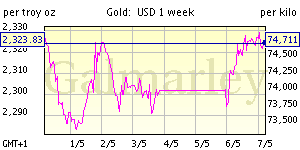
China Demand to Drive Gold Higher
(Live Trading News) Bullion for immediate delivery rose 0.3 percent to $1,392.07 an ounce at 5:36 p.m. in Shanghai after yesterday touching $1,397.50, the highest price since Nov. 12. The metal reached a record $1,424.60 an ounce on Nov. 9 and is set for a 10th annual gain.

China’s investment gold demand may reach 150 tons this year, up from 105 tons last year, the World Gold Council’s Cheng said. That compares with 3 to 4 tons 10 years ago, Cheng said.

“The investment demand we estimate already reached 120 tons in the first three quarters, and it usually spikes in the fourth,” Cheng said. Global investment demand for gold of 1,901 tons last year exceeded jewelry consumption of 1,759 tons for the first time in three decades, according to London-based researcher GFMS Ltd.

China’s gold market may double in the next decade as retail investment and jewelry demand gain, the World Gold Council said Nov. 3. Consumption may climb to 800 tons to 900 tons in the next ten years, said Wang Lixin, the council’s Greater China general manager. China’s jewelry and investment gold demand was 428 tons in 2009, according to the council.
Wanna Buy Some Bank Stock? LOL!

This is from the November 13, 2010 issue of The International Forecaster.


"Bank of America market capitalization stands at $115.6 billion, or 54 percent of book value. That’s the second-lowest price-to-book ratio among the 24 companies in the KBW Bank Index, and well below the 76 percent ratio the company was at in October 2008 when it landed its first round of TARP dough. Put another way, the market is saying there’s a $96.8 billion hole in Bank of America’s balance sheet. "
People's Bank Of China Researcher Calls on U.S. to Sell Gold Reserves, People's Daily Says
The U.S. should cut its government spending and sell some gold reserves to balance its budget and fund its recovery, the People’s Daily overseas edition reported, citing Xia Bin, an adviser to the People’s Bank of China.

The U.S. has to resolve its “twin deficits” in the government budget and the current account, Xia was quoted as saying. Three ways that may help the U.S. achieve that target include reducing military expenses, selling part of its gold reserves and relaxing some export limits on technology, he said.

“The U.S. has more than 8,000 tons of gold reserves; why can’t it sell some of it since the country wants to raise funds for economic recovery but doesn’t want to add more burden to the fiscal deficit,” Xia told the newspaper. He didn’t mention whether China would be willing to purchase any gold from the U.S.

China ranks as the world’s largest foreign holder of U.S. Treasuries, with $883.5 billion as of Sept. 30, according to the U.S. Treasury Department. China should raise its gold holdings and its 1,054 tons of reserves are inadequate compared with the 8,133 tons held by the U.S. and 3,408 tons by Germany, Meng Qingfa, a researcher at the China Chamber of International Commerce said on Oct. 27.

The U.S. won’t be able to get to the bottom of the problem if the government keeps relying on printing money, Xia said.

“The financial market in the U.S. is not short of liquidity, and the money can’t get into the real economy,” he said. Expanding money supply may not be the answer in the U.S. as the high unemployment there is a structural, instead of a liquidity, issue, Xia said.

The Federal Reserve said Nov. 3 it will buy an additional $600 billion of Treasuries through June. Policy makers, setting a pace of about $75 billion of purchases a month, “will adjust the program as needed,” the Fed’s Open Market Committee said in a statement in Washington.