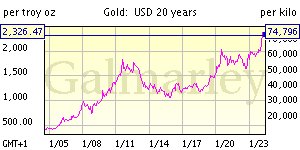
 Monetarily speaking, everything progressed smoothly on the island of yap where large stones weighing hundreds of pounds were transported around to serve as money. That is until something unforeseen happened to the value of the money. For centuries, the stones served as exchange because there wasn't much of this type of rock on yap itself. The depreciation of the stone money began when an enterprising Western businessman realized he could produce stone money cheaply and in copious quantities on a neighboring island and transport it to yap, whence it could be used to procure goods in demand elsewhere. In other words, this oceanic cousin of John Law printed yap stone money to buy his wares at what might be called a "favorable" discount. By this process, the yap stone money was debased until it became worthless. Little did the citizens of yap know that they were being deprived of their wealth -- their money and economy destroyed by the process of monetary inflation. Had they owned gold as a hedge, the effects of the stone money inflation could have been neatly hedged (and avoided). SOURCE
![[Most Recent Quotes from www.kitco.com]](http://www.kitconet.com/images/quotes_7a.gif)
Click to Enlarge
Close Call For US Banks


How the economy of Yap was brought to its knees
 Monetarily speaking, everything progressed smoothly on the island of yap where large stones weighing hundreds of pounds were transported around to serve as money. That is until something unforeseen happened to the value of the money. For centuries, the stones served as exchange because there wasn't much of this type of rock on yap itself. The depreciation of the stone money began when an enterprising Western businessman realized he could produce stone money cheaply and in copious quantities on a neighboring island and transport it to yap, whence it could be used to procure goods in demand elsewhere. In other words, this oceanic cousin of John Law printed yap stone money to buy his wares at what might be called a "favorable" discount. By this process, the yap stone money was debased until it became worthless. Little did the citizens of yap know that they were being deprived of their wealth -- their money and economy destroyed by the process of monetary inflation. Had they owned gold as a hedge, the effects of the stone money inflation could have been neatly hedged (and avoided). SOURCE
Monetarily speaking, everything progressed smoothly on the island of yap where large stones weighing hundreds of pounds were transported around to serve as money. That is until something unforeseen happened to the value of the money. For centuries, the stones served as exchange because there wasn't much of this type of rock on yap itself. The depreciation of the stone money began when an enterprising Western businessman realized he could produce stone money cheaply and in copious quantities on a neighboring island and transport it to yap, whence it could be used to procure goods in demand elsewhere. In other words, this oceanic cousin of John Law printed yap stone money to buy his wares at what might be called a "favorable" discount. By this process, the yap stone money was debased until it became worthless. Little did the citizens of yap know that they were being deprived of their wealth -- their money and economy destroyed by the process of monetary inflation. Had they owned gold as a hedge, the effects of the stone money inflation could have been neatly hedged (and avoided). SOURCE