Gold Is On The Cusp Of A Parabolic Move Up
by John Embry, Sprott Asset Management
![[Most Recent Quotes from www.kitco.com]](http://www.kitconet.com/images/quotes_7a.gif)
Click to Enlarge
Close Call For US Banks


How to Buy Your Kids a House
So, if gold peaks and real estate bottoms in about five years, then a house will cost you about 100 ounces of gold in 2015. Maybe it will take ten years, but the point is, I think we can count on the ratio moving lower this decade, and probably significantly so. Even for the modest budget, 100 ounces almost sounds manageable. continue
So, if gold peaks and real estate bottoms in about five years, then a house will cost you about 100 ounces of gold in 2015. Maybe it will take ten years, but the point is, I think we can count on the ratio moving lower this decade, and probably significantly so. Even for the modest budget, 100 ounces almost sounds manageable. continue
US bank failures in 2010 surpass 100
US bank failures this year surpass milestone of 100; regulators shut 7 banks to make 103
WASHINGTON (AP) -- U.S. bank failures this year have surpassed a bleak milestone of 100 as regulators shut down banks in Georgia, Florida, South Carolina, Kansas, Nevada, Minnesota and Oregon.
The seven bank seizures announced Friday bring to 103 the failures so far in 2010. The pace of bank closures this year is well ahead of that of 2009, which saw a total of 140 banks shuttered amid the recession and mounting loan defaults. That was the highest annual tally since 1992, at the height of the savings and loan crisis.
The pace has accelerated as banks' losses mount on loans made for commercial property and development. Many companies have shut down in the recession, vacating shopping malls and office buildings financed by the loans. That has brought delinquent loan payments and defaults by commercial developers.
The Federal Deposit Insurance Corp. said it took over Crescent Bank and Trust Co., based in Jasper, Ga., with about $1 billion in assets; Sterling Bank of Lantana, Fla., with $407.9 million in assets; Williamsburg First National Bank of Kingstree, S.C., $139.3 million in assets; Thunder Bank of Sylvan Grove, Kan., $32.6 million; SouthwestUSA Bank, with one branch in Las Vegas, $214 million; Community Security Bank of New Prague, Minn., $108 million; and Home Valley Bank of Cave Junction, Ore., $251.8 million.
US bank failures this year surpass milestone of 100; regulators shut 7 banks to make 103
WASHINGTON (AP) -- U.S. bank failures this year have surpassed a bleak milestone of 100 as regulators shut down banks in Georgia, Florida, South Carolina, Kansas, Nevada, Minnesota and Oregon.
The seven bank seizures announced Friday bring to 103 the failures so far in 2010. The pace of bank closures this year is well ahead of that of 2009, which saw a total of 140 banks shuttered amid the recession and mounting loan defaults. That was the highest annual tally since 1992, at the height of the savings and loan crisis.
The pace has accelerated as banks' losses mount on loans made for commercial property and development. Many companies have shut down in the recession, vacating shopping malls and office buildings financed by the loans. That has brought delinquent loan payments and defaults by commercial developers.
The Federal Deposit Insurance Corp. said it took over Crescent Bank and Trust Co., based in Jasper, Ga., with about $1 billion in assets; Sterling Bank of Lantana, Fla., with $407.9 million in assets; Williamsburg First National Bank of Kingstree, S.C., $139.3 million in assets; Thunder Bank of Sylvan Grove, Kan., $32.6 million; SouthwestUSA Bank, with one branch in Las Vegas, $214 million; Community Security Bank of New Prague, Minn., $108 million; and Home Valley Bank of Cave Junction, Ore., $251.8 million.
What’s in bubble territory: gold or treasuries?
There’s been lots of chatter about a gold bubble. But I think you can make a much stronger argument that Treasuries are in the midst of history’s biggest bubble right now.
Let me back up, because I know I’m making some short-cut assumptions that you might not make for yourself.
1) I’m assuming that gold IS money. That is, it’s a store of value and a medium of exchange.
2) I’m assuming that the definition of a bubble describes when an asset is overbought to the point that its price is much, much higher than it should be.
3) If I can safely make these assumptions, then I think it’s fair to compare gold to another form of money: the dollar, and by proxy U.S. Treasuries.
If we can agree that U.S. Treasuries are a fair proxy for the dollar, and that gold is money - then I truly struggle to see how ANYONE can come to the conclusion that gold is in a bubble, while simultaneously seeing Treasuries as not being in a bubble.
Here’s why:
In 2009 the total amount of gold mined, from every mine, in every country for the whole year amounted to $90.6 billion. That was about 90 metric tons more - or a little under $3.5 billion - than the amount mined in 2008. If you’re keeping score, I’m using gold at $1,200 an ounce as my price point.
That $90.6 billion includes all gold for electronics, jewelry and bullion.
According to the 2008 US Geological Survey, less than 10% of all gold is turned into bullion - most of it becomes jewelry, or is used in dental or medical services.
So it’s safe to say that only about $9 billion worth of gold was turned into bullion last year - maybe a little more, but not much. The U.S. mint only minted about $1.7 billion worth of gold into gold eagles, buffaloes, etc.
So, let’s round it up to an even $10 billion worth of gold bullion sold last year. That’s small potatoes, really. Forbes magazine publishes an annual list of a few dozen billionaires who could each buy all of the world’s annual bullion production. Our Federal government actually loses more than twice that every year.
So $10 billion seems like a drip in the ocean.
In any event, that $90.6 billion of new gold in world circulation is still a tiny number, especially when you compare it to the amount of money going into US Treasuries today.
A recent article in Business Week reminded me of the size of the Treasury market:
“The government will auction $69 billion of the maturities next week, according to the median forecast in the survey, compared with $70 billion last month and a record-tying $81 billion in February.”
So at the current sales pace, the U.S. Treasury will sell at least 10 times more Treasury notes than the total amount of gold produced this year. But that’s just U.S. bonds - it doesn’t account for any debt sold out of the Euro-zone, or Asia, South America, Africa, or Australia - which is nothing to sneeze at.
The chart below shows how US Treasury sales have ballooned over the past 10 years:
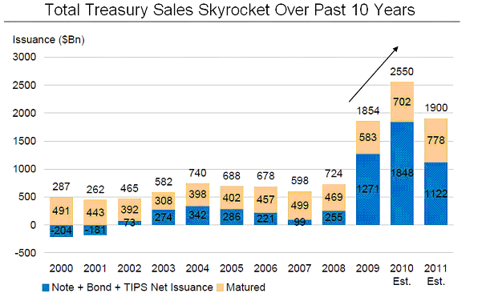
Meanwhile, gold production (and sales) has stayed relatively flat:
Total Gold Production In Metric Tons (2003-2009)
2003 - 2004 - 2005 - 2006 - 2007 - 2008 - 2009
2,420 2,470 2,370 2,370 2,280 2,260 2,350
Right now, Treasuries are still selling near their record high prices. The yields are near all time lows. There’s huge demand for Treasuries, and both in volume of sales as well as growth of sales, Treasuries dwarf gold.
If you’re eschewing gold, but buying Treasuries (especially long-term Treasuries) I’ve got to wonder about the thought process - especially as more and more sovereign debt issues spring up across the pond. Today Portugal’s debt just got downgraded, and if you think the Atlantic ocean will protect us from the same exact problems, then I guess you should keep buying Treasuries.
It’s worked so far.
There’s been lots of chatter about a gold bubble. But I think you can make a much stronger argument that Treasuries are in the midst of history’s biggest bubble right now.
Let me back up, because I know I’m making some short-cut assumptions that you might not make for yourself.
1) I’m assuming that gold IS money. That is, it’s a store of value and a medium of exchange.
2) I’m assuming that the definition of a bubble describes when an asset is overbought to the point that its price is much, much higher than it should be.
3) If I can safely make these assumptions, then I think it’s fair to compare gold to another form of money: the dollar, and by proxy U.S. Treasuries.
If we can agree that U.S. Treasuries are a fair proxy for the dollar, and that gold is money - then I truly struggle to see how ANYONE can come to the conclusion that gold is in a bubble, while simultaneously seeing Treasuries as not being in a bubble.
Here’s why:
In 2009 the total amount of gold mined, from every mine, in every country for the whole year amounted to $90.6 billion. That was about 90 metric tons more - or a little under $3.5 billion - than the amount mined in 2008. If you’re keeping score, I’m using gold at $1,200 an ounce as my price point.
That $90.6 billion includes all gold for electronics, jewelry and bullion.
According to the 2008 US Geological Survey, less than 10% of all gold is turned into bullion - most of it becomes jewelry, or is used in dental or medical services.
So it’s safe to say that only about $9 billion worth of gold was turned into bullion last year - maybe a little more, but not much. The U.S. mint only minted about $1.7 billion worth of gold into gold eagles, buffaloes, etc.
So, let’s round it up to an even $10 billion worth of gold bullion sold last year. That’s small potatoes, really. Forbes magazine publishes an annual list of a few dozen billionaires who could each buy all of the world’s annual bullion production. Our Federal government actually loses more than twice that every year.
So $10 billion seems like a drip in the ocean.
In any event, that $90.6 billion of new gold in world circulation is still a tiny number, especially when you compare it to the amount of money going into US Treasuries today.
A recent article in Business Week reminded me of the size of the Treasury market:
“The government will auction $69 billion of the maturities next week, according to the median forecast in the survey, compared with $70 billion last month and a record-tying $81 billion in February.”
So at the current sales pace, the U.S. Treasury will sell at least 10 times more Treasury notes than the total amount of gold produced this year. But that’s just U.S. bonds - it doesn’t account for any debt sold out of the Euro-zone, or Asia, South America, Africa, or Australia - which is nothing to sneeze at.
The chart below shows how US Treasury sales have ballooned over the past 10 years:
Meanwhile, gold production (and sales) has stayed relatively flat:
Total Gold Production In Metric Tons (2003-2009)
2003 - 2004 - 2005 - 2006 - 2007 - 2008 - 2009
2,420 2,470 2,370 2,370 2,280 2,260 2,350
Right now, Treasuries are still selling near their record high prices. The yields are near all time lows. There’s huge demand for Treasuries, and both in volume of sales as well as growth of sales, Treasuries dwarf gold.
If you’re eschewing gold, but buying Treasuries (especially long-term Treasuries) I’ve got to wonder about the thought process - especially as more and more sovereign debt issues spring up across the pond. Today Portugal’s debt just got downgraded, and if you think the Atlantic ocean will protect us from the same exact problems, then I guess you should keep buying Treasuries.
It’s worked so far.
Top Secret America
Washington Post - The top-secret world the government created in response to the terrorist attacks of Sept. 11, 2001, has become so large, so unwieldy and so secretive that no one knows how much money it costs, how many people it employs, how many programs exist within it or exactly how many agencies do the same work. continue
Washington Post - The top-secret world the government created in response to the terrorist attacks of Sept. 11, 2001, has become so large, so unwieldy and so secretive that no one knows how much money it costs, how many people it employs, how many programs exist within it or exactly how many agencies do the same work. continue
No Time For Risk - Part 2
The following is an excerpt from "Bring Out Your Dead" by Doug Casey.
For now, the key is to get through this period in the best possible shape. That means watching your debt, keeping well cashed up, buying gold on dips, and, when you venture into investment markets, it’s never been more important to understand what you are investing in and why.
There’s no need to chase anything – which means you have the luxury of building your portfolio over time, on exactly the terms you want.
While it may sound contradictory, I think this is also a good time to learn more about speculating. In the simplest terms, a speculator risks just 10% of their portfolio in the hopes of receiving a 100% return. By comparison, most investors put 100% of their portfolio at risk in the hopes of getting a 10% return (actually, these days, most people would be happy with just 5%).
In the case of the speculator, 90% of their portfolio can be largely kept in cash and gold. So, who’s more at risk – the investor or the speculator?
The following is an excerpt from "Bring Out Your Dead" by Doug Casey.
For now, the key is to get through this period in the best possible shape. That means watching your debt, keeping well cashed up, buying gold on dips, and, when you venture into investment markets, it’s never been more important to understand what you are investing in and why.
There’s no need to chase anything – which means you have the luxury of building your portfolio over time, on exactly the terms you want.
While it may sound contradictory, I think this is also a good time to learn more about speculating. In the simplest terms, a speculator risks just 10% of their portfolio in the hopes of receiving a 100% return. By comparison, most investors put 100% of their portfolio at risk in the hopes of getting a 10% return (actually, these days, most people would be happy with just 5%).
In the case of the speculator, 90% of their portfolio can be largely kept in cash and gold. So, who’s more at risk – the investor or the speculator?
No Time For Risk - Part 1
The following is an excerpt from "Bring Out Your Dead" by Doug Casey.
The single most important thing about bear market investing – it’s hard. Or, put another way, it’s hard to make a decent return without taking extraordinary risk.
As Doug points out, in the current environment, everything – including commodities – is overvalued. And they are going to remain that way until they aren’t. Maybe the Fed actually has it right this time, and the bottom won’t be reached until 2015 or 2016? I wouldn’t discount it at this point.
But what of the inflation we see as inevitable? And gold, in the interim?
Let me quickly tackle the second question first.
In any debt crisis, the foremost concern of creditors is to get paid back. Compared to that, returns on investment come in a weak second. In a sovereign debt crisis, the question of repayment is complicated by the fact that the debtors control the creation of the currency units that will ultimately be used for payments.
Individual and institutional holders of U.S. Treasuries, along with other assets amounting to trillions of U.S. currency units, can see with their own eyes what’s going on. To continue holding such large quantities of instruments denominated in these unbacked currency units – or those labeled “euros” or “yen” – is to risk being left with a lot of worthless paper as the governments try to repay debtors by creating the stuff, literally, out of thin air.
And so these holders diversify their portfolios into alternative, and far more tangible, assets – gold and silver included. That is the fuel that has sent gold higher over the last ten years and that will keep it high – short-term corrections notwithstanding.
It is, however, when the inflation from all the money creation starts to appear that we’ll begin to see the shift into gold begin in earnest, and the price will really take off.
Continued tomorrow.....
The following is an excerpt from "Bring Out Your Dead" by Doug Casey.
The single most important thing about bear market investing – it’s hard. Or, put another way, it’s hard to make a decent return without taking extraordinary risk.
As Doug points out, in the current environment, everything – including commodities – is overvalued. And they are going to remain that way until they aren’t. Maybe the Fed actually has it right this time, and the bottom won’t be reached until 2015 or 2016? I wouldn’t discount it at this point.
But what of the inflation we see as inevitable? And gold, in the interim?
Let me quickly tackle the second question first.
In any debt crisis, the foremost concern of creditors is to get paid back. Compared to that, returns on investment come in a weak second. In a sovereign debt crisis, the question of repayment is complicated by the fact that the debtors control the creation of the currency units that will ultimately be used for payments.
Individual and institutional holders of U.S. Treasuries, along with other assets amounting to trillions of U.S. currency units, can see with their own eyes what’s going on. To continue holding such large quantities of instruments denominated in these unbacked currency units – or those labeled “euros” or “yen” – is to risk being left with a lot of worthless paper as the governments try to repay debtors by creating the stuff, literally, out of thin air.
And so these holders diversify their portfolios into alternative, and far more tangible, assets – gold and silver included. That is the fuel that has sent gold higher over the last ten years and that will keep it high – short-term corrections notwithstanding.
It is, however, when the inflation from all the money creation starts to appear that we’ll begin to see the shift into gold begin in earnest, and the price will really take off.
Continued tomorrow.....
Gold Coin Sellers Angered by New Tax Law
July 21, 2010
ABC News - Those already outraged by the president's health care legislation now have a new bone of contention -- a scarcely noticed tack-on provision to the law that puts gold coin buyers and sellers under closer government scrutiny.
The issue is rising to the fore just as gold coin dealers are attracting attention over sales tactics.
Section 9006 of the Patient Protection and Affordable Care Act will amend the Internal Revenue Code to expand the scope of Form 1099. Currently, 1099 forms are used to track and report the miscellaneous income associated with services rendered by independent contractors or self-employed individuals.
Coin Dealers Flipping
Starting Jan. 1, 2012, Form 1099s will become a means of reporting to the Internal Revenue Service the purchases of all goods and services by small businesses and self-employed people that exceed $600 during a calendar year. Precious metals such as coins and bullion fall into this category and coin dealers have been among those most rankled by the change.
This provision, intended to mine what the IRS deems a vast reservoir of uncollected income tax, was included in the health care legislation ostensibly as a way to pay for it. The tax code tweak is expected to raise $17 billion over the next 10 years, according to the Joint Committee on Taxation.
Taking an early and vociferous role in opposing the measure is the precious metal and coin industry, according to Diane Piret, industry affairs director for the Industry Council for Tangible Assets. The ICTA, based in Severna Park, Md., is a trade association representing an estimated 5,000 coin and bullion dealers in the United States.
"Coin dealers not only buy for their inventory from other dealers, but also with great frequency from the public," Piret said. "Most other types of businesses will have a limited number of suppliers from which they buy their goods and products for resale."
So every time a member of the public sells more than $600 worth of gold to a dealer, Piret said, the transaction will have to be reported to the government by the buyer.
Pat Heller, who owns Liberty Coin Service in Lansing, Mich., deals with around 1,000 customers every week. Many are individuals looking to protect wealth in an uncertain economy, he said, while others are dealers like him.
With spot market prices for gold at nearly $1,200 an ounce, Heller estimates that he'll be filling out between 10,000 and 20,000 tax forms per year after the new law takes effect.
"I'll have to hire two full-time people just to track all this stuff, which cuts into my profitability," he said.
An issue that combines gold coins, the Obama health care law and the IRS is bound to stir passions. Indeed, trading in gold coins and bars has surged since the financial crisis unfolded and Obama took office, metal dealers said.
The buying of actual gold, as opposed to futures or options tied to the price of gold, has been a particularly popular trend among Tea Party supporters and others who are fearful of Obama's economic policies, gold industry members such as Heller and Piret said. Conservative/libertarian commentators, such as Fox News Channel's Glenn Beck, routinely tout precious metal on the air as being a safe, shrewd investment in an environment in which the financial system -- and paper money backed by the rest of the world's faith in the U.S. government's credit -- is viewed as increasingly fragile.
The recently revealed investigation by California authorities into consumer complaints against Goldline International, which has used Beck as a pitchman, and Superior Gold Group (which has not) has put a spotlight on what one liberal leaning politician, Rep. Anthony Weiner, D-N.Y., calls the "unholy alliance" between gold coin sellers, such as Goldline, and conservative talk personalities, such as Beck.
Beck, who through his spokesman, Matt Hiltzik, declined to comment for this story, and Goldline marketers portray gold coins as a better alternative to owning bullion in the event that the U.S. government ever decides, as it did under FDR in 1933, to make it illegal for private citizens to own physical gold. At that time, the U.S. dollar was still pegged to the price of gold; the gold standard was abandoned during the Nixon administration.
Rep. Daniel Lungren, R-Calif., has introduced legislation to repeal the section of the health care bill that would trigger the new tax reporting requirement because he says it's a burden on small businesses.
"Large corporations have whole divisions to handle such transaction paperwork but for a small business, which doesn't have the manpower, this is yet another brick on their back," Lungren said in a statement e-mailed to ABCNews.com. "Everyone agrees that small businesses are job creators and the engine which drives the American economy. I am dumfounded that this Administration is doing all it can to make it more difficult for businesses to succeed rather than doing all it can to help them grow."
The ICTA's Piret says identity theft is another concern because criminals may set up shops specifically to extract personal information that would accompany the filing out of a 1099.
The office of the National Taxpayer Advocate, a citizen's ombudsman within the IRS, issued a report June 30 that said the new rule "may present significant administrative challenges to taxpayers and the IRS."
July 21, 2010
ABC News - Those already outraged by the president's health care legislation now have a new bone of contention -- a scarcely noticed tack-on provision to the law that puts gold coin buyers and sellers under closer government scrutiny.
The issue is rising to the fore just as gold coin dealers are attracting attention over sales tactics.
Section 9006 of the Patient Protection and Affordable Care Act will amend the Internal Revenue Code to expand the scope of Form 1099. Currently, 1099 forms are used to track and report the miscellaneous income associated with services rendered by independent contractors or self-employed individuals.
Coin Dealers Flipping
Starting Jan. 1, 2012, Form 1099s will become a means of reporting to the Internal Revenue Service the purchases of all goods and services by small businesses and self-employed people that exceed $600 during a calendar year. Precious metals such as coins and bullion fall into this category and coin dealers have been among those most rankled by the change.
This provision, intended to mine what the IRS deems a vast reservoir of uncollected income tax, was included in the health care legislation ostensibly as a way to pay for it. The tax code tweak is expected to raise $17 billion over the next 10 years, according to the Joint Committee on Taxation.
Taking an early and vociferous role in opposing the measure is the precious metal and coin industry, according to Diane Piret, industry affairs director for the Industry Council for Tangible Assets. The ICTA, based in Severna Park, Md., is a trade association representing an estimated 5,000 coin and bullion dealers in the United States.
"Coin dealers not only buy for their inventory from other dealers, but also with great frequency from the public," Piret said. "Most other types of businesses will have a limited number of suppliers from which they buy their goods and products for resale."
So every time a member of the public sells more than $600 worth of gold to a dealer, Piret said, the transaction will have to be reported to the government by the buyer.
Pat Heller, who owns Liberty Coin Service in Lansing, Mich., deals with around 1,000 customers every week. Many are individuals looking to protect wealth in an uncertain economy, he said, while others are dealers like him.
With spot market prices for gold at nearly $1,200 an ounce, Heller estimates that he'll be filling out between 10,000 and 20,000 tax forms per year after the new law takes effect.
"I'll have to hire two full-time people just to track all this stuff, which cuts into my profitability," he said.
An issue that combines gold coins, the Obama health care law and the IRS is bound to stir passions. Indeed, trading in gold coins and bars has surged since the financial crisis unfolded and Obama took office, metal dealers said.
The buying of actual gold, as opposed to futures or options tied to the price of gold, has been a particularly popular trend among Tea Party supporters and others who are fearful of Obama's economic policies, gold industry members such as Heller and Piret said. Conservative/libertarian commentators, such as Fox News Channel's Glenn Beck, routinely tout precious metal on the air as being a safe, shrewd investment in an environment in which the financial system -- and paper money backed by the rest of the world's faith in the U.S. government's credit -- is viewed as increasingly fragile.
The recently revealed investigation by California authorities into consumer complaints against Goldline International, which has used Beck as a pitchman, and Superior Gold Group (which has not) has put a spotlight on what one liberal leaning politician, Rep. Anthony Weiner, D-N.Y., calls the "unholy alliance" between gold coin sellers, such as Goldline, and conservative talk personalities, such as Beck.
Beck, who through his spokesman, Matt Hiltzik, declined to comment for this story, and Goldline marketers portray gold coins as a better alternative to owning bullion in the event that the U.S. government ever decides, as it did under FDR in 1933, to make it illegal for private citizens to own physical gold. At that time, the U.S. dollar was still pegged to the price of gold; the gold standard was abandoned during the Nixon administration.
Rep. Daniel Lungren, R-Calif., has introduced legislation to repeal the section of the health care bill that would trigger the new tax reporting requirement because he says it's a burden on small businesses.
"Large corporations have whole divisions to handle such transaction paperwork but for a small business, which doesn't have the manpower, this is yet another brick on their back," Lungren said in a statement e-mailed to ABCNews.com. "Everyone agrees that small businesses are job creators and the engine which drives the American economy. I am dumfounded that this Administration is doing all it can to make it more difficult for businesses to succeed rather than doing all it can to help them grow."
The ICTA's Piret says identity theft is another concern because criminals may set up shops specifically to extract personal information that would accompany the filing out of a 1099.
The office of the National Taxpayer Advocate, a citizen's ombudsman within the IRS, issued a report June 30 that said the new rule "may present significant administrative challenges to taxpayers and the IRS."
India's Gold Imports Double
Economics 101: Increased demand equals increased prices!
Gold import doubles
The import of gold has increased by over two times to stand at 14,000 kg in 2009/10 from 6,500 kg in the year 2008/09.
According to Tej Ratna Shakya, president of Nepal Gold and Silver Dealers’ Association (NGSDA), total gold worth Rs. 40 billion has been imported in 2009/10 while it was only Rs. 15 billion in 2008/9.
He also said that the huge import of gold has triggered massive capital flight which has forced the central bank to put cap on gold imports.
As per the new directives of the Nepal Rastra Bank (NRB), it has allowed banks to imports 10 kg of gold per day to reach the demand in the domestic market while during the wedding season it has permitted 20 kg per day.
He also informed that the investors were attracted to invest in gold as it was seen as a good investment and secure.
Shakya said that the annual demand of the gold is only 6,000 kg which is around Rs. 20 billion for its import and the average demand of the gold is around 20 kg per day in the domestic market.
Commercial banks like Standard Chartered, NMB, Machhapuchhre, NIC Bank, Prime Bank, Nabil Bank, and Bank of Kathmandu are importing gold in the market. nepalnews.com
Economics 101: Increased demand equals increased prices!
Gold import doubles
The import of gold has increased by over two times to stand at 14,000 kg in 2009/10 from 6,500 kg in the year 2008/09.
According to Tej Ratna Shakya, president of Nepal Gold and Silver Dealers’ Association (NGSDA), total gold worth Rs. 40 billion has been imported in 2009/10 while it was only Rs. 15 billion in 2008/9.
He also said that the huge import of gold has triggered massive capital flight which has forced the central bank to put cap on gold imports.
As per the new directives of the Nepal Rastra Bank (NRB), it has allowed banks to imports 10 kg of gold per day to reach the demand in the domestic market while during the wedding season it has permitted 20 kg per day.
He also informed that the investors were attracted to invest in gold as it was seen as a good investment and secure.
Shakya said that the annual demand of the gold is only 6,000 kg which is around Rs. 20 billion for its import and the average demand of the gold is around 20 kg per day in the domestic market.
Commercial banks like Standard Chartered, NMB, Machhapuchhre, NIC Bank, Prime Bank, Nabil Bank, and Bank of Kathmandu are importing gold in the market. nepalnews.com

The above chart was sent to me by one of our listeners. Unfortunately he did not know who created it, but it gives a clear illustration of why the bull market in gold will end in a mania. There is a great deal of fear in the gold and silver markets at this point. You can clearly see looking at the chart that we are in phase II and that we are climbing a “Wall of worry.”
Investors are worried that if the stock market is going to fall that gold will head lower as well and sentiment has dropped off accordingly. It may be the case that gold would go down if the stock market heads lower, but the truth is that no one knows how gold is going to react in the short-term. It is being accumulated and has been under accumulation for many years.
The smart money knows this is a cycle where investors move away from traditional paper investments and into gold. As gold corrects lower, there are large amounts of physical buyers that buy the dips and continue to accumulate on weakness. This is one of the primary reasons why gold has remained strong so far this summer.
We are nearing the end of July and I think it will be interesting to see how gold trades in August to close out the summer. If gold remains firm in August that would surprise many professionals. Some have been looking for a correction to the $1,000 area, which on the surface would seem reasonable as gold continues to consolidate between roughly $1,000 and $1,200.
Having said all of that, bull markets in many cases surprise investors and traders alike on the upside. Take a look again at the chart, and note one more time the “Wall of worry.”
Although that chart is comprised of the Nasdaq mania and subsequent collapse, you can see that during phase II there were dips, and sometimes significant market reactions. The important thing to note is that they were always, without exception, buying opportunities to accumulate prior to the mania.
Use weakness in gold as an opportunity to continue dollar cost averaging into the metal at lower prices. Do not use leverage or trade futures or options. Buy physical gold for delivery and be patient, the mania will come.
Eric King
KingWorldNews.com
Carlos Slim
Carlos Slim, the world's richest man, according to Forbes list of billionaires, is looking to make money while precious metals shine. Slim's Grupo Carso SAB's mining arm Grupo Frisco is mulling opening more mines this year in order to benefit from rising gold prices that stood at record highs last month. The headline reads "Carlos Slim Betting on Gold"... and the link is here.
Carlos Slim, the world's richest man, according to Forbes list of billionaires, is looking to make money while precious metals shine. Slim's Grupo Carso SAB's mining arm Grupo Frisco is mulling opening more mines this year in order to benefit from rising gold prices that stood at record highs last month. The headline reads "Carlos Slim Betting on Gold"... and the link is here.
Breakout
Never forget, when silver moves, gold moves.... and visa versa.
Waiting for Silver’s Upside Breakout
July 18, 2010 – Two months ago I stated that silver is inching closer to an upside breakout. It turns out that “inching” was the right word because since then silver has been moving at a snail’s pace. Nevertheless, the huge accumulation pattern that silver has been building over the past three years remains intact, as can be seen on the following chart.
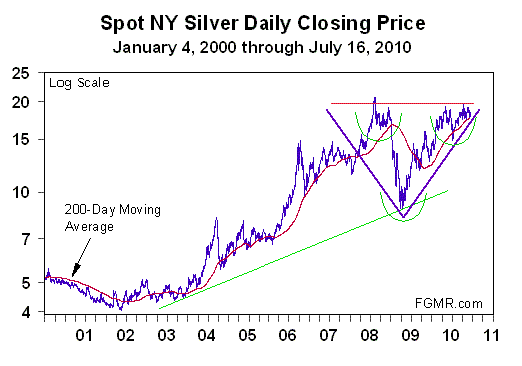
The accumulation pattern on the above chart is nearly complete. All silver needs now is one last push above the neckline around $20. As I noted back on April 1st, silver looks ready to soar once that key level is hurdled.
In presenting my outlook for 2010 I said: “We need to start thinking about silver hurdling above $50.” Noting that this event was only a 20% probability in my view for 2010, I went on to add that “this important event – which is unimaginable to many – will I expect happen in 2011.”
That forecast remains on track, but two events are necessary. The obvious one is that silver must first hurdle above $20, but secondly, silver needs to approach $30 this year. This $30 price target is needed to keep silver on track for challenging $50 next year.
Given that we are now in mid-July, the limited time constraint means that $20 needs to be hurdled soon if silver is going to reach $30 before the end of this year. As a consequence, the next few weeks will be critically important for silver.
Never forget, when silver moves, gold moves.... and visa versa.
Waiting for Silver’s Upside Breakout
July 18, 2010 – Two months ago I stated that silver is inching closer to an upside breakout. It turns out that “inching” was the right word because since then silver has been moving at a snail’s pace. Nevertheless, the huge accumulation pattern that silver has been building over the past three years remains intact, as can be seen on the following chart.
The accumulation pattern on the above chart is nearly complete. All silver needs now is one last push above the neckline around $20. As I noted back on April 1st, silver looks ready to soar once that key level is hurdled.
In presenting my outlook for 2010 I said: “We need to start thinking about silver hurdling above $50.” Noting that this event was only a 20% probability in my view for 2010, I went on to add that “this important event – which is unimaginable to many – will I expect happen in 2011.”
That forecast remains on track, but two events are necessary. The obvious one is that silver must first hurdle above $20, but secondly, silver needs to approach $30 this year. This $30 price target is needed to keep silver on track for challenging $50 next year.
Given that we are now in mid-July, the limited time constraint means that $20 needs to be hurdled soon if silver is going to reach $30 before the end of this year. As a consequence, the next few weeks will be critically important for silver.
Today’s Editorial is from the Desk of Jeff Clark, Editor for Casey’s Gold & Resource Report..
Is Now a Good Time to Buy Gold?
While we’re convinced gold and gold stocks are destined for much higher levels, buying when prices are low can mean the difference between a double or triple and a ten-bagger... a week in Malibu vs. a week in Milan.
There’s no secret formula to buying low, and we aren’t holding the right hand of Midas, but there are periods when prices tend to be lower than others. And if those tendencies play out, it can give us the opportunity to snag a high-quality asset at a bargain price.
So, how do you get a bargain price? You cheat….
more
Is Now a Good Time to Buy Gold?
While we’re convinced gold and gold stocks are destined for much higher levels, buying when prices are low can mean the difference between a double or triple and a ten-bagger... a week in Malibu vs. a week in Milan.
There’s no secret formula to buying low, and we aren’t holding the right hand of Midas, but there are periods when prices tend to be lower than others. And if those tendencies play out, it can give us the opportunity to snag a high-quality asset at a bargain price.
So, how do you get a bargain price? You cheat….
more

Paper Gold
Never forget that owning gold in certificate form is never as good as having it in-hand. The following story is a good reminder of that fact.
Scotiabank gives long abuse to cancer victim trying to reclaim her silver
Submitted by cpowell on Sun, 2010-07-18 15:16. Section: Daily Dispatches
11:15a ET Sunday, July 18, 2010
Dear Friend of GATA and Gold (and Silver):
The difficult attempt of a cancer-stricken Toronto woman to exchange her Scotiabank silver certificates for real metal, witnessed last week by a writer for the Globe and Mail, whose account of the matter is appended, recalls the difficult attempt of Harvey and Lenny Organ to do the same thing with the same bank. (See http://www.gata.org/node/8513.) The bank's mistreatment of the Toronto woman is so outrageous that perhaps some of those who were skeptics of the Organs' story will begin to wonder if there isn't after all really a bullion banking policy to discourage buyers from taking possession of their metal precisely because the banks are selling far more claims to metal than they have actual metal.
CHRIS POWELL, Secretary/Treasurer
Gold Anti-Trust Action Committee Inc.
Never forget that owning gold in certificate form is never as good as having it in-hand. The following story is a good reminder of that fact.
Scotiabank gives long abuse to cancer victim trying to reclaim her silver
Submitted by cpowell on Sun, 2010-07-18 15:16. Section: Daily Dispatches
11:15a ET Sunday, July 18, 2010
Dear Friend of GATA and Gold (and Silver):
The difficult attempt of a cancer-stricken Toronto woman to exchange her Scotiabank silver certificates for real metal, witnessed last week by a writer for the Globe and Mail, whose account of the matter is appended, recalls the difficult attempt of Harvey and Lenny Organ to do the same thing with the same bank. (See http://www.gata.org/node/8513.) The bank's mistreatment of the Toronto woman is so outrageous that perhaps some of those who were skeptics of the Organs' story will begin to wonder if there isn't after all really a bullion banking policy to discourage buyers from taking possession of their metal precisely because the banks are selling far more claims to metal than they have actual metal.
CHRIS POWELL, Secretary/Treasurer
Gold Anti-Trust Action Committee Inc.
What Hyperinflation Looks Like
The National Inflation Association today issued a warning to all Americans that empty store shelves will likely be coming to America as a result of government price controls during the upcoming hyperinflationary crisis. This morning, NIA released a video preview of what hyperinflation will look like in the U.S. This extremely important must see video is now available on NIA's video page at: http://click.icptrack.com/icp/relay.php?r=1039086558&msgid=1977742&act=L6K3&c=422754&destination=http://inflation.us/videos.html
NIA's six-minute video released today goes into detail about an event that took place just outside of Boston, Massachusetts in May of this year. This story was widely ignored by the nationwide mainstream media, but NIA believes it was one of the most important news events of the first half of 2010. Although this particular crisis in Boston was due to decaying infrastructure, NIA believes a currency crisis will lead to the same type of panic on a nationwide basis.
NIA hopes that this video serves as a wake-up call for Americans to take the necessary steps to prepare for hyperinflation and become educated about the U.S. economy. In Zimbabwe during hyperinflation, Zimbabweans were forced to transact in gold and silver. It's only a matter of time before the U.S. dollar becomes worthless and the only Americans with wealth will be those who own gold and silver.
Citizens of Boston were able to survive their recent crisis with the help of the National Guard, but the National Guard won't be there for Americans during hyperinflation. 40.2 million Americans are currently living off of food stamps, but food stamps won't have any purchasing power during hyperinflation. The United States' day of reckoning is ahead. We cannot go on living with record budget deficits and accelerating national debt growth forever.
Just yesterday it was announced that for the first time ever, a major credit ratings agency has given China a higher credit rating than the U.S. While most credit ratings agencies including Moody's, Standard & Poor’s and Fitch Ratings still rate U.S. debt as AAA, NIA believes the real credit rating of the U.S. should be junk. The only way one could possibly justify a U.S. credit rating of AAA is by taking into account the Federal Reserve's ability to monetize our debt through inflation. However, printing money to pay off debt is a lot worse than defaulting on it. Inflation is very deceptive, it destroys the value of savings while transferring wealth from the poor and middle class to the rich.
The U.S. has a budget deficit just from Social Security, Medicare and Medicaid alone. NIA urges President Obama to implement dramatic cuts to these entitlement programs immediately, while simultaneously reducing the size of government across the board. Time is growing short for Obama to rein in government spending. The longer Obama waits to reverse course, the harder it will be for the U.S. to recover from the calamity that is about to unfold.
Please forward this message to everybody you know. It is essential to the well-being of all your family members and friends that they watch our new video entitled "Empty Store Shelves Coming to America" by going to: http://inflation.us/videos.html
The National Inflation Association today issued a warning to all Americans that empty store shelves will likely be coming to America as a result of government price controls during the upcoming hyperinflationary crisis. This morning, NIA released a video preview of what hyperinflation will look like in the U.S. This extremely important must see video is now available on NIA's video page at: http://click.icptrack.com/icp/relay.php?r=1039086558&msgid=1977742&act=L6K3&c=422754&destination=http://inflation.us/videos.html
NIA's six-minute video released today goes into detail about an event that took place just outside of Boston, Massachusetts in May of this year. This story was widely ignored by the nationwide mainstream media, but NIA believes it was one of the most important news events of the first half of 2010. Although this particular crisis in Boston was due to decaying infrastructure, NIA believes a currency crisis will lead to the same type of panic on a nationwide basis.
NIA hopes that this video serves as a wake-up call for Americans to take the necessary steps to prepare for hyperinflation and become educated about the U.S. economy. In Zimbabwe during hyperinflation, Zimbabweans were forced to transact in gold and silver. It's only a matter of time before the U.S. dollar becomes worthless and the only Americans with wealth will be those who own gold and silver.
Citizens of Boston were able to survive their recent crisis with the help of the National Guard, but the National Guard won't be there for Americans during hyperinflation. 40.2 million Americans are currently living off of food stamps, but food stamps won't have any purchasing power during hyperinflation. The United States' day of reckoning is ahead. We cannot go on living with record budget deficits and accelerating national debt growth forever.
Just yesterday it was announced that for the first time ever, a major credit ratings agency has given China a higher credit rating than the U.S. While most credit ratings agencies including Moody's, Standard & Poor’s and Fitch Ratings still rate U.S. debt as AAA, NIA believes the real credit rating of the U.S. should be junk. The only way one could possibly justify a U.S. credit rating of AAA is by taking into account the Federal Reserve's ability to monetize our debt through inflation. However, printing money to pay off debt is a lot worse than defaulting on it. Inflation is very deceptive, it destroys the value of savings while transferring wealth from the poor and middle class to the rich.
The U.S. has a budget deficit just from Social Security, Medicare and Medicaid alone. NIA urges President Obama to implement dramatic cuts to these entitlement programs immediately, while simultaneously reducing the size of government across the board. Time is growing short for Obama to rein in government spending. The longer Obama waits to reverse course, the harder it will be for the U.S. to recover from the calamity that is about to unfold.
Please forward this message to everybody you know. It is essential to the well-being of all your family members and friends that they watch our new video entitled "Empty Store Shelves Coming to America" by going to: http://inflation.us/videos.html
Gold, Silver, Precious and Base Metals Your Best Defense!
Precious and base metals are not only critically strategic commodities — but what’s happening in those markets are also blatant signs of what may well be the most urgent financial AND strategic dilemma of our time:
The threat to the cornerstone of our nation, the massive financial and debt crisis and their impact on the value of the U.S. dollar, and hence, your wealth.
So today I am going to review with you why I believe the precious and base metals sectors are critically important to your portfolio.
I will demonstrate for you that the single best defense you can take for your portfolio is to go on the offense — to use precious and base metals investments to protect your wealth from the ravages of a falling dollar and to capitalize on a myriad of wealth-building opportunities.
First, let’s review the major forces that are poised to drive gold, silver, platinum, palladium, copper, aluminum, tin and more — higher and higher.
The forces are explosive, they’re spinning off huge profits … and, they are just beginning …
WHAT ARE THOSE FORCES?
They are the three most powerful economic forces on earth today!
1. Unprecedented demand from Asia.
And … at the same time …
2. An unprecedented financial crisis and debt implosion in the U.S.
Coupled with …
3. An unparalleled bear market in the purchasing power of the U.S. dollar.
So, let’s review these forces so that you fully understand them … how they are impacting the metals markets … and why you should make metals investments a key part of your investment portfolio.
Read the rest of the story here.
Precious and base metals are not only critically strategic commodities — but what’s happening in those markets are also blatant signs of what may well be the most urgent financial AND strategic dilemma of our time:
The threat to the cornerstone of our nation, the massive financial and debt crisis and their impact on the value of the U.S. dollar, and hence, your wealth.
So today I am going to review with you why I believe the precious and base metals sectors are critically important to your portfolio.
I will demonstrate for you that the single best defense you can take for your portfolio is to go on the offense — to use precious and base metals investments to protect your wealth from the ravages of a falling dollar and to capitalize on a myriad of wealth-building opportunities.
First, let’s review the major forces that are poised to drive gold, silver, platinum, palladium, copper, aluminum, tin and more — higher and higher.
The forces are explosive, they’re spinning off huge profits … and, they are just beginning …
WHAT ARE THOSE FORCES?
They are the three most powerful economic forces on earth today!
1. Unprecedented demand from Asia.
And … at the same time …
2. An unprecedented financial crisis and debt implosion in the U.S.
Coupled with …
3. An unparalleled bear market in the purchasing power of the U.S. dollar.
So, let’s review these forces so that you fully understand them … how they are impacting the metals markets … and why you should make metals investments a key part of your investment portfolio.
Read the rest of the story here.
Some believe gold is a bubble. It is not. The price of gold, however, tracks a bubble and that is why it is mistaken for one.

The real bubble is government debt, not gold. Government debt is a bubble that hasn’t yet burst; one that has grown even more rapidly in the last two years as almost all nations went far deeper into debt after the 2007/2008 global collapse.
..sovereign debts grew by almost 30% in just two years. Sovereigns became the majority of worldwide debt. Several countries doubled their debts from 2007 to 2009 (BIS data).
This recent meteoric rise in government debt has been matched by a corresponding rise in the price of gold. When government borrowing rose after 2007, the price of gold also rose, from $700 to $1200 per ounce, almost precisely tracking the rise in government debt.
source
US Government Bonds Downgraded
According to an AP story, a Chinese credit rating agency has basically downgraded U.S. debt, as they put the United States 13th on a list of 'creditworthy' nations. This rating isn't even remotely close to where the U.S. credit rating agencies puts U.S. debt. A debt rating war is obviously off to the races here. The headline to the story states... "Chinese credit firm says US worse risk than China"... and the link to the article, posted over at Jesse's Café Américain, is here.
In a similar story, China's leading credit rating agency has stripped America, Britain, Germany and France of their AAA ratings, accusing Anglo-Saxon competitors of ideological bias in favour of the West.... and the link to the story is here.
Got your gold yet?
According to an AP story, a Chinese credit rating agency has basically downgraded U.S. debt, as they put the United States 13th on a list of 'creditworthy' nations. This rating isn't even remotely close to where the U.S. credit rating agencies puts U.S. debt. A debt rating war is obviously off to the races here. The headline to the story states... "Chinese credit firm says US worse risk than China"... and the link to the article, posted over at Jesse's Café Américain, is here.
In a similar story, China's leading credit rating agency has stripped America, Britain, Germany and France of their AAA ratings, accusing Anglo-Saxon competitors of ideological bias in favour of the West.... and the link to the story is here.
Got your gold yet?
Quantitative Easing
This from the July 12, 2010 issue of the Delaire Report...
With more than fifty percent of all bank reserves around the world in U.S. Treasuries and since most commodities are traded in US dollars, a collapse in the greenback would have serious global consequences. Whilst I do not see this happening, with increasing budget deficits the US government may have no other choice but to engage in further "quantitative easing," which is simply a way of saying increasing the money supply. And, the consequence of this will be a further devaluation of the green back which of course will be good for gold.
This from the July 12, 2010 issue of the Delaire Report...
With more than fifty percent of all bank reserves around the world in U.S. Treasuries and since most commodities are traded in US dollars, a collapse in the greenback would have serious global consequences. Whilst I do not see this happening, with increasing budget deficits the US government may have no other choice but to engage in further "quantitative easing," which is simply a way of saying increasing the money supply. And, the consequence of this will be a further devaluation of the green back which of course will be good for gold.
This soon-to-be fatal rise in US debt would not have been possible had the US dollar been tied to gold. This is why both bankers and governments who profit and live by debt oppose a return to the gold standard or any attempt to again tie their currencies to gold.
…a gold standard and a redeemable currency…enables a people to keep the government and banks in check. It prevents currency expansion from getting ever farther out of bounds until it becomes worthless…
Professor Walter E. Spahr, Chairman of the Department of Economics, NYU, 1927-1956
…a gold standard and a redeemable currency…enables a people to keep the government and banks in check. It prevents currency expansion from getting ever farther out of bounds until it becomes worthless…
Professor Walter E. Spahr, Chairman of the Department of Economics, NYU, 1927-1956
Avertible catastrophe
Lawrence Solomon, Financial Post · Saturday, Jun. 26, 2010
Some are attuned to the possibility of looming catastrophe and know how to head it off. Others are unprepared for risk and even unable to get their priorities straight when risk turns to reality.
The Dutch fall into the first group. Three days after the BP oil spill in the Gulf of Mexico began on April 20, the Netherlands offered the U.S. government ships equipped to handle a major spill, one much larger than the BP spill that then appeared to be underway. "Our system can handle 400 cubic metres per hour," Weird Koops, the chairman of Spill Response Group Holland, told Radio Netherlands Worldwide, giving each Dutch ship more cleanup capacity than all the ships that the U.S. was then employing in the Gulf to combat the spill.
To protect against the possibility that its equipment wouldn't capture all the oil gushing from the bottom of the Gulf of Mexico, the Dutch also offered to prepare for the U.S. a contingency plan to protect Louisiana's marshlands with sand barriers. One Dutch research institute specializing in deltas, coastal areas and rivers, in fact, developed a strategy to begin building 60-mile-long sand dikes within three weeks.
The Dutch know how to handle maritime emergencies. In the event of an oil spill, The Netherlands government, which owns its own ships and high-tech skimmers, gives an oil company 12 hours to demonstrate it has the spill in hand. If the company shows signs of unpreparedness, the government dispatches its own ships at the oil company's expense. "If there's a country that's experienced with building dikes and managing water, it's the Netherlands," says Geert Visser, the Dutch consul general in Houston.
In sharp contrast to Dutch preparedness before the fact and the Dutch instinct to dive into action once an emergency becomes apparent, witness the American reaction to the Dutch offer of help. The U.S. government responded with "Thanks but no thanks," remarked Visser, despite BP's desire to bring in the Dutch equipment and despite the no-lose nature of the Dutch offer --the Dutch government offered the use of its equipment at no charge. Even after the U.S. refused, the Dutch kept their vessels on standby, hoping the Americans would come round. By May 5, the U.S. had not come round. To the contrary, the U.S. had also turned down offers of help from 12 other governments, most of them with superior expertise and equipment --unlike the U.S., Europe has robust fleets of Oil Spill Response Vessels that sail circles around their make-shift U.S. counterparts.
Why does neither the U.S. government nor U.S. energy companies have on hand the cleanup technology available in Europe? Ironically, the superior European technology runs afoul of U.S. environmental rules. The voracious Dutch vessels, for example, continuously suck up vast quantities of oily water, extract most of the oil and then spit overboard vast quantities of nearly oil-free water. Nearly oil-free isn't good enough for the U.S. regulators, who have a standard of 15 parts per million -- if water isn't at least 99.9985% pure, it may not be returned to the Gulf of Mexico.
When ships in U.S. waters take in oil-contaminated water, they are forced to store it. As U.S. Coast Guard Admiral Thad Allen, the official in charge of the clean-up operation, explained in a press briefing on June 11, "We have skimmed, to date, about 18 million gallons of oily water--the oil has to be decanted from that [and] our yield is usually somewhere around 10% or 15% on that." In other words, U.S. ships have mostly been removing water from the Gulf, requiring them to make up to 10 times as many trips to storage facilities where they off-load their oil-water mixture, an approach Koops calls "crazy."
The Americans, overwhelmed by the catastrophic consequences of the BP spill, finally relented and took the Dutch up on their offer -- but only partly. Because the U.S. didn't want Dutch ships working the Gulf, the U.S. airlifted the Dutch equipment to the Gulf and then retrofitted it to U.S. vessels. And rather than have experienced Dutch crews immediately operate the oil-skimming equipment, to appease labour unions the U.S. postponed the clean-up operation to allow U.S. crews to be trained.
A catastrophe that could have been averted is now playing out. With oil increasingly reaching the Gulf coast, the emergency construction of sand berns to minimize the damage is imperative. Again, the U.S. government priority is on U.S. jobs, with the Dutch asked to train American workers rather than to build the berns. According to Floris Van Hovell, a spokesman for the Dutch embassy in Washington, Dutch dredging ships could complete the berms in Louisiana twice as fast as the U.S. companies awarded the work. "Given the fact that there is so much oil on a daily basis coming in, you do not have that much time to protect the marshlands," he says, perplexed that the U.S. government could be so focussed on side issues with the entire Gulf Coast hanging in the balance.
Then again, perhaps he should not be all that perplexed at the American tolerance for turning an accident into a catastrophe. When the Exxon Valdez oil tanker accident occurred off the coast of Alaska in 1989, a Dutch team with clean-up equipment flew in to Anchorage airport to offer their help. To their amazement, they were rebuffed and told to go home with their equipment. The Exxon Valdez became the biggest oil spill disaster in U.S. history--until the BP Gulf spill.
- Lawrence Solomon is executive director of Energy Probe and author of The Deniers.
.
Read more: http://www.financialpost.com/Avertible+catastrophe/3203808/story.html#ixzz0tRA91bBk
Lawrence Solomon, Financial Post · Saturday, Jun. 26, 2010
Some are attuned to the possibility of looming catastrophe and know how to head it off. Others are unprepared for risk and even unable to get their priorities straight when risk turns to reality.
The Dutch fall into the first group. Three days after the BP oil spill in the Gulf of Mexico began on April 20, the Netherlands offered the U.S. government ships equipped to handle a major spill, one much larger than the BP spill that then appeared to be underway. "Our system can handle 400 cubic metres per hour," Weird Koops, the chairman of Spill Response Group Holland, told Radio Netherlands Worldwide, giving each Dutch ship more cleanup capacity than all the ships that the U.S. was then employing in the Gulf to combat the spill.
To protect against the possibility that its equipment wouldn't capture all the oil gushing from the bottom of the Gulf of Mexico, the Dutch also offered to prepare for the U.S. a contingency plan to protect Louisiana's marshlands with sand barriers. One Dutch research institute specializing in deltas, coastal areas and rivers, in fact, developed a strategy to begin building 60-mile-long sand dikes within three weeks.
The Dutch know how to handle maritime emergencies. In the event of an oil spill, The Netherlands government, which owns its own ships and high-tech skimmers, gives an oil company 12 hours to demonstrate it has the spill in hand. If the company shows signs of unpreparedness, the government dispatches its own ships at the oil company's expense. "If there's a country that's experienced with building dikes and managing water, it's the Netherlands," says Geert Visser, the Dutch consul general in Houston.
In sharp contrast to Dutch preparedness before the fact and the Dutch instinct to dive into action once an emergency becomes apparent, witness the American reaction to the Dutch offer of help. The U.S. government responded with "Thanks but no thanks," remarked Visser, despite BP's desire to bring in the Dutch equipment and despite the no-lose nature of the Dutch offer --the Dutch government offered the use of its equipment at no charge. Even after the U.S. refused, the Dutch kept their vessels on standby, hoping the Americans would come round. By May 5, the U.S. had not come round. To the contrary, the U.S. had also turned down offers of help from 12 other governments, most of them with superior expertise and equipment --unlike the U.S., Europe has robust fleets of Oil Spill Response Vessels that sail circles around their make-shift U.S. counterparts.
Why does neither the U.S. government nor U.S. energy companies have on hand the cleanup technology available in Europe? Ironically, the superior European technology runs afoul of U.S. environmental rules. The voracious Dutch vessels, for example, continuously suck up vast quantities of oily water, extract most of the oil and then spit overboard vast quantities of nearly oil-free water. Nearly oil-free isn't good enough for the U.S. regulators, who have a standard of 15 parts per million -- if water isn't at least 99.9985% pure, it may not be returned to the Gulf of Mexico.
When ships in U.S. waters take in oil-contaminated water, they are forced to store it. As U.S. Coast Guard Admiral Thad Allen, the official in charge of the clean-up operation, explained in a press briefing on June 11, "We have skimmed, to date, about 18 million gallons of oily water--the oil has to be decanted from that [and] our yield is usually somewhere around 10% or 15% on that." In other words, U.S. ships have mostly been removing water from the Gulf, requiring them to make up to 10 times as many trips to storage facilities where they off-load their oil-water mixture, an approach Koops calls "crazy."
The Americans, overwhelmed by the catastrophic consequences of the BP spill, finally relented and took the Dutch up on their offer -- but only partly. Because the U.S. didn't want Dutch ships working the Gulf, the U.S. airlifted the Dutch equipment to the Gulf and then retrofitted it to U.S. vessels. And rather than have experienced Dutch crews immediately operate the oil-skimming equipment, to appease labour unions the U.S. postponed the clean-up operation to allow U.S. crews to be trained.
A catastrophe that could have been averted is now playing out. With oil increasingly reaching the Gulf coast, the emergency construction of sand berns to minimize the damage is imperative. Again, the U.S. government priority is on U.S. jobs, with the Dutch asked to train American workers rather than to build the berns. According to Floris Van Hovell, a spokesman for the Dutch embassy in Washington, Dutch dredging ships could complete the berms in Louisiana twice as fast as the U.S. companies awarded the work. "Given the fact that there is so much oil on a daily basis coming in, you do not have that much time to protect the marshlands," he says, perplexed that the U.S. government could be so focussed on side issues with the entire Gulf Coast hanging in the balance.
Then again, perhaps he should not be all that perplexed at the American tolerance for turning an accident into a catastrophe. When the Exxon Valdez oil tanker accident occurred off the coast of Alaska in 1989, a Dutch team with clean-up equipment flew in to Anchorage airport to offer their help. To their amazement, they were rebuffed and told to go home with their equipment. The Exxon Valdez became the biggest oil spill disaster in U.S. history--until the BP Gulf spill.
- Lawrence Solomon is executive director of Energy Probe and author of The Deniers.
.
Read more: http://www.financialpost.com/Avertible+catastrophe/3203808/story.html#ixzz0tRA91bBk

Gold Rises Most in Three Weeks as Slump May Spur Jump in Demand
July 9 (Bloomberg) -- Gold rose the most in three weeks on speculation that the lowest prices since May will revive demand for the precious metal.
Gold futures settled below $1,200 an ounce on each of the past three days after rallying to a record $1,266.50 on June 21. Holdings in the SPDR Gold Trust, the biggest exchange-traded fund backed by bullion, have dropped 0.3 percent from an all- time high on June 29.
“We’ve got some aggressive buyers coming in today,” said Frank Lesh, a trader at FuturePath Trading LLC in Chicago. “People still want to be long gold. They’re all willing to buy gold on the dips, but they’re not willing to chase the highs.”
Gold futures for August delivery rose $13.70, or 1.1 percent, to $1,209.80 on the Comex in New York, the biggest gain since June 17. On July 7, the metal touched $1,185, the lowest level for the most-active contract since May 24.
The metal gained 0.2 percent this week and has climbed 10 percent this year.
“We believe gold-price strength has not been exhausted,” Deutsche Bank AG said in a report. “Gold prices can still not be considered extreme.”
Gold will average $1,275 in the third quarter and $1,400 in the fourth quarter, the bank said.
July 9 (Bloomberg) -- Gold rose the most in three weeks on speculation that the lowest prices since May will revive demand for the precious metal.
Gold futures settled below $1,200 an ounce on each of the past three days after rallying to a record $1,266.50 on June 21. Holdings in the SPDR Gold Trust, the biggest exchange-traded fund backed by bullion, have dropped 0.3 percent from an all- time high on June 29.
“We’ve got some aggressive buyers coming in today,” said Frank Lesh, a trader at FuturePath Trading LLC in Chicago. “People still want to be long gold. They’re all willing to buy gold on the dips, but they’re not willing to chase the highs.”
Gold futures for August delivery rose $13.70, or 1.1 percent, to $1,209.80 on the Comex in New York, the biggest gain since June 17. On July 7, the metal touched $1,185, the lowest level for the most-active contract since May 24.
The metal gained 0.2 percent this week and has climbed 10 percent this year.
“We believe gold-price strength has not been exhausted,” Deutsche Bank AG said in a report. “Gold prices can still not be considered extreme.”
Gold will average $1,275 in the third quarter and $1,400 in the fourth quarter, the bank said.


Pearl Harbor Revisited
When the UN refused to agree to the severe sanctions that the U.S. wanted, Obama responded with typical Bush flair and went solo. The new U.S. sanctions against Iran — signed into law by Obama on July 1st — are an unmistakable act of war.
If fully enforced, Iran’s economy will be potentially destroyed. The New York Times outlines the central parts of the sanctions:
“The law signed by Mr. Obama imposes penalties on foreign entities that sell refined petroleum to Iran or assist Iran with its domestic refining capacity. It also requires that American and foreign businesses that seek contracts with the United States government certify that they do not engage in prohibited business with Iran.” (July 1, 2010).
Iran must import a large part of its refined oil from foreign corporations and nations, since it does not have the technology needed to refine all the fuel that it pumps from its soil. By cutting this refined oil off, the U.S. will be causing massive, irreparable damage to the Iranian economy — equaling an act of war.
In fact, war against Japan in WWII was sparked by very similar circumstances. Franklin Delano Roosevelt spearheaded a series of sanctions against Japan, which included the Export Control Act, giving the President the power to prohibit the export of a variety of materials to Japan, including oil. This gave Roosevelt the legal stance he needed to implement an oil embargo, an obvious act of war. Japan’s attack on Pearl Harbor simply brought the war out of the economic realm into the military sphere.
Iran is facing the exact same situation. Whereas the Obama Administration calmly portrays economic sanctions as “peaceful” solutions to political problems, they are anything but. The strategy here is to economically attack Iran until it responds militarily, giving the U.S. a fake moral high ground to “defend” itself, since the other side supposedly attacked first.
continue
When the UN refused to agree to the severe sanctions that the U.S. wanted, Obama responded with typical Bush flair and went solo. The new U.S. sanctions against Iran — signed into law by Obama on July 1st — are an unmistakable act of war.
If fully enforced, Iran’s economy will be potentially destroyed. The New York Times outlines the central parts of the sanctions:
“The law signed by Mr. Obama imposes penalties on foreign entities that sell refined petroleum to Iran or assist Iran with its domestic refining capacity. It also requires that American and foreign businesses that seek contracts with the United States government certify that they do not engage in prohibited business with Iran.” (July 1, 2010).
Iran must import a large part of its refined oil from foreign corporations and nations, since it does not have the technology needed to refine all the fuel that it pumps from its soil. By cutting this refined oil off, the U.S. will be causing massive, irreparable damage to the Iranian economy — equaling an act of war.
In fact, war against Japan in WWII was sparked by very similar circumstances. Franklin Delano Roosevelt spearheaded a series of sanctions against Japan, which included the Export Control Act, giving the President the power to prohibit the export of a variety of materials to Japan, including oil. This gave Roosevelt the legal stance he needed to implement an oil embargo, an obvious act of war. Japan’s attack on Pearl Harbor simply brought the war out of the economic realm into the military sphere.
Iran is facing the exact same situation. Whereas the Obama Administration calmly portrays economic sanctions as “peaceful” solutions to political problems, they are anything but. The strategy here is to economically attack Iran until it responds militarily, giving the U.S. a fake moral high ground to “defend” itself, since the other side supposedly attacked first.
continue
Prechter on CNBC: Prechter's Perspective on Stocks
Robert Prechter joins host Maria Bartiromo on CNBC's Closing Bell to talk about his bearish forecast for stocks and offer investment advice.FREE Report: 20 Questions with Robert Prechter
Noted financial commentator Jim Puplava asks Robert Prechter tough questions about fiat currency, gold, the Fed, the Great Depression, financial bubbles, government intervention and how to protect your money -- and even profit -- in today's environment. Read Prechter's candid answers for FREE now. Access the 20-page report here.
US Mint Sales
The U.S. Mint had another sales report yesterday. They reported selling another 6,500 one-ounce gold eagles... 1,500 24-K gold buffaloes... and another 488,500 silver eagles. Month-to-date the U.S Mint's sales are as follows: 26,500 one-ounce gold eagles... 2,500 24-K gold buffaloes... and 875,500 silver eagles. Just as a point of interest... year-to-date sales of silver eagles now sit at 19,044,000.
Do you have your share?
The U.S. Mint had another sales report yesterday. They reported selling another 6,500 one-ounce gold eagles... 1,500 24-K gold buffaloes... and another 488,500 silver eagles. Month-to-date the U.S Mint's sales are as follows: 26,500 one-ounce gold eagles... 2,500 24-K gold buffaloes... and 875,500 silver eagles. Just as a point of interest... year-to-date sales of silver eagles now sit at 19,044,000.
Do you have your share?
Illinois Stops Paying Its Bills, but Can’t Stop Digging Hole
The New York Times
In Illinois, the fiscal pain is radiating downward.
From suburban Elgin to Chicago to Rockford to Peoria, school districts have fired thousands of teachers, curtailed kindergarten and electives, drained pools and cut after-school clubs. Drug, family and mental health counseling centers have slashed their work forces and borrowed money to stave off insolvency.
In Beardstown, a small city deep in the western marshes, Ann Johnson plans to shut her century-old pharmacy. Because of late state payments, she could not afford to keep a 10-day supply of drugs. In Chicago, a funeral home owner wonders whether he can afford to bury the impoverished, as the state has fallen six months behind on its charity payments, $1,103 a funeral.
In Peoria — where the city faced a $14.5 million gap this year and could face an additional $10 million budget hole next year — Virginia Holwell, a trainer of child welfare caseworkers, lost her job when the state cut payments to her agency. She sits in her living room high above the Illinois River and calculates the months of savings left before the bank forecloses on her house.
“I’ve got enough to last until the end of August,” she says, matter-of-factly. “I’m 58 and I’m pretty good at what I do, and I got to tell you, I’m pretty devastated.”
continue
The New York Times
In Illinois, the fiscal pain is radiating downward.
From suburban Elgin to Chicago to Rockford to Peoria, school districts have fired thousands of teachers, curtailed kindergarten and electives, drained pools and cut after-school clubs. Drug, family and mental health counseling centers have slashed their work forces and borrowed money to stave off insolvency.
In Beardstown, a small city deep in the western marshes, Ann Johnson plans to shut her century-old pharmacy. Because of late state payments, she could not afford to keep a 10-day supply of drugs. In Chicago, a funeral home owner wonders whether he can afford to bury the impoverished, as the state has fallen six months behind on its charity payments, $1,103 a funeral.
In Peoria — where the city faced a $14.5 million gap this year and could face an additional $10 million budget hole next year — Virginia Holwell, a trainer of child welfare caseworkers, lost her job when the state cut payments to her agency. She sits in her living room high above the Illinois River and calculates the months of savings left before the bank forecloses on her house.
“I’ve got enough to last until the end of August,” she says, matter-of-factly. “I’m 58 and I’m pretty good at what I do, and I got to tell you, I’m pretty devastated.”
continue
Current Pullback In Gold Price Offers Rare Buying Opportunity
THE BULL MARKET in Gold Prices is "full fledged" and should be both "respected and bought" says a leading investment strategist today.
"The United States turned 234 years old yesterday," says David Rosenberg of Gluskin Sheff – the US$5.3 billion Canadian wealth management group – "and yet over half of the nation's money supply was created since Helicopter Ben [Bernanke] took over the flight controls four years ago.
"No wonder the Gold Price is in a full fledged bull market."
Citing research that shows a 12% drop in annual mining output over the past decade, Rosenberg – who was previously chief North American economist at investment bank Merrill Lynch in New York – says the marginal cost of unearthing one ounce of gold has meantime "more than doubled".
"The marginal cost of pressing on Dr. Bernanke's printing machine is basically zero," he adds in contrast, before forecasting – and also advocating – "a re-expansion" of Quantitative Easing by the Federal Reserve.
Noting last week's 5% drop in Gold Prices, "Gold has corrected to the 50-day moving average," Rosenberg adds, "which in the past has been a terrific entry point." He believes that gold's upward channel "is to be respected and to be bought."
Source
THE BULL MARKET in Gold Prices is "full fledged" and should be both "respected and bought" says a leading investment strategist today.
"The United States turned 234 years old yesterday," says David Rosenberg of Gluskin Sheff – the US$5.3 billion Canadian wealth management group – "and yet over half of the nation's money supply was created since Helicopter Ben [Bernanke] took over the flight controls four years ago.
"No wonder the Gold Price is in a full fledged bull market."
Citing research that shows a 12% drop in annual mining output over the past decade, Rosenberg – who was previously chief North American economist at investment bank Merrill Lynch in New York – says the marginal cost of unearthing one ounce of gold has meantime "more than doubled".
"The marginal cost of pressing on Dr. Bernanke's printing machine is basically zero," he adds in contrast, before forecasting – and also advocating – "a re-expansion" of Quantitative Easing by the Federal Reserve.
Noting last week's 5% drop in Gold Prices, "Gold has corrected to the 50-day moving average," Rosenberg adds, "which in the past has been a terrific entry point." He believes that gold's upward channel "is to be respected and to be bought."
Source
Why You Buy Gold - Reason #549

Many experts believe that at some point such system of borrowing is going to collapse. Peter Schiff, the President of Euro Pacific Capital, argues that the way the U.S. government functions is that “we borrow money and then when the interest payments are due we borrow money to pay the interest. . . It is one gigantic Ponzi scheme.”
Subscribe to:
Posts (Atom)