![[Most Recent Quotes from www.kitco.com]](http://www.kitconet.com/images/quotes_7a.gif)


by Howard Katz
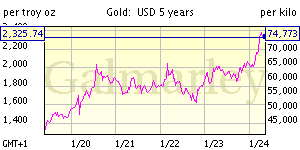
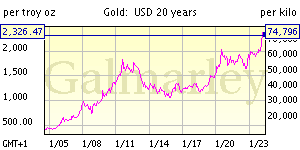
Well, it’s been a bad 5 months. Gold has mostly just gone back and forth, and gold bugs are wringing their hands in frustration. But this is the problem with using intuition in the markets. One intuitively remembers the recent past, and one forgets the larger picture. This is the big advantage of using charts. So let us look at a chart of this bull market going back to its start in early 2001 just slightly above $250.
Well how about that gold bugs? Gold has multiplied by more than 4 times over the past decade! Viewed in the big picture gold has been steadily going up. And how well has the typical establishment follower done over the past decade? Well, we might take the S&P 500 as our measure. Over the past decade, the S&P 500 has declined by 25%. Now what would you prefer – 300% up or 25% down?
Going back to the chart of gold the chart makes us recognize the big picture. And the big picture is a gradual uptrend (which over the decade amounts to considerable). This is crucially important, and it cannot be said too many times: THE BIG MONEY IS MADE IN THE BIG MOVE. And yet we are all sorely tempted to remember the small move (because it is fresh in our minds). As you can see, the fluctuations of the past 5 months are just a minor detail. Soon they will give way to another up move (such as the rally of September, October and November of last year). This will be followed by another round of profit taking, etc.
So who was better off, the gold bug or the establishment? The gold bug has 4 times as much wealth. He lives in a fine house and has a lot more stuff. He is surrounded by beautiful women. (Note to beautiful women. Gold bugs make good catches as they can treat you in the manner to which you would like to become accustomed.) On the other hand, if you are an establishment follower, you can go to parties, stick your nose in the air and pretend that you are one of the elite. Since everyone else at the party has read the same New York Times opinions, they will be struck by your great wisdom, and when you prove disastrously wrong, they will quickly erase that fact from their minds.
Going back to the chart of gold the chart makes us recognize the big picture. And the big picture is a gradual uptrend (which over the decade amounts to considerable). This is crucially important, and it cannot be said too many times: THE BIG MONEY IS MADE IN THE BIG MOVE. And yet we are all sorely tempted to remember the small move (because it is fresh in our minds). As you can see, the fluctuations of the past 5 months are just a minor detail. Soon they will give way to another up move (such as the rally of September, October and November of last year). This will be followed by another round of profit taking, etc.
One of the characteristics of the gold chart, which strikes even the casual observer, is the steadiness of the up trend. Chartists tend to be too mathematical and like to draw precise lines. But you probably get a more honest picture if you stand back and get an intuitive notion of the trend. For example, I have drawn two trendlines, AB (from 2001 to 2005) and BC (from 2005-2008.) An up trendline is drawn connecting two low points. To complete the picture, we select a prominent high point and draw a line through it parallel to the original trendline. Thus through D we draw a line parallel to AB, and through E we draw a line parallel to BC. These lines represent the top of the channel.
For example, when gold got above the line through D in early 2008, this was a signal that gold was (temporarily) too high. Together with other signals this allowed me to put out a sell signal on March 7, 2008. In essence, when gold is near the bottom of the channel (near the trendline), it is a good time to buy. When gold is near the top of the channel, it is a good time to step away and take profits. If you just interpret the lines roughly, then they give you useful information, and together with other signals you can get out close to an intermediate high. It was the same type of thinking which led to my sell signal (special bulletin) of Dec. 2, 2009. Now with the decline from $1,229 and the passage of time, gold has pulled back from the top of its channel.
A very important line (not drawn) extends from point E through $1,000, horizontally through 2008-09. This line was broken in October 2009 as gold moved above $1,000. When a technical pattern makes such a breakout, it is normal behavior to pull back to the break out point one last time before making its real advance. Thus, my original expectation (after the Dec. 2009 top) was for a pull back to $1,000.
But I argue in the April 2, 2010 issue of the One-handed Economist that this is one of those rare exceptions where the pull back does not go all the way to the breakout point, that the intermediate bottom has been made (at $1,050, not $1,000) and that we are ready for another leg up. Thus, I expect the gap between $1,050 and $1,000 to remain open, and this is such an unusual event that it must be regarded as a very powerful (in this case bullish) signal. The final proof that the gap has remained open will be a move in gold above the Dec. top at $1,229, and this event (together with the break above $1,000 back in October) will be a second signal that gold is in a massive, long term bull move.
In other words, dear gold bug, you ain’t hardly seen nothing yet.
What these considerations are telling us is that all the fundamental information which has been coming in since 1981 about the mismanagement of the U.S. economy is correct. It is merely that there is a long time between cause and effect. Ronald Reagan doubled the U.S. money supply. Bush Sr. and Jr. kept on printing money. The Treasury bill rate went from 16% to 0%. All of these distortions have to have their effect. Well, the bill has come due, and – as Ayn Rand predicted – it is marked “ACCOUNT OVERDRAWN.”
________________________________________________
Howard S. Katz was one of the early gold bugs of the late ‘60s and ‘70s, turning bullish on gold in 1965. His favorite gold stock, Lake Shore Mines, went from $3/share to $39/share over the course of the seventies (sold at $31). Katz turned increasingly skeptical about gold as it mounted its final rise in 1979, and he called the top after the close on Jan. 21, 1980 (with gold at $825.50/oz.). Katz traded gold in and out during the ‘80s and ‘90s and once again turned long term bullish in Dec. 2002. His thoughts on commodities, stocks, bonds and real estate are available in a letter entitled The One-handed Economist and published every two weeks giving specific advice on trades in stocks and futures.