![[Most Recent Quotes from www.kitco.com]](http://www.kitconet.com/images/quotes_7a.gif)


Gold and Inflation
by David Tanner
In the 1970's, the last gold bull market, gold peaked at $850 an ounce. Gold was increasing because the government was inflating the money supply. This led to to higher consumer prices, which people mistakenly assume is the definition of inflation. But it is not. Higher prices are simply a result of the increase in the money supply. More money chasing a limited amount of goods will always drive prices higher.
So why haven't we seen higher prices yet since the government has created much more money in the last two years than they ever did in the 70's? It is because all of this newly created money has not filtered down into the system, but has remained in the pockets of the financial establishment to whom it was given (the Banksters).
So, by definition, inflation, which is simply an increase in the money supply, is here. And inflation always drives up the price of gold. Why? Because creating money out of thin air devalues the existing money supply. Therefore, the smart money will flee paper currency (dollars) and park itself in gold until the crisis has passed. This higher demand for gold as a safe haven during times of financial crisis is what drives its price higher.
So, let's ask ourselves a question.... "Where are we in this current cycle? Is gold about to top out, or is there still a long way to go?"

In terms of today's dollars, the price of gold maxed out at almost $2,000 per ounce. So from a historical perspective, gold is still not really "high" yet.
Should we expect gold to return to this level before this current crisis is over? Should we expect it to go higher? Consider the following.
First, the government ended inflation in the 70's simply by raising interest rates to 18%. This ended the borrowing which created the debt which increased the money supply. Since we had a healthy housing market and economy at the time, this drastic measure brought inflation under control and did not kill the economy. Today, no such option is available. Raising interest rates would be political suicide as it would kill the already half-dead economy and ensure that those in office would find their way back home to private practice after the next election cycle.
Therefore, the option of raising interest rates to reign in inflation, which is what ended the last gold bull market is not an option this time around.
Second, this time around, we are not just in a US crisis, but this crisis is world-wide. The Euro, as a currency, is in worse shape than the dollar. This means that there are far more people that will be piling into the gold bankwagon this go 'round. And more demand brings even higher prices.
Even though the price of gold has not yet reached its inflation adjusted peak from the 70's, we are already seeing shortages of physical gold bullion. There is MUCH more demand for gold this time around, yet the price has yet to reflect this shortage due to the Fed's interventionist policies designed to keep the price of gold under control.
And third, the supply of gold today is much less than it was during the last bull market. After twenty years of low gold prices, many gold producers have scaled back their mining and production activities, leaving the market with a supply shortfall that was not a factor in the 70's.
Combined, I believe all of the above will eventually take gold prices far past their previous inflation adjusted highs.
The Blow Off
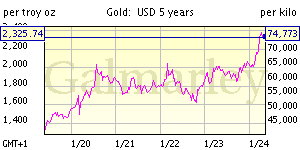
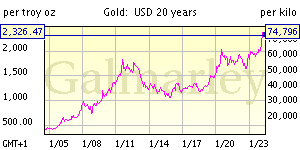
All bull markets eventually end with a parabolic blow-off in which prices increase exponentially over a very short period of time. As you can see from the following graph, this current gold market is plotting a slow and steady path. Prices have not gone "vertical" as they did toward the end of the last gold bull market.
Conclusion
