![[Most Recent Quotes from www.kitco.com]](http://www.kitconet.com/images/quotes_7a.gif)


Here are a few excerpts from a Keynote Speech Presented by Nick Barisheff at the Empire Club’s 16th Annual Investment Outlook Luncheon on Thursday January 7, 2010.
So let's start with the obvious gold events of the past year. It was the first time in 20 years that gold purchases for investment purposes outpaced gold purchases for jewellery demand. However, in terms of significance, central bank buying of gold this past year upstaged all other events. For the first time in over 20 years, central banks became net buyers rather than net sellers of gold. This is a watershed event.
Another event whose implications may require some extrapolation was the move by the Chinese government to encourage and facilitate gold buying by the Chinese public. China watchers know the Chinese have a long-term love for gold. In fact, on December 9, Reuters announced that China had surpassed India as the world’s largest gold buyer, for the first time in recorded history. The Chinese have also demonstrated a strong propensity for saving. With their government making no secret of its displeasure with the US dollar, and with few other safe investment options available, the Chinese public could provide the fuel to move the gold price to new highs. One ounce purchased by each of the 80 million middle-class Chinese would equate to 2,500 tonnes of gold. It is important to remember that during the last gold bull, the Chinese public was unable to participate. This is a story that definitely bears watching.
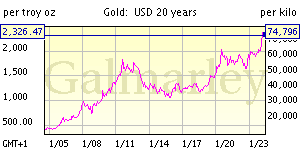
So with these events of 2009 in mind, I am often asked, "How high might the price of gold go?"
Let's look at some figures.
We know that the US must refinance at least two trillion dollars of debt in 2010. They can raise this money in one of three ways: through the sale of bonds, through increased taxation, or through monetization by the Federal Reserve. Foreign investors showed decreasing appetite for US treasuries in 2009. Rising unemployment along with an aging population makes increased taxation a poor option. Therefore, the US Fed will be forced to monetize the ballooning debt, further eroding confidence in the dollar as the world's reserve currency.
This will encourage central bankers, especially those of the developing countries, to accelerate their accumulation of gold. Stephen Jen, a managing director at hedge fund BlueGold Capital and an expert on sovereign wealth funds from his days at Morgan Stanley, estimates that the percentage of gold held by the Chinese, Indian and Russian central banks is just 2.2 percent. This compares with 38 percent held by Western central banks. According to Jen, they would have to buy $115 billion dollars worth of gold at current prices to raise their bullion to just 5 percent of total reserves, and $700 billions' worth to reach just half of Western levels.
________________________________________________________
________________________________________________________
Along with many others in the gold industry, we have noticed that fund managers are starting to buy gold as long-term insurance, which they intend to hold for several years. By one estimate, if the world’s pension funds and hedge funds moved only five percent of their assets into gold, which these days seems quite conservative, gold would trade above $5,000. With leading wealth managers such as David Einhorn, John Paulson and Paul Tudor Jones allocating significant amounts of their portfolios to gold, the process may have already begun.
In conclusion, the events of the past year bode well for the price of gold in 2010. At the recent highs of $1,200 many thought that gold was overbought. For those who feel this way, I would like to close with some recent words from investment legend Richard Russell who said, "If gold is going parabolic, then there’s no such thing as 'overbought'," Almost any of the events of 2009 I have highlighted could trigger such a parabolic rise. Right now the Chinese and Indian public, the non-Western central banks, the sovereign wealth funds, the pension funds and the hedge funds of the world are all looking for ways to increase their long-term gold holdings. The pull-back from the recent highs of $1,200 seems to be over, providing an attractive entry point for investors. In 2010 we will likely see prices rise to at least $1,300 to $1,500.
It is important to understand that this isn’t a typical bull market. Unless governments around the world stop creating massive amounts of new money, the price of gold will continue to rise.
There is a famous investment axiom that states, "Now is always the most difficult time to invest." To that I would add, "But now is also the best time to insure the wealth we have accumulated is protected through the ownership of gold."