![[Most Recent Quotes from www.kitco.com]](http://www.kitconet.com/images/quotes_7a.gif)


2010 Predictions
James Turk made the following statement in his article linked above:
There will be two forces driving gold higher. The first will be the continuing purchases of government paper by the Federal Reserve as the dollar moves ever closer hyperinflation. The second will be the growing demand for physical metal in preference to paper-gold.
In this regard, an important tipping point occurred in July when Greenlight (a major US-based hedge fund whose decisions are widely followed) announced that it was converting its large position in GLD (the big NYSE-listed gold ETF) into physical metal. Greenlight's decision was a wake-up call for investors and asset managers who began to study Greenlight's decision.
These investors and asset managers are now realizing that there is a fundamental difference between owning ‘physical gold’ and ‘paper gold’ in its different forms (ETFs are one of those paper forms). With paper gold you do not own gold. You only own a derivative that gives you exposure to the gold price, and this exposure comes with counterparty risk. Paper gold is a financial asset. Physical gold of course is a tangible asset and therefore does not have counterparty risk.
He continues later with the following insights.
There exists a huge amount of paper gold outstanding relative to the available stock of physical gold at these prices. Therefore, to keep supply and demand in the gold market in balance as the demand for physical metal rises, gold's price has to rise in order to entice present holders of physical metal to sell and hold some national currency instead. After all, physical gold cannot be ‘printed’ by central banks to satisfy the demand for physical metal.
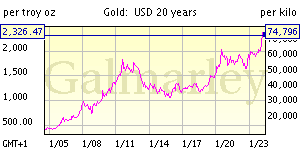
So how high does the gold price have to rise? My sense of it is that this scramble for physical metal could lead to a vicious short squeeze. Regardless whether or not one occurs, the demand for physical metal won't abate until gold hits at least $2000, which I expect will happen some time in 2010. A huge short squeeze could send gold to that price in a matter of weeks. Otherwise, a continuous demand for physical metal will put gold in a steady climb throughout the year that sends it to $2000 by year-end.
To conclude this annual outlook, I would like to provide my usual caveat that no one can predict the future. So instead of relying upon predictions, one should instead focus on undervalued opportunities and avoid overvalued assets.
Therefore, avoid the dollar and other national currencies as well as the paper issued by governments. Given the huge deficits they are incurring and their refusal to make the hard decision to cut spending, a sovereign debt default in 2010 has to be considered a realistic possibility. It will come either through hyperinflation of the currency or a flat out refusal to repay its debts.
So the best strategy for 2010 is to continue accumulating the precious metals, and if you are so inclined to take the investment risk, the mining stocks as well. But please keep in mind one last comment from last year that I would like to repeat because it is still relevant. “In an environment in which people are increasingly fearful about the downturn in the economy, the safety of banks, and the outlook for the dollar, anything is possible for gold. And if 2009 turns out to be the year when the biggest bubble of them all pops (i.e., the dollar becomes suspect), the sky is the limit for gold.” The dollar bubble didn’t ‘pop’ in 2009, but absent an abrupt 180-degree about-face by policymakers to put the US economy and the dollar on the right path, the dollar bubble will eventually ‘pop’. Perhaps 2010 will be the year.