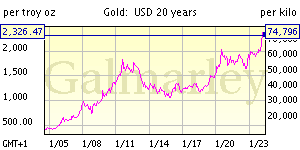
The Golden Years, or if you prefer, Gold For The Old
from What Is Your Exposure? by David Morgan
Let me be clear: I don’t sell bullion but do advocate that everyone buy coins (buy silver) and bars of both gold (buying gold) and silver. I think that’s your best savior in this kind of an environment.
Often the question arises, what percentage of someone’s assets do you recommend in the precious metals sector? Let us understand that we’re talking in a very generic sense here without any kind of suitability or special circumstances or things like that. But what range or percentage is recommended that people allocate through real money?
In The Ten Rules of Silver Investing, I was asked that question. At that time I said 10 percent; however, after that was published, my inclination was to move it up to 20 percent, because the financial system was becoming much more unstable.
The best investment you could ever make is in yourself. If you have a going business, put money in your business, make it stronger, make it better, and market it better, whatever. Or get an education for yourself so you can get a better job or a promotion and so forth. Having said that, you do need some exposure to the metals, and 10 percent as a minimum is a good place to start.
The next question of course is how much gold or silver? This is subject to the individual. The older you are, the less time you have to recover from a mistake. Thus, the older you are, the more gold you should have—so you should probably favor the gold market. The younger or more aggressive you are and the more risk you can take, the more you might consider the silver market. Then there are those who watch the market carefully (such as I do) and trade the gold/silver ratio when it seems favorable. If this is done properly, an investor can actually end up with more metal, with very little effort.
You could look at it this way: if you’re 50 years old, you’re 50 percent gold, 50 percent silver; if you’re 60 years old, you’re 60 percent gold, 40 percent silver, that type of thing. Several people I know who are in their fifties, sixties, and seventies believe silver will outperform gold, but it’s a rougher ride.
![[Most Recent Quotes from www.kitco.com]](http://www.kitconet.com/images/quotes_7a.gif)
Click to Enlarge
Close Call For US Banks


US Operation Confidence Con
Mission:
To restore the underlying false confidence in our economic and monetary systems thus continuing the dominance of the global financial power elite.
Plan of Attack:
1) Start by having the President tell the investing public to buy stocks because they are cheap.
2) Slam the gold and silver markets using the traditional COMEX paper rigging operation to hide the truth about the condition of the US Dollar and the fact that the world is quickly running out of both physical metals.
3) Have CEO's of major banks such as Citigroup and JP Morgan announce that they had a great first two months (excluding losses in mortgage portfolios, credit card portfolios, credit default swaps and other toxic derivatives)
4) Have the Plunge Protection Team flood the markets with stock buy orders to flush the shorts and brings along the perma Bulls like lemmings.
5) Float rumors of ending mark-to-market accounting and re-instating the uptick rule to fry the short traders.
6) Have GM announce that they don't need the extra $2B in March (ooo, so all their problems are cured... for 3 weeks at least!)
7) Have the Muppets on financial TV programs proclaim that the bottom is in and it's safe to go back in the investing water.
8) Introduce a restrictive US mining law that would destroy all hard rock mining operations in the US so the banking cabal can cover their naked mining share shorts..
9) Downgrade GE to AA+ and declare "it's a good thing" giving them a "Stable" outlook and goose their share price so no one thinks there's anything wrong..."No problems here".
10) Do anything and everything you can except NEVER show the true fragile state of the monetary system with over a QUADRILLION DOLLARS in derivatives that have yet to be resolved (...in fact they are growing exponentially!)
EXPECTED RESULT: Buy a few more weeks/months before the complete collapse of the global monetary system.
Mission:
To restore the underlying false confidence in our economic and monetary systems thus continuing the dominance of the global financial power elite.
Plan of Attack:
1) Start by having the President tell the investing public to buy stocks because they are cheap.
2) Slam the gold and silver markets using the traditional COMEX paper rigging operation to hide the truth about the condition of the US Dollar and the fact that the world is quickly running out of both physical metals.
3) Have CEO's of major banks such as Citigroup and JP Morgan announce that they had a great first two months (excluding losses in mortgage portfolios, credit card portfolios, credit default swaps and other toxic derivatives)
4) Have the Plunge Protection Team flood the markets with stock buy orders to flush the shorts and brings along the perma Bulls like lemmings.
5) Float rumors of ending mark-to-market accounting and re-instating the uptick rule to fry the short traders.
6) Have GM announce that they don't need the extra $2B in March (ooo, so all their problems are cured... for 3 weeks at least!)
7) Have the Muppets on financial TV programs proclaim that the bottom is in and it's safe to go back in the investing water.
8) Introduce a restrictive US mining law that would destroy all hard rock mining operations in the US so the banking cabal can cover their naked mining share shorts..
9) Downgrade GE to AA+ and declare "it's a good thing" giving them a "Stable" outlook and goose their share price so no one thinks there's anything wrong..."No problems here".
10) Do anything and everything you can except NEVER show the true fragile state of the monetary system with over a QUADRILLION DOLLARS in derivatives that have yet to be resolved (...in fact they are growing exponentially!)
EXPECTED RESULT: Buy a few more weeks/months before the complete collapse of the global monetary system.
This from Chris Laird at The Prudent Squirrel
Now, next year, I understand that taxes on withdrawals from the last big pool of money out there, tax deferred savings accounts are going up in some ways. Is this a surprise?
For example, with the US running a fiscal deficit of what looks like $2 trillion this year, they have to raise taxes – I mean, they WILL raise taxes. It’s academic. And we have not seen anything yet on that vein either. Wait till the bond markets start rebelling on the huge and ever increasing US Treasury issuances. We have been seeing one week periods this year with $100-200 billion of US Treasury issuances at certain times!
One of our comments to subscribers has been that if you think taxes on your ‘tax deferred’ savings is high now on withdrawals, you have seen nothing yet. They are going to raise taxes more on your supposedly tax deferred savings…
One subscriber considered that, then when he found out they are raising taxes next year on one category of his tax deferred savings, he decided to go ahead and pull the money out in a chunk (a part of it) and pay off his mortgage, so at least he would have a paid off house that he liked; the recent market rally helped that decision he said. Which I personally think is mandatory Financial Survival 101 anyway, having a paid off turtle shell in an area you like. That is the FIRST thing anyone should try to have.
Then of course, gold. In the last 2 years, what market if any is up consistently over 2 years, and up big? Gold is the only one that comes to mind other than T bonds. And of course, that’s logical since gold reacts primarily as a currency, being a key central bank reserve asset in all the world’s central banks, gold rises relentlessly as central banks monetize markets. Gold is at records, or near them, in all major currencies.
Then of course, if you have gold and gold stocks (silver too, but gold is less volatile) in your tax deferred accounts, at least you have a very liquid protective vehicle for your savings.
Now, next year, I understand that taxes on withdrawals from the last big pool of money out there, tax deferred savings accounts are going up in some ways. Is this a surprise?
For example, with the US running a fiscal deficit of what looks like $2 trillion this year, they have to raise taxes – I mean, they WILL raise taxes. It’s academic. And we have not seen anything yet on that vein either. Wait till the bond markets start rebelling on the huge and ever increasing US Treasury issuances. We have been seeing one week periods this year with $100-200 billion of US Treasury issuances at certain times!
One of our comments to subscribers has been that if you think taxes on your ‘tax deferred’ savings is high now on withdrawals, you have seen nothing yet. They are going to raise taxes more on your supposedly tax deferred savings…
One subscriber considered that, then when he found out they are raising taxes next year on one category of his tax deferred savings, he decided to go ahead and pull the money out in a chunk (a part of it) and pay off his mortgage, so at least he would have a paid off house that he liked; the recent market rally helped that decision he said. Which I personally think is mandatory Financial Survival 101 anyway, having a paid off turtle shell in an area you like. That is the FIRST thing anyone should try to have.
Then of course, gold. In the last 2 years, what market if any is up consistently over 2 years, and up big? Gold is the only one that comes to mind other than T bonds. And of course, that’s logical since gold reacts primarily as a currency, being a key central bank reserve asset in all the world’s central banks, gold rises relentlessly as central banks monetize markets. Gold is at records, or near them, in all major currencies.
Then of course, if you have gold and gold stocks (silver too, but gold is less volatile) in your tax deferred accounts, at least you have a very liquid protective vehicle for your savings.
This from Ed Steer this morning in his daily commentary.
In a story that was all over the Internet yesterday, I see that the Senate has approved legislation to raise the federal government's borrowing limit by $1.9 trillion... enough to enable the Treasury to pay its bills through 2010. As reader S.A. put it yesterday... "Eric Sprott is right, the U.S. dollar is "not a safe haven". It should be a message to you, gentle reader, to buy physical gold and silver with both hands.
As I said in yesterday's column, we are much closer to the end of this liquidation cycle than we are to the beginning, so it's time to think seriously about where to deploy any capital you may have still lying about. Market bottoms, although financially and emotionally painful, are the exact times that one should be making serious investment decisions... while blood is running in the streets.
In a story that was all over the Internet yesterday, I see that the Senate has approved legislation to raise the federal government's borrowing limit by $1.9 trillion... enough to enable the Treasury to pay its bills through 2010. As reader S.A. put it yesterday... "Eric Sprott is right, the U.S. dollar is "not a safe haven". It should be a message to you, gentle reader, to buy physical gold and silver with both hands.
As I said in yesterday's column, we are much closer to the end of this liquidation cycle than we are to the beginning, so it's time to think seriously about where to deploy any capital you may have still lying about. Market bottoms, although financially and emotionally painful, are the exact times that one should be making serious investment decisions... while blood is running in the streets.
Two Roads
We have arrived at a point in our nation's history that will define how our future will unfold. There are now only two Roads left to take:
The First Road continues our relentless pursuits of power, control and manipulation that can only spell destruction in our future: destruction of our liberties, destruction of our prosperity and destruction of our moral compass. For too long our CONTROLERS have lied, cheated and stolen their way to the top only to discover that WE THE PEOPLE have been left behind in the process.
The Second Road completely destroys the global fiat monetary system erasing all forms of false wealth, false power and false governance. It is truly a Creative Destruction Event that has never been witnessed in the history of the world. All paper and electronic forms for wealth will evaporate in the blink of an eye completely leveling the playing field in order to rebuild our monetary structures from the ground up. It is a lesson to be learned the hard way but it is a necessary lesson in order to create a new future for our country. A future built on hard work, complete honesty and good will.
When paper and electronic wealth vanishes overnight, ONLY those with tangible assets will survive. In fact, they will be able to live like kings. NEVER has any generation had the opportunity to turn from ordinary folks into super-wealthy individuals as ours has at present. Of course those who ignore this opportunity will turn from ordinary folks to super-poor just as quickly
We have arrived at a point in our nation's history that will define how our future will unfold. There are now only two Roads left to take:
The First Road continues our relentless pursuits of power, control and manipulation that can only spell destruction in our future: destruction of our liberties, destruction of our prosperity and destruction of our moral compass. For too long our CONTROLERS have lied, cheated and stolen their way to the top only to discover that WE THE PEOPLE have been left behind in the process.
The Second Road completely destroys the global fiat monetary system erasing all forms of false wealth, false power and false governance. It is truly a Creative Destruction Event that has never been witnessed in the history of the world. All paper and electronic forms for wealth will evaporate in the blink of an eye completely leveling the playing field in order to rebuild our monetary structures from the ground up. It is a lesson to be learned the hard way but it is a necessary lesson in order to create a new future for our country. A future built on hard work, complete honesty and good will.
When paper and electronic wealth vanishes overnight, ONLY those with tangible assets will survive. In fact, they will be able to live like kings. NEVER has any generation had the opportunity to turn from ordinary folks into super-wealthy individuals as ours has at present. Of course those who ignore this opportunity will turn from ordinary folks to super-poor just as quickly

Chinese dig deep to join the gold rush
The assistant pushed the red velvet sacks across the counter discreetly. The customer quickly slipped them into her bag. With a brief, nervous look around, she walked briskly from the shop, already clutching her car keys.
Few people feel comfortable lugging around a kilo of pure gold bars. But that doesn't stop Chinese shoppers from thronging to Caibai, the number one place for buying the precious metal. The Beijing store's 5,000 daily customers are at the forefront of a new gold rush.
A glass case close to the entrance – and closer to security guards – offers a clue to the hottest draw. Inside sits a 50kg, 24-carat bar: so big, it looks as though it should be made of chocolate and covered in foil. Upstairs, shoppers are buying smaller versions. To them, gold is not just a lavish gift or a reward for hard work, but a hedge against uncertainty and a potential money maker.
"This is the first time I've invested in it," said Ji Junqing, a 38-year-old accountant, hugging her treasure-filled handbag as she spoke. "I used the stock market before, but I think this is more stable. I've been reading about it in all the newspapers and magazines, so I'm putting in about 20% of my assets.
"Whether it's a short- or long-term move depends on how it fares, but I believe the price will keep going up. When you buy gold you see real gold – when you buy something else it's simulated."
The assistant pushed the red velvet sacks across the counter discreetly. The customer quickly slipped them into her bag. With a brief, nervous look around, she walked briskly from the shop, already clutching her car keys.
Few people feel comfortable lugging around a kilo of pure gold bars. But that doesn't stop Chinese shoppers from thronging to Caibai, the number one place for buying the precious metal. The Beijing store's 5,000 daily customers are at the forefront of a new gold rush.
A glass case close to the entrance – and closer to security guards – offers a clue to the hottest draw. Inside sits a 50kg, 24-carat bar: so big, it looks as though it should be made of chocolate and covered in foil. Upstairs, shoppers are buying smaller versions. To them, gold is not just a lavish gift or a reward for hard work, but a hedge against uncertainty and a potential money maker.
"This is the first time I've invested in it," said Ji Junqing, a 38-year-old accountant, hugging her treasure-filled handbag as she spoke. "I used the stock market before, but I think this is more stable. I've been reading about it in all the newspapers and magazines, so I'm putting in about 20% of my assets.
"Whether it's a short- or long-term move depends on how it fares, but I believe the price will keep going up. When you buy gold you see real gold – when you buy something else it's simulated."
Freedom Update
From time to time I like to post headlines that pertain to the erosion of our freedoms. My purpose is to help you realize two things:
First, get some of your money out of the country. Sooner or later they are coming for it and there's not a thing you can do about it.
Second, gold is private and portable. Again, the US Gestapo agencies of FEMA, Homeland Security, FBI and CIA now have only one mission. To convert the US into a socialist system where your freedoms are non existent.
So let's go with some recent news items.
FBI 'fabricated terror emergencies to get phone records'
Justice department to accuse FBI of invoking crises to obtain details of more than 2,000 calls, Washington Post reports
The US justice department is preparing a report which concludes that the FBI repeatedly broke the law by invoking terrorism emergencies that did not exist to obtain more than 2,000 telephone call records over four years from 2002, including those of journalists on US newspapers, according to emails obtained by the Washington Post.
The FBI's general counsel, Valerie Caproni, told the Washington Post that the agency violated privacy laws by inventing non-existent terrorist threats to justify collecting the phone records. "We should have stopped those requests from being made that way," she said.
After the 9/11 attacks, the USA patriot act greatly expanded the government's ability to monitor American citizens, including increased access to their phone calls with the approval of lower-level officials than previously allowed. But the authorisation had to be tied to an open terrorism investigation.
Here's a funny video from Canadian Comedian Rick Mercer on airport security. As I have always said, 911 and the ensuing airport restrictions were not developed to keep the bad guys out, but to keep the good guys in.
Regarding full body scanners in airports, it is interesting to ponder the fact that gold does not set off metal detectors. The powers-the-best know that gold is the investment that will be in great demand when the markets inevitably crash. As usual, I believe this is a pre-emptive strategy to keep the gold from fleeing the US, AS IS ALREADY HAPPENING.
One high ranking executive of Goldman Sachs recently took ALL of his $1 million bonus, bought gold and sent it to a deposit box in Latin America. This information was told to me first-hand from the dealer from whom he made the gold purchase.
So, regarding gold, you might find the following story of interest:
Precious Metals Stored Beneath The World Trade Center
One of the less noted of the possible motives for the attack was the creation of diversion in order to steal hundreds of millions of dollars worth of precious metals.
The basement of 4 World Trade Center housed vaults used to store gold and silver bullion. Published articles about precious metals recovered from the World Trade Center ruins in the aftermath of the attack mention less than $300 million worth of gold. All such reports appear to refer to a removal operation conducted in late October of 2001. On Nov. 1, Mayor Rudolph Giuliani announced that "more than $230 million" worth of gold and silver bars that had been stored in a bomb-proof vault had been recovered stated a New York Times article.
An article in the TimesOnline gives the following rundown of precious metals that were being stored in WTC vaults belonging to Comex.
Comex metals trading - 3,800 gold bars weighing 12 tonnes and worth more than $100 million
Comex clients - 800,000 ounces of gold with a value of about $220 million
Comex clients - 102 million ounces of silver, worth $430 million
Bank of Nova Scotia - $200 million of gold
The TimesOnline article is not clear as to whether the $200 million in gold reported by the Bank of Nova Scotia was part of the $220 million in gold held by Comex for clients. If so, the total is $750 million; otherwise $950 million.
There appear to be no reports of precious metals discovered between November of 2001 and the completion of excavation several months later. It would seem that at least the better part of a billion dollars worth of precious metals went missing. It is not plausible that whatever destroyed the towers vaporized gold and silver, which are heavy malleable metals that are extremely unlikely to participate in chemical reactions with other materials.
I find it more than a coincidence that just as gold was beginning to climb in price that three quarters of a billion dollars worth of gold has come up missing! I also find it interesting that the Chinese have recently turned up gold-plated tungsten bars they received from American, instead of the solid-gold 400 ounce bars they were expecting.
How long has this swindle been going on and how many other bars are out there? Who has the control and money to pull off such an operation?
Perhaps the gold that was supposedly never recovered from 911 had already been replaced by the counterfeit bars. I wonder who has it now?
Still think gold isn't important? Obviously some very powerful people think otherwise!
On a related note:
Quote:
Personally, I have little confidence in the government's claims of the Fort Knox gold supply, and only slightly more confidence in GLD's ETF books. 2008 taught us hard lessons about counter party risk, and I prefer to hold it in my hand rather than see it in my brokerage account. - Simon Black, Sovereign Man... 22 January 2010
The Events of 911 Disclosed 11 Months Earlier - Bankers Complicit
An interview with Aaron Russo, former gubernatorial Candidate of Nevada.
American was formed as a Constitutional Republic, not a Democracy. In a Democracy, 51% of the people have the right to deny 49% of the people of their rights. In a Republic, 99% of the people can't deny the rights of the 1%.
Today's government has done an end-run around this protection that our founding fathers gave us by controlling and shaping public opinion and then rewriting the Constitution (through court interpretations) to suit their goals.
Democracy is two wolves and a sheep voting on what's for supper. In a Republic, the sheep has a gun. Benjamin Franklin
Regarding 911, public opinion has been shaped to the point that American's have ASKED to give up their freedoms in return for safety. The plot of 911 has succeeded wonderfully.
Every thought that you THINK is yours has actually been arrived at by your media brainwashing. And anytime you think outside of that little box, a little voice inside your head says "don't get too carried away... what will people think?"
Well let me clue you in.... those who care more about what others think than the truth deserve what they get. But there are still a few of us that are "mad as hell, and we're not gonna take it anymore, to borrow a line from the movie "Network."
It is to those few Christians and Patriots that I urge you to think outside the box. Don't blindly accept what the media feeds you. Begin to think outside the box and you will find that the answers that are going to insure your survival in the future are outside the mainstream box as well. Question everything, as did the Bereans when the Apostle Paul taught them that the Messiah had come.
Acts 17:10-11 And the brethren immediately sent away Paul and Silas by night unto Berea: who coming thither went into the synagogue of the Jews.
11 These were more noble than those in Thessalonica, in that they received the word with all readiness of mind, and searched the scriptures daily, whether those things were so.
Be noble!
From time to time I like to post headlines that pertain to the erosion of our freedoms. My purpose is to help you realize two things:
First, get some of your money out of the country. Sooner or later they are coming for it and there's not a thing you can do about it.
Second, gold is private and portable. Again, the US Gestapo agencies of FEMA, Homeland Security, FBI and CIA now have only one mission. To convert the US into a socialist system where your freedoms are non existent.
So let's go with some recent news items.
FBI 'fabricated terror emergencies to get phone records'
Justice department to accuse FBI of invoking crises to obtain details of more than 2,000 calls, Washington Post reports
The US justice department is preparing a report which concludes that the FBI repeatedly broke the law by invoking terrorism emergencies that did not exist to obtain more than 2,000 telephone call records over four years from 2002, including those of journalists on US newspapers, according to emails obtained by the Washington Post.
The FBI's general counsel, Valerie Caproni, told the Washington Post that the agency violated privacy laws by inventing non-existent terrorist threats to justify collecting the phone records. "We should have stopped those requests from being made that way," she said.
After the 9/11 attacks, the USA patriot act greatly expanded the government's ability to monitor American citizens, including increased access to their phone calls with the approval of lower-level officials than previously allowed. But the authorisation had to be tied to an open terrorism investigation.
Here's a funny video from Canadian Comedian Rick Mercer on airport security. As I have always said, 911 and the ensuing airport restrictions were not developed to keep the bad guys out, but to keep the good guys in.
Regarding full body scanners in airports, it is interesting to ponder the fact that gold does not set off metal detectors. The powers-the-best know that gold is the investment that will be in great demand when the markets inevitably crash. As usual, I believe this is a pre-emptive strategy to keep the gold from fleeing the US, AS IS ALREADY HAPPENING.
One high ranking executive of Goldman Sachs recently took ALL of his $1 million bonus, bought gold and sent it to a deposit box in Latin America. This information was told to me first-hand from the dealer from whom he made the gold purchase.
So, regarding gold, you might find the following story of interest:
Precious Metals Stored Beneath The World Trade Center
One of the less noted of the possible motives for the attack was the creation of diversion in order to steal hundreds of millions of dollars worth of precious metals.
The basement of 4 World Trade Center housed vaults used to store gold and silver bullion. Published articles about precious metals recovered from the World Trade Center ruins in the aftermath of the attack mention less than $300 million worth of gold. All such reports appear to refer to a removal operation conducted in late October of 2001. On Nov. 1, Mayor Rudolph Giuliani announced that "more than $230 million" worth of gold and silver bars that had been stored in a bomb-proof vault had been recovered stated a New York Times article.
An article in the TimesOnline gives the following rundown of precious metals that were being stored in WTC vaults belonging to Comex.
Comex metals trading - 3,800 gold bars weighing 12 tonnes and worth more than $100 million
Comex clients - 800,000 ounces of gold with a value of about $220 million
Comex clients - 102 million ounces of silver, worth $430 million
Bank of Nova Scotia - $200 million of gold
The TimesOnline article is not clear as to whether the $200 million in gold reported by the Bank of Nova Scotia was part of the $220 million in gold held by Comex for clients. If so, the total is $750 million; otherwise $950 million.
There appear to be no reports of precious metals discovered between November of 2001 and the completion of excavation several months later. It would seem that at least the better part of a billion dollars worth of precious metals went missing. It is not plausible that whatever destroyed the towers vaporized gold and silver, which are heavy malleable metals that are extremely unlikely to participate in chemical reactions with other materials.
I find it more than a coincidence that just as gold was beginning to climb in price that three quarters of a billion dollars worth of gold has come up missing! I also find it interesting that the Chinese have recently turned up gold-plated tungsten bars they received from American, instead of the solid-gold 400 ounce bars they were expecting.
How long has this swindle been going on and how many other bars are out there? Who has the control and money to pull off such an operation?
Perhaps the gold that was supposedly never recovered from 911 had already been replaced by the counterfeit bars. I wonder who has it now?
Still think gold isn't important? Obviously some very powerful people think otherwise!
On a related note:
Quote:
Personally, I have little confidence in the government's claims of the Fort Knox gold supply, and only slightly more confidence in GLD's ETF books. 2008 taught us hard lessons about counter party risk, and I prefer to hold it in my hand rather than see it in my brokerage account. - Simon Black, Sovereign Man... 22 January 2010
The Events of 911 Disclosed 11 Months Earlier - Bankers Complicit
An interview with Aaron Russo, former gubernatorial Candidate of Nevada.
American was formed as a Constitutional Republic, not a Democracy. In a Democracy, 51% of the people have the right to deny 49% of the people of their rights. In a Republic, 99% of the people can't deny the rights of the 1%.
Today's government has done an end-run around this protection that our founding fathers gave us by controlling and shaping public opinion and then rewriting the Constitution (through court interpretations) to suit their goals.
Democracy is two wolves and a sheep voting on what's for supper. In a Republic, the sheep has a gun. Benjamin Franklin
Regarding 911, public opinion has been shaped to the point that American's have ASKED to give up their freedoms in return for safety. The plot of 911 has succeeded wonderfully.
Every thought that you THINK is yours has actually been arrived at by your media brainwashing. And anytime you think outside of that little box, a little voice inside your head says "don't get too carried away... what will people think?"
Well let me clue you in.... those who care more about what others think than the truth deserve what they get. But there are still a few of us that are "mad as hell, and we're not gonna take it anymore, to borrow a line from the movie "Network."
It is to those few Christians and Patriots that I urge you to think outside the box. Don't blindly accept what the media feeds you. Begin to think outside the box and you will find that the answers that are going to insure your survival in the future are outside the mainstream box as well. Question everything, as did the Bereans when the Apostle Paul taught them that the Messiah had come.
Acts 17:10-11 And the brethren immediately sent away Paul and Silas by night unto Berea: who coming thither went into the synagogue of the Jews.
11 These were more noble than those in Thessalonica, in that they received the word with all readiness of mind, and searched the scriptures daily, whether those things were so.
Be noble!
25 States Out Of Money
The U.S. unemployment insurance system is in crisis. So far, 25 states have run out of funds and have been forced to borrow from the federal government, raise taxes or cut benefits. The headline reads "Two Dozen States' Unemployment Funds in the Red; Nine More Within Six Months". There's an inter-active graph that shows you how each state is doing... and how far down the road to insolvency each is. The link is here.
The U.S. unemployment insurance system is in crisis. So far, 25 states have run out of funds and have been forced to borrow from the federal government, raise taxes or cut benefits. The headline reads "Two Dozen States' Unemployment Funds in the Red; Nine More Within Six Months". There's an inter-active graph that shows you how each state is doing... and how far down the road to insolvency each is. The link is here.
Popular Culture and the Stock MarketWall Street legend and best-selling author Robert Prechter says "You can almost hear the Dow going up and
Stock Market Top Is In
There is an accurate way to quantify the collective level of fear (or lack of fear, for that matter) among market participants: it's called the CBOE Volatility Index (VIX). A rising VIX indicates increasing pessimism; a falling VIX signals mounting optimism. The VIX reading was one of the indicators that led EWI analysts to publish a bullish outlook for stocks in the period from March-June of 2009, in our Elliott Wave Financial Forecast publications. In March, with U.S. stocks circling the drain of a 12-year abyss, we anticipated a powerful rally that would bring the Dow Industrials to the 10,000 level at minimum, with an accompanying surge in positive sentiment readings.  Just as a historically high VIX reading in late 2008-early 2009 signaled a fully saturated pessimism and therefore an approaching bottom in stocks -- a steeply falling VIX reading now exposes a near absence of fear. In time, the Elliott wave structure, momentum indicators, and Fibonacci time cycles joined the VIX to tip the scales in favor of a downturn. Here, the January 13 Short Term Update stepped up to the plate with this commanding insight: "The larger and stronger the trend, the better the signal... With respect to the VIX, [the current 16.86 reading is commensurate with] a peak. The odds increase that a "VIX" sell now will lead to a decline that is more than just a few percentage points. This means a trend reversal is fast approaching.
More Problems Ahead For Commercial Real Estate
Here's a very high-profile commercial real estate story from the Wall Street Journal that may give you some inkling of just how bad things are going to get in commercial real estate. And remember, the commercial real estate market is barely coming off the rails now... and it will be many years before it all shakes out and we see anything resembling a bottom. I said in January of 2007 that I wouldn't start talking about a bottom in the residential real estate market until sometime in 2013... and I think you can add five years to that [2018] before we see any kind of bottom in the commercial real estate market. Source The following is an abridged version of the story: A group led by Tishman Speyer Properties has decided to give up the sprawling Peter Cooper Village and Stuyvesant Town apartment complex in Manhattan to its creditors in the collapse of one of the most high-profile deals of the real-estate boom. The decision comes after the venture between Tishman and BlackRock Inc. defaulted on the $4.4 billion debt used to help finance the deal. The venture acquired the 56-building, 11,000-unit property for $5.4 billion in 2006—the most ever paid for a single residential property in the U.S. The venture had been struggling for months to restructure the debt but capitulated facing a massive debt load and a weak New York City economy that has undercut rents and demand for high-priced apartments  By some accounts, Stuyvesant Town is only valued at $1.8 billion now, less than half the purchase price. By that measure, all the equity investors—including the California Public Employees' Retirement System, a Florida pension fund and the Church of England—and many of the debtholders, including Government of Singapore Investment Corp., or GIC, and Hartford Financial Services Group, are in danger of seeing most, if not all, of their investments wiped out. The troubles at Stuyvesant Town reflect the dismal condition of the apartment market throughout the country as high unemployment hammers rents and occupancy levels. Hardest-hit are highly leveraged deals done by private companies that, unlike large public real-estate companies, have been closed out of the capital markets. Nationwide, scores of other apartment deals also are tanking as landlords are being forced to cut rents and offer incentives like flat-screen TVs to attract and retain tenants. San Francisco's Lembi family, the biggest apartment owner in that city, has been forced to give up numerous apartment properties to its lenders because it couldn't repay debt. The troubles experienced by landlords nationwide are stoking fears among regulators and bankers that turmoil in commercial real-estate may derail the hoped-for economic recovery. The Tishman venture's decision to hand back the keys represents a defeat for a company that for years represented the gold standard of commercial real-estate deals, reaping high returns for investors.
FDIC Has MANY Problems
The FDIC is in trouble. Unfortunately, they have modeled themselves after AIG in that they have insured Trillions of dollars of assets and have nothing to back it up with. The US Treasury has granted them a $500B line of credit but the Treasury is smacking up against the US debt ceiling. Sheila Bair has said publically that that "a few large banks will need to fail" but there is no money to bail them out. Let's take Citigroup for example who just released their latest earnings disaster with a 4th quarter loss of $7.6B. http://www.citibank.com/citi/press/2010/100119a.htm Why in the world ANYONE would keep their money with this bank in beyond me, but they claim to have over $300B in FDIC insured deposits! And that's not all…. the FDIC has also Guaranteed over $300B in Toxic Asset Garbage owned by Citigroup! AND THAT'S JUST ONE BANK!!! It's Friday again and I highly recommend watching the Friday Night Bank Failures for some high drama tonight. Here's the link: http://www.fdic.gov/bank/individual/failed/banklist.html
Demand Continues To Grow
The U.S. Mint had another update yesterday. One-ounce gold eagle sales were up another 4,000 to 85,000 for the month so far... but silver eagles sales soared another 502,000 to 3,592,500 for the month of January so far! This is a new high record for monthly silver eagle sales... and represents very close to 10% of the United States yearly silver output! 
Street’s Hog-Trading Game Has Hit a Wall
Wall Street seems to have caught more than a whiff of the Great Recession last week. More like the scent of a corpse, notwithstanding the full court press by Government and news media to convince us there’s a recovery going on. The insane energy that had been pushing stocks higher since last March now seems to be failing. Notice in the chart below how the Nasdaq index has suffered two sharp setbacks since November. There is nothing bearish about this per se, since all uptrends need to correct now and then. However, it is the price action that followed the breaks that raises doubts about the veracity of the ten-month-old bear rally. The thrusts were noticeably tepid compared to the spectacular surge that lifted stocks from a funk in July, taking the broad averages to new recovery highs. What this suggests is that short-covering, the main source of power for bear and bull rallies alike, is running out of fuel. And it’s not because shorts are so certain about the economy’s death spiral than they can no longer be spooked. More likely is that they have simply left the game in order to survive. To be sure, even a relative handful of panicky shorts can goose stocks sharply higher on a given day, and there are probably still enough of them around to levitate the Dow by 150 points on whatever faintly encouraging speck of bullish news crosses the tape. Such buying is driven by margin calls and feeds on itself, and that is why it is far more potent than merely bullish buying, able to push stocks through resistance levels. But the take-no-prisoners rallies of summer have given way to a wafting uptrend that has ceased to spook bears or much impress the public. The market’s tepid ascent reminds one of the story about the two hog farmers who conspired to trade pigs back and forth to raise the price of pork. That’s what institutional traders have been doing since spring, even as individual investors have completely deserted the market. With last week’s slide in the broad averages, evidence grows that, for Wall Street’s “hog farmers,” the game may be over.
They're Coming For Your Retirement Plan
Another great insight from Doug Casey: I just looked up John Williams’ shadow stats on unemployment, and he’s showing BLS Broadest unemployment, which includes “short-term discouraged workers” at over 17%. His SGS alternate unemployment, which includes “long-term discouraged workers” (who were “defined out of official existence in 1994”), is about 22%. One of the things that makes this particularly serious now is that rumors are circulating about the government licking its chops over all the money sitting in personal pension funds, Keogh plans, HR-10 plans, etc. The Pension Benefit Guarantee Corporation (PBGC – like the FDIC, but for pension funds) is bankrupt, and it’s going to get much worse. It’s still early days in this grand misadventure. Usually – not always, but usually – when things get really bad, they float some trial balloons to see how people might react to things they are considering. One of the most dangerous proposals floating out there now is that, since people’s pension plans have been hurt so badly, people should be required to buy annuities with their pension funds. Still adding to your retirement plan? Not smart! Doug continues later in the article talking about Social Security. Well, that’s never been anything but a welfare scheme. Logic does not apply in the government sphere. One way or another, the government will get more involved in pensions, and I suspect they’ll do it like they did down here in Argentina. I doubt most Americans are aware that the Argentine government basically nationalized everyone’s private pension plans last year, including those denominated in dollars, and now they are going to pay people in pesos, fresh off the printing press. I think the same thing is going to happen in the U.S.: they’ll require that a certain percentage of your pension plan be used to buy T-bills, or other government securities, or an approved annuity. This will be for the safety of The People, of course. The end result will be to wipe out an entire form of financial security Americans count on today. So what should we do Doug? The smartest thing to do would be to get them offshore. I say this so often in these conversations and other places that I fear sounding like a broken record, but it’s really that important. But it’s absolutely true that for an American, the safest wealth is the wealth that’s outside of the U.S. Your biggest risk is a political risk, from a completely bankrupt U.S. government. The government is desperate for money.
Close Enough For Govamint Work
I came across this today in Doug Casey's column. Here's a man after my own heart, calling it like he sees it, no matter how politically incorrect. The government is saying the unemployment is around 10%, but that’s a fraud. They don’t count things the same way as they did then, not even as they did in the recession of 1982. Furthermore, they should count many government employees among the unemployed, since relatively few of them produce anything that anyone would voluntarily pay for. I’m not talking about police, garbage collectors, judges, and the like. The market would employ many of them in their current jobs even if the state were to disappear. But many of the apparatchiks filling offices not only don’t serve any useful purpose, but they actively destroy, and prevent the creation of, wealth. These people are worse than just unemployed. I love it!
“The danger to America is not Barack Obama but a citizenry capable of entrusting a man like him with the presidency. It will be easier to limit and undo the follies of an Obama presidency than to restore the necessary common sense and good judgment to a depraved electorate willing to have such a man for their president. The problem is much deeper and far more serious than Mr. Obama, who is a mere symptom of what ails us. Blaming the prince of the fools should not blind anyone to the vast confederacy of fools that made him their prince. The republic can survive a Barack Obama, who is, after all, merely a fool. It is less likely to survive a multitude of fools such as those who made him their president.” -- Author Unknown
Ed Steer, in his daily commentary article this morning entitled JPMorgan et al Do It To Us One More Time had some interesting comments on this week's gold price decline that began on Wednesday, and as I write this on Friday morning, is continuing.
Of course, what really happened on Wednesday won't be known until next Friday's Commitment of Traders report on January 29th... not today's. As I've mentioned many times in the past, these crooks always seem to arrange a major decline in prices starting after the Tuesday cut-off for Friday's [today's] Commitment of Traders report. This decline began on Tuesday night [Wednesday morning in the Far East] at 8:00 p.m. in New York... about three hours after the markets had closed on Tuesday. The other thing I forgot about yesterday was the fact that we're coming up hard on the next gold delivery month... which is February. Option expiry for the February contract is next Tuesday, January 26th. Needless to say, the bullion banks are leaning on the price for that reason as well. Tuesday the 26th is also the cut-off for next Friday's COT report, so the banks can keep what they're doing hidden between now and then... and they obviously are... at least in gold. Translation: The major banks, JP Morgan, et al, are all in the paper money creation business. A rising gold price endangers their little legal counterfeiting enterprise. To hold down gold prices, they sell massive amounts of Gold Short Contracts in the futures markets which artificially bids the price of gold down. As long as that price is down when those options contracts expire, they don't lose money. This is why they often make their biggest moves toward the end of the month, which is when the contracts expire. They really don't care what happens to the price in the middle of the month. They also like to make their major moves after Tuesdays, which delays disclosure of these moves till the following Friday. This gives the public time to overlook their connection to the market rigging that is going on. Of course, everyone knows what is going on Silver Lining Of course the silver lining is this.... For ten years the price of gold has continued to rise IN SPITE OF THEIR EFFORTS to hold it down. They win some short term battles, but are losing the war. They know they can't keep the price from rising. All they are trying to do is keep it from exploding to the upside and wrecking their house of cards in the process. Therefore, look at these temporary assaults on the price of gold as buying opportunities, for we know that the laws of supply and demand cannot be suspended indefinantly. They've (the Banksters) got a tiger (the Gold Price) by the tail. They are slowing him down some, but he is still gonna go where HE wants to go. When he finally shakes them free, he will amaze everyone at how fast he can go.
Post Turtle
Recently a friend passed this joke on to me and I had to share it. While suturing a cut on the hand of a 75 year old rancher, who's hand was caught in the gate while working cattle, the doctor struck up a conversation with the old man. Eventually the topic got around to Obama and his bid to be our president. The old rancher said, 'Well, ya know, Obama is a 'Post Turtle''. Not being familiar with the term, the doctor asked him what a 'post turtle' was.
The Great Wealth Transfer
These are excepts from Ted Andros' January Newsletter The world is falling into what ultimately will be an inflationary depression. This will cause the death or near death of the world’s principle reserve currencies: US Dollar, UK Pounds, Euros, Swiss Francs and Yen, and it is unfolding. OPPORTUNITIES ABOUND FOR THE PREPARED INVESTOR, and in fact they are BIGGER than EVER. Investors will be crushed if not properly prepared; however, If properly prepared this is the greatest opportunity in history. VOLATILITY is set to soar “Up and down” as people scramble to price in and discover the REAL PURCHASING POWER of the Oceans of FAKE money which has been created in the last year. You must learn to fix your paper currencies and then find alternative investments which have the potential to thrive in UP and DOWN markets. Ludwig von Mises describes the "Crack-up Boom" that marks the denouement of all great monetary inflations: “This first stage of the inflationary process may last for many years. While it lasts, the prices of many goods and services are not yet adjusted to the altered money relation. There are still people in the country who have not yet become aware of the fact that they are confronted with a price revolution which will finally result in a considerable rise of all prices,although the extent of this rise will not be the same in the various commodities and services. “But then, finally, the masses wake up. They become suddenly aware of the fact that inflation is a deliberate policy and will go on endlessly. A breakdown occurs. Everybody is anxious to swap their money against "real" goods, whether he needs them or not, no matter how much money he has to pay for them. Within a few weeks or even days, the things which were used as money are no longer used as media of exchange. They become scrap paper.” At no time in my career have so many asset classes been this mispriced. Stocks and bonds are in the ether of overvaluations, and gold and silver are massively undervalued, to name but a few. As bubbles can be seen forming around the globe in selected asset classes. We are in a period which, when completed, will have seen the greatest transfer of wealth from those who hold their wealth in paper to those that don’t. Tedbits is authored by Theodore "Ty" Andros, a registered CTA (Commodity Trading Advisor) and Global Asset Advisors (Introducing Broker) with Traderview - a managed futures and alternative investment boutique. Mr. Andros began his commodity career in the early 1980's, specializing in managed futures since 1985. His duties include portfolio selection and monitoring, customer relations and all aspects required in building a successful managed futures and alternative investment brokerage service. Mr. Andros attended the University of San Diego, and the University of Miami, majoring in Marketing, Economics and Business Administration. Mr. Andros is active in economic analysis and brings this information to his clients on a regular basis, creating professionally-managed investment portfolios designed to capture unfolding opportunities as they emerge. Ty prides himself on his personal preparation for the markets as they unfold and has developed a loyal clientele.
Gold Investment Demand is Exploding:
Large institutional investors - hedge funds and pension funds - are making large allocations to gold, as are individual investors. The proliferation of gold-focused exchange-traded funds (ETFs) bears this out. The SPDR Gold Trust (NYSE: GLD, Stock Forum), the world's largest physically backed ETF with 1,100 tons of the lustrous metal, is the sixth-largest holder of gold bullion. Individual investors have never had an easier avenue for owning gold. This isn't just merely a U.S. manifestation. According to the World Gold Council, demand advanced 15% from the second quarter to the third last year. Asia, with a population that exceeds 2.5 billion inhabitants and a long-standing cultural affinity for gold, is stoking global demand in a big way. China is overtly encouraging its citizens to buy gold and silver, while offering them gold-linked checking accounts. China is primed to overtake India as the world's largest consumer of gold. A quickly developing middle class whose members are experiencing rapid escalations in disposable income are a major bullish driver for the price of gold. ________________________________________________ During the past 10 years, gold has indeed become the trade of the decade, beating out commodities, oil, high-grade U.S. corporate bonds, U.S. Treasuries, and yes, U.S. stocks. A crisp $100 bill invested 10 years ago would today be worth more than $400 in gold, $357 in commodities (as measured by the S&P GSCI Enhanced Total Return Index), $268 in oil, $190 in corporate bonds or U.S. Treasuries, and only $90 in U.S. stocks. That's right: We're talking about a $10 loss in U.S. stocks over 10 years. Ouch. Meanwhile, gold has embarked upon a secular upward trend that is far from over. If the 1970's are any indication, gold's going much, much higher from here. Source
Writing today in the China Daily, "The growth potential for the China private gold market is huge," claim Eric Yuen and Becky Yuen of Hong Kong's GuocoCapital.
"According to the China Gold Association, China's average gold holdings per resident stands at less than 3 grams per person, much lower than India's average of 15 grams per person. So there is still plenty of room for catching up." The world's No.1 gold mining nation as well as top private consumer, China saw its gold output overtake full-year 2008 by November last year, says Zhang Bingnan, vice-president of the China Gold Association. He projects full-year 2009 output at 310 tonnes. Source
Money Magazine Still Hates Gold, So Buy It!
Over the last decade, it would have been possible for investors to make lots of money doing exactly the opposite of what Money Magazine has been telling their readers to do and one of the best examples of this can be found in their very consistent advice about gold. Put simply, the yellow metal has no place in a Money Magazine reader's investment portfolio, that is, if they want to RETIRE RICH like the happy couple on the magazine cover. These trends look like they'll be carrying well into the new decade since, by the time it's over, we will likely have seen one of the most exciting final stages to a long-term bull market ever and Money Magazine will no doubt be advising their two million readers to stay away from precious metals all the way up until the end, at which time, their advice will finally be good advice. But, that process will take years, and there's no telling how high the gold price may go between now and then.
America Slides Deeper Into Depression as Wall Street Revels
December was the worst month for US unemployment since the Great Recession began. The labour force contracted by 661,000. This did not show up in the headline jobless rate because so many Americans dropped out of the system. The broad U6 category of unemployment rose to 17.3pc. That is the one that matters. The home foreclosure guillotine usually drops a year or so after people lose their job, and exhaust their savings. The local sheriff will escort them out of the door, often with some sympathy –– just like the police in 1932, mostly Irish Catholics who tithed 1pc of their pay for soup kitchens. Realtytrac says defaults and repossessions have been running at over 300,000 a month since February. One million American families lost their homes in the fourth quarter. Moody's Economy.com expects another 2.4m homes to go this year. It takes heroic naivety to think the US housing market has turned the corner (apologies to Goldman Sachs, as always). The fuse has yet to detonate on the next mortgage bomb, $134bn (£83bn) of "option ARM" contracts due to reset violently upwards this year and next.
The nation's railroads had their worst year in decades in 2009, a dramatic reminder of the brutality with which the recession damped demand for coal, lumber and other goods that make up the backbone of the economy.
Freight trains carried 20% less cargo last year than in 2008, according to a report by the Assn. of American Railroads, and the industry shed nearly 21,000 jobs. The 12-month period was the slowest since the association began keeping records in 1988. Among the most dramatic declines was a 33% drop in lumber and wood products carried by train, a key indicator of demand for new construction. Trains carried 34% fewer motor vehicle parts and 8% less coal. Source Taken over a two-year period that included all of 2008 and 2009, the declines were even more dramatic, according to the report: a 48% drop in the transportation of motor vehicle parts; a 49% drop in metallic ore and metals; and a 47% drop in lumber and wood products.
Here are a few excerpts from a Keynote Speech Presented by Nick Barisheff at the Empire Club’s 16th Annual Investment Outlook Luncheon on Thursday January 7, 2010.
So let's start with the obvious gold events of the past year. It was the first time in 20 years that gold purchases for investment purposes outpaced gold purchases for jewellery demand. However, in terms of significance, central bank buying of gold this past year upstaged all other events. For the first time in over 20 years, central banks became net buyers rather than net sellers of gold. This is a watershed event. Another event whose implications may require some extrapolation was the move by the Chinese government to encourage and facilitate gold buying by the Chinese public. China watchers know the Chinese have a long-term love for gold. In fact, on December 9, Reuters announced that China had surpassed India as the world’s largest gold buyer, for the first time in recorded history. The Chinese have also demonstrated a strong propensity for saving. With their government making no secret of its displeasure with the US dollar, and with few other safe investment options available, the Chinese public could provide the fuel to move the gold price to new highs. One ounce purchased by each of the 80 million middle-class Chinese would equate to 2,500 tonnes of gold. It is important to remember that during the last gold bull, the Chinese public was unable to participate. This is a story that definitely bears watching. So with these events of 2009 in mind, I am often asked, "How high might the price of gold go?" Let's look at some figures. We know that the US must refinance at least two trillion dollars of debt in 2010. They can raise this money in one of three ways: through the sale of bonds, through increased taxation, or through monetization by the Federal Reserve. Foreign investors showed decreasing appetite for US treasuries in 2009. Rising unemployment along with an aging population makes increased taxation a poor option. Therefore, the US Fed will be forced to monetize the ballooning debt, further eroding confidence in the dollar as the world's reserve currency. This will encourage central bankers, especially those of the developing countries, to accelerate their accumulation of gold. Stephen Jen, a managing director at hedge fund BlueGold Capital and an expert on sovereign wealth funds from his days at Morgan Stanley, estimates that the percentage of gold held by the Chinese, Indian and Russian central banks is just 2.2 percent. This compares with 38 percent held by Western central banks. According to Jen, they would have to buy $115 billion dollars worth of gold at current prices to raise their bullion to just 5 percent of total reserves, and $700 billions' worth to reach just half of Western levels. ________________________________________________________ ________________________________________________________ Along with many others in the gold industry, we have noticed that fund managers are starting to buy gold as long-term insurance, which they intend to hold for several years. By one estimate, if the world’s pension funds and hedge funds moved only five percent of their assets into gold, which these days seems quite conservative, gold would trade above $5,000. With leading wealth managers such as David Einhorn, John Paulson and Paul Tudor Jones allocating significant amounts of their portfolios to gold, the process may have already begun. In conclusion, the events of the past year bode well for the price of gold in 2010. At the recent highs of $1,200 many thought that gold was overbought. For those who feel this way, I would like to close with some recent words from investment legend Richard Russell who said, "If gold is going parabolic, then there’s no such thing as 'overbought'," Almost any of the events of 2009 I have highlighted could trigger such a parabolic rise. Right now the Chinese and Indian public, the non-Western central banks, the sovereign wealth funds, the pension funds and the hedge funds of the world are all looking for ways to increase their long-term gold holdings. The pull-back from the recent highs of $1,200 seems to be over, providing an attractive entry point for investors. In 2010 we will likely see prices rise to at least $1,300 to $1,500. It is important to understand that this isn’t a typical bull market. Unless governments around the world stop creating massive amounts of new money, the price of gold will continue to rise. There is a famous investment axiom that states, "Now is always the most difficult time to invest." To that I would add, "But now is also the best time to insure the wealth we have accumulated is protected through the ownership of gold."
Here is an interesting comment by Doug Casey of Casey Research.
As the government takes over more and more of the economy, they'll mismanage that activity, as they always – necessarily – do. Why do I say necessarily? Because they do things that are politically productive for them, not economically productive for society. That's going to hurt productivity and profitability, misallocating and even destroying capital wherever they stick their noses. And, today, that's absolutely everywhere. A little later in the article Casey states, "It makes no sense to be in the stock market at this point. Real estate is a terrible place to be. Bonds are a terrible place to be. Even cash, especially if you're holding euros or dollars, is surprisingly risky. That makes this a truly unique time, in which there's almost nothing that's a good place to be. I'm very bullish on gold.... I still think gold is going over $2,500 or even $3,000, in today's dollars, but it's risen enough that it's not going to be a one-way street straight up from here."
The following are two slides from a presentation by California Director of Finance Michael Genest. You can find the full presentation here.
  Think of the layoffs that will follow when these services as well as projects are discontinued. We are talking hundreds of thousands of jobs. The scary thing is this.... what starts in California usually comes to the rest of the country afterwards. I personally feel that chaos and riots are on the horizion, sparked by Americans that can no longer feed their families. I would advice you to remember the 4 G's and the 4 B's: Guns, Gold, Grits and God or you may prefer: Bullets, Bullion, Beans and Bible.
I just cut and pasted this off of Ed Steer's Gold & Silver daily commentary:
The only gold story of any importance that I could find yesterday was a Bloomberg interview with Robert McEwen, chairman and CEO of U.S. Gold Corp. Rob's been around the track a few times... and when he gets up on national television and says that gold will hit $2,000 this year, [and $5,000 or higher by 2012-2014] one should be paying attention. Craig McCarty sent me the link yesterday, but the video is no longer posted... so you'll just have to take my word that he said it... which he did!
Here is and interesting interview with Egon von Greyerz, the founder of GoldSwitzerland, and his outlook for the price of gold, and why.

Government cover-up of food shortage feared
World Net Daily While trend experts, economists and investment gurus have been predicting food shortages for some time, new evidence indicates the U.S. Department of Agriculture may be covering up the greatest food shortage in modern history. Beginning in 2009, global agricultural markets faced a supply and demand imbalance, caused by a substantial drop in output resulting from the financial crisis and extreme weather around the world.
At the same time, growing economies in Asia have begun consuming record amounts of raw goods, particularly food staples as consumers move to higher protein, higher calorie diets. When supplies are reduced and demand is constant or growing, prices normally rise. Industry observers and economists remained mystified by the low agricultural prices in spite of this trend. One analyst, Eric deCarbonnel from MarketSkeptics.com believes the answer is found in data he believes the U.S. Department of Agriculture has manipulated to keep food prices low. "Instead of adjusting production estimates down to reflect decreased production, [the USDA] adjusted estimates upwards to match increasing demand from China. In this way, the USDA has brought supply and demand back into balance (on paper) and temporarily delayed a rise in food prices by ensuring a catastrophe in 2010," he said. DeCarbonnel points out that across the Midwest United States, many counties already have been declared federal disaster areas, which is defined by a decrease in crop production of at least one type by 30 percent or more. Hundreds of other counties across the country have experienced crop failures of 10-20 percent, not enough to qualify as federal disaster areas but still contributing to the overall poor harvest. In some states, including Oklahoma, Louisiana, Arkansas and Alabama, the majority of counties have been declared disaster areas, and yet the USDA is predicting record harvests. DeCarbonnel's conclusion is that the government is intentionally covering up the nature of the food shortage because if the public realized the true extent of the crisis and/or prices rose dramatically, economies could collapse and governments could fall. He's not alone in his claims, as researchers around the world are now publishing similar accusations. Consumers in the United States are responding to the latest revelations with an unprecedented private-sector emergency preparedness plan. Websites such as www.survivalseedbank.com are struggling to keep up with orders as people make plans to go "off-grid" in pursuit of food independence.
HSBC Bank Tips Their Hand Regarding Gold Demand Expectations
It seems that everyone these days wants gold. Real, physical gold coins that they can hold in their hands, or bars that they’re assured are resting safely in a well-guarded vault. HSBC’s New York vault, for example, buried deep below its 5th Avenue tower, where it has stored people’s gold since it inherited the facility from Republic Bank a decade ago. But no more. HSBC has served notice to its retail customers – many of whom are simply middle-men and custodial services which store gold with HSBC on behalf of hundreds of their own account holders – that all their gold must be out of its facility by July 2010. The logic behind HSBC’s decision, according to the Wall Street Journal, is simple. The vaults are being cleared of smaller clients in order to make more room for institutional holdings. It all has to do with the COMEX. That exchange, which handles futures activity in gold, has to maintain a cache of metal with which to settle trades. As a courtesy, it will also arrange to store gold for buyers who don’t want to take physical delivery. But it has no vaults of its own. It contracts with four banks to do the actual storage, though only two maintain significant amounts: of the 9.73 million ounces of COMEX gold, Scotia Mocatta has the most, nearly 5.1 million; HSBC USA is next, with over 4.1 million. The amount of gold warehoused by the COMEX has exploded since the metal’s bull run began in 2001. The trend is obvious, and what it means is that HSBC needs an ever-increasing amount of space for its COMEX gold. Provided, of course, that the trend remains in place. Or accelerates. HSBC has cast its vote. It clearly believes that it’s going to be getting more gold from the COMEX, maybe a lot more, and it’s making room by giving the boot to other depositors. Perhaps the bank knows something we don’t know, or perhaps it’s just acting out of reasonable expectation. Either way, it’s telling us that the demand for gold is going to continue rising. And coming from a major bullion bank, that’s about as bullish a signal as anyone could want. If you don’t own any physical gold, it’s time. source
Here is a link to a video posted over on my Behind The Fed website entitled: Bill Moyers' PBS Interview On The Fed Banksters
Bill Black, a regulator during the S&L crisis, answers "why" the current banking crisis was allowed to develop to the point of collapse. When asked why something was not done, even when the FBI warned as far back as 2004 that a collapes was eminent, here is a part of his answer. After 911, the Justice Department transfers 500 "white-collar" specialists in the FBI to national terroristm. The Bush administration refused to replace those specialists. Even today, there are one fifth as many FBI agents as there were in the S&L crisis in the 80's, even though this crisis is a thousand times larger than the S&L crisis. I have always stated that 911 was "allowed" to take place by the powers that be AS AN EXCUSE to create Homeland Security (the equivalent of the German Gestapo) and further strip Americans of their freedoms. Now it seems there has been another benefit derived for the power elite from 911. It provided them a way to avoid regulation of their illegal ponzi schemes right up till the point of collapse. I would like to remind you that it was a Republican White House, Senate and Congress who turned a blind eye to this growing problem. We live in a one-party, two-headed system that is controlled by a few powerful behind-the-scenes men that are bent on destroying America, and they have the money, influence and ruthlessnes to succeed. "Some of the biggest men in the United States in the fields of commerce and manufacturing are afraid of something. They know that there is a power somewhere so organized, so subtle, so watchful, so interlocked, so complete, so pervasive, that they had better not speak above their breath when they speak in condemnation of it.” Woodrow Wilson read more To My Republican Friends
I have never voted Democrat in my life. I am not an athiest, liberal, tree hugging, socialist, Muslim or globalist. I actually LOVE my country, or at least, the country it used to be. But, to my conservative Republican friends, I want to let you know that neither am I in denial as to how economically liberal that my former party has become. I read the following today and I think it sums up pretty well why I feel like I feel.
The government is mainly in the business of national defense and infrastructure. They benefit from rising tax revenues, not from an increase in marginal tax rates, not from taking a larger piece of the pie, but from taking a smaller piece of a much larger pie. This was the economics of Kennedy, of Ronald Reagan, and to a lesser extent, of Bill Clinton, largely thanks in Clinton's case to the Contract with America bottom up economic revolution of the 1994 Congress. To start a bottom-up approach requires an initial large budget deficit as taxes are rebated and cut, hitting the choke button to start the engine. It appears to be an unproductive use of fuel, but shortly thereafter, the engine is purring and producing more fuel than that initial start up process required. By the end of Bill Clinton's reign over America, we had achieved a budget surplus. America was prosperous. Main Street did well. Households felt good. But things changed in the early 2000 millennium. Rather than accept a normal mild correction, the decision was made to take a top-down approach to economic stimulus, to attempt to minimize the economic correction, and keep the good times rolling. But the game changed from real prosperity to artificial prosperity. We entered the age of economic oligarchy in our nation, and it started in a big way in 2000. The shift that took place was to equate the economy with Wall Street. Main Street was no longer considered the key cog determining economic growth. Wall Street, mega-money center banks and mega corporations such as Exxon Mobil, were considered to be the relevant drivers of economic prosperity. If Main Street benefitted, great. But if they did not, so be it. The goal was to make sure Wall Street financial firms made big money. Bigger was better. Industry consolidation was considered a good thing where mom and pops were bought out so the mega firm could control local markets. If a few large firms could control commerce, the government could control all commerce through partnering with the few mega-firms. As this incestuous relationship grew throughout the decade, it became increasingly unclear whether it was government controlling the few large firms, or the other way around. It hasn't mattered whether a Republican or a Democrat occupied the White House, the same top-down economic policy has been enforced since 2000. The mantra has been, simply, if it is good for Goldman Sachs, it is good enough for everyone. source I would like to point out that not only did the Republicans control the post-Clinton White House, but they also controlled the legislative branch as well. The Republican Party is no longer the party that truly cares about America. They, along with the Democrats, have turned our nation from a nation of winners, to a nation of losers. BOTH parties have sold us down the globalist river. To all my Republican friends who still think that America would be better off economically with a Republican in the White House, you haven't been paying attention. When we quit wasting our votes by voting for who we think is the lesser of two evils, then, and only then, will we have a chance of turning this thing around. But I am not holding my breath on that one. Most of my conservative Republican friends quit thinking for themselves a long time ago, settling instead to just blindly follow what Fox News or their favorite televangelist tell them what to do. That's why I continue to buy gold. I close by asking you to take this advice from Robert McHugh of Safe Haven Capital: What we have witnessed over the past decade, and continue to witness is nothing more than the sabotaging of the American Economy. The American household elected three administrations to conduct this policy. They drank the Kool-Aid. They believed the smooth talking rhetoric. They ceded their power to an oligarchy. They need to yank that power back, and return this great nation to the democracy our founding fathers established, by holding representatives and an out-of-control executive branch accountable for their oversight and policy mistakes. At the coming congressional elections, any politician who had anything to do with this economic mess should be tossed out on his or her pampered derriere and replaced with a populist candidate, who believes in bottom up capitalism, low marginal tax rates, and aggressive policies to kick start the American household, small businesses, and small banks. The next election may be our last chance, if several ominous Bearish technical charts are accurate, forecasting stock markets world-wide to plunge toward zero around the 2012-2013 time period. Which is a fascinating prognostication, given the plethora of scientific and prophetic evidence being presented regularly on the History channel about the significance of a potential cataclysmic event in late 2012.
Part Of The System
by David Tanner I have advised my customers for quite some time to quit adding to their 401(k) plans at work. My logic is simple. First, pay your taxes now rather than defer them till later when tax brackets will be much higher. We are all going to have to pay a larger percentage of our incomes in taxes as our government debt becomes greater and greater with a shrinking working population to pay for it. Retirees will be forced to pay higher taxes in the future to make up for the shortfall. Period. Consider the following: However, it is the three levels of the U.S. government who have the most serious solvency crises. Over just the next generation, the U.S. government is facing a $3 trillion per year shortfall just on benefit entitlements of existing social programs – for which not one penny of money has been set aside. Indeed, instead of saving money for when those trillions would be needed, the federal government has plundered over $4 trillion from various government “trust funds”, over just the last two decades. source Second, I would not suggest putting your money in anything that "ties it up" at this point in history. ANYBODY can be jobless tomorrow. Liquidity is of ultimate importance at this time. It is also important to have a source of funds out of the reach of the long arm of the federal government. And finally, you have no investment options within your retirement plans except mutual funds and insurance company fixed accounts. THIS IS THE MAJOR DANGER. As our economy spirals into the abyss, the government and corporations alike are finding it harder to sell their bonds to raise money. Smart money managers are refusing to buy them with their own funds. HOWEVER, they are glad to buy them with yours. Mutual funds and insurance company guaranteed accounts are simply pools of investor money that are managed by professional money managers. These managers are the same "insiders" that are responsible for this whole mess in the first place. The future derivatives collapse (perpetrated by professional money managers) is a time bomb waiting to go off. Nobody in-the-know wants to own them. However, mutual fund investors are not in-the-know, and the professionals that are paid to manage their 401(k)s are more than happy to dump these trash securities from their mega-client portfolios into yours and mine. If you think they care about you, then you need to return to Kansas, Dorothy. Our government recently quit reporting who was buying their bonds. (see note below) Why? Because no one is buying them. They are being forced to buy them back themselves, and pawn them off on the banksters who in turn pawn them off on unsuspecting mutual fund investors. It is you and I that will be left holding the bag when all this "crap" defaults. So, as you go through your annual 401(k) enrollment at work, if you really care about your financial future, you will opt out and buy gold, which is the ONLY financial asset that is not somebody else's liability. (Plus, if you buy gold from me, I will make lots of money, and that's really what this post is all about!) Note: source Again, this act of desperation is also being (temporarily) concealed, through totally altering the reporting of its Treasury “auctions” so that even bond-dealers with decades of experience in this market have absolutely no idea who is buying U.S. Treasuries. While the U.S. government claims that most of these auctions are “covered”, as a matter of elementary logic, such denials are obvious lies. The U.S. government is currently attempting to flog more of its debt than any other government has ever attempted in history – at a time when the amount of available dollars to soak-up those new debts is at its lowest level in at least a decade. Obviously if you want to try to borrow more money than any other nation has ever attempted, you would go out of your way to increase the “transparency” of that bond market – to inspire the confidence of your would-be lenders. The only, possible explanation for the U.S. government going to extreme lengths to obscure its bond market is to hide the fact that the U.S. government has become virtually the only “buyer” for its own debt.
Gold Gaining Acceptance
The Wall Street Journal, known apologist for the banking cartel that hates gold, has brought up the idea of a gold backed Treasury Note. Gold continues to gain acceptance by governments and citizens around the world, which will ensure that its price will continue to climb. Here's a little excerpt from the article. And what about gold? The price of gold has soared to $1,128 today from $282 at the beginning of the decade, a fourfold increase. During the critical 2002-2006 period—when Mr. Bernanke insists monetary policy was consistent with the Fed's price-stability goals—the dollar price of gold climbed steadily to $700 from below $300. Did the governors of our nation's central bank not notice? Given that the U.S. government holds the largest amount of official gold reserves in the world, it would seem pertinent. Indeed, gold is viewed by central banks the world over as a unique reserve asset. Contrary to monetary assets denominated in national currencies, its status cannot be undermined by inflation in the issuing country, nor is it subject to repudiation or default. Which suggests that perhaps it is time to make available to the American public the sort of insurance against dollar depreciation that monetary authorities have long sought for their own portfolios. For those citizens who've become skeptical of the Fed's ability to guarantee price stability in terms more meaningful than elementary CPI statistics—or who believe the bigger threat to their personal financial security lies in a potential repeat of the last debacle—why not provide a new class of Treasury obligations that would guarantee the purchasing power of the dollar in terms of gold? It would not necessarily be a difficult task. Congress could pass legislation authorizing a limited issuance of gold-backed Treasury notes in compliance with existing legal restrictions pertaining to U.S. savings bonds (to own U.S. savings bonds you must be a U.S. resident and have been issued a Social Security number). The five-year Treasury notes would pay no interest, but they would provide for payment of principal at maturity in either ounces of gold or the face value of the security, at the option of the holder. With holders of the notes likely demand gold at maturity, this additional demand should keep gold's price heading skyward.
"Greater Depression" More Bullish For Gold Than The 1930's
In 1930, the world was on a gold standard, with (relatively) strong, solvent economies in most of the world – with the exception of Germany. At that time, no economy was stronger than that of the United States, despite the necessary economic correction it suffered as punishment for a prior period of economic excess. Today, most of those same economies are swamped with higher debt levels than at any time in the history of these nations – with no economy being more insolvent than the United States. At the same time that the wealth-generation of the U.S. economy has been stripped away through the dismantling of most of its manufacturing base, it is forced to bear a debt-load far greater than that borne by the other 95% of the global population combined. Obviously the combination of exponentially rising debts, ever more-reckless spending, and relatively no cash flow for this government must end in default and insolvency. Current policies (and propaganda) of the U.S. government are designed purely to hide the mountains of debt, and delay the inevitable default. The United States is long past the point where economic salvation is possible, through any combination of fiscal restraint and feasible, future economic growth. It is only through every more-distorted economic “statistics” that the U.S. government has been able to hide its insolvency from its many, large creditors. Such deceit and concealment is rapidly coming to an end. As the sources for yet more U.S. borrowing totally dry up, the U.S. government has now been forced to the ultimate act of economic desperation: printing money to pretend to “pay” its bills.
The reversal by global, central banks from being huge, net sellers of gold to net buyers is the exclamation point which should hammer this concept home to every investor. When the world's central banks, the peddlers of those mountains of fiat currencies, display an open preference for gold over their own paper, any investor who ignores this obvious warning does so at his or her own peril.
source
Gold May Gain 35% In 2010
NEW YORK (Commodity Online): Investors can expect a gold bull market in 2010 while silver could outperform gold as was the case in 2009, according to Jeffrey Nichols, Senior Economic Advisor to Rosland Capital. "Gold rallied sharply on the first trading day of 2010 - in part, mirroring a weaker U.S. dollar but also reflecting reestablishment of long positions by some funds and speculators who, despite their bullish view of the market, sold metal in December to realize profits earned from last year's price surge. "I expect the yellow metal will hit $1,500 an ounce or higher during the year, a gain of more than 35 percent from its Dec. 31 close. Looking further ahead, gold's bull market will likely continue for another few years, carrying the metal to a cyclical peak of at least $2,000 or more. At the same time, silver could very well outperform gold, rising from $17 an ounce at the end of last year to an annual high of at least $25 sometime during 2010, a gain of more than 45 percent from last year's close.
How low will the bear market go? It’ll go a lot lower than the 6,470 points that the Dow reached in early March 2009 because this is the Long Wave winter bear market, which follows the huge autumn bull market. This autumn bull market was two and a half times bigger than its predecessor of 1921-1929. The bear market which followed caused the Dow to decline by 90%. Considering the difference in size between the two respective bull markets we expect that this bear market would be bigger in percentage terms than its 1929-32 counterpart. Perhaps the 93% drop experienced by the Transportation index between 1929 and 1932 would be a fitting reversal. This would drop the Dow to 822 points. If we used the Dow peak of 14,200 points reached in October 2007, a 93% reversal from this point would see the Dow bottom almost exactly at 1,000 points.
The Longwave Group - Dow 1000 For a long time, Ive thought that what will happen is that someone will come out of left field and offer the world a gold-backed version of their currency. It could easily be the Russians, or the Chinese. And if they did it right, making the currency fully redeemable in gold, that currency would become the strongest in the world. As a result, capital would pour into their banking system. And, assuming they made some other reforms, namely cutting taxes and regulation, their economies would become real powerhouses producing sustainable growth. Doug Casey - Casey Research
Market Cycles
excerpt from The Longwave Analyst In November 1928, W. D. Gann published his ‘Outlook for 1929’ for his subscribers. What follows, are the opening three paragraphs of this publication. “This year occurs in a cycle which shows the ending of the bull market and the beginning of a prolonged bear campaign. The present bull campaign has lasted longer (1921-1929) than any other previous campaign in the history of this country. The fact that it has run longer and prices have advanced to such abnormal heights means that when the decline sets in it must be in proportion to the advance. The year 1929 will witness some sharp, severe panicky declines in many high-priced stocks.” “During the year 1928 the public have entered the stock market on the largest scale ever known in history. Foreigners have bought our stocks more than at any time since or prior to the outbreak of the World War. The American public is no longer making safe investments in stocks. They have the gambling fever and are buying everything regardless of price, simply buying on hope that stocks will continue to go up. This is a dangerous situation and has always resulted in a big decline. There will be no exception in this case.” “As long as the public believes that everything is all right, they will hold on and hope, but when public buying power has exhausted itself and the largest number of stock gamblers in history lose confidence and all start to sell, it requires no stretch of imagination to picture what will happen.....Gamblers do not think: they always gamble on hope and that is why they lose. Investors and traders must pause and think, look and listen, and get out of stocks before the great deluge comes.” W. D. Gann, Outlook for 1929. I think you’d have to agree that it was a pretty impressive call. The accuracy of Mr. Gann’s prognostication is a testament to his unique skills in his interpretation of cycles. He died in 1955, but his exceptional trading skills, based upon his financial cycle knowledge, is likely never to be surpassed. What Mr. Gann did demonstrate, time and time again, is that the correct interpretation of economic and financial cycles is an exceptional method of determining the most probable course of future events. The most important thing to understand about financial and economic cycles is that they are just like their counterparts in the natural world. They are as predictable as are the tides, the moon phases, the annual seasons and, yes, a human lifetime. Like a human lifespan, financial and economic cycles follow a similar path from birth to death. The Long or Kondratieff Wave follows this path over 60 or 70 years, which is typically a meaningful human lifetime. In the cycle, spring is the birth of the economy. In winter, the economy dies. It dies because it is overcome by too much debt. During winter, most of the debt is purged from the economy, which enables its rebirth in the following spring. All cycles are natural phenomena; financial and economic cycles are also. This means that man is powerless to intervene. Nature must take its course. “There is no power, Divine or human that can oblige a stream to flow back to its source.” Le Bon. Gann wrote in November 1928 in his Outlook for 1929, “When the time cycle is up, neither Republican, Democrat, nor our good President Hoover can stem the tide. It is natural law. Action equals reaction in the opposite direction. We see it in the ebb and flow of the tide and we know from the full bloom of summer follows the dead leaves of winter.” He was right; there was nothing that anyone could do to halt the vicious stock bear market or the economic depression. Here we are again; current world leaders think that they can stop the natural course of events that follow a debt bubble that is unprecedented in scale. They and we are to be hugely disappointed. Spring doesn’t occur until winter has run its course. In the Long Wave, these leaders think they have the power to circumvent winter. They don’t.
Subscribe to:
Posts (Atom)
|


