Ed Steer's Gold and Silver Daily

24hGold.com RSS Feed - Gold and Silver Market Analysis

24hGold.com RSS Feed - Gold and Silver Editorials

Whiskey & Gunpowder

Numismatic News

Click to Enlarge

Close Call For US Banks
Failing governments eventually resort to the last ditch efforts of confiscating their citizens' wealth to stay afloat. Most recently this was done in Argentina as citizens' retirement plans were nationalized. With the dollar's death rattle becoming more pronounced, one wonders how long before this happens here.

How big is that risk in our nation? Check out the following map of nations with the most and least privacy protections for their citizens. Guess who is on the bottom? Yep, you guessed it. The good ole US of A.


CLICK MAP TO ENLARGE

Summary of Findings
No right to privacy in constitution, though search and seizure protections exist in 4th Amendment; case law on government searches has considered new technology

No comprehensive privacy law, many sectoral laws; though tort of privacy

FTC continues to give inadequate attention to privacy issues, though issued self-regulating privacy guidelines on advertising in 2007

State-level data breach legislation has proven to be useful in identifying faults in security

REAL-ID and biometric identification programs continue to spread without adequate oversight, research, and funding structures

Extensive data-sharing programs across federal government and with private sector
Spreading use of CCTV

Congress approved presidential program of spying on foreign communications over U.S. networks, e.g. Gmail, Hotmail, etc.; and now considering immunity for telephone companies, while government claims secrecy, thus barring any legal action

No data retention law as yet, but equally no data protection law

World leading in border surveillance, mandating trans-border data flows

Weak protections of financial and medical privacy; plans spread for 'rings of steel' around cities to monitor movements of individuals

Democratic safeguards tend to be strong but new Congress and political dynamics show that immigration and terrorism continue to leave politicians scared and without principle

Lack of action on data breach legislation on the federal level while REAL-ID is still compelled upon states has shown that states can make informed decisions

Recent news regarding FBI biometric database raises particular concerns as this could lead to the largest database of biometrics around the world that is not protected by strong privacy law
Some may argue that they can avoid volitility and the risk of loss by staying in "safe" accounts like bank cds, annuities and government bonds. But the trouble with this logic is that they are denominated in dollars and the dollar is steadily losing purchasing power. Yeah, you have the same amount of dollars, but they are losing value relative to the would in which you live, as the following graph points out, if you stayed in "safe" investments since 1993, you have lost 20% and don't even know it.


Source: World Gold Council CLICK CHART TO ENLARGE
This article is a MUST READ. Excerpts below.

> There are no real estate bargains. There is only a coming decade of real estate pain and agony.

> I've gotten a number of emails from the gold community (GC) that President Obama is on the verge of handing USA sovereignty to a world government. I think that is coming, but it's far too early to occur now. Many years too early. I think those claiming it's about to occur are "showboating." The banksters understand risk better than the gold community does as a group. For them to move forward on such a plan now would invite total chaos. High ranking members of the US military would not be so keen on any handover and nor would millions of armed US citizens.

> However, should new OTCDs (OTC derivatives) be revealed as dead, in size, as happened with Lehman, banks and stock markets would close. Many more citizens would be open to a global govt/currency solution if grocery stores and banks were closed and empty of food and money. Another major terror attack could also galvanize a need for a global solution.

> This is not 1979, the era of greed. This is the era of fear. Panic and rash action will not help you. It's important to understand that the risk of repeated bank and brokerage closures is high, and means you may not be able to trade stock for intermittent periods of time. For those of you who have ordered safes for your home, keep in mind that the companies you ordered from employ workers who could receive "invitations" from criminal gangs to supply them with lists of the customers.


> Bank workers are also gang targets when the social order breaks down. Lists of thousands of depositors from major banks have been found in ravines and fields in countries where gangs have infiltrated the banking system. Kidnapping, extortion, and robbery of depositors is the main purpose of getting the lists, but good old identity fraud is also a popular play.

> When the system is at risk, bank and insurance company workers may become desperate to assist other family members who are in dire situations. Desperate people do desperate things, and criminal acts are more easily justified when many people are in the same sinking boat.

> Keeping 1-10% of your net worth outside of the financial system in multiple locations is your best insurance policy. The percentage of insurance should suit your personality, but zero is a number that isn't very smart. In fact, it borders on insane. I suspect most of those who lost large money in the stock and real estate markets over the last 10 years are laughing as they read this, but it won't end well for them, and you can take that to the bank.

Source: World Gold Council

CLICK CHART TO ENLARGE
Just in case you haven't been paying attention, post 911 USA is virtually a police-state. The Patriot Act contains little publicized regulationa that allow the United States government to open customers' safety deposit boxes in the event of a bank holiday. They have the right to confiscate your gold, silver and cash. DON'T KEEP YOUR VALUABLES IN A SAFE DEPOSIT BOX!
Gold and stocks go through long (20 years on average) bull and bear markets. The following chart, just published by the World Gold Council, clearly shows that stocks have entered a bear market while gold is in a bull market.


Many complain that gold is more risky/volitile than stocks and bonds. But does that claim match up with the facts?

Source: World Gold Council
It is evident the demand for gold is being driven by investors and not by the usual demand factors such as jewellery. In their latest report, the United States Mint, states that sales of its one-ounce American Eagle gold bullion coins have rocketed to some 1,030,000 year to date. Sales for the one ounce American Eagles in 2008 were 710,000 ounces and 140,000 ounces a year before. Source
Yesterday we looked at the Real Estate/Gold Ratio. Today let's consider the Food/Gold ratio.

Are your food prices going up? Sure they are, because you pay for your food with dollars. But if you paid for your food in gold, as you can see from the following graph, it is actually getting cheaper.


Store your wealth in gold, not dollars, and prosper.

________________________________________________________

The following is an excerpt from The Crash, Cash and Gold.

Everywhere we hear of well-meaning citizens prepping with the four "G"s: guns, gold, groceries, and God.
Or the four "F"s: food, funds, firearms, and faith.
Or the four "B"s: beans, bullion, bullets, and Bible.

There exists a stark polarization in mood between the powers-that-be and their "bosses" - the American public. Emerging from the cold war and into the gold war, many patriotic Americans have shifted their panic from foreign to domestic enemies. What does it say about the empire when, in fear of the government, a good segment of its citizens have hunkered down with food and ammo, or when millions of "taxpayers" march on Washington? Is there any way this ends well?

Weekend Fun

Curtis & Leroy saw an ad in the The Oxford Eagle Newspaper in OXFORD, MS. and bought a mule for $100. The farmer agreed to deliver the mule the next day.

The next morning the farmer drove up and said, "Sorry, fellows, I have some bad news, the mule died last night.

"Curtis & Leroy replied, "Well, then just give us our money back."

The farmer said, "Can't do that. I went and spent it already."

They said, "OK then, just bring us the dead mule."

The farmer asked, "What in the world ya'll gonna do with a dead mule?"

Curtis said, "We gonna raffle him off."

The farmer said, "You can't raffle off a dead mule!"

Leroy said, "We shore can! Heck, we don't hafta tell nobody he's dead!"

A couple of weeks later, the farmer ran into Curtis & Leroy at the Piggly Wiggly grocery store and asked. What'd you fellers ever do with that dead mule?"

They said,"We raffled him off like we said we wuz gonna do."

Leroy said, "Shucks, we sold 500 tickets fer two dollars apiece and made a profit of $898."

The farmer said, "My Lord, didn't anyone complain?"

Curtis said, "Well, the feller who won got upset. So we gave him his two dollars back."

Curtis and Leroy now work for the government.

They're overseeing the Bailout Program.

Limit all US politicians to two terms.

One in office, One in prison.
Basic economics teaches us that if there is a limited supply of something and more and more people want it, then the price is bid up until enough of the prospective buyers can no longer afford it. For instance, if 100 people want to purchase a bag of wheat and there are only 50 bags of wheat available, then the bidding for the wheat will continue until 50 people quit bidding and the wheat goes to the remaining 50.

The same principle holds true in the gold market. Increased demand makes prices rise. With that in mind, consider the following excert from Mineweb.

In a scheme which has now been running for a full year, the Indian Post Office has been a conduit for the sale of specially minted gold coins. The scheme appears to have been promulgated by the World Gold Council and was put out to tender by the India Post, with the contract won by Reliance Money Limited, a division of Reliance Capital, one of India's largest financial services companies.

India Post points out that the Indian Economy is one of the fastest growing economies of the world., with per capita income rising consistently. Purchasing of gold, it points out, is an age-old tradition and even religious too.

Most other Indian banks have similar schemes being pushed out to market small denomination coins and bars.

Recent reports also suggest that HDFC bank is looking at selling silver too in a similar manner.
So it is not only Chinese state institutions which are promoting the sale of precious metals as an investment, but Indian ones too, meaning THE WORLD'S TWO LARGEST CONSUMERS OF PRECIOUS METALS BOTH HAVE ONGOING MARKETING IN PLACE TO PERSUADE INVESTORS TO BUY BULLION.

Limited supply plus increasing demand equals higher prices.
The sixties and seventies were the decades of the commodity. Oil, gold, food all surged in price while stocks and financial instruments languished.

But then the commodities cycle gave way to the stocks as the best performing asset for the eighties and ninties.

As usual, after about twenty years, stocks and financial instruments began to decline and commodities began to shine.

Commodities cycles generally last for twenty years. We are not even half way through this cycle with the biggest gains yet to come.

Case in point: Median home prices have fallen from a high of $249,000 to $210,000 since November 2007, a little more than a 15% decline when measured in dollars.

But look at those same home values when priced in gold.


Over the same time period, median home prices that are priced in terms of gold have declined almost 30%.

What's the point?

If your currency is gold, then you can buy real estate cheaper than if your currency is dollars.

Store your wealth in gold and during the coming depression, you will be like a kid in the candy store, buying assets for pennies on the dollar.

More millionaires were made during the Great Depression than in any other time in our nation's history!

Don't fear the future..... Prepare for it!

____________________________________________________

90% Of Fund Managers Think the Market Will Go Up

Maybe the street has become a bit too bullish afterall.

90% of institutional investors believe that the S&P500 will rise to 1,200 by the end 2011 according to a survey by The Markets. 75% then expect it to hit 1,500 by the end of 2013, and 75% believe that the market already bottomed earlier this year. The survey covered 103 invesors in 20 countries.

We don't necessarily disagree with these views, but naturally find it disturbing to find such a strong consensus on market direction. It sets off our contrarian alarm loud and clear.
Source here


Just remember, the crowd is ALWAYS wrong, if the crowd was always right then we'd all be rich.
A picture is worth a thousand words.


_______________________________________________


The following graph shows that Russia's gold reserves have grown by 50% over the last three years.

Why?

As I have continually preached, the rest of the world is heading back to a monetary system that has some kind of a gold backing.


When the plug is finally pulled on the dollar, if you are one of the few who own gold, your foresight will be greatly rewarded.
The Mogambo Guru, Richard Daughtry, heaps ridicule and sarcasm at the Fed.

The Fed was, as I recall, charged with maintaining a “stable currency”, which they have manifestly failed to do, seeing that the dollar has lost 96% of its value since 1913, which is now officially “enough of all of it that it can be considered to be all”, a lesson in “rounding off” that I learned after I took a lousy $20 from my wife’s purse when she wasn’t looking, and when I came back, there she was, bad mood and all, holding her stupid purse like I needed some kind of audio-visual materials to refresh my memory or something. So, to keep it from being a total loss, I gave her what I had left: 80 cents.

“But,” I explained, “you got back 80 cents, which is only a loss of 96% of the original $20, which is the same loss that the Federal Reserve has given us in the purchasing power of the dollar, but you don’t make a big fuss with the Federal Reserve! You won’t even sign the hate mail that I write for you to send to them, with your signature and your fingerprints on the paper, wherein you protest their glaring incompetence and their neo-Keynesian econometric stupidities!”

Well, let me tell you that I never, ever heard the end of the story about that damned $20. Never! But I noticed, and constantly protested, that nothing is ever, ever said of the 80 cents I gave her back. Nothing!

And why is that? Because it proves that, as far as she is concerned, I have lost “all” of the money, which she demonstrated by throwing the handful of change right at my head from point-blank range. One of the quarters hit my forehead with a “thunk!” where it left a red mark and a little lump, and when I cried out in my pain and mortal anguish, she laughed and said, “Good!” which shows you the kind of crap that I put up with around here all the time.

So there are several lessons here. One is that even a girl can throw a quarter hard enough to hurt the hell out of your forehead if she is standing close enough and is angry enough, and another lesson is to not spend the money you take from your wife’s purse for a few days to see if she notices it missing, and if she does, then you can seize the purse, saying, “Let me look in there!” and surreptitiously put the money back in the purse while rifling around in there so that you can “find” it and, holding it aloft, triumphantly say, “Hey!”

The biggest lesson is that the Federal Reserve is still destroying the dollar by creating so many more dollars so that the government can borrow them and spend them, which means that you should be buying gold, silver and oil in a Freaking Mogambo Panic (FMP), using the dwindling purchasing power your dollars.

And if you don’t, then you can take comfort in that you are in the majority of investors that must lose so that the minority of investors, who do, can make the money which makes it all so easy that you find yourself saying, “Whee! This investing stuff is easy!”


Richard Daughty (Mogambo Guru) is general partner and COO for Smith Consultant Group, serving the financial and medical communities, and the writer/publisher of the Mogambo Guru economic newsletter, an avocational exercise to better heap disrespect on those who desperately deserve it. The Mogambo Guru is quoted frequently in Barron’s, The Daily Reckoning , and other fine publications.


U.S. credit card defaults rise to record: Moody's
NEW YORK (Reuters) - The U.S. credit card charge-off rate rose to a record high in August, as more Americans lost their jobs, Moody's Investors Service said on Wednesday, in another sign consumers remain under stress. The Moody's credit card charge-off index -- which measures credit card loans that banks do not expect to be repaid -- rose to 11.49 percent in August from 10.52 percent in July.

The index resumed an upward trend after declining in July for the first time in almost a year, vanishing hopes of stabilization in the industry after record high credit losses
.

_______________________________________

The concept of a world without one superpower dominant, has always been a temporary situation and one preceded or followed by war. In a world where economics and money dominate, the same principle applies. Whatever happens, uncertainty reigns until Pax Romana or Pax Americana, or any other Pax persists. The difference this time is that the war will be fought in the global economy and in foreign exchanges.

In such a world, national monetary certainty is illusive. It is in this type of world that gold reigns supreme because it is trusted all the world over as being untied to any government. It is the currency that enemies can pay each other in.
Source: The Gold Forecaster
This from Jeff Clark of Casey's Gold & Resource Report sent along a reference from the Bearish News website, quoting an October report from Hayman advisors.

"There have been 28 episodes of hyperinflation of national economies in the 20th century, with 20 occurring after 1980. Peter Bernholz (Professor Emeritus of Economics in the Center for Economics and Business (WWZ) at the University of Basel, Switzerland) has spent his career examining the intertwined worlds of politics and economics with special attention given to money."


"In his most recent book, Monetary Regimes and Inflation: History, Economic and Political Relationships, Bernholz analyzes the 12 largest episodes of hyperinflations – all of which were caused by financing huge public budget deficits through money creation. His conclusion: the tipping point for hyperinflation occurs when the government’s deficit exceeds 40% of its expenditures. Guess what? The U.S. will hit the 40% mark in 2009.”


I assume you know what hyperinflation does to the price of gold?

_________________________________________________


This comment from Rick's Picks further reinforces my contention that this thing is gonna get much worse before it gets better.

A recent Wall Street Journal story explains that the airlines’ strategy is to ground as many planes as it takes to keep the supply of seats tight. That means layoffs and unpaid furloughs for pilots, flight attendants, baggage handlers, mechanics and other personnel.

And the cycle continues to feed on itself as every round of layoffs further curtail consumer spending which breeds more layoffs.

_______________________________________________

Foreclosures: 'Worst three months of all time'
NEW YORK (CNNMoney.com) -- Despite concerted government-led and lender-supported efforts to prevent foreclosures, the number of filings hit a record high in the third quarter, according to a report issued Thursday.

"They were the worst three months of all time," said Rick Sharga, spokesman for RealtyTrac, an online marketer of foreclosed homes.

During that time, 937,840 homes received a foreclosure letter -- whether a default notice, auction notice or bank repossession, the RealtyTrac report said. That means one in every 136 U.S. homes were in foreclosure, which is a 5% increase from the second quarter and a 23% jump over the third quarter of 2008.
This from Rick Ackerman this morning:

December Gold has sold off mildly so far after peaking within inches of a 1074.50 rally target drum-rolled here a while ago. We see little reason for concern, since the futures would need to fall all the way to 983.10 to create room on the daily chart for doubts. Actually, we’d view any pullback into the range 1057 (already achieved) – 1019 as a terrific buying opportunity, since it would take only a $20 booster rally thereafter to set gold in motion toward the next key threshold, 1134. The dollar’s bearish chart would seem to corroborate a bullish outlook for gold.

If you are serious about investing, Rick's newsletter is well worth the time.


Dollar to Hit 50 Yen, Cease as Reserve, Sumitomo Says
Bloomberg -Oct. 15 (Bloomberg) -- The dollar may drop to 50 yen next year and eventually lose its role as the global reserve currency, Sumitomo Mitsui Banking Corp.’s chief strategist said, citing trading patterns and a likely double dip in the U.S. economy.

“The U.S. economy will deteriorate into 2011 as the effects of excess consumption and the financial bubble linger,” said Daisuke Uno at Sumitomo Mitsui, a unit of Japan’s third- biggest bank. “The dollar’s fall won’t stop until there’s a change to the global currency system.”


I don't have to tell you what this means to the future gold price. This just reinforces what I have always said. The best time to buy gold is WHEN YOU HAVE THE MONEY!
Big news day today. Had to pass this one one.

GM CLOSES SATURN

It's getting worse and you better get your wealth out of the banks, IRAs and 401ks and buy something that will last.


Guess who said this?
Rising prices of precious metals and other commodities are an indication of a very early stage of an endeavor to move away from paper currencies...What is fascinating is the extent to which gold still holds reign over the financial system as the ultimate source of payment. -Alan Greenspan, 9 Sep 2009
Today's Notes:

"Citigroup says gold could rise above $2,000 next year. According to an internal client note the US bank stated that gold is poised for a dramatic surge and could blast through $2,000 an ounce by the end of next year as central banks flood the world's monetary system with liquidity. Barclays Capital predicted that the gold price could rise as high as $1,500/oz. The bank is targeting $1,050/oz initially, followed by $1,120/oz. It advises holding long positions in the precious metal."
Source: here

Here is a very good, short article showing how overpriced the markets are, and how underpriced gold is.

“Over the last three months, banks put 63 percent of their new cash into Euros – not the greenbacks – a nearly complete reversal of the dollar’s onetime dominance for reserves, according to Barclays Capital. The dollar’s share of new cash in the central banks was down to 37 percent – compared with two-thirds a decade ago. Currently, dollars account for about 62 percent of the currency reserve at central banks – the lowest on record, said the International Monetary Fund.” Source: here

Again, based on the above comments, we see that the world continues to lose confidence in the dollar, which means that everyone who owns them is losing value. Who owns the dollar? You and I. Anyone who invests in stocks, bonds, mutual funds, annuities, real estate or bank accounts owns dollars. The only asset going up in terms of dollars at this time is gold.

And finally, the following quote by Al Korelin caught my eye this morning:

"Capitalism, as the basic business paradigm, no longer exists.

Capitalism made our country great and its disappearance is creating havoc in the United States by dramatically increasing our federal deficit; keeping our unemployment numbers high; and, obviously dramatically slowing down our economic growth.

To those folks who question the direction of gold prices in the near term I would say the following:

Since the days of the Old Testament people believed in the value of gold and silver and that belief still exists today. That is why smart people will continue to purchase gold and silver and the respective prices of these precious metals will not go down until we go back to the tried and true business paradigm of free markets and no government intervention."
Yesterday's article at the Prudent Bear entitled When Money Becomes Worthless presented the following statistics:

The problem arises because of the size of the world's capital pools in relation to its volume of trade. The total assets of U.S. hedge funds in September 2009 were $1.95 trillion (down from almost $3 trillion a year earlier). That compares with total U.S. imports of goods and services in 2008 of $2.1 trillion. However, in addition to the hedge funds, there are other huge pools of money available for deployment in commodities markets. For example China and Japan each have around $2 trillion of foreign exchange reserves, while Saudi Arabia and the Gulf states have comparable sized pools of liquid assets available for investment. Since the available inventory of commodities is a fraction of their annual production, we could potentially end up with an extreme case of too much money chasing too few goods.

Since most of the world's gold is already owned by governments and sovereign wealth funds, it is estimated that the available supply of gold is about $1 trillion. So, if we add up the above numbers of available funds, JUST FROM THE ABOVE MENTIONED SOURCES, you end up with $6 trillion. When you add in the Saudi's and Gulf states you come up with $8 trillion.

So if you have $8 trillion chasing $1 trillion, that ends up forcing the price of gold up 8 times its current price of $1000 per ounce.

Of course these figures are minimal compared to the total world's wealth that is available to be deployed into gold.

My guess is that the ultimate price of gold in the years to come will end up much, much higher than this $8000 per ounce figure.

So it matters not whether the price of gold is $1000, $1100, or $1200. The best time to buy gold is "as soon as you can."
Banks make money by creating debt. This is paper money and it is created with nothing backing it. Therefore gold is an enemy to the banks because it represents REAL money and cannot be created out of thin air.

Because of this, the major banks engage in futures trading to hold down the price of gold. If they can control the futures markets, they can keep the price from rising to its natural price which would be in the thousands of dollars per ounce.

The following is from Ed Steer this morning:

The latest report shows that three or four banks hold 75% of the entire non-U.S. bank short position.

It isn't rocket science to figure out who is holding the price of gold down and the goverment is looking the other way.

The current position limits per trading entity [for all months] is 6,000 contracts for gold. According to this Bank Participation Report... JPMorgan and HSBC are short 116,790 contracts. If they followed the CFTC regulations, the total short position allowed is 12,000 contracts total for both banks. So, they are currently 104,790 contracts over the position limit in gold.

This is against the laws that were created to keep the "free" markets from being controlled by those who have the money to do so.

The CFTC will not even enforce these limits. At the moment, there are effectively no limits in gold or silver. The bullion banks are allowed to short whatever quantities of gold and silver on the Comex that's necessary to control their respective prices... and that's exactly what they've been doing for the last 20+ years!.
Every bull market has periods of consolidation before it resumes its upward march. The following chart shows three such periods going back to 2005. The recent breakout of gold above its most recent consolidation makes it a pretty good bet that we are embarking on our next upward leg.

If past breakout moves are used as an indicator, the this leg should take us to around $1300 per ounce.


Click chart to enlarge
How will we know when the gold bull market has run its course? The answer to that question lies in the understanding of the three stages of a bull market.

Stage 1
Bull markets begin in obscurity with only speculators and bargain hunters interested in the market. Often markets will double or triple in this first stage which will attract the attention of the professionals. This market will receive no press coverage and will be looked upon with ridicule by all.

Stage 2
Professional money managers will begin to notice the bull market and develop specialty products to take advantage of the trend. This is the longest stage, usually lasting for many years (5-10), and it is the most profitable. Prices may go up 10 to 20-fold during this stage. You will begin to see this market mentioned in the financial media on occasion, but the consensus is that this rise is just an aberration.

Stage 3
After years of exceptional returns in the bull market, the professionals finally admit that we are in a bull market and begin openly advocating the sector. The finanical media presents this market as the next "hot" thing, and talk about it incessantly. Individual investors finally take notice and pile in, not wanting to miss out on the easy money. This particular market is the talk of the office, Christmas parties and even the bartenders and barbers are giving buying tips. Of course, by this time, the easy money has already been made, and a bubble is immenent. After a massive selloff in a short period of time, the sheeple that bought in AFTER the hype lose the majority of their investment.


A Historical Example
The tech market bubble of 2000 was a textbook example of the three stages of a bull market. Here is a graph of Cisco stock from 1993 to 2003.


In January 1993, you could have bought Cisco stock for $1 per share when tech stocks were considered speculative. By 1996 you could have still bought it at $4 per share. By 1998 you could have picked it up at $8 per share. By then, everyone was wanting in as it was up eight-fold in 5 years. Of course, the stampede of greed took the stock to $82 per share in March 2000. EVERYBODY OWNED TECH STOCKS AND TECH MUTUAL FUNDS!

Then the bubble burst and by 2002 Cisco traded at $12 per share. The late-comers had lost most of their investment.


Gold - Stage 2 Begins
Over the last 10 years gold has risen in price from $250 to $1000 per ounce. During this time it has been shunned by everyone. Financial news channels laugh at the idea of owning gold, and the public doesn't even have a clue that gold has been the best performing asset over the last 10 years.

However, within the last few years, Wall Street has begun to create products to take advantage of this bull market. Gold and silver ETFs (sort of like a gold mutual fund) are starting to be pushed as investments by Wall Street. Yet, the masses still have not considered gold. (Ask ANY ten people you know if they have gold in their investment portfolios. They will give you a strange look and ask you what you are talking about.)

This is the typical start of Stage 2, which I repeat, provides the largest gains in a bull market.

The fact that gold is up over 4 times its value in the last 10 years is nothing compared to what is on the horizon. Were gold and Yahoo placed side by side, in terms of the price of Yahoo, gold would be selling at about $4/share now. So assuming it peaks where Yahoo did at $82/share, that would put gold at $20,000/ounce.

Maybe gold won't have the blow-off that the tech stocks had. Maybe it will be greater. My bet is on the latter.

In the 1990's there were plenty of alternatives for investors to choose from. Today, there is nothing. Gold is the only positive performing asset over the last 10 years. The stock market has been flat for the last ten years, and bonds and bank accounts are showing negative returns adjusted for taxes and inflation.


When will we be at the top?
When everyone it talking about investing in gold, when all you see on TV is advertisements for gold investments, and when the financial news media is shouting the praises of gold, THAT will be the time to get out.

When your hairdresser is giving you gold tips, run screaming.

We are a long ways away from that day, so accummulate all you can, while you can. And when that day comes..... I'll see YOU in the Bahamas.

I often hear investors say "I don't want to buy gold now because the price is too high."

So, let's see for ourself if the price really is too high.

The following gold graph is one calculated by John Williams over at shadowstats.com. He uses the true CPI numbers that were in effect during the Carter administration.


The true price of gold in January of 1980 comes in at $7,267 when adjusted for inflation.

It is not hard to see why the true price of gold is not allowed to trade freely, and why the US government is sitting on the price of gold. If allowed to trade freely, its price would be much higher, thereby attracting investor monies the the government desperately need to continue to be invested in the stock and bond markets to keep the ponzi scheme going.

So, to answer the question "should you buy gold now at these high prices" you only have to consider two things.

First, the true all-time high is $7,267, 7 times higher than today. This occurred during the crisis in the late 70's which is nothing compared to what we are going through today. The upside potential for gold today is unlimited, and the current increase in gold from $250 to $1,000 per ounce is only scratching the surface of what is to come.

Second, notice how gold prices go through very discernable cycles. As you can see, the current cycle has just begun. Buy today and you will be buying low, not high.

The conclusion is obvious. Buying gold today, at these prices, is a no-brainer.

Quit Funding Your 401(k)

POINT #1
According to estimates, the interest of our [U.S.] debt will more than likely exceed $450 billion for the fiscal year 2009 and that is significantly more than the estimated US $300 billion in tax revenues flowing into the government coffers.

It is obvious that taxes HAVE TO GO UP.

POINT #2

Saturn just closed up nationwide. 92 banks closed this year, and the FDIC says 450 more are on the "watch list."

The state of SC just discontinued the extra 13 week unemployment benefit extention. They are out of money.

California is broke and isssuing IOUs instead of checks on many payments to citizens.

The "official" government unemployment rate is 10%. This does not include what are known as "disenfranchised workers." These are workers who have been unemployed for more than 12 months. If you add those to the "official" totals, unemployment nationwide is around 20%. At the height of the great depression, unemployment was 25%. In some places like Detroit, the figure is closer to 50%.

What's the point?

The economy is going to get a lot worse before it gets better. Tax revenues will drop, more businesses will close and more layoffs and less spending.

All of your investment options in your 401(k) plans are going to get killed and you will lose a substantial amount of your money.

CONCLUSION
If able, get your money out of your 401(k) and roll it over into an IRA that contains gold, the only asset that will save your wealth from eroding.

Second, if able, go ahead and pay taxes on some of it now and use the remainer to buy gold outside of an IRA or 401(k). Gold in hand is better than gold in an IRA.

Paying taxes now is better than paying them later at a higher rate, and then YOU have control over your wealth, not the government.

And finally, QUIT ADDING TO YOUR 401(k)!!!!

Again, pay taxes on your money now rather than defer them to a later date when tax rates will be much higher.

Adding money to a company retirement play at this point in history is financial suicide. Forget the employer match.

A bird in the hand is worth two in the bush.

You can set up an automatic payment plan to purchase gold weekly, bi-weekly or monthly. Set it up in the same amount that you are paying into your company plan now and you will never miss it.
Great video on the dollar.

Dow Theory Letters Richard Russell has been pounding the table on gold for some time, but he reached a new level of enthusiasm this past evening:

"Meanwhile, a great bull market starts... a bull market that mirrors the demise of the dollar. Gold is priced in dollars, and as the dollar weakens, it takes an increasing amount of fiat dollars to buy an ounce of gold. Beginning in 1999, gold started up in a primary bull market. In my personal opinion, this is fated to be one of the greatest bull markets in history. It will be a bull market built on not one, but two powerful human emotions -- both greed and fear. The speculative third phase lies ahead. Slowly but surely, the US public will finally realize that the US government is bankrupt both morally and monetarily. People will panic into gold... I believe that there will be a world panic to buy gold. This will set off one of the wildest and most explosive bull market in history."
24hgold - The impending gold breakout has been so long in the making that it has engendered a "we'll believe it when we see it" mentality amongst most market participants. What this means of course is that most will miss out on the big easy gains that will accrue during the dynamic phase of the next major uptrend and will turn up late at the party, as usual.

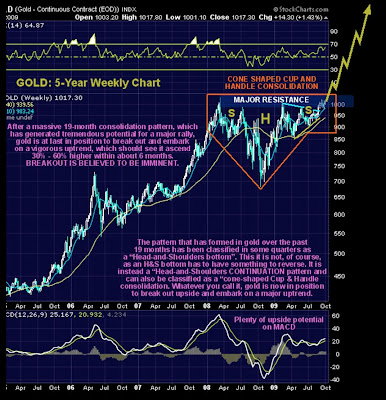
The key point to grasp here is that this rally is going to be BIG. The major consolidation in gold has been going on for about 19 months now, so gold has built up a tremendous amount of energy for its next move. This is the 5th attempt to break above the March 2008 high, the other 4 attempts, after March 2008 itself, occurring in July 2008, February and May of this year, and the attempt now in progress. Thus it should be quite clear that once gold breaks clear above the MAJOR RESISTANCE at this level, it is not going to settle for some pitiful $50 - $100 gain - it is going up at least $300 and very possibly of the order of $500 - $600 and this gain should be achieved in short order over the space of three to six months or so.

(click chart to enlarge)


To conclude, gold is in position to embark on a major uptrend here that is expected to result in it tacking on a 30% - 60% gain in the space of about 6 months.


IndependantUK: In the most profound financial change in recent Middle East history, Gulf Arabs are planning – along with China, Russia, Japan and France – to end dollar dealings for oil, moving instead to a basket of currencies including the Japanese yen and Chinese yuan, the euro, gold and a new, unified currency planned for nations in the Gulf Co-operation Council, including Saudi Arabia, Abu Dhabi, Kuwait and Qatar.

Secret meetings have already been held by finance ministers and central bank governors in Russia, China, Japan and Brazil to work on the scheme, which will mean that oil will no longer be priced in dollars.

The plans, confirmed to The Independent by both Gulf Arab and Chinese banking sources in Hong Kong, may help to explain the sudden rise in gold prices, but it also augurs an extraordinary transition from dollar markets within nine years.

The transitional currency in the move away from dollars, according to Chinese banking sources, may well be gold. An indication of the huge amounts involved can be gained from the wealth of Abu Dhabi, Saudi Arabia, Kuwait and Qatar who together hold an estimated $2.1 trillion in dollar reserves.

“These plans will change the face of international financial transactions,” one Chinese banker said. “America and Britain must be very worried. You will know how worried by the thunder of denials this news will generate.”

Iran announced late last month that its foreign currency reserves would henceforth be held in euros rather than dollars. Bankers remember, of course, what happened to the last Middle East oil producer to sell its oil in euros rather than dollars. A few months after Saddam Hussein trumpeted his decision, the Americans and British invaded Iraq.
I am not one to espouse political action or even grass roots rebellion. We are well past that stage, so don't grab your guns and head for the nearest bank president you can find, but I just want you to know how much money has been stolen from you, your kids and your grandkids in the last year.

The government's supposed bailout was to stimulate the economy by giving banks money to lend. Well guess what... the banks have decided they'd rather keep it for themselves than lend it.
In the United States, the rate of growth of lending plunged to minus 3.8% in August 2009 from a positive figure of 8.6% in August 2008. At the end of July this year, [however], US banks were sitting on $729 billion of cash against $1.9 billion in July last year. http://mises.org/story/3697

Still think your government is looking out for your best interest? You'd better wise up. This money will find its way to the pockets of the "haves" while us "have nots" will end up wondering why the bail out didn't work.

IT WAS NEVER SUPPOSED TO WORK! This is a money grab, pure and simple, and your only retaliation is to buy gold; the one thing that the paper monsters have no defence against.
Here is an interesting quote I came across this weekend. It is by Robert Darryl Schoon and you can read the entire article here.

While often wrong, Bernanke is right about the recession. It’s almost over. But a depression is about to replace it.

________________________

Many have said that gold is a relic of the past. One such "authority" who espoused this rhetoric was Milton Friedman who was championed as an expert in the economics textbooks I studied in college 3 decades ago. Consider the following quote by Schoon and decide for yourself if Friedman was an "authority."

When exchange rates were allowed to float in 1974 as encouraged by Friedman who also encouraged Nixon to abandon the gold standard in 1971, the US had a positive balance of trade. Thirty five years later, the US trade deficit is well over $800 billion and is growing over $20 billion each month (Hey, Milton, how much more time will it take to balance the trade deficit?).
Here's a link to a Bloomberg commentary written by Jonathan Weil about how Atlanta-based Georgian Bank came crashing down last week... and it wasn't even on the FDIC's latest list of "problem" banks either. Ed Steer of Casey Research has said for years, more than 95% of all American financial institutions are technically insolvent right now. The headline of Weil's commentary is entitled "Banks Have Us Flying Blind on Depth of Losses"... link.