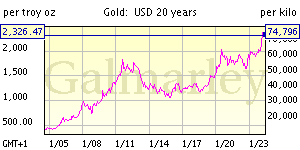
"The whole concept of a stealth deflation is now dawning on many of the smartest investors in the world. It is also dawning on the various central banks of the world. As the truth sinks in, these central banks, in their tortured confusion, are halting their sale of gold for garbage currencies -- and they are rapidly reversing their stands. They are now BUYING gold. China and Russia both openly admit that they want to increase the gold percentage of their reserves. India has just done so in buying 200 metric tons of the gold that was so stupidly offered for sale by the IMF.
As I see it, the trend is in place. The rush to own gold is on. It's starting very slowly and conservatively with gold increasing against fiat currencies by 2% to 5% a week. To many people, gold seems "too high," "too expensive." The poor ignorant fools don't see or understand that fiat currency is being denigrated before our eyes, and it is doomed. The fact is that it's really the currencies created by the central banks that are far too expensive. In fact, the real question is -- five or ten years from now, will fiat currencies be worth anything at all?" Richard Russell - Dow Theory Letters
Russell began publishing Dow Theory Letters in 1958, and he has been writing the Letters ever since (never once having skipped a Letter). Dow Theory Letters is the oldest service continuously written by one person in the business.
Russell gained wide recognition via a series of over 30 Dow Theory and technical articles that he wrote for Barron's during the late-'50s through the '90s. Through Barron's and via word of mouth, he gained a wide following. Russell was the first (in 1960) to recommend gold stocks. He called the top of the 1949-'66 bull market. And almost to the day he called the bottom of the great 1972-'74 bear market, and the beginning of the great bull market which started in December 1974.
The Letters, published every three weeks, cover the US stock market, foreign markets, bonds, precious metals, commodities, economics --plus Russell's widely-followed comments and observations and stock market philosophy.
In 1989 Russell took over Julian Snyder's well-known advisory service, "International Moneyline", a service which Mr. Synder ran from Switzerland. Then, in 1998 Russell took over the Zweig Forecast from famed market analyst, Martin Zweig. Russell has written articles and been quoted in such publications as Bloomberg magazine, Barron's, Time, Newsweek, Money Magazine, the Wall Street Journal, the New York Times, Reuters, and others. Subscribers to Dow Theory Letters number over 12,000, hailing from all 50 states and dozens of overseas counties.
![[Most Recent Quotes from www.kitco.com]](http://www.kitconet.com/images/quotes_7a.gif)
Click to Enlarge
Close Call For US Banks


Legendary Investor Paulson Invests $250 Million In New Gold Fund
Hedge fund manager John Paulson plans to invest as much as $250m of his $6bn personal fortune in a new gold fund he is in the process of establishing.
Mr Paulson, best known for making $3.7bn from bets on the collapse of the US sub-prime mortgage market, is believed to have told investors that the new fund, to be run by Paulson & Co, will invest not just in gold miners but also in other investments related to the precious metal.
Although not Paulson & Co's first foray into gold, given approximately 10pc of the $30bn it has under management is in gold-related investments, it would be the firm's first pure-play gold fund.
No fund-raising cap is thought to have been set at the moment, but Mr Paulson's personal commitment is considerable and is likely to be seen as a highly attractive draw by investors.
Hedge fund investors – known as limited partners in the trade – take a great deal of comfort from managers' – known as general partners – co-investments.
Investors will inevitably question the timing of the new fund, coming at a point when gold is at an all-time high of close to $1,150 an ounce.
However, Mr Paulson is one of the most successful hedge fund managers in the US, and is known for his knack of buying assets at low prices.
Hedge fund manager John Paulson plans to invest as much as $250m of his $6bn personal fortune in a new gold fund he is in the process of establishing.
Mr Paulson, best known for making $3.7bn from bets on the collapse of the US sub-prime mortgage market, is believed to have told investors that the new fund, to be run by Paulson & Co, will invest not just in gold miners but also in other investments related to the precious metal.
Although not Paulson & Co's first foray into gold, given approximately 10pc of the $30bn it has under management is in gold-related investments, it would be the firm's first pure-play gold fund.
No fund-raising cap is thought to have been set at the moment, but Mr Paulson's personal commitment is considerable and is likely to be seen as a highly attractive draw by investors.
Hedge fund investors – known as limited partners in the trade – take a great deal of comfort from managers' – known as general partners – co-investments.
Investors will inevitably question the timing of the new fund, coming at a point when gold is at an all-time high of close to $1,150 an ounce.
However, Mr Paulson is one of the most successful hedge fund managers in the US, and is known for his knack of buying assets at low prices.
Welcome to Stage Two of Gold's Bull Market
Bull markets are marked by three distinct stages, and when gold climbed above $1,000, it only entered its second stage. In other words, gold has much further to climb in the months and years ahead.
So don’t be misled by what you may hear or read in the mainstream media and even much of the alternative media. After all, how many commentators have correctly identified gold’s bull market, now a decade old?
As Robert Blumen cogently argues: “Many of the financial media have a pronounced anti-gold bias. Of the writers and news anchors now calling gold a bubble, not only did they fail to identify the stock market bubble in the 90s or the subsequent housing market boom as a bubble, they actively promoted the excesses of those unsustainable booms, encouraging their viewers or readers to participate. For the most part, these pundits have failed to identify a rising gold price as an investment trend at any point in the past ten years (during which gold had a positive return each and every year).” Robert then goes on to observe the silly incongruity of their warnings about gold: “Witness the irony of the financial media transformed from hypesters who never saw a bubble they couldn’t promote into bubble vigilantes, issuing concerned warnings to ‘get out [of gold], now, before you get hurt.’”
There are different ways to determine relative value, and one of these is gauging market sentiment, which is what a bull market’s three stages communicate. During the first stage of a bull market, the media and most investors alike focus on past issues, rather than future potential. Over the past decade one consequently heard all the reasons not to own the gold.
An old and trusty adage says that bull markets climb a ‘wall of worry’. In gold’s first stage, there seemingly was a lot to worry about. But most of these worries were emotional in nature and not logical. Few paid attention to relative value, which is the proper determining factor when making decisions about your portfolio. Truth be told, I too was worried, but I didn’t let it keep me from accumulating gold and recommending to anyone reading my analyses to do the same.
Gold is now in its second stage, and of course, the worries don’t disappear. They never do because there are always emotional reactions that at first blush offer seemingly plausible reasons for not taking the right action. But there is a notable difference in this stage compared to stage one. Look how many people are writing and talking about gold. Gold has moved from apathy and neglect – stage one characteristics – to growing attention. But importantly, instead of embracing gold and analyzing it to determine relative value, today’s attention is one of widespread disbelief and skepticism that gold can climb higher. These are exactly the responses one should expect to emanate from stage two.
As gold climbs higher, we will eventually enter stage three. The timing of its arrival cannot be predicted, but we will know it has arrived when commentators who have been consistently wrong about gold will be telling everyone willing to listen to buy gold. But at some point in stage three when gold no longer is relatively good value, it is when I will be advising to reduce your gold holding by spending or investing it. We are, however, a long way from there, so my advice for now remains the same as it has been throughout this decade. Continue to accumulate gold. View it as your savings account. Savings are always a good thing, particularly when you are saving sound money.
Bull markets are marked by three distinct stages, and when gold climbed above $1,000, it only entered its second stage. In other words, gold has much further to climb in the months and years ahead.
So don’t be misled by what you may hear or read in the mainstream media and even much of the alternative media. After all, how many commentators have correctly identified gold’s bull market, now a decade old?
As Robert Blumen cogently argues: “Many of the financial media have a pronounced anti-gold bias. Of the writers and news anchors now calling gold a bubble, not only did they fail to identify the stock market bubble in the 90s or the subsequent housing market boom as a bubble, they actively promoted the excesses of those unsustainable booms, encouraging their viewers or readers to participate. For the most part, these pundits have failed to identify a rising gold price as an investment trend at any point in the past ten years (during which gold had a positive return each and every year).” Robert then goes on to observe the silly incongruity of their warnings about gold: “Witness the irony of the financial media transformed from hypesters who never saw a bubble they couldn’t promote into bubble vigilantes, issuing concerned warnings to ‘get out [of gold], now, before you get hurt.’”
There are different ways to determine relative value, and one of these is gauging market sentiment, which is what a bull market’s three stages communicate. During the first stage of a bull market, the media and most investors alike focus on past issues, rather than future potential. Over the past decade one consequently heard all the reasons not to own the gold.
An old and trusty adage says that bull markets climb a ‘wall of worry’. In gold’s first stage, there seemingly was a lot to worry about. But most of these worries were emotional in nature and not logical. Few paid attention to relative value, which is the proper determining factor when making decisions about your portfolio. Truth be told, I too was worried, but I didn’t let it keep me from accumulating gold and recommending to anyone reading my analyses to do the same.
Gold is now in its second stage, and of course, the worries don’t disappear. They never do because there are always emotional reactions that at first blush offer seemingly plausible reasons for not taking the right action. But there is a notable difference in this stage compared to stage one. Look how many people are writing and talking about gold. Gold has moved from apathy and neglect – stage one characteristics – to growing attention. But importantly, instead of embracing gold and analyzing it to determine relative value, today’s attention is one of widespread disbelief and skepticism that gold can climb higher. These are exactly the responses one should expect to emanate from stage two.
As gold climbs higher, we will eventually enter stage three. The timing of its arrival cannot be predicted, but we will know it has arrived when commentators who have been consistently wrong about gold will be telling everyone willing to listen to buy gold. But at some point in stage three when gold no longer is relatively good value, it is when I will be advising to reduce your gold holding by spending or investing it. We are, however, a long way from there, so my advice for now remains the same as it has been throughout this decade. Continue to accumulate gold. View it as your savings account. Savings are always a good thing, particularly when you are saving sound money.
BUY LOCAL!
Remember the Fram Oil Filter commercial that said "you can pay me a little now, or a lot later?" Everytime I think about Walmart and Lowes I am reminded of that commercial.
These two giants have cornered their respective markets with their slash and burn pricing strategies, and here is how they have done it.
First, they sell clothes below cost, forcing local mom and pop retailers out of business. Then, once this objective has been accomplished, they can gradually raise prices since they have no competition.
Then, they enter the lawn/garden equipment business and employ the same strategy. Next comes books, sporting goods, food etc. Of course Lowes has done the same thing with building supplies.
And what is the end result?

Mom and pop businesses across the country have been forced out of business, unable to compete with Walmart's ability to sell at a loss until mom and pop are forced to close. THEN, once the competition is wiped out, these giant retailers will be able to adjust prices upward as they see fit. This takes money OUT of the community and creates higher unemployment.
Personally, I will always go somewhere else and pay a little more for my lumber, lawn equipment, groceries, electronic etc. and keep my money in the community. Why should I pad the pockets of Lowes' and Walmart's stockholders. I'd rather pad the pocket of my neighborhood business that pays taxes in my town, and sends his kids to school with my kids, and shares my Bible Belt values.
I'd rather do business with someone who can SERVICE what they sell, and give me ADVICE on what product would suit my needs best in the long run. Remember, paying a little more now for quality quite often saves money IN THE LONG RUN.
So as you shop this holiday season, consider paying a little more to preserve our way of life. Like the Fram Oil Filter commercial, you may pay a little more in the short run, but I promise you, you will be glad you did in the long run.
Remember the Fram Oil Filter commercial that said "you can pay me a little now, or a lot later?" Everytime I think about Walmart and Lowes I am reminded of that commercial.
These two giants have cornered their respective markets with their slash and burn pricing strategies, and here is how they have done it.
First, they sell clothes below cost, forcing local mom and pop retailers out of business. Then, once this objective has been accomplished, they can gradually raise prices since they have no competition.
Then, they enter the lawn/garden equipment business and employ the same strategy. Next comes books, sporting goods, food etc. Of course Lowes has done the same thing with building supplies.
And what is the end result?

Mom and pop businesses across the country have been forced out of business, unable to compete with Walmart's ability to sell at a loss until mom and pop are forced to close. THEN, once the competition is wiped out, these giant retailers will be able to adjust prices upward as they see fit. This takes money OUT of the community and creates higher unemployment.
Personally, I will always go somewhere else and pay a little more for my lumber, lawn equipment, groceries, electronic etc. and keep my money in the community. Why should I pad the pockets of Lowes' and Walmart's stockholders. I'd rather pad the pocket of my neighborhood business that pays taxes in my town, and sends his kids to school with my kids, and shares my Bible Belt values.
I'd rather do business with someone who can SERVICE what they sell, and give me ADVICE on what product would suit my needs best in the long run. Remember, paying a little more now for quality quite often saves money IN THE LONG RUN.
So as you shop this holiday season, consider paying a little more to preserve our way of life. Like the Fram Oil Filter commercial, you may pay a little more in the short run, but I promise you, you will be glad you did in the long run.
Left to its own devices, gold is the ultimate barometer of public confidence in government. It is also the ultimate means for ordinary citizens to opt-out of an oppressive, fraudulent system.
That is why gangsters who wield power in the name of the “people” always make ownership of gold a crime. So it was in France during the Revolution, in Germany during the Nazi era, in Russia during the Soviet era, in China during Mao’s rule, and in the United States from 1933 through 1974. It is why, even during periods when the ownership of gold is not outlawed, its price is ‘governed’, as one commentator puts it, or officially manipulated, as others of us put it.
It’s often hard for practical men of affairs to understand the vehemence of those of us who assert, seemingly ad nauseam, that gold is money. The truth is, our passion has more to do with the concept of liberty than with that of money. We know from history and experience that once the free market has lost control over the definition and creation of money, individuals have lost their liberty.
Viva la Restoration, Remarks of Robert K. Landis, finews.ch Gold Conference, Zurich, Switzerland, November 17, 2009
That is why gangsters who wield power in the name of the “people” always make ownership of gold a crime. So it was in France during the Revolution, in Germany during the Nazi era, in Russia during the Soviet era, in China during Mao’s rule, and in the United States from 1933 through 1974. It is why, even during periods when the ownership of gold is not outlawed, its price is ‘governed’, as one commentator puts it, or officially manipulated, as others of us put it.
It’s often hard for practical men of affairs to understand the vehemence of those of us who assert, seemingly ad nauseam, that gold is money. The truth is, our passion has more to do with the concept of liberty than with that of money. We know from history and experience that once the free market has lost control over the definition and creation of money, individuals have lost their liberty.
Viva la Restoration, Remarks of Robert K. Landis, finews.ch Gold Conference, Zurich, Switzerland, November 17, 2009
Happy Thanksgiving
by Patrick Heller
This week at Thanksgiving I will include owning gold and silver as one of my blessings. After I bought both metals in the 1970s, it then enabled me to purchase a home in 1980 for a much lower cost than if I had not owned them.
In more recent years, owning precious metals has helped me survive some of the ravages of the falling values of paper assets like stocks and bonds and the U.S. dollar.
As I reflected on the blessing of owning gold and silver, it occurred to me that it has also better enabled me to protect and care for my children.
by Twelve years ago, the financial calamities in the Far East were so devastating in Indonesia that those who did not own gold were wiped out financially. Those who owned gold saw little impact on their standard of living.
There are hundreds of thousands of Southeast Asian refugees in the United States today who survived because they owned gold to get them away from the governments that killed so many of their compatriots. Owning gold definitely helped them provide a better life for their children.
After all the economic trials and tribulations of the past 30 months, it is not too difficult to imagine a world where U.S. dollars finally fall to the intrinsic value of the paper and ink used to produce them. In such a circumstance, all the dollars in your wallet, your bank accounts, your credit and debit card limits, and the like could become useless in providing for your children.
by Patrick Heller
This week at Thanksgiving I will include owning gold and silver as one of my blessings. After I bought both metals in the 1970s, it then enabled me to purchase a home in 1980 for a much lower cost than if I had not owned them.
In more recent years, owning precious metals has helped me survive some of the ravages of the falling values of paper assets like stocks and bonds and the U.S. dollar.
As I reflected on the blessing of owning gold and silver, it occurred to me that it has also better enabled me to protect and care for my children.
by Twelve years ago, the financial calamities in the Far East were so devastating in Indonesia that those who did not own gold were wiped out financially. Those who owned gold saw little impact on their standard of living.
There are hundreds of thousands of Southeast Asian refugees in the United States today who survived because they owned gold to get them away from the governments that killed so many of their compatriots. Owning gold definitely helped them provide a better life for their children.
After all the economic trials and tribulations of the past 30 months, it is not too difficult to imagine a world where U.S. dollars finally fall to the intrinsic value of the paper and ink used to produce them. In such a circumstance, all the dollars in your wallet, your bank accounts, your credit and debit card limits, and the like could become useless in providing for your children.


He sees an eery similarity between the decision of India’s central bank to buy half the IMF’s entire sale of gold, and the move by France’s central bank to start converting dollars into gold in 1965 — which was, of course, the start of the slippery slope leading to the collapse of Bretton Woods and the closure of the US gold window under Nixon.
In the gold mania that followed, the price rose to levels that matched the US dollar monetary base (it reached 140pc at the peak). If that were to occur today after Ben Bernanke’s go at the printing press, gold would have to reach $6,300 an ounce. The US owns 263m ounces of gold while the Fed’s monetary base is $1.7 trillion. Simple equation. Source
In the gold mania that followed, the price rose to levels that matched the US dollar monetary base (it reached 140pc at the peak). If that were to occur today after Ben Bernanke’s go at the printing press, gold would have to reach $6,300 an ounce. The US owns 263m ounces of gold while the Fed’s monetary base is $1.7 trillion. Simple equation. Source
Looking at the monthly chart as far back as 2004, we see that gold has formed the same patterns repeatedly. This has created a stair step pattern and allows us to calculate measured moves and a time frame for this to take place.
Click chart to enlarge

As we can see gold has broken its 2008 high and is starting another rally which we have seen several times before. I figure we could see gold rally for another 3-5 months and possibly reach the $1500 -$1600 level before forming a multi- month or year consolidation. Source
Click chart to enlarge

As we can see gold has broken its 2008 high and is starting another rally which we have seen several times before. I figure we could see gold rally for another 3-5 months and possibly reach the $1500 -$1600 level before forming a multi- month or year consolidation. Source
Prices go up when demand increases. This is what has recently driven the price of gold to new heights, and there doesn't appear to be any signs that that demand will do anything but grow for years to come. Consider the following.
The up trend for the precious metals has accelerated recently with a spat of supportive news. In September 2009, the gold bugs were buzzing with the news that China was pushing their citizens to invest in precious metals as detailed here. Then on November 4th, 2009, the Indian central bank reveals a surprise purchase of 250 metric tons of Gold bullion from the International Monetary Fund as related here. Finally on November 12, 2009 in Vietnam, which had restricted imports of Gold in mid 2008, the local price had climbed to a $60 premium from the global spot price, before the government relented. All these events are indicators that the marketplace fervour for Gold is hot and getting hotter. It is interesting that these events are all happening on the Asian side of the world ...... Source
Not only is demand rising, but supply is seeing changes as well. Consider the following chart showing declining mine production.

There is not enough new supply to keep up with the increasing demand.
The up trend for the precious metals has accelerated recently with a spat of supportive news. In September 2009, the gold bugs were buzzing with the news that China was pushing their citizens to invest in precious metals as detailed here. Then on November 4th, 2009, the Indian central bank reveals a surprise purchase of 250 metric tons of Gold bullion from the International Monetary Fund as related here. Finally on November 12, 2009 in Vietnam, which had restricted imports of Gold in mid 2008, the local price had climbed to a $60 premium from the global spot price, before the government relented. All these events are indicators that the marketplace fervour for Gold is hot and getting hotter. It is interesting that these events are all happening on the Asian side of the world ...... Source
Not only is demand rising, but supply is seeing changes as well. Consider the following chart showing declining mine production.

There is not enough new supply to keep up with the increasing demand.
This from Ed Steer's Daily Commentary
As I noted yesterday... and as Dennis Gartman mentioned as well... there's a huge pile of December gold call options at the $1,200 strike price. The CME preliminary report for Wednesday's trading shows that there are still 28,157 call options at that price... down 1,696 from what was reported on Tuesday. But there are also 9,187 call options at $1,300... 12,319 at $1,400 and a huge 15,658 at $1,500... plus 2,892 at $1,700... 9,696 at $2,000... and 5,189 gold call options at $2,500. These are big numbers! Either somebody knows something... or there are a lot of traders out there that want to throw their money away, regardless of the price of the option when they bought it.
As I noted yesterday... and as Dennis Gartman mentioned as well... there's a huge pile of December gold call options at the $1,200 strike price. The CME preliminary report for Wednesday's trading shows that there are still 28,157 call options at that price... down 1,696 from what was reported on Tuesday. But there are also 9,187 call options at $1,300... 12,319 at $1,400 and a huge 15,658 at $1,500... plus 2,892 at $1,700... 9,696 at $2,000... and 5,189 gold call options at $2,500. These are big numbers! Either somebody knows something... or there are a lot of traders out there that want to throw their money away, regardless of the price of the option when they bought it.
If you have followed the gold or silver markets for any period of time, you already know that they are manipulated by western governments that try to hold prices artificially low. This has gone on for some time now, but I found the following comments from commentator Jeff Nielson to be a good reminder of just how close we could be to the breakout from this period of history.
Yes, markets can remain irrational for a long time (especially manipulated markets). However, they don't remain “irrational” forever. And the longer that price-fixing keeps silver at an artificial price – far below its real value – the more rapidly that silver will be over-consumed. It is this simple reality that guarantees to investors that the longer they have to wait before silver begins its real “bull market” the more radically we can expect the price to spike, once price-fixing fails (as it has on every occasion, throughout history).
As for when this takes place, with both gold and silver having quadrupled in price this decade, it is obvious that this price-fixing is already failing and on the verge of collapse. This is the expected consequence of the Manipulators running out of both gold and silver to short/dump onto the market. Given these parameters, I am firmly convinced that this wait will be both relatively short, and extremely lucrative for those with the vision to take advantage of this opportunity.
Yes, markets can remain irrational for a long time (especially manipulated markets). However, they don't remain “irrational” forever. And the longer that price-fixing keeps silver at an artificial price – far below its real value – the more rapidly that silver will be over-consumed. It is this simple reality that guarantees to investors that the longer they have to wait before silver begins its real “bull market” the more radically we can expect the price to spike, once price-fixing fails (as it has on every occasion, throughout history).
As for when this takes place, with both gold and silver having quadrupled in price this decade, it is obvious that this price-fixing is already failing and on the verge of collapse. This is the expected consequence of the Manipulators running out of both gold and silver to short/dump onto the market. Given these parameters, I am firmly convinced that this wait will be both relatively short, and extremely lucrative for those with the vision to take advantage of this opportunity.
I am often asked by prospective investors whether I recommend silver or gold as the best investment now. My answer is always that gold is the best protection against economic uncertainty, and, as such, that is what I recommend buying. However, if one wants to buy gold or silver strictly for investment "performance," there are lots of factors that suggest silver has more upside potential than gold at present. One such factor is brought out in the excerpt below.
As a reminder to those who are new to the silver market, in the Earth's crust, there is roughly 17 times as much silver as gold. Through nearly 5,000 years of history, the silver/gold price ratio has averaged 15:1. Today, despite estimates that as much as 90% of global silver stockpiles have been consumed, the ratio sits at greater than 60:1. A 15:1 ratio today implies a price of silver of over $70/oz.
Source
As a reminder to those who are new to the silver market, in the Earth's crust, there is roughly 17 times as much silver as gold. Through nearly 5,000 years of history, the silver/gold price ratio has averaged 15:1. Today, despite estimates that as much as 90% of global silver stockpiles have been consumed, the ratio sits at greater than 60:1. A 15:1 ratio today implies a price of silver of over $70/oz.
Source
Be A Good American
The framers of our Constitution specifically forbid any currency that was not issued by the US Government. Today we have an organization that prints and controls our currency known as the Federal Reserve that is a PRIVATE CORPORATION. It is owned by its member banks, which are in turned owned by the world's private banking families.
Prior to the creation of the Federal Reserve, our dollars were obligations of our government, and there was gold backing these obligations. A $10 gold coin was worth the same as a $10 bill, known as a Gold Note. People were willing to accept the paper money just as readily as the gold, because they knew that there was gold backing the money.
How did they know? Because the money/note told them so, and that "note" was a legally binding contract.

With the creation of the Federal Reserve, all paper currency was reissued, NOT as an obligation of the US Government, but as a LOAN/NOTE of the Federal Reserve.

Notice that there is no mention of any backing of the above note. And because it is backed by nothing, as many of them can be printed as the Federal Reserve desires.
This enables the Federal Reserve to loan money to the US Government so that the budget deficit can be funded. Where do they get the money to loan the US Government? They print it!
The above is an oversimplification of the mess we AMERICANS find ourselves in. We are held hostage by a cartel of INTERNATIONAL banksters to whom we owe more than we can ever repay.
They have stripped Americans of their economic freedom and have enslaved us with their printing presses.
HOW DO WE FIGHT BACK?
As long as WE THE PEOPLE continue to take paper dollars in exchange for goods and services, then the Fed will continue to print them. BUT, if Americans wise up and quit storing their wealth in paper, and begin storing their wealth in gold (which cannot be printed out of thin air by the bankers), then the paper house of cards will fall.
If you want to restore America to the America we grew up in, if you want to restore America to the economic powerhouse that it should be, if you want to take back control of our government from politicians that are bought and paid for by bankers who can create money out of thin air, THEN WE NEED TO KILL THE DOLLAR AND BUY GOLD.
Voting Democrat or Republican will do no good. Tax protests will do no good. Armed revolt will do no good. We must fight fire with fire. America's problem is a monetary problem, and requires a monetary cure. When enough of us begin to refuse dollars and only accept gold as a store of wealth, THEN, AND ONLY THEN, will we be able to rescue America from the globalist banking impostors posing as Americans that now hold it captive.
Should you buy gold? I say, it is your duty as a patriot to buy gold.
Prior to the creation of the Federal Reserve, our dollars were obligations of our government, and there was gold backing these obligations. A $10 gold coin was worth the same as a $10 bill, known as a Gold Note. People were willing to accept the paper money just as readily as the gold, because they knew that there was gold backing the money.
How did they know? Because the money/note told them so, and that "note" was a legally binding contract.
With the creation of the Federal Reserve, all paper currency was reissued, NOT as an obligation of the US Government, but as a LOAN/NOTE of the Federal Reserve.
Notice that there is no mention of any backing of the above note. And because it is backed by nothing, as many of them can be printed as the Federal Reserve desires.
This enables the Federal Reserve to loan money to the US Government so that the budget deficit can be funded. Where do they get the money to loan the US Government? They print it!
The above is an oversimplification of the mess we AMERICANS find ourselves in. We are held hostage by a cartel of INTERNATIONAL banksters to whom we owe more than we can ever repay.
They have stripped Americans of their economic freedom and have enslaved us with their printing presses.
HOW DO WE FIGHT BACK?
As long as WE THE PEOPLE continue to take paper dollars in exchange for goods and services, then the Fed will continue to print them. BUT, if Americans wise up and quit storing their wealth in paper, and begin storing their wealth in gold (which cannot be printed out of thin air by the bankers), then the paper house of cards will fall.
If you want to restore America to the America we grew up in, if you want to restore America to the economic powerhouse that it should be, if you want to take back control of our government from politicians that are bought and paid for by bankers who can create money out of thin air, THEN WE NEED TO KILL THE DOLLAR AND BUY GOLD.
Voting Democrat or Republican will do no good. Tax protests will do no good. Armed revolt will do no good. We must fight fire with fire. America's problem is a monetary problem, and requires a monetary cure. When enough of us begin to refuse dollars and only accept gold as a store of wealth, THEN, AND ONLY THEN, will we be able to rescue America from the globalist banking impostors posing as Americans that now hold it captive.
Should you buy gold? I say, it is your duty as a patriot to buy gold.
Reuters has reported that Vietnam has lifted its ban on gold imports. This move to try to stabilize their failing currency is just another in a long list of countries that will be forced to purchase gold for the same reasons, and in the process, forcing the price of gold ever higher.
For an investment to go up in price, and the investor make money, there has to be increasing demand for that investment. But demand itself is not at the root of understanding gold. To understand gold, and why it goes up and down in price, you must understand what CAUSES that demand to rise and fall. The following is from a blog called Gold vs. Paper.
There is too much confusion regarding Gold and its role in society. This confusion, of course, is not by accident in a paper currency regime. The deflation versus inflation debate, it seems to me, has become the democrat versus republican debate in my opinion. In other words, it is a distraction and unimportant to serious Gold investors. Those who thought a democrat (i.e. Obama) would fix our country's structural problems and stop the senseless warfare against innocent third world nations hopefully now understand and will learn from their naive mistake.
We are in the "confidence versus no confidence" cycle and let's just say that confidence in Wall street and government isn't exactly waxing right now. The Dow to Gold ratio, in my opinion, is a more reasonable proxy for the current secular cycle than the inflation versus deflation debate. The Dow to Gold ratio is a measure of confidence in "the system." Gold is a proxy vote of "no confidence" in the system while the Dow Jones Industrial Average is a proxy for a "confidence" vote in the system.
The simple truth is raw and not so pretty: Gold is a good investment when people lose trust in their society and its power structure. Think of the shift in trust over the past few years when it comes to bankers, Wall Street, the federal reserve (not federal, but rather a for-profit corporation given a no-bid contract to counterfeit money), and the federal government.
Gold is a bet that the "powers that be" are going to screw things up even worse than they already have/they already are. Does that really sound like a high risk bet to you? If it does, go back to watching CNBC and see what Cramer has to say.
Once you understand these things, do you really want to keep your savings in a crappy 401(k) where you get to choose between "blue chip growth," "aggressive growth," or "lifestyle 2020"?
For an investment to go up in price, and the investor make money, there has to be increasing demand for that investment. But demand itself is not at the root of understanding gold. To understand gold, and why it goes up and down in price, you must understand what CAUSES that demand to rise and fall. The following is from a blog called Gold vs. Paper.
There is too much confusion regarding Gold and its role in society. This confusion, of course, is not by accident in a paper currency regime. The deflation versus inflation debate, it seems to me, has become the democrat versus republican debate in my opinion. In other words, it is a distraction and unimportant to serious Gold investors. Those who thought a democrat (i.e. Obama) would fix our country's structural problems and stop the senseless warfare against innocent third world nations hopefully now understand and will learn from their naive mistake.
We are in the "confidence versus no confidence" cycle and let's just say that confidence in Wall street and government isn't exactly waxing right now. The Dow to Gold ratio, in my opinion, is a more reasonable proxy for the current secular cycle than the inflation versus deflation debate. The Dow to Gold ratio is a measure of confidence in "the system." Gold is a proxy vote of "no confidence" in the system while the Dow Jones Industrial Average is a proxy for a "confidence" vote in the system.
The simple truth is raw and not so pretty: Gold is a good investment when people lose trust in their society and its power structure. Think of the shift in trust over the past few years when it comes to bankers, Wall Street, the federal reserve (not federal, but rather a for-profit corporation given a no-bid contract to counterfeit money), and the federal government.
Gold is a bet that the "powers that be" are going to screw things up even worse than they already have/they already are. Does that really sound like a high risk bet to you? If it does, go back to watching CNBC and see what Cramer has to say.
Once you understand these things, do you really want to keep your savings in a crappy 401(k) where you get to choose between "blue chip growth," "aggressive growth," or "lifestyle 2020"?
Below are the 23 reasons you buy gold now, as summed up by Roger Wiegand.
1. Bond markets are overbought.
2. Junk bonds and municipal bonds are going very scary.
3. Japan’s bond pile is so enormous it simply cannot go on much longer.
4. Since U.S. bond markets are 70 times larger than the shares, when this baby pops it could be financial Armageddon.
5. Equities have gained nothing for a decade. They gave it all back.
6. Gold has tripled in less than ten years and is rising even faster.
7. Consumer confidence is at new lows.
8. Real estate foreclosures were reported up 18% this morning. It’s getting worse.
9. Billionaire Wilbur Ross posted an extreme warning on commercial real estate. We said the same thing many months ago. Insurance companies holding this paper are going down, too.
10. Moody’s is going to report stuff ever faster; each month instead of intermittently. They do not intend to take more extreme criticisms on all of these bank and corporate failures.
11. The stimulus in the U.S. has stopped having any effects. Now the political manipulation idiots want another one. More paper printing and dilution with inflation and hyper-inflation results.
12. One of the last remaining sources of investment bank income, trading, is being capped by a federal dolt restricting pay. The good traders are going overseas. Adios bank income. All they need is Glass-Stegal and reasonable SEC enforcement. They won’t do it.
13. China has five big bubbles in progress. Watch for them to pop individually or collectively-credit, shares, housing, banks and real estate.
14. Financial stocks are headed south again after the bear market dead cat bounce and free taxpayer cash.
15. Bank credit is as scarce as hen’s teeth. These guys are working the spread on free government cash and not lending. New loans are pure fiction.
16. Borrowers qualified to borrow are cutting back credit lines and hunkering down with cash. Smart ones are shunning debt for liquidity. They know what’s coming.
17. GE is having a fire sale to off-load as many divisions and assets as possible to raise cash. Being a big bank (not in name but as GE Capital) they are in deep you know what. We think they could potentially fail and we give it one out of three. That would really dump ALL the markets.
18. CIT, the premier lender for medium and small businesses went bankrupt. Yes, they will reorganize but with what tiny previous percentage of loans being originated? Small business is credit dry as CIT funded receivables.
19. Dollars are oversold and will bounce a little. For the longer pull they get cut in half again.
20. The Canadian Dollar is rising on commodities and a government with a much better balance sheet. For the shorter term it could correct mildly but then should rise in value beyond the US dollar. Canada is best situated to weather the storm in our view.
21. The Swiss Franc is another fiat currency. However, it is sounder than the others and is still perceived as being a “safe and secure currency”…a place to park some cash for a rainy day.
22. The Euro is overbought and should be selling back to some place lower. Recently it’s been an inverse dollar trade in rallies.
23. Barter has begun in earnest with crude oil. Producers are finally skipping the interim paper cash or bond route as currency. China can buy oil with trade goods and so can others. Look for barter to spread rapidly.
IN SUMMARY
- Since USA consumers are 70% of the American economy and this economy is the world’s fiscal driver with our failing dollar covering 80% of the world’s reserves; think about this nasty combo.
- U.S. consumers are saving not spending.
- Consumers are unemployed to the tune of 20% in USA. It’s going to 30-35%.
- Since credit is terribly expensive (29.99% on credit cards) and not available for the most part, the American economy is stalled and frozen.
- Stocks are flat to down and have earned nothing for a decade.
- Where is the engine of growth? Who has credit? Who has money to spend?
- U.S. Dollars are sliding in value as shares are peaking and selling-off.
- We are toast and the worse hits in 2010-2012; then comes World War III.
1. Bond markets are overbought.
2. Junk bonds and municipal bonds are going very scary.
3. Japan’s bond pile is so enormous it simply cannot go on much longer.
4. Since U.S. bond markets are 70 times larger than the shares, when this baby pops it could be financial Armageddon.
5. Equities have gained nothing for a decade. They gave it all back.
6. Gold has tripled in less than ten years and is rising even faster.
7. Consumer confidence is at new lows.
8. Real estate foreclosures were reported up 18% this morning. It’s getting worse.
9. Billionaire Wilbur Ross posted an extreme warning on commercial real estate. We said the same thing many months ago. Insurance companies holding this paper are going down, too.
10. Moody’s is going to report stuff ever faster; each month instead of intermittently. They do not intend to take more extreme criticisms on all of these bank and corporate failures.
11. The stimulus in the U.S. has stopped having any effects. Now the political manipulation idiots want another one. More paper printing and dilution with inflation and hyper-inflation results.
12. One of the last remaining sources of investment bank income, trading, is being capped by a federal dolt restricting pay. The good traders are going overseas. Adios bank income. All they need is Glass-Stegal and reasonable SEC enforcement. They won’t do it.
13. China has five big bubbles in progress. Watch for them to pop individually or collectively-credit, shares, housing, banks and real estate.
14. Financial stocks are headed south again after the bear market dead cat bounce and free taxpayer cash.
15. Bank credit is as scarce as hen’s teeth. These guys are working the spread on free government cash and not lending. New loans are pure fiction.
16. Borrowers qualified to borrow are cutting back credit lines and hunkering down with cash. Smart ones are shunning debt for liquidity. They know what’s coming.
17. GE is having a fire sale to off-load as many divisions and assets as possible to raise cash. Being a big bank (not in name but as GE Capital) they are in deep you know what. We think they could potentially fail and we give it one out of three. That would really dump ALL the markets.
18. CIT, the premier lender for medium and small businesses went bankrupt. Yes, they will reorganize but with what tiny previous percentage of loans being originated? Small business is credit dry as CIT funded receivables.
19. Dollars are oversold and will bounce a little. For the longer pull they get cut in half again.
20. The Canadian Dollar is rising on commodities and a government with a much better balance sheet. For the shorter term it could correct mildly but then should rise in value beyond the US dollar. Canada is best situated to weather the storm in our view.
21. The Swiss Franc is another fiat currency. However, it is sounder than the others and is still perceived as being a “safe and secure currency”…a place to park some cash for a rainy day.
22. The Euro is overbought and should be selling back to some place lower. Recently it’s been an inverse dollar trade in rallies.
23. Barter has begun in earnest with crude oil. Producers are finally skipping the interim paper cash or bond route as currency. China can buy oil with trade goods and so can others. Look for barter to spread rapidly.
IN SUMMARY
- Since USA consumers are 70% of the American economy and this economy is the world’s fiscal driver with our failing dollar covering 80% of the world’s reserves; think about this nasty combo.
- U.S. consumers are saving not spending.
- Consumers are unemployed to the tune of 20% in USA. It’s going to 30-35%.
- Since credit is terribly expensive (29.99% on credit cards) and not available for the most part, the American economy is stalled and frozen.
- Stocks are flat to down and have earned nothing for a decade.
- Where is the engine of growth? Who has credit? Who has money to spend?
- U.S. Dollars are sliding in value as shares are peaking and selling-off.
- We are toast and the worse hits in 2010-2012; then comes World War III.
Time, history and markets move through cycles. This current bull market in gold has moved through textbook market cycles as well. Notice on the following chart that each upleg is followed by a period of consolidation.

It appears that over the last few weeks we have entered another upleg which, odds are, should take us to somewhere between $1300 and $1500/ounce.
For an excellent detailed analysis of this chart click here.

It appears that over the last few weeks we have entered another upleg which, odds are, should take us to somewhere between $1300 and $1500/ounce.
For an excellent detailed analysis of this chart click here.

Some interesting comments I've read over the weekend:
It’s significant that, on an inflation-adjusted basis, all of the natural resources except gold and silver have surpassed their previous all-time highs. Gold is only approaching the halfway mark to $2,300 an ounce, which would be its 1980 high when adjusted for inflation.
********************************
And with this purchase from the IMF, India has gone from being a price taker as a jewelry consumer to being a price maker as an investor. This is the sort of change in government policy that we watch for in shaping and maintaining our investment models. It is significant that India, the second largest country in the world by population and the largest gold jewelry consumer, may have created a new floor for gold at $1,000 per ounce.
The presence of a big bullish buyer tends to create a big bullish buzz for gold. We’re seeing it now – gold on Friday surpassing $1,100 an ounce – and history suggests it may last a while.
Around this time in 2005, for example, Russia announced that it was doubling its gold holdings from 5 percent to 10 percent of its reserves. At that time, gold was selling for about $490 an ounce. A year later, the price was up 30 percent.
********************************
Here is an interesting chart. We have more gold than anybody else, but as the rest of the world tries to catch up, the increasing demand will continue to force the price higher.

*******************************
Our wise guy and absolutely marvelous U.S. Treasury Secretary Timmy The G. told us this morning the economy needs more time to rebound. No Kidding. The last time we went through this mess it lasted from 1929 to 1954 for the stock market recovery. This time it’s infinitely worse times ten. We might all die of old age before the next recovery in mainstream shares. The stocks today (excluding precious metals and a few others) are just where they were in the year 2000. Consequently those holding from there to here had a wonderful exercise in brain damage and futility. So much for buy and hold forever.
*******************************
Lord Christopher Moncton of Britain's House of Lords shares his insights into the upcoming December climate change conference in Copenhagen.
A 3 point summary for Moncton's short (4 minutes) but serious statement is:
1) A World Government will be a reality sooner rather than later.
2) Enormous wealth will be transferred from the developed world
to the developing as "carbon indebtedness".
3) There will be no-nonsense law enforcement for new less-than-
democratic global edicts.
THIS is one of the main reasons that gold is rallying. Those in-the-know are buying quickly and largely in anticipation of the day when our regional currencies will not be worth the paper they are printed on.
My gold dealer in NY tells me that almost every week he has senior executives from Goldman Sachs placing 6 and 7 figure orders with him and they are having it shipped OUT OF THE COUNTRY!
Anyway, nothing may happen in this conference, but I have never known the New World Order crowd to let a good crisis go to waste.
A 3 point summary for Moncton's short (4 minutes) but serious statement is:
1) A World Government will be a reality sooner rather than later.
2) Enormous wealth will be transferred from the developed world
to the developing as "carbon indebtedness".
3) There will be no-nonsense law enforcement for new less-than-
democratic global edicts.
THIS is one of the main reasons that gold is rallying. Those in-the-know are buying quickly and largely in anticipation of the day when our regional currencies will not be worth the paper they are printed on.
My gold dealer in NY tells me that almost every week he has senior executives from Goldman Sachs placing 6 and 7 figure orders with him and they are having it shipped OUT OF THE COUNTRY!
Anyway, nothing may happen in this conference, but I have never known the New World Order crowd to let a good crisis go to waste.
Courtesy of Nick Laird of sharelynx.com in Australia:
The value of all the in-the-money call options, a huge position at $1,000 [over 15,000 Comex contracts] stands out like a sore thumb. If the bullion banks want to blast these guys out, so their options expire worthless, they're going to have to get the gold price below $1,000 by November 23rd... which is Comex options expiry. The 50-day moving average won't do anymore... as it's at $1,028 already... and to really do some real damage, da boyz would have to blast the price well below its 200-day moving average, which is $955 at this writing. Can they... or will they? Don't know. Both Ted Butler and I are waiting to see if they can pull this off. If they can, they're certainly leaving it to the last minute... which they've done before.
Translation: Gold is the enemy of the banksters being able to print money out of thin air. They MUST keep the price of gold down, or else the party is over. To keep the price down, they sell short contracts on the commodities exchanges. This forces the price down in the short run, BUT, if the price at the expiry date of the option is above the contract price, then the seller of the short contract (the bullion banks, unaffectionately known as "da boyz") has to deliver the gold if the buyer demands delivery. This is a huge risk to the bullion banks, BECAUSE THEY DON'T OWN THE GOLD THAT THEY HAVE CONTRACTED TO DELIVER.
Because of this, prior to the expiry date of November 23, da boyz may try to force the price of gold down to around $1000 to get themselves off of the hook.
BOTTOM LINE: Gold might take a big drop in the next few weeks, but if it does, the rebound should be just as dramatic. So hold on.
The value of all the in-the-money call options, a huge position at $1,000 [over 15,000 Comex contracts] stands out like a sore thumb. If the bullion banks want to blast these guys out, so their options expire worthless, they're going to have to get the gold price below $1,000 by November 23rd... which is Comex options expiry. The 50-day moving average won't do anymore... as it's at $1,028 already... and to really do some real damage, da boyz would have to blast the price well below its 200-day moving average, which is $955 at this writing. Can they... or will they? Don't know. Both Ted Butler and I are waiting to see if they can pull this off. If they can, they're certainly leaving it to the last minute... which they've done before.
Translation: Gold is the enemy of the banksters being able to print money out of thin air. They MUST keep the price of gold down, or else the party is over. To keep the price down, they sell short contracts on the commodities exchanges. This forces the price down in the short run, BUT, if the price at the expiry date of the option is above the contract price, then the seller of the short contract (the bullion banks, unaffectionately known as "da boyz") has to deliver the gold if the buyer demands delivery. This is a huge risk to the bullion banks, BECAUSE THEY DON'T OWN THE GOLD THAT THEY HAVE CONTRACTED TO DELIVER.
Because of this, prior to the expiry date of November 23, da boyz may try to force the price of gold down to around $1000 to get themselves off of the hook.
BOTTOM LINE: Gold might take a big drop in the next few weeks, but if it does, the rebound should be just as dramatic. So hold on.
Friday, the Fed's released the 'official' unemployment rate, which hit a new high of 10.2%. The 'real' unemployment rate, when all the fluff is taken out, shows 17.5%. Normally an unemployment report as negative as that would have left a great smoking hole where the Dow-Jones Industrial Average used to be, but in these days of managed markets, no one should be surprised that the Dow finished in positive territory... if only by a hair.
Ed Steer's Gold & Silver Daily
FDIC Closes 5 More Banks - Bank stock no longer the investment of widows and orphans.
Ed Steer's Gold & Silver Daily
FDIC Closes 5 More Banks - Bank stock no longer the investment of widows and orphans.
The Paulson Barometer
The John Paulson Barometer is not a classical indicator, but I’ll go along with the world’s best speculator (up 590% in 2007 and 40% last year). Paulson expects a huge commodity inflation down the pike (below) and I wouldn’t wager against him. Here’s a report on Paulson from Porter Stansberry, whose stunning prediction of the collapse of Fannie Mae and Freddie Mac was featured in Rick’s Picks well ahead of the event. “World’s richest and most successful speculator warns of great inflation,” is how Porter headlined the feature:
“At a recent breakfast, John Paulson, the most successful speculator of the last 20 years, explained exactly how the great inflation will come to pass. Says Paulson: The banks will resume regular lending – thereby releasing all of the excess money supply into the system – within six to 24 months. Two or three years after that, we will see 12% annual inflation.
“Paulson is recommending investing in gold. He’s already placed more than $4 billion of his firm’s assets in the metal. Why is Paulson building his position so early if he doesn’t expect inflation to kick in for four years? In a word: Scarcity. Paulson notes, of the $200 trillion of investable assets in the world, only $800 billion is gold. You won’t be able to get much of that $200 trillion into gold at any reasonable price. But that won’t stop people from trying.
The John Paulson Barometer is not a classical indicator, but I’ll go along with the world’s best speculator (up 590% in 2007 and 40% last year). Paulson expects a huge commodity inflation down the pike (below) and I wouldn’t wager against him. Here’s a report on Paulson from Porter Stansberry, whose stunning prediction of the collapse of Fannie Mae and Freddie Mac was featured in Rick’s Picks well ahead of the event. “World’s richest and most successful speculator warns of great inflation,” is how Porter headlined the feature:
“At a recent breakfast, John Paulson, the most successful speculator of the last 20 years, explained exactly how the great inflation will come to pass. Says Paulson: The banks will resume regular lending – thereby releasing all of the excess money supply into the system – within six to 24 months. Two or three years after that, we will see 12% annual inflation.
“Paulson is recommending investing in gold. He’s already placed more than $4 billion of his firm’s assets in the metal. Why is Paulson building his position so early if he doesn’t expect inflation to kick in for four years? In a word: Scarcity. Paulson notes, of the $200 trillion of investable assets in the world, only $800 billion is gold. You won’t be able to get much of that $200 trillion into gold at any reasonable price. But that won’t stop people from trying.
This from the NY Times....
In addition to high anxiety about the future, recent political trends may also be playing a part in the global gold fever. With a crackdown on tax havens worldwide and Swiss bankers handing over the names of wealthy American clients to authorities, some experts say rich people now prefer an investment that can easily be hidden from the prying eyes of tax collectors.
“In Europe, people want physical gold to store themselves, with no documents,” said Bernhard Schnellmann, director for precious-metal services at Argor-Heraeus. Often, the company doesn’t know the ultimate destination of the bars it makes, only the identity of the bank in Zurich or London that is handling the order.
Link here
In addition to high anxiety about the future, recent political trends may also be playing a part in the global gold fever. With a crackdown on tax havens worldwide and Swiss bankers handing over the names of wealthy American clients to authorities, some experts say rich people now prefer an investment that can easily be hidden from the prying eyes of tax collectors.
“In Europe, people want physical gold to store themselves, with no documents,” said Bernhard Schnellmann, director for precious-metal services at Argor-Heraeus. Often, the company doesn’t know the ultimate destination of the bars it makes, only the identity of the bank in Zurich or London that is handling the order.
Link here
DO NOT KEEP YOUR GOLD IN A SAFETY DEPOSIT BOX!
ABCNEWS - “Not-So-Safe-Deposit Boxes: States Seize Citizens' Property to Balance Their Budgets”
“The 50 U.S. states are holding more than $32 billion worth of unclaimed property that they're supposed to safeguard for their citizens. But a "Good Morning America" investigation found some states aggressively seize property that isn't really unclaimed and then use the money -- your money -- to balance their budgets.” “Not-So-Safe-Deposit Boxes San Francisco resident Carla Ruff's safe-deposit box was drilled, seized, and turned over to the state of California, marked "owner unknown." "I was appalled," Ruff said. "I felt violated."
“Unknown? Carla's name was right on documents in the box at the Noe Valley Bank of America location. So was her address -- a house about six blocks from the bank. Carla had a checking account at the bank, too -- still does -- and receives regular statements. Plus, she has receipts showing she's the kind of person who paid her box rental fee. And yet, she says nobody ever notified her. " “They are zealously uncovering accounts that are not unclaimed," Ruff said. To make matters worse, Ruff discovered the loss when she went to her box to retrieve important paperwork she needed because her husband was dying. Those papers had been shredded.”
“And that's not all. Her great-grandmother's precious natural pearls and other jewelry had been auctioned off. They were sold for just $1,800, even though they were appraised for $82,500. "These things were things that she gave to me," Ruff said. "I valued them because I loved her." “Bank of America told ABC News it deeply regrets the situation…” “…Ruff is not alone. Attorney Bill Palmer represents her and countless other citizens in a class action lawsuit against the state of California. "They figured the safety-deposit box was safer than keeping it under the mattress," Palmer said. "In the case of a lot of citizens, they were wrong, weren't they?"
“California law used to say property was unclaimed if the rightful owner had had no contact with the business for 15 years. But during various state budget crises, the waiting period was reduced to seven years, and then five, and then three. Legislators even tried for one year. Why? Because the state wanted to use that free money.”
"That's absolutely correct," said California State Controller John Chiang, who inherited the situation when he came into office. "What we've done here over the last two decades has been dead wrong. We've kept the property and not provided owners with the opportunities -- the best opportunities -- to get their property back."
“Chiang now faces the daunting task of returning $5.1 billion worth of unclaimed property to people. Some states keep their unclaimed property in a special trust fund and only tap into the interest they earn on it. But California dumps the money into the general fund -- and spends it. "It's supposed to be segregated and protected," Palmer said.”
"California has taken all of that $5.1 billion and has used it as a massive loan." “California became so addicted to spending people's money, that, for years, it simply stopped sending notices to the rightful owners.”
“ABC News obtained a 1996 internal memo in which the lawyer for the Bureau of Unclaimed Property argued against expanding programs to notify rightful owners. He wrote, "It could well result in additional claims of monies that would otherwise flow into the general fund."
“Seizing More Than Safe-Deposit Boxes. It's not just safe-deposit boxes. A British man went to retire and discovered the $4 million in U.S. stock he had been counting on had been seized and sold for $200,000 years earlier -- even though he was in touch with the company about other matters. A Sacramento family lost out on railroad land rights their ancestors had owned for generations -- also sold off as unclaimed property. "If I had hung onto it, I would be a millionaire, multimillionaire," said John Whitley. "But that didn't happen because we didn't get to hold it."
“State Reforms. California's unclaimed property program was so out of control that, last year, the courts issued injunctions barring the state from seizing any more property until it made reforms.”
“…all 50 states pay private contractors 10 to 12 percent commissions to locate and seize accounts for them. It's an inherent conflict of interest: the more rightful owners are found, the less money the contractors make.”
“The 50 U.S. states are holding more than $32 billion worth of unclaimed property that they're supposed to safeguard for their citizens. But a "Good Morning America" investigation found some states aggressively seize property that isn't really unclaimed and then use the money -- your money -- to balance their budgets.” “Not-So-Safe-Deposit Boxes San Francisco resident Carla Ruff's safe-deposit box was drilled, seized, and turned over to the state of California, marked "owner unknown." "I was appalled," Ruff said. "I felt violated."
“Unknown? Carla's name was right on documents in the box at the Noe Valley Bank of America location. So was her address -- a house about six blocks from the bank. Carla had a checking account at the bank, too -- still does -- and receives regular statements. Plus, she has receipts showing she's the kind of person who paid her box rental fee. And yet, she says nobody ever notified her. " “They are zealously uncovering accounts that are not unclaimed," Ruff said. To make matters worse, Ruff discovered the loss when she went to her box to retrieve important paperwork she needed because her husband was dying. Those papers had been shredded.”
“And that's not all. Her great-grandmother's precious natural pearls and other jewelry had been auctioned off. They were sold for just $1,800, even though they were appraised for $82,500. "These things were things that she gave to me," Ruff said. "I valued them because I loved her." “Bank of America told ABC News it deeply regrets the situation…” “…Ruff is not alone. Attorney Bill Palmer represents her and countless other citizens in a class action lawsuit against the state of California. "They figured the safety-deposit box was safer than keeping it under the mattress," Palmer said. "In the case of a lot of citizens, they were wrong, weren't they?"
“California law used to say property was unclaimed if the rightful owner had had no contact with the business for 15 years. But during various state budget crises, the waiting period was reduced to seven years, and then five, and then three. Legislators even tried for one year. Why? Because the state wanted to use that free money.”
"That's absolutely correct," said California State Controller John Chiang, who inherited the situation when he came into office. "What we've done here over the last two decades has been dead wrong. We've kept the property and not provided owners with the opportunities -- the best opportunities -- to get their property back."
“Chiang now faces the daunting task of returning $5.1 billion worth of unclaimed property to people. Some states keep their unclaimed property in a special trust fund and only tap into the interest they earn on it. But California dumps the money into the general fund -- and spends it. "It's supposed to be segregated and protected," Palmer said.”
"California has taken all of that $5.1 billion and has used it as a massive loan." “California became so addicted to spending people's money, that, for years, it simply stopped sending notices to the rightful owners.”
“ABC News obtained a 1996 internal memo in which the lawyer for the Bureau of Unclaimed Property argued against expanding programs to notify rightful owners. He wrote, "It could well result in additional claims of monies that would otherwise flow into the general fund."
“Seizing More Than Safe-Deposit Boxes. It's not just safe-deposit boxes. A British man went to retire and discovered the $4 million in U.S. stock he had been counting on had been seized and sold for $200,000 years earlier -- even though he was in touch with the company about other matters. A Sacramento family lost out on railroad land rights their ancestors had owned for generations -- also sold off as unclaimed property. "If I had hung onto it, I would be a millionaire, multimillionaire," said John Whitley. "But that didn't happen because we didn't get to hold it."
“State Reforms. California's unclaimed property program was so out of control that, last year, the courts issued injunctions barring the state from seizing any more property until it made reforms.”
“…all 50 states pay private contractors 10 to 12 percent commissions to locate and seize accounts for them. It's an inherent conflict of interest: the more rightful owners are found, the less money the contractors make.”
Taipan Daily: The Best Trader in the World Is Wildly Bullish on Gold
Justice Litle, Editorial Director, Taipan Publishing Group
The “Michael Jordan of trading” is now table-poundingly bullish on gold. And the Reserve Bank of India may have just made him look like a prophet...
John Paulson (no relation to Hank) is widely viewed as the most successful money manager of our times. Paulson made billions of dollars for himself and his investors by finding an obscure, non-public way to bet against the housing bubble. In terms of absolute dollar profit, his subprime crisis score is the largest ever.
Given his success, it is notable that Paulson is now quite bullish on gold. The Paulson Funds have heavy exposure to gold and gold stocks, and even offer an investment vehicle with payouts denominated in gold.
But, for all that, John Paulson is more of an investor than a trader. A trader, in the purist sense of the word, is an opportunistic mercenary type... someone who can raid most any asset class – stocks, bonds, commodities, currencies – and walk away with armloads of cash.
A Trader’s Trader
That is what it makes it even more notable for Paul Tudor Jones – the ultimate trader’s trader, and arguably the most successful pure trader alive today – to be wildly bullish on gold.
Your editor has long been a fan of PTJ (Jones’ initials), seeing him as a sort of market mentor from afar. In the 80s and 90s, PTJ was known as the “Michael Jordan of trading.” After cutting his teeth in the commodity pits, Jones went on to trade most every asset class under the sun in his futures trading fund.
The track record is legendary. PTJ started out with multiple consecutive years of triple-digit returns in the 1980s. He then reputedly made $80 million to $100 million in the 1987 stock market crash... nearly doubled investors’ money again in the 1990 Nikkei crash... and went 20+ years overall with no losing years.
While some fund managers are happy to chat with the press, PTJ prefers to avoid the spotlight as a rule of thumb. After a documentary came out in the 1980s (appropriately called Trader), PTJ decided he didn’t want it out there and bought up all the copies. (You will never see him embracing the public eye.)
Hence the surprise when PTJ came out in his recent quarterly letter pounding the table for gold.
“I have never been a gold bug,” Jones writes to his investors. “It is just an asset that, like everything else in life, has its time and place. And now is that time. The economic and political comparisons to the late 1970’s are too numerous to ignore.”
Justice Litle, Editorial Director, Taipan Publishing Group
The “Michael Jordan of trading” is now table-poundingly bullish on gold. And the Reserve Bank of India may have just made him look like a prophet...
John Paulson (no relation to Hank) is widely viewed as the most successful money manager of our times. Paulson made billions of dollars for himself and his investors by finding an obscure, non-public way to bet against the housing bubble. In terms of absolute dollar profit, his subprime crisis score is the largest ever.
Given his success, it is notable that Paulson is now quite bullish on gold. The Paulson Funds have heavy exposure to gold and gold stocks, and even offer an investment vehicle with payouts denominated in gold.
But, for all that, John Paulson is more of an investor than a trader. A trader, in the purist sense of the word, is an opportunistic mercenary type... someone who can raid most any asset class – stocks, bonds, commodities, currencies – and walk away with armloads of cash.
A Trader’s Trader
That is what it makes it even more notable for Paul Tudor Jones – the ultimate trader’s trader, and arguably the most successful pure trader alive today – to be wildly bullish on gold.
Your editor has long been a fan of PTJ (Jones’ initials), seeing him as a sort of market mentor from afar. In the 80s and 90s, PTJ was known as the “Michael Jordan of trading.” After cutting his teeth in the commodity pits, Jones went on to trade most every asset class under the sun in his futures trading fund.
The track record is legendary. PTJ started out with multiple consecutive years of triple-digit returns in the 1980s. He then reputedly made $80 million to $100 million in the 1987 stock market crash... nearly doubled investors’ money again in the 1990 Nikkei crash... and went 20+ years overall with no losing years.
While some fund managers are happy to chat with the press, PTJ prefers to avoid the spotlight as a rule of thumb. After a documentary came out in the 1980s (appropriately called Trader), PTJ decided he didn’t want it out there and bought up all the copies. (You will never see him embracing the public eye.)
Hence the surprise when PTJ came out in his recent quarterly letter pounding the table for gold.
“I have never been a gold bug,” Jones writes to his investors. “It is just an asset that, like everything else in life, has its time and place. And now is that time. The economic and political comparisons to the late 1970’s are too numerous to ignore.”
Investors live in the here and now. We can’t pick what our investment climate will be. If only we could live our lives with the market deciding what money is and 100-percent reserve banks protected our money on deposit. No such luck. The financial waters are treacherous and we must navigate them.
In his newly released book The Dollar Meltdown: Surviving The Impending Currency Crisis With Gold, Oil, And Other Unconventional Investments, Charles Goyette provides a roadmap for survival in these "interesting" economic times. The following are some of his observations.
Ultimately inflation leads to a state-controlled economy and America is headed that way, evidenced by Washington picking which businesses survive and which are left to fail, not to mention how much executives – high level and low – can be paid. So what’s a person to do? In a state-controlled economy he suggests investing in real things and he especially likes the yellow metal.
Specifics are provided on how to invest in other commodities and what to invest in to take advantage of the coming bond market crash. Goyette’s explanation of how volatility can eat up an investment in leveraged funds is especially helpful as well as his tip about TIPS.
At the book’s end Goyette’s sadness of America’s loss of liberty is evident. He worries what will become of this country’s prosperity and freedoms. But he doesn’t waste time urging his readers to write their congressmen or elect the right people. It’s too late for that. Protect your assets, get out of the dollar.
In his newly released book The Dollar Meltdown: Surviving The Impending Currency Crisis With Gold, Oil, And Other Unconventional Investments, Charles Goyette provides a roadmap for survival in these "interesting" economic times. The following are some of his observations.
Ultimately inflation leads to a state-controlled economy and America is headed that way, evidenced by Washington picking which businesses survive and which are left to fail, not to mention how much executives – high level and low – can be paid. So what’s a person to do? In a state-controlled economy he suggests investing in real things and he especially likes the yellow metal.
Specifics are provided on how to invest in other commodities and what to invest in to take advantage of the coming bond market crash. Goyette’s explanation of how volatility can eat up an investment in leveraged funds is especially helpful as well as his tip about TIPS.
At the book’s end Goyette’s sadness of America’s loss of liberty is evident. He worries what will become of this country’s prosperity and freedoms. But he doesn’t waste time urging his readers to write their congressmen or elect the right people. It’s too late for that. Protect your assets, get out of the dollar.
(Ed.: This article originally appeared in the July 31 "Weekly Insight" column of EWI's intensive Currency and Interest Rates Specialty Services.)
"The worst thing about real estate is its lack of liquidity during a bear market." Robert Prechter, Conquer the Crash, Chapter 16.
Large commercial buildings are illiquid. This is especially true during an economic contraction and credit crunch. The commercial real estate market is twice the size of the total U.S. stock market, so its problems are too large to ignore. They include:
1.Lower Prices. The commercial real estate market didn’t top until late 2007, about a year and a half AFTER the top in residential real estate prices. But, since the top, prices are now down close to the same percentage, as the chart shows. During May and June commercial real estate prices have fallen 16%!
2.Financing Trouble. Almost 40% of the financing for retail, industrial and office space flowed through the securitization market. The securitization market has largely been shut down, effectively turning off liquidity for purchases and refinancing. As a result, in the first quarter of 2009 the delinquency rate on commercial properties rose 43%, and sales volume in the US fell 83% year-over-year in the second quarter of 2009.
3.Rising Supply. General Growth Properties, the second-largest shopping mall owner in the country, became the first large-scale bankruptcy in April. Vacancy rates are at a 20-year high, which is putting additional downward pressure on prices and rents.
Is it any wonder that commercial real estate lenders want to delay recognizing bad commercial real estate loans considering their paper-thin capital levels? The leverage on banks’ balance sheets remains astonishingly high. For perspective, in the first half of last century, banks were required to hold 18 cents for every dollar of loans, or only 5.5 times leverage. Today big banks, on average, have only 4.2 cents of equity for every dollar of exposure. These capital levels are still so thin that a new wave of commercial defaults could require further capital-raising or larger government bailouts.
Many loans that lenders hold on commercial property are classified as “whole loans,” so it behooves the banks to keep them out of foreclosure. A “whole loan” is carried on the banks’ books at par until it actually enters the foreclosure process. But, because the prices of properties have fallen so far, the underlying collateral is now likely to be less than the banks’ exposure should the loans sour. As a result, banks are attempting to delay foreclosures by modifying commercial real estate loans through interest rate reductions. Unlike the residential market, commercial properties have multiple tenants, so there’s at least some cash flow coming in. This cash flow is one reason banks are willing to modify troubled commercial loans. This stalling suggests that there are significant unrecognized commercial real estate losses currently hidden on banks’ balance sheets.
The new consumer frugality is wreaking havoc on real estate and therefore on banks. Real estate investment trust (REIT) investors would do well to recall Bob Prechter's comment regarding REITs from At the Crest of the Tidal Wave: “In 1974, some REITs that had topped out two years earlier could be bought for 40 cents on the dollar.”
Now is the time to prepare for the devastating impact on commercial real estate and financial institutions by saving your bullets to shoot when prices are much lower than they are now. Don't get impatient. Fortunes will be made before this deflationary cycle is finished.
"The worst thing about real estate is its lack of liquidity during a bear market." Robert Prechter, Conquer the Crash, Chapter 16.
Large commercial buildings are illiquid. This is especially true during an economic contraction and credit crunch. The commercial real estate market is twice the size of the total U.S. stock market, so its problems are too large to ignore. They include:
1.Lower Prices. The commercial real estate market didn’t top until late 2007, about a year and a half AFTER the top in residential real estate prices. But, since the top, prices are now down close to the same percentage, as the chart shows. During May and June commercial real estate prices have fallen 16%!
2.Financing Trouble. Almost 40% of the financing for retail, industrial and office space flowed through the securitization market. The securitization market has largely been shut down, effectively turning off liquidity for purchases and refinancing. As a result, in the first quarter of 2009 the delinquency rate on commercial properties rose 43%, and sales volume in the US fell 83% year-over-year in the second quarter of 2009.
3.Rising Supply. General Growth Properties, the second-largest shopping mall owner in the country, became the first large-scale bankruptcy in April. Vacancy rates are at a 20-year high, which is putting additional downward pressure on prices and rents.
Is it any wonder that commercial real estate lenders want to delay recognizing bad commercial real estate loans considering their paper-thin capital levels? The leverage on banks’ balance sheets remains astonishingly high. For perspective, in the first half of last century, banks were required to hold 18 cents for every dollar of loans, or only 5.5 times leverage. Today big banks, on average, have only 4.2 cents of equity for every dollar of exposure. These capital levels are still so thin that a new wave of commercial defaults could require further capital-raising or larger government bailouts.
Many loans that lenders hold on commercial property are classified as “whole loans,” so it behooves the banks to keep them out of foreclosure. A “whole loan” is carried on the banks’ books at par until it actually enters the foreclosure process. But, because the prices of properties have fallen so far, the underlying collateral is now likely to be less than the banks’ exposure should the loans sour. As a result, banks are attempting to delay foreclosures by modifying commercial real estate loans through interest rate reductions. Unlike the residential market, commercial properties have multiple tenants, so there’s at least some cash flow coming in. This cash flow is one reason banks are willing to modify troubled commercial loans. This stalling suggests that there are significant unrecognized commercial real estate losses currently hidden on banks’ balance sheets.
The new consumer frugality is wreaking havoc on real estate and therefore on banks. Real estate investment trust (REIT) investors would do well to recall Bob Prechter's comment regarding REITs from At the Crest of the Tidal Wave: “In 1974, some REITs that had topped out two years earlier could be bought for 40 cents on the dollar.”
Now is the time to prepare for the devastating impact on commercial real estate and financial institutions by saving your bullets to shoot when prices are much lower than they are now. Don't get impatient. Fortunes will be made before this deflationary cycle is finished.
The Super-Rich Are Spooked
This weekend, Swiss banking giant UBS AG will hand over the names of 500 suspected American tax dodgers to the Internal Revenue Service, the first of 4,450 names it will turn over as part of an August agreement between the U.S. and Swiss governments. That accord marked a historic breach of Switzerland's cherished bank secrecy, and prodded many Swiss banks to refuse to take American clients for fear of falling foul of U.S. laws.
The focus on tax evasion misses the real point. No one really cares what happens to people who hide fortunes in order to avoid paying taxes. They -- and their bankers -- are criminals and deserve to be treated that way. But tax evasion isn't the only thing Swiss banks make possible; they also provide geographic diversification and privacy. That is, they've historically enabled clients to get wealth beyond the reach of corrupt and rapacious governments. They saved countless European fortunes from the Nazis during World War II, for instance, and to this day enable citizens of unstable countries to protect at least some of their wealth.
But now bank privacy is being systematically eliminated. Capital is being flushed out of hiding so it can be taxed today and, if some future government chooses, confiscated. The anxious rich -- and the rest of us -- are right to be spooked.
The iron fist of government control is closing in on our freedom faster and faster. Sort of reminds me of a passage in the Bible that talks about no man being able to buy or sell without the mark of the beast. Total monetary control is a precursor to the beast system that seems to be right around the corner.
This weekend, Swiss banking giant UBS AG will hand over the names of 500 suspected American tax dodgers to the Internal Revenue Service, the first of 4,450 names it will turn over as part of an August agreement between the U.S. and Swiss governments. That accord marked a historic breach of Switzerland's cherished bank secrecy, and prodded many Swiss banks to refuse to take American clients for fear of falling foul of U.S. laws.
The focus on tax evasion misses the real point. No one really cares what happens to people who hide fortunes in order to avoid paying taxes. They -- and their bankers -- are criminals and deserve to be treated that way. But tax evasion isn't the only thing Swiss banks make possible; they also provide geographic diversification and privacy. That is, they've historically enabled clients to get wealth beyond the reach of corrupt and rapacious governments. They saved countless European fortunes from the Nazis during World War II, for instance, and to this day enable citizens of unstable countries to protect at least some of their wealth.
But now bank privacy is being systematically eliminated. Capital is being flushed out of hiding so it can be taxed today and, if some future government chooses, confiscated. The anxious rich -- and the rest of us -- are right to be spooked.
The iron fist of government control is closing in on our freedom faster and faster. Sort of reminds me of a passage in the Bible that talks about no man being able to buy or sell without the mark of the beast. Total monetary control is a precursor to the beast system that seems to be right around the corner.
Accirding to Bloomberg "the U.S. Treasury Department said it plans to sell a record $81 billion in its quarterly auctions of long-term debt next week and replaced its inflation-protected 20-year bond with a reintroduced 30-year security." By choosing to replace its 30-year TIPS with fixed rate, 20-year notes the Treasury is telling everyone that even they believe the US will have higher than normal inflation. With such an obvious move, I don't understand why they just don't take out a full page ad in The Wall Street Journal and tell everyone straight out. The link to the story is here.
Higher inflation will continue to drive gold higher.
In another story that continues to reinforce the strength that gold will continue to have going forward, yesterday's Wall Street Journal headlined "Fed Statement May Let Gold Continue Upward Course"... "Federal Reserve officials did not offer any hints Wednesday on when they might start to tighten monetary policy for the foreseeable future, which may well mean a green light for further gains in gold." Since the whole story needs a subscription, I have linked the GATA release which carries the story in full... and the link is here.
Higher inflation will continue to drive gold higher.
In another story that continues to reinforce the strength that gold will continue to have going forward, yesterday's Wall Street Journal headlined "Fed Statement May Let Gold Continue Upward Course"... "Federal Reserve officials did not offer any hints Wednesday on when they might start to tighten monetary policy for the foreseeable future, which may well mean a green light for further gains in gold." Since the whole story needs a subscription, I have linked the GATA release which carries the story in full... and the link is here.
Howard Katz, in an article entitled Confiscation of Gold, recently wrote:
So you do not need to worry about the Government stealing your gold. They don’t need to. They already steal the wealth of the naïve (anti-gold) majority. This majority believes their lie that the Government is robbing from the rich to give to them. They keep getting poorer and poorer, and they can’t figure out why. And they keep re-electing the politicians who victimize them.
They steal our wealth by printing dollars out of thin air which makes them buy less and less. Unlike gold, which cannot be manipulated, paper lends itself to theft.
For example, suppose you buy some real estate and intend to hold it for 10 years. You have the choice to pay either 200,000 dollars for the property or 200 ounces of gold (in American Eagle coins). At the end of the 10 years, the value of the U.S. dollar has fallen in half. All real estate, quoted in dollars, has doubled. But the price of your property in gold is still 200 ounces.
Along comes the Internal Revenue Service and says, “Sir, you have made a handsome profit on your real estate. You bought it for 200,000 dollars and sold it for 400,000 dollars. Here is your tax bill. You, however, reply, “I did not buy the property for dollars. I bought it for ounces. I paid 200 ounces, and I sold it for 200 ounces. I made no profit at all. My house did not go up; your dollar went down. But since I did not use your dollars, what does that have to do with me?
So you do not need to worry about the Government stealing your gold. They don’t need to. They already steal the wealth of the naïve (anti-gold) majority. This majority believes their lie that the Government is robbing from the rich to give to them. They keep getting poorer and poorer, and they can’t figure out why. And they keep re-electing the politicians who victimize them.
They steal our wealth by printing dollars out of thin air which makes them buy less and less. Unlike gold, which cannot be manipulated, paper lends itself to theft.
For example, suppose you buy some real estate and intend to hold it for 10 years. You have the choice to pay either 200,000 dollars for the property or 200 ounces of gold (in American Eagle coins). At the end of the 10 years, the value of the U.S. dollar has fallen in half. All real estate, quoted in dollars, has doubled. But the price of your property in gold is still 200 ounces.
Along comes the Internal Revenue Service and says, “Sir, you have made a handsome profit on your real estate. You bought it for 200,000 dollars and sold it for 400,000 dollars. Here is your tax bill. You, however, reply, “I did not buy the property for dollars. I bought it for ounces. I paid 200 ounces, and I sold it for 200 ounces. I made no profit at all. My house did not go up; your dollar went down. But since I did not use your dollars, what does that have to do with me?
I recently had a customer who bought a place at the beach because it was such a good deal. She didn't want to let it get away while the prices were so low.
I thought to myself that she didn't have to worry about losing what she thought was such a great deal. In fact, I wanted to scream at her DON'T DO IT! In deflation it takes years to work off excesses, and real estate (especially vacation homes) prices are no where near the bottom.
But that's the problem with human nature. We always do what has worked in the past, that is, until it doesn't work any more. I am afraid my clients that love real estate because they have always made money on it are about to learn that lesson the hard way, namely, that just because it worked in the past does not guarantee that it will work today.
It's hard to tell a bargain hunter to not jump at a bargain. Rick Ackerman's commentary today about Warren Buffett tells the same story.
As for Buffett and the optimists, it’s going to be difficult for them to resist the seeming bargains that come along over the next few years. And that is exactly why debt deflation poses such an investment challenge. If you’ve become adept a scooping up bargains, there are going to be bargains such as no one has seen since the depths of the 1930s Depression. The trick will be to distinguish between discount prices, distressed prices and extremely distressed prices. The example we have used here before is the East Side co-op that changed hands for $15 million in boom times. The discount price, which is where we are now, is $10 million; the distressed price is $4-$6 million; and the extremely distressed price – where we think things are ultimately headed – is $250,000. You could overlay the same downward trajectory on a chart of Chrysler Motors. Fiat is in at the distressed price, having bought its stake from private equity investors who thought they were getting a steal. But when Fiat is forced to unload the company a few years down the road – the buyer will be Chinese, of course – the price will be close to scrap value.
I thought to myself that she didn't have to worry about losing what she thought was such a great deal. In fact, I wanted to scream at her DON'T DO IT! In deflation it takes years to work off excesses, and real estate (especially vacation homes) prices are no where near the bottom.
But that's the problem with human nature. We always do what has worked in the past, that is, until it doesn't work any more. I am afraid my clients that love real estate because they have always made money on it are about to learn that lesson the hard way, namely, that just because it worked in the past does not guarantee that it will work today.
It's hard to tell a bargain hunter to not jump at a bargain. Rick Ackerman's commentary today about Warren Buffett tells the same story.
As for Buffett and the optimists, it’s going to be difficult for them to resist the seeming bargains that come along over the next few years. And that is exactly why debt deflation poses such an investment challenge. If you’ve become adept a scooping up bargains, there are going to be bargains such as no one has seen since the depths of the 1930s Depression. The trick will be to distinguish between discount prices, distressed prices and extremely distressed prices. The example we have used here before is the East Side co-op that changed hands for $15 million in boom times. The discount price, which is where we are now, is $10 million; the distressed price is $4-$6 million; and the extremely distressed price – where we think things are ultimately headed – is $250,000. You could overlay the same downward trajectory on a chart of Chrysler Motors. Fiat is in at the distressed price, having bought its stake from private equity investors who thought they were getting a steal. But when Fiat is forced to unload the company a few years down the road – the buyer will be Chinese, of course – the price will be close to scrap value.
The Wall Street Journal recently ran a story about how Uncle Sam is now paying Americans to buy, of all things, golf carts. Yes, you too can own that great necessity of modern life thanks to the federal tax credit to buy high-mileage cars that was part of President Obama’s stimulus plan.
Here’s an excerpt from the article:
The federal credit provides from $4,200 to $5,500 for the purchase of an electric vehicle, and when it is combined with similar incentive plans in many states the tax credits can pay for nearly the entire cost of a golf cart. Even in states that don't have their own tax rebate plans, the federal credit is generous enough to pay for half or even two-thirds of the average sticker price of a cart, which is typically in the range of $8,000 to $10,000. "The purchase of some models could be absolutely free," Roger Gaddis of Ada Electric Cars in Oklahoma said earlier this year. "Is that about the coolest thing you've ever heard?"
The golf-cart boom has followed an IRS ruling that golf carts qualify for the electric-car credit as long as they are also road worthy. These qualifying golf carts are essentially the same as normal golf carts save for adding some safety features, such as side and rearview mirrors and three-point seat belts. They typically can go 15 to 25 miles per hour.
In South Carolina, sales of these carts have been soaring as dealerships alert customers to Uncle Sam's giveaway. "The Golf Cart Man" in the Villages of Lady Lake, Florida is running a banner online ad that declares: "GET A FREE GOLF CART. Or make $2,000 doing absolutely nothing!"
Golf Cart Man is referring to his offer in which you can buy the cart for $8,000, get a $5,300 tax credit off your 2009 income tax, lease it back for $100 a month for 27 months, at which point Golf Cart Man will buy back the cart for $2,000. "This means you own a free Golf Cart or made $2,000 cash doing absolutely nothing!!!" You can't blame a guy for exploiting loopholes that Congress offers.
The IRS has also ruled that there's no limit to how many electric cars an individual can buy, so some enterprising profiteers are stocking up on multiple carts while the federal credit lasts, in order to resell them at a profit later. We should note that some states, such as Oklahoma, have caught on to the giveaway and are debating whether to cancel or limit their state credits. But in Congress they're still on the driving range.
Here’s an excerpt from the article:
The federal credit provides from $4,200 to $5,500 for the purchase of an electric vehicle, and when it is combined with similar incentive plans in many states the tax credits can pay for nearly the entire cost of a golf cart. Even in states that don't have their own tax rebate plans, the federal credit is generous enough to pay for half or even two-thirds of the average sticker price of a cart, which is typically in the range of $8,000 to $10,000. "The purchase of some models could be absolutely free," Roger Gaddis of Ada Electric Cars in Oklahoma said earlier this year. "Is that about the coolest thing you've ever heard?"
The golf-cart boom has followed an IRS ruling that golf carts qualify for the electric-car credit as long as they are also road worthy. These qualifying golf carts are essentially the same as normal golf carts save for adding some safety features, such as side and rearview mirrors and three-point seat belts. They typically can go 15 to 25 miles per hour.
In South Carolina, sales of these carts have been soaring as dealerships alert customers to Uncle Sam's giveaway. "The Golf Cart Man" in the Villages of Lady Lake, Florida is running a banner online ad that declares: "GET A FREE GOLF CART. Or make $2,000 doing absolutely nothing!"
Golf Cart Man is referring to his offer in which you can buy the cart for $8,000, get a $5,300 tax credit off your 2009 income tax, lease it back for $100 a month for 27 months, at which point Golf Cart Man will buy back the cart for $2,000. "This means you own a free Golf Cart or made $2,000 cash doing absolutely nothing!!!" You can't blame a guy for exploiting loopholes that Congress offers.
The IRS has also ruled that there's no limit to how many electric cars an individual can buy, so some enterprising profiteers are stocking up on multiple carts while the federal credit lasts, in order to resell them at a profit later. We should note that some states, such as Oklahoma, have caught on to the giveaway and are debating whether to cancel or limit their state credits. But in Congress they're still on the driving range.
GOLD: The Lowest Risk Investment
I have clients that are hesitant about buying gold at these "high" prices for fear of it dropping in price after they buy. But in my opinion, gold is the lowest risk investment available during our lifetimes.
Why do I feel this way?
I think the answer is best summed up in an article from Eric deCarbonel entitled Gold Market Reaching the Breaking Point.
China is now the fastest growing market for gold, with Beijing's gold markets reporting record sales. As the Chinese economy rebounds from the global recession this year, China is overtaking India to become the world’s top gold consumer. The Chinese authorities are reinforcing this strong demand for precious metals by pushing their citizens to buy gold.
China’s main state-owned television company is promoting gold and silver as an investment. The government is telling its people to buy gold. What's more, every bank will sell gold and silver bullion bars in four different sizes to individuals, and China's largest bank, the ICBC, is setting up a precious metals department to handle growing investor demand.
And if the Chinese authorities are pushing gold as an investment to their citizens, it obliges them to 'protect' the gold price. It would be tantamount to a betrayal if it fell, never mind the loss of all-important face that would result. Just as the US and the UK stepped in to bail out its banks, so China will be duty bound to prop up gold.
But the surprising strength we have seen in gold over the summer – we never really got the summer low I was looking for – suggests that somebody is already 'buying the dips' anyway. Indeed, the gold price has this week repeatedly gone through $1,000 during overnight trading, only to fall back when the US markets open. That indicates that the buyers are out east somewhere. I have written about this before: Gold is shifting from West to East – along with the balance of power.
When you have the largest country in the world, with the fastest growing economy in the world, and who virtually owns the United States, that is propping up the price of gold, I'd say it is a pretty safe bet right now that those who worry about buying in at the top of the market are worrying about a non-existent risk.
Why do I feel this way?
I think the answer is best summed up in an article from Eric deCarbonel entitled Gold Market Reaching the Breaking Point.
China is now the fastest growing market for gold, with Beijing's gold markets reporting record sales. As the Chinese economy rebounds from the global recession this year, China is overtaking India to become the world’s top gold consumer. The Chinese authorities are reinforcing this strong demand for precious metals by pushing their citizens to buy gold.
China’s main state-owned television company is promoting gold and silver as an investment. The government is telling its people to buy gold. What's more, every bank will sell gold and silver bullion bars in four different sizes to individuals, and China's largest bank, the ICBC, is setting up a precious metals department to handle growing investor demand.
And if the Chinese authorities are pushing gold as an investment to their citizens, it obliges them to 'protect' the gold price. It would be tantamount to a betrayal if it fell, never mind the loss of all-important face that would result. Just as the US and the UK stepped in to bail out its banks, so China will be duty bound to prop up gold.
But the surprising strength we have seen in gold over the summer – we never really got the summer low I was looking for – suggests that somebody is already 'buying the dips' anyway. Indeed, the gold price has this week repeatedly gone through $1,000 during overnight trading, only to fall back when the US markets open. That indicates that the buyers are out east somewhere. I have written about this before: Gold is shifting from West to East – along with the balance of power.
When you have the largest country in the world, with the fastest growing economy in the world, and who virtually owns the United States, that is propping up the price of gold, I'd say it is a pretty safe bet right now that those who worry about buying in at the top of the market are worrying about a non-existent risk.
A $20 bill and a $20 one ounce gold piece could both purchase the same amount of goods in 1933.
Today, that same $20 bill will still purchase $20 worth of goods, while one ounce of gold will purchase over $1000 worth.
Over the long run, storing your wealth in anything denominated by dollars (banks, insurance companies, stock, bonds and mutual funds) is a losing bet.

CLICK CHART TO ENLARGE
Today, that same $20 bill will still purchase $20 worth of goods, while one ounce of gold will purchase over $1000 worth.
Over the long run, storing your wealth in anything denominated by dollars (banks, insurance companies, stock, bonds and mutual funds) is a losing bet.

CLICK CHART TO ENLARGE
Bill Murphy is the chairman of GATA. He reported late last week the latest scoop from a London trader who has been his source of secret information since the early years of this decade. This source has an extremely accurate record on trends. For instance, he was the first to tell Murphy that it looked like the Chinese government was regularly buying gold reserves, including information on quantities, back in 2003. This same source says he has recently added two American clients, one a very wealthy individual and the other a large corporation, with instructions to execute major physical gold purchases. His source told Murphy that he is having extreme difficulty locating any sizeable quantities of physical metal to fill the orders.
Last Friday, Bloomberg reported an interview with Shayne McGuire, director of global research at the Teacher Retirement System of Texas, the nation’s seventh largest pension fund. McGuire noted that his retirement fund has now invested $250 million of its $95 billion in total assets in precious metals, mining stocks, and exchange traded funds. McGuire further predicted that pension funds were going to have to significantly increase the percentage of their portfolios devoted to precious metals.
Source
Last Friday, Bloomberg reported an interview with Shayne McGuire, director of global research at the Teacher Retirement System of Texas, the nation’s seventh largest pension fund. McGuire noted that his retirement fund has now invested $250 million of its $95 billion in total assets in precious metals, mining stocks, and exchange traded funds. McGuire further predicted that pension funds were going to have to significantly increase the percentage of their portfolios devoted to precious metals.
Source
What Really Goes on When the House Convenes
This picture and the following comments are courtesy of The Casey Report.
 Here we see House Minority Leader Lawrence F. Cafero Jr., R-Norwalk (standing on far right) speaking while colleagues Rep. Barbara Lambert, D-Milford, and Rep. Jack F. Hennessy, D-Bridgeport, play Solitaire as the House convenes to vote on a new budget.
Also, you’ll notice the guy sitting in front of these two to the right is on Facebook and the guy behind Hennessy is checking out the baseball scores.
I suppose it’s possible that this photo was doctored. But I don’t believe so. I have too much faith in our politicians. They are certainly smart enough to play Solitaire and figure out how they are going to waste more of our money at the same time. Give me a break…
This picture and the following comments are courtesy of The Casey Report.
Here we see House Minority Leader Lawrence F. Cafero Jr., R-Norwalk (standing on far right) speaking while colleagues Rep. Barbara Lambert, D-Milford, and Rep. Jack F. Hennessy, D-Bridgeport, play Solitaire as the House convenes to vote on a new budget.Also, you’ll notice the guy sitting in front of these two to the right is on Facebook and the guy behind Hennessy is checking out the baseball scores.
I suppose it’s possible that this photo was doctored. But I don’t believe so. I have too much faith in our politicians. They are certainly smart enough to play Solitaire and figure out how they are going to waste more of our money at the same time. Give me a break…

The Census Bureau report on residential vacancies and home ownership shows that 18,843,000 homes were vacant for Q3/09 vs. 18,448,000 in Q3/08... an 11.1% national vacancy rate. The enormous overhang of houses, plus the hidden inventory, must be worked off over many years. Census Bureau News File
Subscribe to:
Posts (Atom)