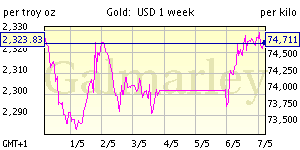
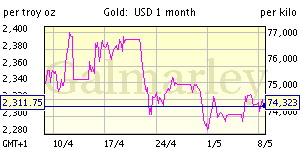
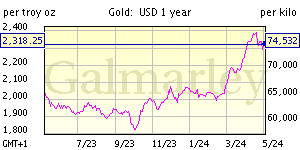
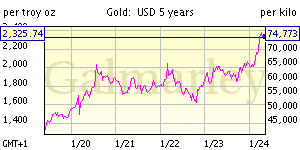
Great article this morning on the disconnect between the quoted price of gold, which is based on institutional trading of "paper" gold and the actual price investors are paying for physical gold.
For gold, a tussle between two groups of investors
Retail-based demand jumps even as institutions undergo a massive exodus
By Moming Zhou, MarketWatch
Last update: 10:55 a.m. EST Nov. 19, 2008
NEW YORK (MarketWatch) -- Retail investors sharply increased their demand for gold bars and coins in the past few months as they struggled to find a safe place for their money amid the financial crisis, research shows.
But institutional investors have kept the upper hand, according to Wednesday's report from the World Gold Council, a gold mining industry association. Heavy selling by institutions has more than offset retail buying and pushed gold prices to their lowest level in more than a year.
Moves by retail investors, including demand for bars and coins, resulted in a net inflow of 232 tons (7.46 million ounces) in the third quarter, compared to 105 tons in the same time frame a year ago.
The figures, compiled independently for the council by GFMS Ltd, a precious metals consultancy, show strong bar and coin buying in Swiss, German and U.S. markets.
Demand for physical gold didn't slow even when some financial institutions were forced to sell their gold assets to ease the squeeze in their cash balances.
"Funds who would like to keep their asset of last resort are being forced to sell," said Peter Spina, an analyst at GoldSeek.com. "This is causing weakness in the paper gold market price, but it is not a true reflection of the physical market."
"There will be more victims of the fund collapse and more forced liquidations even if it requires selling your most desired assets such as precious metals," he added. "Once this process works itself through, the true market prices for gold will readjust."
end of article
In my opinion, that word "readjust" means "move up a lot, real fast."
In light of the recent shortage of physical gold, I would suggest buying all you can, as quick as you can.
![[Most Recent Quotes from www.kitco.com]](http://www.kitconet.com/images/quotes_7a.gif)
Click to Enlarge
Close Call For US Banks


The Best Investment of 2009
 With unemployment soaring, banks failing and prices rising,....sell steak and buy Spam.
This is a guaranteed winner!
The Baltic Dry Index
The Baltic Dry Index is an economic indicator that measures the cost of moving product from one place to another. In other words, if the cost of a ship moving products from China to the United States increases, then this index would increase by that percentage. Likewise, it the cost of shipping goes down, then the index declines.
The Baltic Dry Index at present is down 92%.
What does this tell us?
Goods coming into the US (primarily from China) are at a standstill. And this with the Christmas season approaching.
The wheels of economic progress have come to a stop. As mentioned in a previous post, adjusted for true inflation numbers, our economy is contracting about 10%/year. Of course this number will grow as the government continues to print money, forcing the cost of goods and services (at least in dollar terms) higher.
Merry Christmas? It is not looking to promising at present.
The Baltic Dry Index at present is down 92%.
What does this tell us?
Goods coming into the US (primarily from China) are at a standstill. And this with the Christmas season approaching.
The wheels of economic progress have come to a stop. As mentioned in a previous post, adjusted for true inflation numbers, our economy is contracting about 10%/year. Of course this number will grow as the government continues to print money, forcing the cost of goods and services (at least in dollar terms) higher.
Merry Christmas? It is not looking to promising at present.
How Low Can We Go?
excerpt from Obama To the Rescue
by John Brown
October 06, 2008
Regardless of government action, we feel that the recession will be both severe and long lasting. The resulting fall in corporate earnings will be reflected in future stock prices. In light of this, we urge investors to be wary of claims that U.S. stocks are cheap.

It is worth remembering that prior to the stock market crash of October of 1929, the Dow had peaked 381 earlier that same year. It was not until some three years later, when severe recession and then depression took hold, that the Dow reached its low of just 42, a fall of some 90 percent from its 1929 highs.
In a historical context, the Dow’s recent fall from 14,164 to some 8,200 (a decline of just over 40%) does not necessarily indicate that stocks are cheap. Today, a 90% fall would bring the Dow down to a level of 1,416!
This economy and stock market are looking eerily similar to the 1929 market. The only difference is that today, our fundamentals are much worse than in 1929.
With that in mind, sit tight in a diversified mix of cash, gold and Treasury bonds/bills and/or Treasury funds. Not that I particularly like cash or Treasuries....these are just the best of the worse.
by John Brown
October 06, 2008
Regardless of government action, we feel that the recession will be both severe and long lasting. The resulting fall in corporate earnings will be reflected in future stock prices. In light of this, we urge investors to be wary of claims that U.S. stocks are cheap.

It is worth remembering that prior to the stock market crash of October of 1929, the Dow had peaked 381 earlier that same year. It was not until some three years later, when severe recession and then depression took hold, that the Dow reached its low of just 42, a fall of some 90 percent from its 1929 highs.
In a historical context, the Dow’s recent fall from 14,164 to some 8,200 (a decline of just over 40%) does not necessarily indicate that stocks are cheap. Today, a 90% fall would bring the Dow down to a level of 1,416!
This economy and stock market are looking eerily similar to the 1929 market. The only difference is that today, our fundamentals are much worse than in 1929.
With that in mind, sit tight in a diversified mix of cash, gold and Treasury bonds/bills and/or Treasury funds. Not that I particularly like cash or Treasuries....these are just the best of the worse.
------------------------------------------------------ Click on chart to enlarge
Lately, It's Not the Dems Who Are The Big Spenders
When the Republican Party hijacked the Whig party under Abraham Lincoln, it was known as the party of big government. The Democratic Party was the party of the common man who wanted limited government involvement in trade and finance.
By the 1970's the two parties had reversed roles, and as we know, today the Democrats are known as the "tax and spend" party.
But is this still true? I think the following chart may reveal that the parties have reversed roles again.
What do you think?

By the 1970's the two parties had reversed roles, and as we know, today the Democrats are known as the "tax and spend" party.
But is this still true? I think the following chart may reveal that the parties have reversed roles again.
What do you think?
The REAL Inflation Rate
I ran across some stats this week I would like to pass on.
As we all know, the government economic statistics are doctored up a bit before release.
How much?
The official inflation rate is about 4%, based on the way the feds calculate it today.
If inflation today, were calculated based on the 1992 formula, it would be 8.6%.
If calculated using the 1980 formula, it would be 12.8%.
Why the change in formulas? What are they hiding?
GDP growth is estimated at 4%. GDP growth is simply how fast the economy is growing. If it is growing, then we can look for favorable employment figures, and the political party in charge can look to get reelected. Of course the opposite is true as well.
Bottom line, the better the GDP number, the better the public feels about the direction our economy (translated: their pocketbooks) his headed.
Back to the numbers.
GDP is about 4%. Half of that has been money spent from home refinancing, that will no longer be spent going forward, as the average American has borrowed all of the home equity they can get.
So this gives us a net expected rate of 2% going forward. Subtract the REAL inflation rate of 12.8% and you come up with negative GDP growth of 10.8%.
The economy is shrinking by 10% a year! This is the truth that Washington doesn't want you to know. And this isn't a Republican or Democrat problem, it's a WASHINGTON problem.
What do you think this will do to the job market?
First, it will destroy all of the jobs we have outsourced to the emerging market countries. This will throw their economies into a tailspin, eventually resulting in defaults on their debt.
When whole nations begin defaulting on their loans, our banking system will be devestated.
Look for this next wave of debt defaults to come from the emerging markets.
Back to the US.
After the outsourced jobs go, then comes the jobs of the average American. No job, no money, no spending.
Then, what do you think that will do to the bottom line earnings of businesses?
Then, what do you think that will do to the stock market?
Can't invest in the stock market, can't trust the banks, can't buy real estate in a falling market? What should I do to preserve my wealth?
I suggest that the ONLY protection one has right now is to invest in GOLD (That is, while you still can.)
The IMF recently approved the sale of 400 tonnes from their gold reserves. For every ounce of gold that is sold, somebody is on the other end buying it.
Who has enough money to buy billions of dollars worth of gold at a time? What do they know that John Q. Public doesn't know?
I submit that they understand the above figures and the direction things are headed and are smart enough to not only protect themselves, but to PROFIT from the future economic downturn.
More millionaires were made during the Great Depression than in the Roaring 20's that preceeded it. Are you ready to get rich?
I am!
As we all know, the government economic statistics are doctored up a bit before release.
How much?
The official inflation rate is about 4%, based on the way the feds calculate it today.
If inflation today, were calculated based on the 1992 formula, it would be 8.6%.
If calculated using the 1980 formula, it would be 12.8%.
Why the change in formulas? What are they hiding?
GDP growth is estimated at 4%. GDP growth is simply how fast the economy is growing. If it is growing, then we can look for favorable employment figures, and the political party in charge can look to get reelected. Of course the opposite is true as well.
Bottom line, the better the GDP number, the better the public feels about the direction our economy (translated: their pocketbooks) his headed.
Back to the numbers.
GDP is about 4%. Half of that has been money spent from home refinancing, that will no longer be spent going forward, as the average American has borrowed all of the home equity they can get.
So this gives us a net expected rate of 2% going forward. Subtract the REAL inflation rate of 12.8% and you come up with negative GDP growth of 10.8%.
The economy is shrinking by 10% a year! This is the truth that Washington doesn't want you to know. And this isn't a Republican or Democrat problem, it's a WASHINGTON problem.
What do you think this will do to the job market?
First, it will destroy all of the jobs we have outsourced to the emerging market countries. This will throw their economies into a tailspin, eventually resulting in defaults on their debt.
When whole nations begin defaulting on their loans, our banking system will be devestated.
Look for this next wave of debt defaults to come from the emerging markets.
Back to the US.
After the outsourced jobs go, then comes the jobs of the average American. No job, no money, no spending.
Then, what do you think that will do to the bottom line earnings of businesses?
Then, what do you think that will do to the stock market?
Can't invest in the stock market, can't trust the banks, can't buy real estate in a falling market? What should I do to preserve my wealth?
I suggest that the ONLY protection one has right now is to invest in GOLD (That is, while you still can.)
The IMF recently approved the sale of 400 tonnes from their gold reserves. For every ounce of gold that is sold, somebody is on the other end buying it.
Who has enough money to buy billions of dollars worth of gold at a time? What do they know that John Q. Public doesn't know?
I submit that they understand the above figures and the direction things are headed and are smart enough to not only protect themselves, but to PROFIT from the future economic downturn.
More millionaires were made during the Great Depression than in the Roaring 20's that preceeded it. Are you ready to get rich?
I am!
The Worst Is Yet To Come

I hate writing articles like this one. I am like everyone else in that I want to be happy. I want to be liked. I want to be the bearer of good news. I want everyone to be happy when I walk in the room....not running for the exits.
But the truth is this. There is a very strong case being made for a severe worldwide depression by some of the most intelligent and well-informed economists I know. Two of them are Nouriel Roubini and Bert Dohmen.
DR. NOURIEL ROUBINI
Dr Nouriel Roubini served in various roles at the Treasury Department, including Senior Advisor to the Under Secretary for International Affairs and Director of the Office of Policy Development and Review (July 1999 - June 2000). Previously, he was a Senior Economist for International Affairs on the Staff of the President's Council of Economic Advisors (July 1998 – July 1999).
Currently, Professor Roubini is a Professor at the Stern School of Business at New York University. He has also held teaching positions at Yale University.
New York Times August 15, 2008 excerpt from article entitled Dr. Doom
"On Sept. 7, 2006, Nouriel Roubini, an economics professor at New York University, stood before an audience of economists at the International Monetary Fund and announced that a crisis was brewing. In the coming months and years, he warned, the United States was likely to face a once-in-a-lifetime housing bust, an oil shock, sharply declining consumer confidence and, ultimately, a deep recession. He laid out a bleak sequence of events: homeowners defaulting on mortgages, trillions of dollars of mortgage-backed securities unraveling worldwide and the global financial system shuddering to a halt. These developments, he went on, could cripple or destroy hedge funds, investment banks and other major financial institutions like Fannie Mae and Freddie Mac."
At present, all of these have happened. However, there is more.
"Following the Fed’s further extraordinary actions in the spring — including making lines of credit available to selected investment banks and brokerage houses — many economists made note of the ensuing economic rally and proclaimed the credit crisis over and a recession averted. Roubini, who dismissed the rally as nothing more than a “delusional complacency” encouraged by a “bunch of self-serving spinmasters,” stuck to his script of “nightmare” events: waves of corporate bankrupticies, collapses in markets like commercial real estate and municipal bonds and, most alarming, the possible bankruptcy of a large regional or national bank that would trigger a panic by depositors. Not all of these developments have come to pass (and perhaps never will), but the demise last month of the California bank IndyMac — one of the largest such failures in U.S. history — drew only more attention to Roubini’s seeming prescience."
"What economic developments does Roubini see on the horizon? And what does he think we should do about them? The first step, he told me in a recent conversation, is to acknowledge the extent of the problem. “We are in a recession, and denying it is nonsense,” he said. When Jim Nussle, the White House budget director, announced last month that the nation had “avoided a recession,” Roubini was incredulous. For months, he has been predicting that the United States will suffer through an 18-month recession that will eventually rank as the “worst since the Great Depression.” Though he is confident that the economy will enter a technical recovery toward the end of next year, he says that job losses, corporate bankruptcies and other drags on growth will continue to take a toll for years. "
Dr. Roubini went on to tell his audience that a "global meltdown" and "generational crisis" was coming.
And this, from the The Sunday Times, October 26, 2008: “Nouriel Roubini: I fear the worst is yet to come.”
So far, he has been dead on with every forecast, including this technical recovery we are seeing right now.
Bottom line: Roubini see a depression coming that will last years, result in job losses, bank failures and falling asset prices.
BERT DOHMEN
For the past 30 years, Bert Dohmen has authored the Wellington Letter, and is often quoted in the Wall Street Journal, Barrons and Investors Business Daily. He has advised Presidents Reagan, Carter and Ford. He is a frequent guest on Louis Rukeyser's "Wall Street Week," CNN's "Moneyline," and many others.
From Bert Dohmen's Wellington Letter, October 27, 2008
"The big problems are still ahead. Whereas all the focus until now has been on the financial system, the next round will be the imploding economy, plunging earnings, corporate bankruptcies, soaring unemployment, etc. It won't be pretty."
"When we headlined the Wellington Letter of April 2007, "THE MAKINGS OF A PERFECT FINANCIAL STORM," we listed all the bubbles that would be imploding, leading to a potential meltdown in the fall of 2008. So far, the relatively easy bubbles have popped, such as CDO's, subprime mortgages, write-offs of bad paper assets and loans, etc. For us, it's been a U.S. domestic problem that has gotten the attention of Washington. Although these bailout efforts and guarantees are now probably above $2 TRILLION nothing has worked to stem the crisis. It's getting worse, the stock market is at new bear market lows and the panic is in full swing. But those were the domestic problems. "
"Now come the much bigger problems: Debt defaults by entire countries. Whereas in the past, we had emerging country crises triggered by one country, such as 1997 and 1998, this time it's a whole alphabet soup of countries simultaneously. How will the IMF, or any organization, handle that?"
Regarding gold, Bert comments that gold will continue to stay subdued for the near term while investment firms are forced to sell their gold holdings to raise cash to cover their other losses. However, after this "you will be able to buy gold for one of the most spectacular upmoves in history."
My Conclusion
Both of these advisors have been consistently right in their economic forecasts for many years. They often go against the Wall Street consensus, as they are so doing at present.
My expectation going forward is an economic decline which will lead to stock market declines, interest rate declines and job losses.

The only protection for investors will be to harbor the bulk of their assets in gold, or gold pool accounts.
Do not buy stocks. Do not keep any more of your assets in the banking system that you may need over the next 6 - 12 months, as FDIC is already insolvent. The president of Bank of America stated recently that he expects about half of the banks in the US to fail over the next few years.
Intermediate term funds should be invested in US Treasury money markets or mutual funds only. Longer term funds could be invested in Treasury bonds, as yeilds are expected to decline, forcing prices upwards.
Shorting the dollar should once again become profitable when the next leg of the decline resumes. This can also be easily done in a pool account.
So regardless of my negative outlook, I would like to point out that more people became millionaires during the Great Depression than in the booming 20s that preceeded it.
I believe this coming crisis will be VERY profitable for those who are prepared for it, and ruinous for those who are not.
In the meantime, don't let this temporary stock market recovery fool you. This is a normal bear market rally. Use it to sell stocks, not buy.
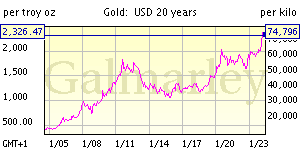
I expect the next gold move up to approach the $2,000/ounce level, even though it may get as low as the high $500s for a short while.
To contrarians like myself, things have never looked better! For everyone else, the worst is yet to come.
Subscribe to:
Posts (Atom)