Regarding the fear generated by the recent headlines regarding the bank and insurance company failures, perhaps the following can give you a little perspective.
I worked for First Federal Savings & Loan in 1987 when the S&L’s went out of business, due in large part to the Texas oil bust. The stock market dropped 25% in ONE DAY. Government bond mutual funds that investors had bought for their safety ended up going in the tank because the fund managers were selling options on the bonds. Of course no one knew this, and when they blew up, average investors that thought they had something solid got kicked in the pants.
Also, don’t forget about the junk bond meltdown about this same time. Michael Milken went to jail and Drexel, Burnham, Lambert, the biggest junk bond investment bank, went belly up.
That was a far worse time than this!
And since history does have a tendency to repeat itself, I would remind you that after all the speculators, crooks and con men got cleaned out of the system in the 80’s, the 90’s turned out the be the best economic decade of the century. So what might this say about the next 5-10 years here?
So, my advice is PARTLY, don’t panic because you can be pretty sure that THIS TIME IS NO DIFFERENT!
BUT, WHAT IF IT IS DIFFERENT? WHAT IF THIS IS THE BIG ONE? WHAT ARE YOU GOING TO DO TO PROTECT YOURSELF?
1. Should you put all your money in the bank because it is FDIC insured? Not hardly. (See the post below How Can The System Collapse?)
If you are protecting against the unthinkable, against the system locking up where banks begin to fall like dominos, the FDIC cannot bail all of them out. People in-the-know understand that the FDIC program was simply a PR move by the government to restore the public’s confidence in the banking system after the great depression. It was never intended, nor could it ever be, a bailout of the entire system. According to news reports, we came perilously close to a meltdown when Lehman bit the dust, and even closer when AIG bought the farm. I don’t know if these dire reports are overstated or not, but why take a chance?
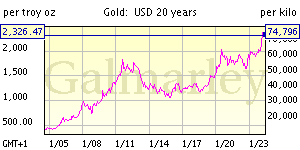
2. Hold everything in cash? Again, not a good call. Paper is worth, well, paper! If our financial system collapses due to failure, terrorism, natural disaster, war or computer terrorism, believe me, the dollar will be worthless. Our trading partners would quickly demand gold in exchange for goods and services. (But keep some cash on hand anyway, because toilet paper might become scarce!)
No, these are not options, because in times like these, gold is the currency of last resort. You may remember in 1998 when Korea turned over $2.2 billion of its citizens' gold to the IMF to prevent economic collapse. Even with the bailout, 630 financial institutions collapsed. Dominos.
So, should you put everything in gold? Nope!
In times like these, whether the world comes to an end tomorrow or not, there is only one way to protect yourself and that is to diversify. That doesn’t mean to put your money in different banks. No, that means put your money in different asset classes all together. Put some money in the banks, put some in cash, put some in gold, put some in bonds, put some in real estate, put some in some quality stocks, and put some in an envelope and send it to me.
ALL of these aren’t going to zero anytime soon, AND, if things turn around (like they always do) you will do very well going forward with a nice mix of quality assets. This sure beats converting to cash and moving to Montana and waiting on big one to hit!
SO……In conclusion, don’t worry too much about this short term negative performance. This up and down we are seeing now is no different than doing a real estate deal.
If people watched the short term performance of the value of their real estate like they do their brokerage statements, they would never buy a thing. Thank God we don't get statements every month from our realtors showing what the highest bid for our land is.
Remember, property is only worth what someone is going to give you for it. Now if you just bought it, that means you are the high bidder, right? Well that means that if you want to turn around and sell it, you are going to take a loss, since no one else was willing to pay what you did. And if the real estate market tanks for a couple years, you might have to take a lot less for it if you sell it. But you don’t worry because you bought a physical asset that is not going to do anything but go up over the LONG TERM.
Your investment accounts are the same. So what if your mutual funds that invest in SCANA, GE, Ford, Microsoft, Sara Lee and Pfizer are down in value now? Just like the real estate, you don’t worry because you know that LONG TERM these companies will still continue to make money because people will still use electricity, gas and food. And the profits from those products will be passed on to you’re the shareholder in the form of higher stock prices and/or dividends.
As a broker, I will move things around from time to time in my clients' accounts to take advantage of perceived market inefficiencies ( like gold right now), but my long term philosophy has always been to buy quality and then hold on to it.
Western civilization probably still has a little time left.
![[Most Recent Quotes from www.kitco.com]](http://www.kitconet.com/images/quotes_7a.gif)
Ed Steer's Gold and Silver Daily
24hGold.com RSS Feed - Gold and Silver Market Analysis
24hGold.com RSS Feed - Gold and Silver Editorials
Whiskey & Gunpowder
Numismatic News
Click to Enlarge
Close Call For US Banks


How The System Could Collapse
This is an excerpt from Martin Weiss' newsletter Money and Markets
Martin Weiss, PhD
Here's the great dilemma: The tangled web of bets and debts linking each of these giant players to the other is so complex and so difficult to unravel, it may be impossible for the Fed to protect the financial system from paralysis if just one major player defaults. And if Lehman is not that player, the next one will be.
To understand why, put yourself in the shoes of a senior derivatives trader at a big firm like Morgan Stanley (which has $7.1 trillion in derivatives on its books and about $10 billion in capital).
Let's say you're personally responsible for $500 billion in derivatives contracts with Bank A, essentially betting that interest rates will decline.
By itself, that would be a huge risk. But you're not worried because you have a similar bet with Bank B that interest rates will go up.
It's like playing roulette, betting on both black and red at the same time. One bet cancels the other, and you figure you can't lose.
Here's what happens next ...
> Interest rates go up, reflecting a 2% decline in bond prices.
> You lose your bet with Bank A.
> But, simultaneously, you win your bet with Bank B.
> So, in normal circumstances, you'd just take the winnings from one to pay off the losses with the other — a non-event.
But here's where the whole scheme blows up and the drama begins:
Bank B suffers large mortgage-related losses. It runs out of capital. It can't raise additional capital from investors. So it can't pay off its bet. Suddenly and unexpectedly ...
You're on the hook for your losing bet.
But you can't collect on your winning bet.
You grab a calculator to estimate the damage. But you don't need one — 2% of $500 billion is $10 billion. Simple.
Bottom line: In what appeared to be an everyday, supposedly "normal" set of transactions ... in a market that has moved by a meager 2% ... you've just suffered a loss of ten billion dollars, wiping out all of your firm's capital.
Now, you can't pay off your bet with Bank A — or any other losing bet, for that matter.
Bank A, thrown into a similar predicament, defaults on its bets with Bank C, which, in turn, defaults on bets with Bank D. Bank D has bets with you as well ... it defaults on every single one ... and it throws your firm even deeper into the hole.
So now do you understand why bookies belong to the Mafia and why gamblers who welsh on their debts wind up at the bottom of the East River? It's because defaulting gamblers are a grave threat to the entire system, just like Lehman Brothers is today.
Martin Weiss, PhD
Here's the great dilemma: The tangled web of bets and debts linking each of these giant players to the other is so complex and so difficult to unravel, it may be impossible for the Fed to protect the financial system from paralysis if just one major player defaults. And if Lehman is not that player, the next one will be.
To understand why, put yourself in the shoes of a senior derivatives trader at a big firm like Morgan Stanley (which has $7.1 trillion in derivatives on its books and about $10 billion in capital).
Let's say you're personally responsible for $500 billion in derivatives contracts with Bank A, essentially betting that interest rates will decline.
By itself, that would be a huge risk. But you're not worried because you have a similar bet with Bank B that interest rates will go up.
It's like playing roulette, betting on both black and red at the same time. One bet cancels the other, and you figure you can't lose.
Here's what happens next ...
> Interest rates go up, reflecting a 2% decline in bond prices.
> You lose your bet with Bank A.
> But, simultaneously, you win your bet with Bank B.
> So, in normal circumstances, you'd just take the winnings from one to pay off the losses with the other — a non-event.
But here's where the whole scheme blows up and the drama begins:
Bank B suffers large mortgage-related losses. It runs out of capital. It can't raise additional capital from investors. So it can't pay off its bet. Suddenly and unexpectedly ...
You're on the hook for your losing bet.
But you can't collect on your winning bet.
You grab a calculator to estimate the damage. But you don't need one — 2% of $500 billion is $10 billion. Simple.
Bottom line: In what appeared to be an everyday, supposedly "normal" set of transactions ... in a market that has moved by a meager 2% ... you've just suffered a loss of ten billion dollars, wiping out all of your firm's capital.
Now, you can't pay off your bet with Bank A — or any other losing bet, for that matter.
Bank A, thrown into a similar predicament, defaults on its bets with Bank C, which, in turn, defaults on bets with Bank D. Bank D has bets with you as well ... it defaults on every single one ... and it throws your firm even deeper into the hole.
So now do you understand why bookies belong to the Mafia and why gamblers who welsh on their debts wind up at the bottom of the East River? It's because defaulting gamblers are a grave threat to the entire system, just like Lehman Brothers is today.
Bear Market Statistics
from Curian Capital Investment News article 09/24/08
In last weeks Investment News, an article titled "Investors Should Not Panic in Downturn, Study Says", does a nice job of putting current conditions in perspective. In a study going back to 1948, it found that there have been 12 bear markets that have lasted an average of 14 months and saw an average decline of 22.4%. Following each bear market, there were 12 bull markets that lasted 45 months on average and saw an increase of 123.9%.
Knowing that, lets assume that you invested a clients $100,000 the first day of a bear market. Their account would have dipped to $77,600 14 months later and likely pulled out of the market. However, if they remained committed to their plan they would have finished with $173,746 at the end of the 45 month bull market.
In addition to these findings, if you track the S and P for approximately the last 40 years we know that it has average an annual rate of return of nearly 12%. That means that the average monthly return for those 480 months is approximately 1%. However, the top 10% (48 months) have averaged nearly 8%, while the bottom 90% (432 months) have seen an average return of approximately .1%. This tells us two things. First, the market moves in spurts making it more difficult to miss the lows and capture the highs. Second, if you are out of the market you miss the bulk of the returns.
In last weeks Investment News, an article titled "Investors Should Not Panic in Downturn, Study Says", does a nice job of putting current conditions in perspective. In a study going back to 1948, it found that there have been 12 bear markets that have lasted an average of 14 months and saw an average decline of 22.4%. Following each bear market, there were 12 bull markets that lasted 45 months on average and saw an increase of 123.9%.
Knowing that, lets assume that you invested a clients $100,000 the first day of a bear market. Their account would have dipped to $77,600 14 months later and likely pulled out of the market. However, if they remained committed to their plan they would have finished with $173,746 at the end of the 45 month bull market.
In addition to these findings, if you track the S and P for approximately the last 40 years we know that it has average an annual rate of return of nearly 12%. That means that the average monthly return for those 480 months is approximately 1%. However, the top 10% (48 months) have averaged nearly 8%, while the bottom 90% (432 months) have seen an average return of approximately .1%. This tells us two things. First, the market moves in spurts making it more difficult to miss the lows and capture the highs. Second, if you are out of the market you miss the bulk of the returns.
What AIG, Lehman and Fannie Mae Mean To You
The following is excerpted from What Just Happened To AIG, And What It Means To You
Regarding IRAs, 401ks, Deferred Compensation and Profit Sharing Retirement Plans
IF the world central banks insist on bailing out the bad capital, they will run gigantic deficits. They will eventually be forced to raise taxes. It’s impossible. This is one reason we have been talking about the idea to subscribers that maybe tax deferred savings are not quite what they are cracked up to be.
Basically, when the central banks and each nation realize they are going insolvent too, they will raise taxes on those ‘tax deferred’ accounts by the time you want to pull out the money. So, I’m fairly sure that you’re going to pay a lot more taxes on that pile of money than you think. If the world economy was not collapsing, then that would not be the case. But it is the case.
********************************************************************************
I've been shouting this for years. ( http://tannerinvestments.blogspot.com/2007/10/dont-put-too-much-in-your-401k.html )
It's good to hear somebody else finally figured this out too!
I'd much rather pay my taxes now and put my money in a Roth IRA and let is triple or quadruple between now and retirement and pay no taxes then. That's a no brainer.
Tax deferred accounts are a sucker bet. Don't let em fool you.
Regarding IRAs, 401ks, Deferred Compensation and Profit Sharing Retirement Plans
IF the world central banks insist on bailing out the bad capital, they will run gigantic deficits. They will eventually be forced to raise taxes. It’s impossible. This is one reason we have been talking about the idea to subscribers that maybe tax deferred savings are not quite what they are cracked up to be.
Basically, when the central banks and each nation realize they are going insolvent too, they will raise taxes on those ‘tax deferred’ accounts by the time you want to pull out the money. So, I’m fairly sure that you’re going to pay a lot more taxes on that pile of money than you think. If the world economy was not collapsing, then that would not be the case. But it is the case.
********************************************************************************
I've been shouting this for years. ( http://tannerinvestments.blogspot.com/2007/10/dont-put-too-much-in-your-401k.html )
It's good to hear somebody else finally figured this out too!
I'd much rather pay my taxes now and put my money in a Roth IRA and let is triple or quadruple between now and retirement and pay no taxes then. That's a no brainer.
Tax deferred accounts are a sucker bet. Don't let em fool you.
No Supply of Gold
I am just going to be straight to the point. If you do not own any gold right now, then you never will.
My New York wholesaler, who saw the last financial crisis in the 1970s when we had 20% interest rates, $800 gold and gas lines, told me this morning that he had never seen such demand for physical gold combined with no supply.
He said there are some denominations of gold that he can't get at any price!
Now let's see if I can remember that formula from Econ 101? High demand + low supply = increasing price.
In short, in his opinion, gold would blow by $1000/ounce very shortly as soon as the hedge funds are done unloading their paper gold on the market, which has temporarily forced prices down.
If you have Ira money that you can't buy physical gold with, consider a mutual fund like the Franklin Gold and Precious Metals Fund.
Either way, this should be a gold lining in an otherwise ugly financial cloud that we find ourselves in.
********************************************************************************
Why Wall Street Hates Gold and Silver??
Inside Wall Street
Wall Street is a culture, as well as a financial institution.
Most of the young brokers who are the big producers on Wall Street are human beings, subject to all the errors of habit and behavior and peer pressure that plague all of us. They are surrounded by “group-think.” They make tons of money on the status quo. I have visited firms on Wall Street with big trading rooms full of twenty-something men and women whose annual income is measured in the millions – all on commissions on stock sales.
Few big Wall Street firms sell bullion (right off hand I can’t think of any) so it is only money out of their pockets if hot-shot brokers tell their clients to sell some stock and put the money into bullion or coins. Maturity and client concern are scarce commodities on Wall Street.
They are congenitally bullish on stocks, because that’s where their bread is buttered.
Financial Shows
Many of you listen to or watch financial shows, populated with people who are typical examples of main-stream Wall Street financial thinking.
If your broker’s opinion is important to you, you may be uncomfortable here. If you aren’t a maverick, you had better become one, and be quiet about it. You will have to leave the herd, and for a while, Merrill Lynch’s herd is all on Wall Street.
Panama and the Dollar
.........one key part of Linowitz’s banker-inspired mission was that the Canal Zone would be a “Free-banking Zone,” not subject to regulations or oversight. Even before the deal was signed, bank buildings were going up all over the Zone. Every multi-national bank was there, and it appears that they moved many of their international money systems there, with no oversight or regulation. Who determines their safety or vulnerability? No one!
If terrorist hackers were to hack into those computers and infect them with a destructive virus, the entire dollar-based monetary system would disappear in a nanosecond. In that case, for all practical purposes, the only spendable money left would be gold or silver coins or barter.
And what if they were able to sneak a nuke onto a ship and detonate it in the canal? It’s already bad enough that the Chinese are in control of the ports on both ends of the canal. Imagine the chaos with the banks obliterated and commerce fatally crippled.
These and innumerable other scenarios may seem beyond the edges of credibility, but I dare you to say they are not possible.
This is not a forecast, only a speculation about a possible worst-case, we-hope-not scenario.
The Hyperinflation Scenario
What if monetary inflation rose as a result of soaring demands on government with the soaring deficits, and the subsequent inevitable consumer inflation broke out into a real hyperinflation, with the modern money machine running night and day, like Germany during the 1920s. This would make money increasingly worthless and the precious metals increasingly precious. History tells us that this has happened over and over again, and we are repeating most of the same deadly mistakes.
These are only a few of the possibilities.
Best Case Scenario
Even in this “best-case” situation, you will make a bundle on this monetary-inflation-sensitive investment, even in a still-orderly world.
If all else fails, you still can count on Social Security, Medicare and the prescription-drug program to trigger a flood of trillions of dollars of “money printing” and the subsequent monetary inflation, followed as night follows day with soaring price inflation. As it becomes obvious to the public that these programs are plummeting into insolvency, the consumer inflation rate and gold and silver will soar.
When the dire facts become obvious, Congress will start desperately searching for solutions, but which ones?
Will they raise taxes and watch FICA soar and taxpayers revolt? Very little, if any! Will they cut benefits or raise the Social Security retirement age? Maybe a little bit, but not much. Will they dig in their heels and memorialize the current dysfunctional system by simply printing money? You bet! This will lay the groundwork for more ruinous inflation, and soaring gold and silver.
In this best case (the most likely – I think, I hope?), we will at least see rising inflation and an inflationary recession (which is already written in cement), and gold and silver and the metals and their mining stocks will go up – perhaps five to ten times, perhaps a lot more.
There is no best-case – or worst-case – scenario in which I can conceive of gold and silver being losers. You can mortgage the kids and bet the farm!
My New York wholesaler, who saw the last financial crisis in the 1970s when we had 20% interest rates, $800 gold and gas lines, told me this morning that he had never seen such demand for physical gold combined with no supply.
He said there are some denominations of gold that he can't get at any price!
Now let's see if I can remember that formula from Econ 101? High demand + low supply = increasing price.
In short, in his opinion, gold would blow by $1000/ounce very shortly as soon as the hedge funds are done unloading their paper gold on the market, which has temporarily forced prices down.
If you have Ira money that you can't buy physical gold with, consider a mutual fund like the Franklin Gold and Precious Metals Fund.
Either way, this should be a gold lining in an otherwise ugly financial cloud that we find ourselves in.
********************************************************************************
Why Wall Street Hates Gold and Silver??
Inside Wall Street
Wall Street is a culture, as well as a financial institution.
Most of the young brokers who are the big producers on Wall Street are human beings, subject to all the errors of habit and behavior and peer pressure that plague all of us. They are surrounded by “group-think.” They make tons of money on the status quo. I have visited firms on Wall Street with big trading rooms full of twenty-something men and women whose annual income is measured in the millions – all on commissions on stock sales.
Few big Wall Street firms sell bullion (right off hand I can’t think of any) so it is only money out of their pockets if hot-shot brokers tell their clients to sell some stock and put the money into bullion or coins. Maturity and client concern are scarce commodities on Wall Street.
They are congenitally bullish on stocks, because that’s where their bread is buttered.
Financial Shows
Many of you listen to or watch financial shows, populated with people who are typical examples of main-stream Wall Street financial thinking.
If your broker’s opinion is important to you, you may be uncomfortable here. If you aren’t a maverick, you had better become one, and be quiet about it. You will have to leave the herd, and for a while, Merrill Lynch’s herd is all on Wall Street.
Panama and the Dollar
.........one key part of Linowitz’s banker-inspired mission was that the Canal Zone would be a “Free-banking Zone,” not subject to regulations or oversight. Even before the deal was signed, bank buildings were going up all over the Zone. Every multi-national bank was there, and it appears that they moved many of their international money systems there, with no oversight or regulation. Who determines their safety or vulnerability? No one!
If terrorist hackers were to hack into those computers and infect them with a destructive virus, the entire dollar-based monetary system would disappear in a nanosecond. In that case, for all practical purposes, the only spendable money left would be gold or silver coins or barter.
And what if they were able to sneak a nuke onto a ship and detonate it in the canal? It’s already bad enough that the Chinese are in control of the ports on both ends of the canal. Imagine the chaos with the banks obliterated and commerce fatally crippled.
These and innumerable other scenarios may seem beyond the edges of credibility, but I dare you to say they are not possible.
This is not a forecast, only a speculation about a possible worst-case, we-hope-not scenario.
The Hyperinflation Scenario
What if monetary inflation rose as a result of soaring demands on government with the soaring deficits, and the subsequent inevitable consumer inflation broke out into a real hyperinflation, with the modern money machine running night and day, like Germany during the 1920s. This would make money increasingly worthless and the precious metals increasingly precious. History tells us that this has happened over and over again, and we are repeating most of the same deadly mistakes.
These are only a few of the possibilities.
Best Case Scenario
Even in this “best-case” situation, you will make a bundle on this monetary-inflation-sensitive investment, even in a still-orderly world.
If all else fails, you still can count on Social Security, Medicare and the prescription-drug program to trigger a flood of trillions of dollars of “money printing” and the subsequent monetary inflation, followed as night follows day with soaring price inflation. As it becomes obvious to the public that these programs are plummeting into insolvency, the consumer inflation rate and gold and silver will soar.
When the dire facts become obvious, Congress will start desperately searching for solutions, but which ones?
Will they raise taxes and watch FICA soar and taxpayers revolt? Very little, if any! Will they cut benefits or raise the Social Security retirement age? Maybe a little bit, but not much. Will they dig in their heels and memorialize the current dysfunctional system by simply printing money? You bet! This will lay the groundwork for more ruinous inflation, and soaring gold and silver.
In this best case (the most likely – I think, I hope?), we will at least see rising inflation and an inflationary recession (which is already written in cement), and gold and silver and the metals and their mining stocks will go up – perhaps five to ten times, perhaps a lot more.
There is no best-case – or worst-case – scenario in which I can conceive of gold and silver being losers. You can mortgage the kids and bet the farm!
Ultimate Safety
Even though the values of our most Americans' investments are down, it is times like these that prove the value of mutual funds and their diversification. (This would include funds held within variable annuities as well as managed funds within corporate retirement plans such as deferred compensation plans and 401(k)s.) Even Wachovia, traditionally thought of as one of the most conservative and strongest banks, has seen the price of its stock drop 80%.
80%. That is $100,000 dropping to $20,000.
As evidenced by the hasty government bailout of these troubled institutions, it would only take one unsupported failure to bring down the whole banking system, likely wiping out banking depositor’s savings. FDIC was never intended, nor could it bail out every depositor if the banking dominoes ever begin to fall.
In a systemic failure, dollars, government bonds and bank deposits would almost certainly be worthless. All paper is only a promise. When the one making the promise fails, you lose.
None of us know just how close we just came to that event this week.
Brick and mortar companies, gold and silver and real estate continue to be your safest bet going forward, in spite of their short term volatility.
80%. That is $100,000 dropping to $20,000.
As evidenced by the hasty government bailout of these troubled institutions, it would only take one unsupported failure to bring down the whole banking system, likely wiping out banking depositor’s savings. FDIC was never intended, nor could it bail out every depositor if the banking dominoes ever begin to fall.
In a systemic failure, dollars, government bonds and bank deposits would almost certainly be worthless. All paper is only a promise. When the one making the promise fails, you lose.
None of us know just how close we just came to that event this week.
Brick and mortar companies, gold and silver and real estate continue to be your safest bet going forward, in spite of their short term volatility.
Subscribe to:
Posts (Atom)