Here's an article I posted back in February on my Behind the Fed website. As I will be writing about the Fed, JP Morgan and Bear Stears in the near future, I thought this background information might be helpful.
Why Do You Care If OPEC Abandons the Dollar?
by David Tanner
February 12, 2008
Today's Wall Street Journal Marketbeat carried an article entitled OPEC Rattles the Dollar. In it OPEC Secretary-General Abdullah al-Badri was quoted in the Middle East Economic Digest, saying “maybe we can price the oil in the euro.”
Why would they want to do that?
Because the lowering of interest rates by the Fed has the effect of flooding the economy with money/dollars (Which is exactly why the Fed lowers the rates....so the extra money boosts the economy). But, the extra money created out of thin air devalues all existing dollars. This is known as inflation.
This devaluation of all existing dollars occurs because the new dollars are backed by nothing.
To understand this, a little history lesson might help.
In 1933, FDR signed Executive Order #6102 which outlawed private gold ownership. Americans were instructed to turn in their gold, and dollars would no longer be redeemable in gold. This did not apply to foreign governments who wished to redeem their dollars in gold, so the dollar remained the standard currency for international settlements.
However, when Nixon closed the gold window in 1971, governments nor individuals could any longer redeem their dollars for gold. The dollar became a peice of paper backed by the credit of the US Government.
This is the problem OPEC and the world are trying to avoid... holding more dollars
.
The US already has more debt than it can ever repay. Because of this, foreigners are hesitant to loan us any more money (Which is in essence what happens when they hold our dollars).
Would you loan money to a friend who already owed you $100,000, earned an annual salary of $20,000, and paid half of that in interest? No, that wouldn't be too smart.
Well, OPEC doesn't want to loan more to the US either, but for fear of military reprisal, they are only very very slowly moving in this direction.
Today's statement was nothing more than a testing of the waters for an American response, so that OPEC will know if it is safe to proceed.
With Americans already weary of an unwinnable war, and an election year where no candidate wants to escalate our military involvements, now would be a logical time for OPEC to move in this direction, as reprisals would seem unlikely, at least until after November.
The bottom line is this: OPEC does not want to be paid in dollars, because dollars are a depreciating asset.
AND WHY DO YOU CARE?
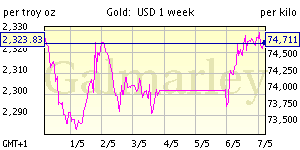
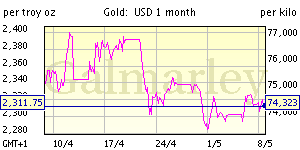
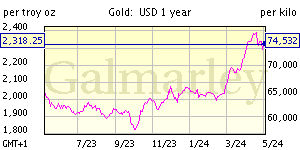
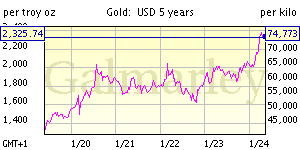
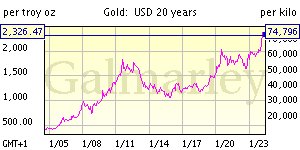
As dollars depreciate, more and more investors will turn to gold to preserve their purchasing power. Whether you are buying physical gold, or a gold fund, such as the Franklin Gold & Precious Metals Fund, the long term prospects for above average performance appear to remain intact.
For bond investors, European bonds denominated by the Euro look to continue to be a good hedge against the falling dollar. Not only does the investor earn interest from the fund, but as the dollar declines, the underlying value of the fund increases as well.
My favorite for several years has been the Templeton Global Bond Fund.
![[Most Recent Quotes from www.kitco.com]](http://www.kitconet.com/images/quotes_7a.gif)
Click to Enlarge
Close Call For US Banks


How Safe is Your Bank?*
by David Tanner
March 24, 2008
"Last week, JPMorgan signed an emergency deal to buy Bear Stearns for 0.05473 share, valued at roughly $2 a share at the time. The rapidly signed agreement came after investors began pulling money out of Bear Stearns amid fears of a liquidity crisis, creating a cash crunch at the bank that would have sent it into bankruptcy absent a buyout. " JP, Bear Stearns Reach New Deal
The recent buyout of Bear Stearns by JP Morgan has fueled a new round of speculation regarding the safety of financial institutions.
Bear Stears was reportedly worth $159/share last year, and is trading today at $10/share, a 94% loss.
The Fed's $30 billion bailout to keep Bear Stearns from sliding into bankruptcy is a bold move designed to keep investor's in similar financial institutions confidence up, to prevent further runs.
Should this have happened, followed by similar runs on other investment banks, the Fed knows it would not not have been able to bail-out the entire system. In such an event, a systemic collapse would become a real possibility.
In such a scenario, the spillover into commercial banks and s&ls would only be a matter of time, exposing the FDIC for what it really is......a public relations move to keep confidence in the system.
In light of the above, it would behoove investors to check into financial stability of their bank. In the event of another Great Depression-type financial meltdown, depositors would only receive back a fraction of their deposits. Obviously, one would prefer to have their money in "A" rated institutions.
Our system has flirted with collapse many times in the past, and sooner or later, the inevitable will happen. Will it be this time, or 50 years from now? Who knows? But it is very easy to protect oneself by dealing only with "A" rated institutions, as well as diversifying one's remaining assets among stocks, bonds, and precious metals.
Follow the link to the right to check your bank's rating.
March 24, 2008
"Last week, JPMorgan signed an emergency deal to buy Bear Stearns for 0.05473 share, valued at roughly $2 a share at the time. The rapidly signed agreement came after investors began pulling money out of Bear Stearns amid fears of a liquidity crisis, creating a cash crunch at the bank that would have sent it into bankruptcy absent a buyout. " JP, Bear Stearns Reach New Deal
The recent buyout of Bear Stearns by JP Morgan has fueled a new round of speculation regarding the safety of financial institutions.
Bear Stears was reportedly worth $159/share last year, and is trading today at $10/share, a 94% loss.
The Fed's $30 billion bailout to keep Bear Stearns from sliding into bankruptcy is a bold move designed to keep investor's in similar financial institutions confidence up, to prevent further runs.
Should this have happened, followed by similar runs on other investment banks, the Fed knows it would not not have been able to bail-out the entire system. In such an event, a systemic collapse would become a real possibility.
In such a scenario, the spillover into commercial banks and s&ls would only be a matter of time, exposing the FDIC for what it really is......a public relations move to keep confidence in the system.
In light of the above, it would behoove investors to check into financial stability of their bank. In the event of another Great Depression-type financial meltdown, depositors would only receive back a fraction of their deposits. Obviously, one
would prefer to have their money in "A" rated institutions.Our system has flirted with collapse many times in the past, and sooner or later, the inevitable will happen. Will it be this time, or 50 years from now? Who knows? But it is very easy to protect oneself by dealing only with "A" rated institutions, as well as diversifying one's remaining assets among stocks, bonds, and precious metals.
Follow the link to the right to check your bank's rating.
Subscribe to:
Posts (Atom)